Comparison · the only rival that competes on the flame
Electric fireplace vs bioethanol
Every other alternative to an electric fireplace competes on heat. This one competes on the thing this whole site is about, and it wins that round outright. What it costs to win it is the rest of the page.
By Scooter M.Published October 30, 2026Last reviewed October 30, 2026
Disclosure: the buy links below are affiliate links. We earn a commission on Amazon purchases at no extra cost to you. It has never changed a ranking on this site, and every roundup here names a unit we think you should skip. How this site is funded.
Bioethanol beats electric on the flame, because its flame is real fire. It needs no flue, no gas line and no chimney, which is why it gets compared to electric at all. The cost is that it is unvented combustion indoors. A Fraunhofer chamber study of nonvented ethanol fireplaces found carbon dioxide and nitrogen dioxide "close to or even above the guideline values in many cases", benzene over 12 ppb and formaldehyde above 0.1 ppm in two runs, and the units were "strong sources of fine and ultrafine particles" — with ventilation set to the manufacturers' own recommendations. Electric gives you a flame that is not real and combustion risk that is zero. Which way that trades depends entirely on how much the realism is worth to you.
Why this comparison is different from the others
Every other alternative on this site competes with an electric fireplace on heat. Gas, wood, pellet, baseboard and a heat pump all make more heat than 1,500 watts, and the honest answer in each case is some version of the same sentence: if you want warmth, buy the other thing.
Bioethanol is not in that argument. A domestic ethanol burner produces modest heat and nobody buys one as a heating system. It competes on the one thing this entire site is organized around — whether the fire looks like a fire — and on that question it does not merely compete. It wins, because there is nothing to simulate. The flame is combustion.
So this page is the mirror image of the rest of the cluster. Everywhere else we tell you the other appliance is better at heat. Here the other appliance is better at the thing we sell, and the case for electric has to be made on different ground entirely.
What unvented combustion does to the room
This is the ground. A bioethanol fireplace has no flue by design — that is the feature. The consequence is stated plainly in the Fraunhofer study: these fireplaces "are constructed such that they have no fume extraction system, and so all of the gases from combustion, volatile organic compounds, and particulate emissions are released into the room".
Four ethanol fireplaces were run with eight different fuels — three liquid, five gel — in a 48-cubic-meter emission test chamber under typical living-room conditions. The detail that matters most is the one easiest to skim past: the ventilation was set according to the manufacturers' own recommendations and DIN 4734-1. These are the numbers from using the product as directed, not from misusing it.
| What was measured | What the study found |
|---|---|
| Carbon dioxide and nitrogen dioxide | "close to or even above the guideline values in many cases" |
| Benzene | over 12 ppb, in two of the experiments |
| Formaldehyde | above 0.1 ppm, in the same two experiments |
| Fine and ultrafine particles | the fireplaces were "strong sources" of both, irrespective of the fuel used |
| Fuel components | denaturing substances from the fuel detected in the chamber air |
Their closing sentence is the one to carry away: "Overall, ethanol fireplaces have a considerable influence on the quality of the indoor air due to the lack of ventilation. This aspect should — in addition to fire protection — be properly considered when using such devices."
The fire-pot problem, and where it does and does not apply
There is a second hazard, and it is important to be precise about which products it attaches to, because the category is not one thing. In December 2024 the CPSC issued a consumer alert telling people to stop using alcohol and other liquid-burning fire pits, which it said "have been associated with two deaths and at least 60 injuries since 2019".
The mechanism is flame jetting. Refilling a liquid-fuel burner while any flame is still present lets a small flame ignite the fuel as it is poured, "causing an explosion that propels flames and burning liquid onto the consumer or bystanders". The CPSC names voluntary standard ASTM F3363-19, which is designed to prevent that and to prevent pool fires "in which flames burn along the surface of pooled or spilled flammable liquids".
The comparison, line by line
| Electric | Bioethanol | |
|---|---|---|
| Is the flame real | No — light, or light through mist | Yes — it is combustion |
| Flue or chimney | None needed | None needed, and that is the problem |
| Combustion products in the room | None | CO2, NO2, particles, VOCs |
| Fuel | Electricity, and tap water on mist units | Liquid or gel ethanol, bought and stored |
| Refueling | None | Manual, and it is where the injuries happen |
| Running cost | Metered, and computable in advance | Per bottle of fuel, and consumed whether or not you want heat |
| Heat | Up to about 5,118 BTU/hr at 1,500 W | Modest; not a heating system either |
| Turn it off and on | A switch, or an app | Lighting and extinguishing a liquid fire |
| Safe around children and pets at floor level | Yes on mist units — nothing is hot | No — it is an open flame |
Where bioethanol is genuinely the better answer
We would not pretend there is no case. If the fire is for a room you use occasionally rather than every evening — a dining room used at weekends, a covered terrace, a space with real through-ventilation — then the air-quality argument weakens considerably, because the exposure is occasional and the room is not sealed. The Fraunhofer finding is about a closed living room at typical ventilation rates, and an airy, intermittently used space is a different situation.
And if what you want is specifically the smell, the heat on your face and the irregularity of real combustion, no electric fireplace at any price delivers it. Water vapor gets closest to the look. It does not get close to the fire.
Where electric wins, and it is not the flame
- Nothing is consumed and nothing is emitted. No fuel to buy, store or pour, and no combustion products in a room without a flue.
- There is no refueling step, which is where the CPSC's two deaths and sixty injuries happened.
- It is safe at floor level and around children, and on a water-vapor unit there is not even anything warm to touch.
- The running cost is knowable in advance rather than per bottle — the running cost calculator will price any unit at your own tariff.
- It switches off. A fuel flame burns until the fuel is gone or you extinguish it; an electric flame stops when you stop it, including from an app.
Quick picks: if the real flame was the reason
Ranked. The running cost column is computed from each unit's rated wattage, not quoted from a manufacturer. Tap a row for the full write-up.
| # | Product | Best for | Cost per hour | Price |
|---|---|---|---|---|
| 1 | 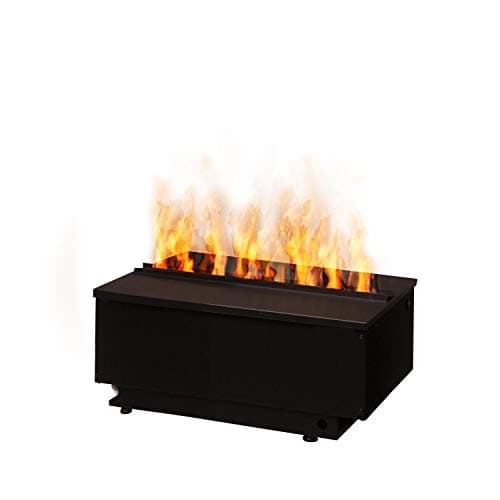 Dimplex Opti-Myst Pro 500 20" Water Vapor Cassette (CDFI500-PRO)Ultrasonic mist lit from beneath — a flame with genuine three-dimensional volume, and nothing burning. | The closest electric gets to a real flame | No heaterflame effect only | |
| 2 | 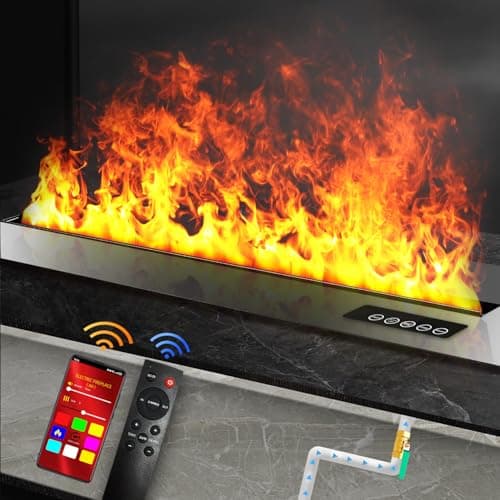 SUNLITUP 31.6" Water Vapor Fireplace (3D-100W)31.6 inches of mist flame in a unit that arrives complete — the realistic route for most people comparing against a bioethanol burner on price. | The same idea, finished and affordable | No heaterflame effect only | |
| 3 | 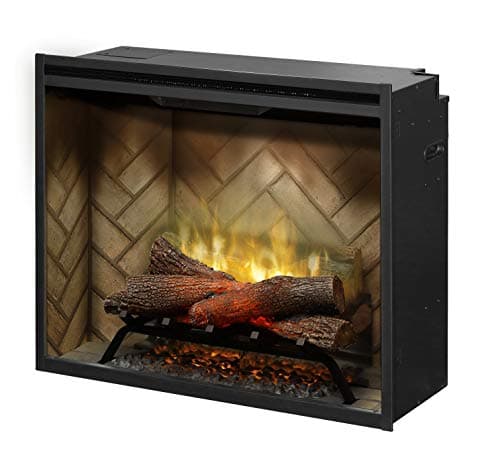 Dimplex Revillusion RBF30 30" Built-In FireboxA deep firebox with no visible light source — the pick if the bioethanol plan was to drop a burner tray into an existing fireplace. | A real opening you were going to put a burner in | 27.5¢1,500 W · 5,118 BTU | |
| — | 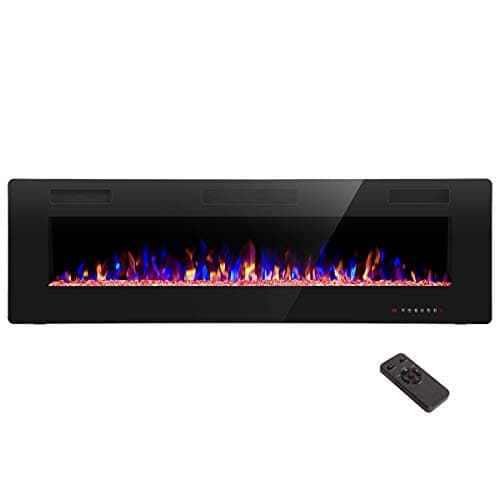 R.W.FLAME 60" Ultra-Thin Recessed & Wall-Mount FireplaceA genuinely good budget linear panel, and the single most likely way for a bioethanol shopper to end up disappointed.Skip this one | Nothing, if realism is why you are here | 27.5¢1,500 W · 5,118 BTU |
#ad Buy links are affiliate links — we earn a commission on Amazon purchases at no extra cost to you, and it never changes the ranking. How this site is funded. Running cost is computed at 18.34¢/kWh; see what these actually cost to run.
What we would actually do
If flame realism is the whole reason you are on this page, do not buy a budget LED panel and hope — that is the one outcome guaranteed to disappoint you, and it is why there is a skip on this page for a fireplace we otherwise rate highly. Buy a water-vapor unit, which is the only electric mechanism that produces a flame with real volume, or accept that bioethanol is what you want and read its safety instructions as though they matter, because they do.
What we would not do is put an unvented combustion appliance in a bedroom, a small sealed room, or anywhere a child can reach it. Are electric fireplaces safe? sets out the much shorter list of things that can go wrong with the electric version.
#1 · The closest electric gets to a real flame
Dimplex Opti-Myst Pro 500 20" Water Vapor Cassette (CDFI500-PRO)
Ultrasonic mist lit from beneath — a flame with genuine three-dimensional volume, and nothing burning.
If you were looking at bioethanol because LED flames do not convince you, this is the honest alternative, and it is the only one in the category that changes the argument rather than restating it. Opti-Myst raises a cool mist from ordinary tap water with ultrasonic transducers and lights it from below, so the flame occupies real space and moves the way smoke moves instead of being a lit surface.
The comparison with bioethanol is unusually direct. Both produce something physical in the air that light passes through. One of them is a combustion product and one of them is water. Dimplex publishes 120 V and 230 W for the Pro 500 cassette with a rated 785 BTU per hour, which is to say it is not a heater and does not pretend to be — and nothing in the room is being consumed except electricity and tap water.
It runs up to eight hours of continuous flames on a filled tank, and the cassettes can be combined in series for a longer linear run.
The costs are real and large. This is a bare cassette, not a finished fireplace: the log set, the plug kit, the plumb kit and the direct-wire heater are all separate items, and it needs an enclosure built for it. There is a reservoir to refill unless you plumb it. The dealer specification contradicts itself on height and publishes no cutout. And it is expensive — a bioethanol burner of similar width generally is not. We go through the technology on water vapor fireplaces.
What it does not do: Nearly everything around it. This is a bare cassette, and Dimplex sells the log set (CDFILOG), the plug kit (CDFI-PLUGKIT), the plumb kit (CDFIPLUMB-KIT) and the direct-wire heater (CDFI-TMHEAT) as separate items — budget for the ones you need before comparing the price to a finished fireplace. It also needs an enclosure built for it. It produces no useful warmth: 785 BTU/hr is a rounding error beside the 5,118 BTU/hr any 1,500 W unit on this site makes. The tank needs refilling unless you plumb it. And the dealer specification contradicts itself on height — 9 in in the dimensions line, 9.5 in in a separate field — while no cutout dimension is published anywhere we could find, so get both from Dimplex before cutting an opening.
Published specs
- Dimensions:
- 20 in W x 9 in H x 12 in D
- Electrical:
- 120 V, 230 W
- Heat output:
- 785 BTU/hr — the flame effect itself is heat-free
- Flame:
- Opti-myst ultrasonic transducers turning ordinary tap water into a fine cool mist, lit from beneath by LEDs
- Run time:
- Up to 8 hours of continuous flames on a filled tank
- Form:
- Built-in cassette — a firebox module for an enclosure you build, not a finished fireplace
- Linking:
- Cassettes can be run in series for a linear installation, and mixed with the CDFI1000-PRO
- Weight:
- 1.81 kg
- Warranty:
- 2 years limited
What it costs to run
No heater. The flame effect alone draws far less than a heating unit — see what these cost to run.
Computed at 18.34¢/kWh (EIA, June 2026). Your rate will differ — work out your own.
#ad We earn a commission on this link at no cost to you. How this is funded. Price as of October 30, 2026.
Specs from: Amazon listing — Dimplex Opti-Myst Pro 500 20-Inch Built-in Electric Cassette (CDFI500-PRO); Flame Authority dealer specification — Dimplex Opti-Myst 500-Pro CDFI500-PRO: 230 W, 120 V, 785 BTU, 20 x 9 x 12 in, 1.81 kg, up to 8 hours of continuous flames, 2 yr limited warranty, cassettes combinable in series; Dimplex Optimyst water vapor fireplaces — how the mist flame works.
#2 · The same idea, finished and affordable
SUNLITUP 31.6" Water Vapor Fireplace (3D-100W)
31.6 inches of mist flame in a unit that arrives complete — the realistic route for most people comparing against a bioethanol burner on price.
Bioethanol's practical appeal is often that a burner insert is cheap relative to what it does. This is the water-vapor answer to that, and the price gap against the Dimplex is the whole reason it is on the page.
It is a finished recessed fireplace rather than a cassette, so there is no enclosure project and no accessory list. The flame is the same physical mechanism — illuminated mist — which means the same genuinely unusual property: no combustion, no smell, no smoke, no emissions of any kind, and nothing hot to touch.
That last part is what makes it the direct substitute for a bioethanol burner rather than a compromise. A mist fireplace can sit at floor level in a room with small children in a way an open liquid-fuel flame cannot, and there is no fuel to buy, store or pour.
The honest costs: the flame effect produces no heat at all, so buy it as a flame and not as a fireplace. There is a reservoir to refill. And SUNLITUP publishes no atomizer wattage and no rough opening, where Dimplex at least publishes a draw — the documentation is the thing you give up at this price.
What it does not do: It produces no heat whatsoever, which is the point rather than a fault — but it means this can never double as a heater on a cold evening. It is also the only product on this site that needs plumbing: SUNLITUP's installation note says to connect the hose to a water source, and to reserve air-inlet space at the bottom for convection or the flames sit low. Remote batteries are not included. SUNLITUP publishes no wattage for the atomizer and no rough opening, and the Amazon dimension fields do not make clear which figure is the depth.
Published specs
- Width:
- 31.6 in
- Heat:
- None — the manufacturer states zero heat output
- Effect:
- 3D mist flame with glowing embers, rising sparks and semi-transparent flame tips
- Lighting:
- 8 LED colors, switchable or lockable, auto-changing every 2 minutes
- Water system:
- 3.5 L tank, automatic inlet and drainage, 0.26 to 0.4 L per hour depending on setting
- Runtime:
- 8 to 9 hours continuous on the lowest setting
- Control:
- Remote, control panel and smart app, with child lock and a simulated wood-burning sound
- Safety:
- Low-water automatic protection and auto-stop when full
- Body:
- 304 stainless steel exterior panel and internal tank
What it costs to run
No heater. The flame effect alone draws far less than a heating unit — see what these cost to run.
Computed at 18.34¢/kWh (EIA, June 2026). Your rate will differ — work out your own.
#ad We earn a commission on this link at no cost to you. How this is funded. Price as of October 30, 2026.
#3 · A real opening you were going to put a burner in
Dimplex Revillusion RBF30 30" Built-In Firebox
A deep firebox with no visible light source — the pick if the bioethanol plan was to drop a burner tray into an existing fireplace.
A common bioethanol plan is to buy a burner tray and set it into a masonry opening that no longer has a fire in it. If that is the project, this is the electric version of it, and it is the one that holds up at close range in a real hearth.
Revillusion is a genuinely deep firebox at 12 1/8 inches with a mirror-free viewing area and a herringbone brick interior. Depth and a concealed light source are what separate a convincing fire from a lit panel, and the effect survives being looked at from below and from the side — which is exactly how you look at a fire set into a hearth.
Unlike the mist units it is also a real heater: Dimplex rates it up to 8,794 BTU per hour, though only on the higher-voltage configuration, which is a hardwired job for a licensed electrician. On a standard 120 V circuit it sits under the same ceiling as everything else.
The costs. At 12 1/8 inches deep it will not go into a 2x4 or even a 2x6 wall, so outside an existing masonry opening it needs a purpose-built enclosure — see electric fireplaces in a cabinet or media wall. It is a firebox rather than a plug-in unit, and it is the most expensive way on this page to fill a hearth.
What it does not do: This is a firebox, not a plug-in wall unit. At 12 1/8 in deep it will not go into a 2x4 or even a 2x6 wall — it needs a purpose-built enclosure. The higher BTU figures require a higher-voltage hardwired supply and a licensed electrician.
Published specs
- Dimensions:
- 31 1/8 in W x 26 5/8 in H x 12 1/8 in D
- Weight:
- 50 lb
- Form:
- Built-in firebox — framed into a wall or a surround, not a stud bay
- Heat output:
- Up to 8,794 BTU/hr on the higher-voltage configuration
- Flame:
- Revillusion mirror-free viewing area with herringbone brick interior
- Heater:
- Fan-forced
What it costs to run
- 27.5¢/hr on full heat
- $99.04 across a 90-day winter at 4 hrs a night
- 5,118 BTU/hr · 12.5 A on a 120 V circuit
Computed at 18.34¢/kWh (EIA, June 2026). Your rate will differ — work out your own.
#ad We earn a commission on this link at no cost to you. How this is funded. Price as of October 30, 2026.
Specs from: Dimplex Revillusion RBF30 owner's manual; Retailer listing — RBF30 dimensions and weight.
Skip this one
R.W.FLAME 60" Ultra-Thin Recessed & Wall-Mount Fireplace
A genuinely good budget linear panel, and the single most likely way for a bioethanol shopper to end up disappointed.
There is nothing wrong with this fireplace. It is five feet of fire at 3.85 inches deep with a published specification — 750 W low and 1,500 W high, 120 V, a manufacturer rating up to 400 square feet, twelve flame colors and twelve ember-bed colors — and we recommend it warmly on several other pages as one of the best-value wall units in the catalog.
It is a skip here for a reason that is entirely about who is reading this page. If you arrived comparing electric against bioethanol, the reason is almost always that a real flame looks real and an LED flame does not. A layered LED panel is the one purchase guaranteed not to solve that, however good it is for the money.
The failure mode is specific and predictable: an LED flame is a lit surface rather than a lit object, so it flattens out from an angle, in daylight, and from above. Those are the three conditions a bioethanol flame handles effortlessly, because it is a real fire. Buying a budget LED panel to replace a bioethanol plan is swapping the thing you wanted for the thing you were trying to avoid.
If the budget genuinely stops here, the honest advice is to buy it for what it is — a handsome wall of light in an evening room — and not to expect it to answer the realism question. What makes a flame look fake sets out why.
What it does not do: No mantel and no surround. The published depth is 3.85 in, but the manufacturer's own listing also references 2x6 framing — confirm the rough-opening requirement with R.W.FLAME before you cut a 60-inch hole in anything.
Published specs
- Dimensions:
- 60 in L x 18.1 in H x 3.85 in D
- Heater:
- 750 W low / 1,500 W high
- Electrical:
- 120 V AC, 60 Hz
- Coverage:
- Rated by the manufacturer for up to 400 sq ft
- Flame:
- 12 flame colors, 12 ember-bed colors, 5 speeds, 5 brightness levels
- Control:
- Touchscreen panel and remote, adjustable thermostat
- Warranty:
- 1 year
What it costs to run
- 27.5¢/hr on full heat
- $99.04 across a 90-day winter at 4 hrs a night
- 5,118 BTU/hr · 12.5 A on a 120 V circuit
Computed at 18.34¢/kWh (EIA, June 2026). Your rate will differ — work out your own.
#ad We earn a commission on this link at no cost to you. How this is funded. Price as of October 30, 2026.
Specs from: R.W.FLAME 60 in listing — 60 x 18.1 x 3.85 in, 750/1500 W, 120 V, 400 sq ft; R.W.FLAME recessed / wall-mount range page.
Questions people actually ask
Is a bioethanol fireplace more realistic than an electric one?
Yes, and it is not a close call, because a bioethanol flame is real combustion rather than a simulation of it. No LED fireplace matches it. The nearest electric mechanism is ultrasonic water vapor, which produces a flame with genuine three-dimensional volume by lighting a mist — it is the only electric technology that competes on this question at all, and it still is not fire.
Are bioethanol fireplaces safe to use indoors?
They are unvented combustion appliances, which means every product of that combustion enters the room. A Fraunhofer chamber study of four nonvented ethanol fireplaces found carbon dioxide and nitrogen dioxide close to or above indoor-air guideline values in many cases, benzene over 12 ppb and formaldehyde above 0.1 ppm in two runs, and described the units as strong sources of fine and ultrafine particles — with ventilation set to the manufacturers' own recommendations. Separately, the CPSC has warned repeatedly about flame jetting when refueling liquid-fuel fire pits. Neither finding makes the category unusable, but both belong in the decision.
What is flame jetting?
It is what happens when liquid fuel is poured into a burner that still has a flame in it. The CPSC describes a small flame igniting the fuel as it is poured, "causing an explosion that propels flames and burning liquid onto the consumer or bystanders". Its December 2024 alert associated alcohol and other liquid-burning fire pits with two deaths and at least 60 injuries since 2019, and named ASTM F3363-19 as the voluntary standard designed to prevent it.
Does a bioethanol fireplace need a chimney?
No, and that is the entire appeal — no flue, no gas line, no chimney, which is exactly the problem an electric fireplace also solves. The difference is what happens to the combustion gases. An electric fireplace produces none; a bioethanol fireplace produces them and releases them into the room, because there is nowhere else for them to go.
Is bioethanol cheaper to run than electric?
They are not comparable in a useful way, and the shapes of the costs differ. Electricity is metered and computable in advance from a wattage. Ethanol is bought by the bottle and consumed whenever the fire is lit, whether or not you want the heat it produces. What is calculable is the electric side: our running cost calculator prices any wattage at your own tariff, and a water-vapor unit drawing a couple of hundred watts costs very little to run as a flame.
Sources
Every figure on this page is either taken from one of these documents or computed from a formula shown on the page. Nothing here is recalled from memory.
- Schripp, Salthammer, Wientzek & Wensing, "Chamber studies on nonvented decorative fireplaces using liquid or gelled ethanol fuel", Environmental Science & Technology 48(6):3583-90 (2014), Fraunhofer WKI — four ethanol fireplaces and eight fuels in a 48 m3 emission test chamber under typical living room conditions, ventilation set per the manufacturers' recommendations and DIN 4734-1: the fireplaces "are constructed such that they have no fume extraction system, and so all of the gases from combustion, volatile organic compounds, and particulate emissions are released into the room"; carbon dioxide and nitrogen dioxide "close to or even above the guideline values in many cases"; benzene over 12 ppb and formaldehyde above 0.1 ppm in two experiments; "strong sources of fine and ultrafine particles" irrespective of fuel; "Overall, ethanol fireplaces have a considerable influence on the quality of the indoor air due to the lack of ventilation"
- US CPSC consumer alert 25-074 (2024-12-19) — stop using alcohol or other liquid-burning fire pits that violate voluntary standards: the products "have been associated with two deaths and at least 60 injuries since 2019"; flame jetting occurs when refueling with a flame present, "causing an explosion that propels flames and burning liquid onto the consumer or bystanders"; voluntary standard ASTM F3363-19 is designed to prevent flame jetting and pool fires "in which flames burn along the surface of pooled or spilled flammable liquids"; the alert covers products "also sold as tabletop fire pits, fire pots, miniature fireplaces, or portable fires for indoor use"
- Flame Authority dealer specification — Dimplex Opti-Myst 500-Pro cassette (CDFI500-PRO): 230 W, 120 V, 785 BTU, 20 x 9 x 12 in, 1.81 kg, up to 8 hours of continuous flames on a filled tank, 2 yr limited warranty, Opti-myst ultrasonic mist, cassettes combinable in series with the CDFI1000-PRO
- Dimplex Optimyst water vapor fireplaces — ultrasonic mist and LED mechanism
- Dimplex Revillusion RBF30 owner's manual — built-in firebox installation and ratings
- EIA Electric Power Monthly, Table 5.3 — US residential average, June 2026
Read next
- Water vapor fireplaces
How ultrasonic mist flame works, why it beats every LED unit on realism, and the two things it cannot do at all.
- Electric vs gas fireplace
Install cost, running cost, heat, realism and venting — with an honest account of where gas wins.
- The most realistic electric fireplaces
Ranked by flame mechanism, not adjectives. Water vapor, layered LED and three-sided glass, with the trade-offs stated.
- Are electric fireplaces safe?
No combustion, no carbon monoxide, no flue. The four electrical considerations that do matter.
- Electric fireplaces without heat
Why nearly every electric fireplace already runs without heat, what flame-only actually costs to run, and the three situations that genuinely need a heaterless unit.