Comparison · the one with a clear loser
Electric fireplace vs pellet stove
On heat this is the most lopsided comparison on the site, and pretending otherwise would be dishonest. What is genuinely in doubt is whether you want a heating appliance at all.
By Scooter M.Published October 10, 2026Last reviewed October 10, 2026
Disclosure: the buy links below are affiliate links. We earn a commission on Amazon purchases at no extra cost to you. It has never changed a ranking on this site, and every roundup here names a unit we think you should skip. How this site is funded.
The answer first
On heat, it is not close. The EPA puts EPA-certified pellet stoves at 70-83% efficient with heating capacities from 8,000 to 90,000 BTU per hour. Every plug-in electric fireplace is capped at 1,500 W and about 5,118 BTU per hour. So the *smallest* pellet stove the EPA certifies out-heats the entire electric category by about 56%, and a large one by more than 17 times. What is genuinely in doubt is not which heats better — it is whether you want a fuel-burning appliance in your house at all.
This is the most lopsided comparison on the site and we would rather open with that than build suspense. The useful part of the page is everything a pellet stove asks of you in exchange, because that is where the decision actually gets made.
The surprise: a pellet stove needs electricity too
This is the fact that catches people, and it inverts the argument most often made for fuel-burning appliances. The EPA is explicit: *unlike wood stoves and fireplaces, most pellet stoves need electricity to operate.* They contain motorized components to feed the fire and blow out hot air — an auger moving pellets into the burn pot and fans moving air through the unit. Cut the power and a conventional pellet stove stops.
So the "it works in an outage" advantage that genuinely belongs to an open wood fire does not transfer to pellets. The EPA notes you can buy backup batteries with some models, and that gravity-fed stoves *are less common but do not require electricity in order to provide heat* — which tells you the ordinary case needs the grid. If outage heat is the reason you are shopping, that is a specification to hunt for rather than assume, and it is worth reading electric vs a wood-burning fireplace alongside this page.
What that leaves is a genuine asymmetry rather than a tie. A pellet stove spends a little electricity moving a lot of wood energy into the room. An electric fireplace spends a lot of electricity to produce a comparatively small amount of heat. Both have a cord; only one of them is a heating system.
The output gap, in the site's usual units
| Appliance | Output | Multiple of the electric ceiling | Rule-of-thumb room |
|---|---|---|---|
| Electric fireplace on high | 5,118 BTU/hr at 1,500 W | 1.0x | ~256 sq ft |
| Smallest EPA-certified pellet stove | 8,000 BTU/hr | 1.56x | ~400 sq ft |
| Mid-range pellet stove | 40,000 BTU/hr | 7.8x | ~2,000 sq ft |
| Largest EPA-certified pellet stove | 90,000 BTU/hr | 17.6x | ~4,500 sq ft |
Put the other way round: one hour of the smallest certified pellet stove delivers about as much heat as 1.6 hours of an electric fireplace running flat out, and one hour of a 90,000 BTU unit delivers what would take an electric fireplace nearly 18 hours and about $4.84 of electricity. There is no configuration, brand or flame technology that closes that gap, because the gap is the circuit.
What to buy if you decide against the pellet project
Ranked. The running cost column is computed from each unit's rated wattage, not quoted from a manufacturer. Tap a row for the full write-up.
| # | Product | Best for | Cost per hour | Price |
|---|---|---|---|---|
| 1 | 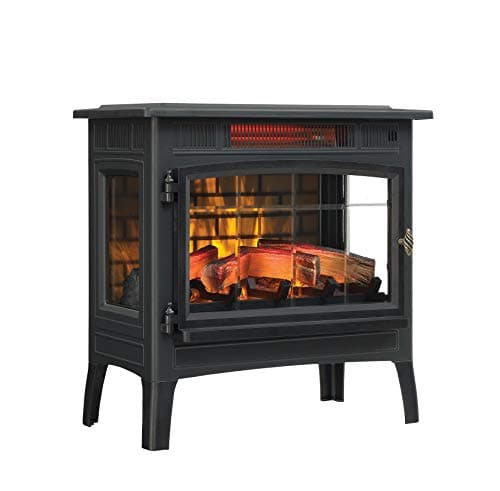 Duraflame DFI-5010-01 3D Infrared Fireplace StoveThe closest thing in our catalog to the object you were shopping for. It stands on the floor, radiates from its whole front face, and needs nothing but a socket. | The pellet-stove shape, minus the pellets | 27.5¢1,500 W · 5,118 BTU | |
| 2 | 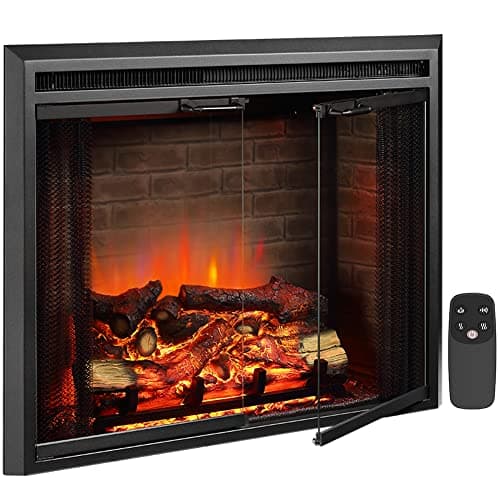 PuraFlame Klaus 33" Electric Fireplace InsertA pellet insert can reuse your chimney. This needs no flue at all, no liner and no fuel delivery, and it fills the same opening. | If you were pricing a pellet insert, not a stove | 27.5¢1,500 W · 5,118 BTU | |
| 3 | 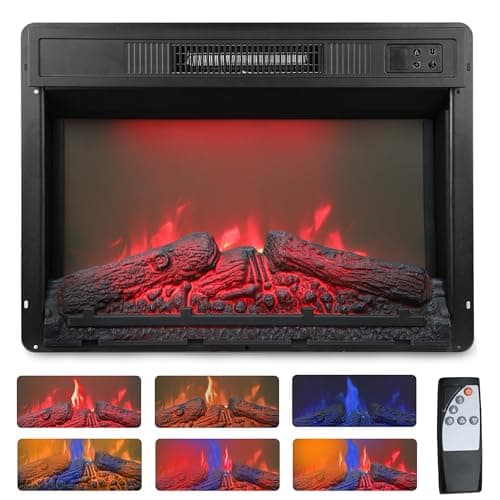 RoyalCraft 23" Recessed Insert (ZEP001)The cheapest unit we cover. If the pellet quote came back and you decided the whole idea was too much appliance, this is the floor of the category. | Abandoning the project as cheaply as possible | 25.7¢1,400 W · 4,777 BTU | |
| — | 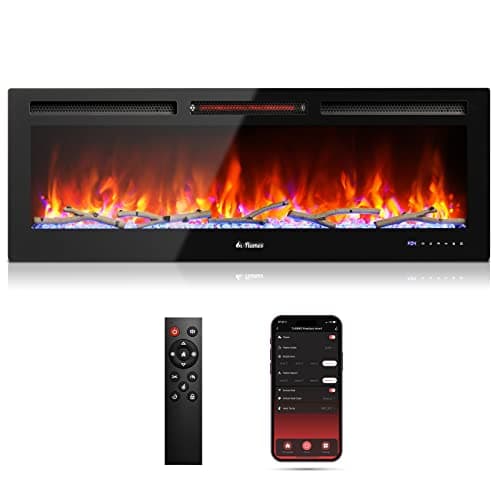 TURBRO In-Flame INF50W-3D 50" Smart WiFi Infrared FireplaceA good wall unit carrying the one number that makes people think electric competes with a pellet stove. It is a supplemental rating, not an output figure.Skip this one | Nothing here, and its own spec sheet explains why | 27.5¢1,500 W · 5,118 BTU |
#ad Buy links are affiliate links — we earn a commission on Amazon purchases at no extra cost to you, and it never changes the ranking. How this site is funded. Running cost is computed at 18.34¢/kWh; see what these actually cost to run.
Side by side
| Pellet stove | Electric fireplace | |
|---|---|---|
| Output | 8,000-90,000 BTU/hr | 5,118 BTU/hr, full stop |
| Efficiency | 70-83% (EPA-certified) | Essentially 100% at the point of use |
| Needs electricity | Yes — auger and fans | Yes, obviously |
| Works in an outage | Not usually. Battery or gravity-fed models excepted | No |
| Venting | External wall or ceiling; inserts can reuse a chimney | None |
| Fuel | Bagged pellets, bought, carried and stored dry | None |
| Ash | Ash pan to empty | None |
| Annual service | Professional cleaning at least once a year, per EPA | Wipe the glass |
| Flame | Real combustion, behind glass | An effect |
| Flame without heat | No | Yes — under 2¢/hr |
| Install | Vent kit, clearances, usually a trade | Plug it in |
| Where it can go | Somewhere you can vent | Anywhere with a socket |
What a pellet stove genuinely wins
- Heat, by a margin nothing else on this site approaches. The smallest certified unit beats the electric ceiling by half again; the largest by more than seventeen times. If the room is genuinely cold, this is the appliance and the rest of the page is a consolation prize.
- It is among the cleanest ways to burn wood. Pellet stoves are typically the cleanest wood-burning appliances available, which is why the EPA certifies over ninety of them. Compare that with the 10-20% efficiency of the open fireplace we take apart on electric vs a wood-burning fireplace.
- Thermostatic, hands-off running. Unlike a wood fire it feeds itself from a hopper, so it holds a temperature for hours rather than needing a log every forty minutes. That is most of why people choose pellets over cordwood.
- Real fire behind the glass. Not the volume of an open hearth, but combustion rather than an effect — and that is a thing an LED cannot be talked into being.
What an electric fireplace genuinely wins
- There is nothing to vent. This is the big one and it is binary. A pellet stove needs a route through an external wall or ceiling, or a chimney it can reuse. An electric unit needs a socket, which is why it is the only one of the two that can go in an apartment, a rental, an interior room or a basement with no flue route.
- No fuel in your life. No bags to buy, carry, stack and keep dry; no hopper to fill; no delivery to schedule before a cold snap. The absence of a logistics chain is a real feature and it is the one people underrate until they have lived with the alternative.
- No ash and no annual service bill. The EPA recommends professional cleaning of a pellet stove at least once a year, and bottom-fed models push ash into a pan you then empty. An electric fireplace has no combustion by-products at all.
- The flame runs with the heat off. For most of the year what you want from a fireplace is the look, and only one of these two gives you that for under two cents an hour. A pellet stove producing a flame is a pellet stove producing heat, whether the room wants it or not.
- It costs a fraction up front. The cheapest pick above is a two-figure appliance. A pellet stove plus a vent kit plus installation is a different order of spending, and that gap buys a lot of the electricity our running-cost page prices out.
What both of them cost to run
| Usage | Hours | Heat on (1,500 W) | Flame only (~100 W) |
|---|---|---|---|
| One evening | 4 | $1.10 | $0.07 |
| A week of evenings | 28 | $7.70 | $0.51 |
| A month, 4 hrs a night | 120 | $33.01 | $2.20 |
| A 90-day winter, 4 hrs a night | 360 | $99.04 | $6.60 |
| Per hour | 1 | 27.5¢ | 1.8¢ |
About 27.5 cents an hour on full heat, and roughly $99 across a 90-day winter at four hours a night. We are not putting a pellet figure beside that, because a pellet stove's running cost depends on the price of a ton of pellets where you live and how hard you run it — and we would rather leave a gap in the table than fill it with a national average we cannot stand behind. Price a ton locally and divide by the heat it carries, the same way we do the wood arithmetic on the wood-burning comparison.
The mistake this comparison invites
It is reading an electric unit's square-footage rating as though it were a pellet stove's output. Manufacturers rate electric fireplaces for *supplemental* heat — the figure describes a room the unit can take the edge off while something else does the actual heating. Those ratings run up to 1,000 square feet on units drawing 1,500 W, which is the same 5,118 BTU per hour as every other unit in the category. Put that 1,000 next to a pellet stove's 90,000 BTU per hour in a table and the electric unit looks competitive. It is not, and the skip above is the clearest example of a good product carrying a misleading number.
The arithmetic that settles it is on BTU and room size, and if you want the figure for your own room before you shop either appliance, the room size calculator will tell you which side of the 5,118 BTU line you are on.
#1 · The pellet-stove shape, minus the pellets
Duraflame DFI-5010-01 3D Infrared Fireplace Stove
The closest thing in our catalog to the object you were shopping for. It stands on the floor, radiates from its whole front face, and needs nothing but a socket.
If what drew you to a pellet stove was partly the appliance itself — a solid thing standing in the corner throwing light across the floor, rather than a slot in a wall — this is the honest electric answer to that. It is the same silhouette and the same placement, and the install is a socket.
It is also the best-documented unit in our catalog, which matters on a page like this one: 5,200 BTU per hour, 120 V at 12.5 A per the manual, 24 by 23.4 by 13.1 inches, 28.6 pounds, a layered 3D flame across five brightness settings, an adjustable digital thermostat and an overheat shutoff.
Two cons. It is a freestanding stove rather than an insert, so it needs floor space plus clearance in front of the glass door and will not fill a masonry opening. And the honest one: 5,200 BTU per hour is a published figure we trust, and it is still well under the output of the smallest pellet stove the EPA certifies. If you want this object because it heats, buy the pellet stove.
What it does not do: It is a freestanding stove, not an insert. It will not fill a masonry opening and it needs floor space plus clearance in front of the glass door.
Published specs
- Heat output:
- 5,200 BTU/hr
- Electrical:
- 120 V, 12.5 A
- Dimensions:
- 24 in W x 23.4 in H x 13.1 in D
- Weight:
- 28.6 lb
- Flame:
- Layered 3D flame effect, five brightness settings
- Safety:
- Overheat shutoff, adjustable digital thermostat
What it costs to run
- 27.5¢/hr on full heat
- $99.04 across a 90-day winter at 4 hrs a night
- 5,118 BTU/hr · 12.5 A on a 120 V circuit
Computed at 18.34¢/kWh (EIA, June 2026). Your rate will differ — work out your own.
#ad We earn a commission on this link at no cost to you. How this is funded. Price as of October 17, 2026.
Specs from: Duraflame DFI-5010-02-3A user manual — 120 V, 12.5 A; Walmart product page — 5,200 BTU, dimensions, weight.
#2 · If you were pricing a pellet insert, not a stove
PuraFlame Klaus 33" Electric Fireplace Insert
A pellet insert can reuse your chimney. This needs no flue at all, no liner and no fuel delivery, and it fills the same opening.
The EPA notes that pellet inserts can use an existing chimney where freestanding units vent through an external wall or ceiling. So if the plan was a pellet insert in a masonry fireplace you already own, the real comparison is between relining and venting that chimney for a pellet appliance and dropping in something that vents nowhere.
Published as 33 1/16 inches wide and 25 9/16 inches high, with 750 W and 1,500 W heat settings, an LED flame across three intensity settings that runs with the heat off, a glass door and mesh screen in front of a three-sided brick interior, and a resin cast log 11 13/16 inches high on a grate over the ember bed.
The con is dimensional and it catches people out. There is no trim kit in the base version, so a masonry opening wider than 33 inches leaves a visible gap unless you buy the trim separately — measure the opening before you order. Our longer treatment of that job is on inserts for an existing fireplace.
What it does not do: No trim kit in the base version — an existing masonry opening wider than 33 in leaves a visible gap unless you buy the trim separately.
Published specs
- Heater:
- 750 W / 1,500 W, two settings
- Width:
- 33 1/16 in
- Height:
- 25 9/16 in
- Flame:
- LED, three intensity settings, runs with heat off
- Front:
- Glass door, mesh screen, three-sided brick interior
- Log:
- Resin cast log, 11 13/16 in high, on a grate over the ember bed
What it costs to run
- 27.5¢/hr on full heat
- $99.04 across a 90-day winter at 4 hrs a night
- 5,118 BTU/hr · 12.5 A on a 120 V circuit
Computed at 18.34¢/kWh (EIA, June 2026). Your rate will differ — work out your own.
#ad We earn a commission on this link at no cost to you. How this is funded. Price as of October 17, 2026.
Specs from: PuraFlame Klaus insert listing (specifications and dimensions); Walmart product listing — 750/1500 W rating confirmed.
#3 · Abandoning the project as cheaply as possible
RoyalCraft 23" Recessed Insert (ZEP001)
The cheapest unit we cover. If the pellet quote came back and you decided the whole idea was too much appliance, this is the floor of the category.
Some people arrive at a pellet stove quote, add up the vent kit, the fuel and the annual service, and decide they wanted a lit corner rather than a heating system. This is what that decision costs at the bottom of the market.
Published as 23 by 17 by 5 inches, 1,400 W on a single setting with no low mode, 120 V, a thermostat with 22 settings from 62 to 82 °F, six flame colors across three brightness levels, a 30-minute to 6-hour timer, 45 dB, a carbon steel body and CSA certification, with a manufacturer coverage rating of up to 400 square feet.
Three cons, and the first is a number that does not add up. RoyalCraft publishes 5,000 BTU per hour, but 1,400 W is 4,777 BTU per hour — treat the round number as marketing and the wattage as the real figure. It also publishes no rough opening and no weight, the timer stops at 6 hours where most rivals reach 8, and the identical specification is sold under the Heynemo name, which tells you this is a rebadged body rather than a brand doing its own engineering.
What it does not do: The published 5,000 BTU/hr does not follow from the published 1,400 W: 1,400 W is 4,777 BTU/hr, so treat the round number as marketing and the wattage as the real figure. RoyalCraft publishes no rough opening and no weight, the timer stops at 6 hours where most rivals reach 8, and 1,400 W is the lowest heat ceiling on this page. The identical specification is also sold under the Heynemo name, which tells you this is a rebadged body rather than a brand with its own engineering.
Published specs
- Dimensions:
- 23 in W x 17 in H x 5 in D
- Heater:
- 1,400 W — a single setting, with no low mode
- Electrical:
- 120 V, 60 Hz
- Heat output:
- 5,000 BTU/hr (manufacturer claim — see below)
- Coverage:
- Rated by the manufacturer for up to 400 sq ft
- Thermostat:
- 22 settings from 62 to 82 °F
- Flame:
- 6 flame colors, 3 brightness levels
- Timer:
- 30 minutes to 6 hours
- Noise:
- 45 dB (manufacturer figure)
- Safety:
- CSA certified, overheat protection
- Body:
- Carbon steel
What it costs to run
- 25.7¢/hr on full heat
- $92.43 across a 90-day winter at 4 hrs a night
- 4,777 BTU/hr · 11.7 A on a 120 V circuit
Computed at 18.34¢/kWh (EIA, June 2026). Your rate will differ — work out your own.
#ad We earn a commission on this link at no cost to you. How this is funded. Price as of October 17, 2026.
Specs from: RoyalCraft specification page — 23 x 17 x 5 in, 120 V/1400 W/60 Hz, 5,000 BTU claimed, 400 sq ft, 6 flame colors, 3 brightness levels, 22 settings from 62-82 °F, 30 min to 6 h timer, 45 dB, carbon steel, CSA certified; Amazon listing — Royalcraft 23 in electric fireplace insert for TV stand (model ZEP001), 1400 W.
Skip this one
TURBRO In-Flame INF50W-3D 50" Smart WiFi Infrared Fireplace
A good wall unit carrying the one number that makes people think electric competes with a pellet stove. It is a supplemental rating, not an output figure.
There is nothing wrong with the INF50W-3D and we recommend it elsewhere. Published as 50 by 16 by 4.6 inches, 47.6 pounds, 1,500 W infrared quartz, with a 60 to 99 °F thermostat, a 30-minute to 12-hour timer, a media bed of five birch logs and crystals, and app, Alexa and Google control over 2.4 GHz WiFi.
It is the skip because of its coverage line: *rated by the manufacturer for 400-1,000 sq ft*. That is the figure that ends up in comparison tables next to a pellet stove's, and the two are not the same kind of number. A supplemental-heat rating describes a room the unit can take the edge off alongside your actual heating. A pellet stove's 8,000 to 90,000 BTU per hour is output. Read the top of that range as a heating claim and you will be disappointed in a way that is nobody's fault but the spec sheet's.
The other two cons stand on their own. TURBRO publishes no BTU figure for this model, so we do not quote one — plan from the 1,500 W rating, which is 5,118 BTU per hour and the same ceiling as everything else. And at 4.6 inches deep it will not sit flush in a standard 2x4 stud bay.
What it does not do: TURBRO does not publish a BTU figure for this model, so we do not quote one — the 1,500 W rating is the number to plan from. At 4.6 in deep it will not sit flush in a standard 2x4 stud bay, and the app needs a 2.4 GHz network, which catches people out on modern dual-band routers.
Published specs
- Heater:
- 1,500 W infrared quartz
- Coverage:
- Rated by the manufacturer for 400-1,000 sq ft
- Dimensions:
- 50 in L x 16 in H x 4.6 in D
- Weight:
- 47.6 lb
- Noise:
- 42 dB or lower (manufacturer figure)
- Thermostat:
- Adjustable, 60-99 °F
- Timer:
- 30 minutes to 12 hours
- Media bed:
- Five birch logs and crystals
- Mounting:
- Recessed or wall-mounted
- Smart control:
- App, Alexa and Google Assistant over 2.4 GHz WiFi
What it costs to run
- 27.5¢/hr on full heat
- $99.04 across a 90-day winter at 4 hrs a night
- 5,118 BTU/hr · 12.5 A on a 120 V circuit
Computed at 18.34¢/kWh (EIA, June 2026). Your rate will differ — work out your own.
#ad We earn a commission on this link at no cost to you. How this is funded. Price as of October 17, 2026.
Specs from: Home Depot — TURBRO INF50W-3D, 50 in, 1,500 W infrared quartz, WiFi and voice control; TURBRO In-Flames INF50W-3D product page — 50 x 16 x 4.6 in, 47.6 lb, 400-1,000 sq ft, 42 dB, 60-99 °F.
Questions people actually ask
Does a pellet stove heat better than an electric fireplace?
Yes, by a wide margin. The EPA puts certified pellet stoves at 8,000 to 90,000 BTU per hour, while every plug-in electric fireplace is capped at 1,500 W and about 5,118 BTU per hour. The smallest certified pellet stove therefore out-heats the entire electric category by roughly 56%, and the largest by more than seventeen times.
Do pellet stoves need electricity?
Most do. The EPA states that unlike wood stoves and fireplaces, most pellet stoves need electricity to operate, because they use motorized components to feed the fire and blow out hot air. Backup batteries are sold with some models, and gravity-fed stoves that need no electricity exist but are less common, so treat outage operation as a specification to check rather than assume.
Is an electric fireplace cheaper than a pellet stove?
Up front, by a long way — there is no vent kit, no installation trade and no fuel supply, and the cheapest units in the category are two-figure appliances. Running cost is the harder comparison: an electric fireplace is about 27.5 cents an hour at 1,500 W and the EIA US average of 18.34 cents per kWh, while a pellet stove depends on the local price of a ton of pellets and how hard you run it.
Can I put a pellet stove where an electric fireplace goes?
Usually not, and this is the constraint that decides most of these decisions. A pellet stove needs to vent through an external wall or ceiling, or reuse an existing chimney in the case of an insert. An electric fireplace needs a socket, so it can go in an apartment, a rental, an interior room or anywhere with no flue route at all.
How much maintenance does a pellet stove need compared with electric?
The EPA recommends having a pellet stove professionally cleaned at least once a year, and you empty an ash pan through the season — bottom-fed models push ash into the pan automatically, while top-fed designs are more likely to fill with ash and debris. An electric fireplace produces no combustion by-products, so maintenance is wiping the glass.
Should I buy an electric fireplace if I actually want to heat the room?
Only if the room is small or the heating is already handled. A plug-in electric fireplace delivers about 5,118 BTU per hour, which is roughly a 256 square foot room on the usual 20 BTU per square foot rule of thumb. If the room is bigger or genuinely cold and you can vent, a pellet stove is the appliance for the job and we would rather say so.
Sources
Every figure on this page is either taken from one of these documents or computed from a formula shown on the page. Nothing here is recalled from memory.
- EPA Burn Wise, pellet stoves — "EPA-certified pellet stoves usually fall into the 70-83% efficiency range, while heating capacities range from 8,000-90,000 Btu per hour"; they contain "motorized components to feed the fire and blow out hot air", so backup batteries are sold with some models and gravity-fed stoves "are less common but do not require electricity in order to provide heat"; freestanding units vent through an external wall or ceiling while inserts can use an existing chimney; professional cleaning at least once a year; EPA currently certifies over 90 different pellet stoves
- EPA Burn Wise, choosing wood-burning appliances — "Unlike wood stoves and fireplaces, most pellet stoves need electricity to operate" and "Fireplaces are typically very inefficient heaters"; EPA-certified stoves are cleaner burning and more energy efficient
- Penn State Extension, "Heating with Wood: An Introduction" — "A fireplace is only 10-20% efficient at creating heat" while "modern wood stoves are 80% or more efficient"; a fireplace can have a negative heating impact when the flue is left open with no fire burning; air-dried heat content per cord runs from 24 MMBTU (northern red oak) to 25.7 (white oak), 28.0 (hickory) and 30.7 (Osage orange), and a cord of seasoned northern red oak carries about the same heat as 159 gallons of fuel oil
- Penn State Extension, "Wood Heat for Your Home: Does It Pay Off?" — appliance efficiencies used in its cost model: wood stove 60%, pellet stove 80%, gas furnace 80%, oil boiler 80%
- EIA Electric Power Monthly, Table 5.3 — US residential average, June 2026
- EcoCostSavings — measured wattage and BTU across 117 electric fireplace models
- Wikipedia — Electric fireplace (mechanism and history)
Read next
- Electric fireplace vs heat pump
A heat pump transfers heat rather than generating it, which puts it beyond a ceiling an electric fireplace can never pass. What that means in practice, and what to buy for the fire instead.
- Electric fireplace vs wood-burning fireplace
An open fire is 10-20% efficient and can be a net heat loss. Electric delivers everything it draws but caps at 1,500 W. Which trade that favors, and when the answer is a wood insert instead.
- Freestanding electric fireplace stoves
No opening, no framing, no electrician. Four stoves compared on heater type, flame depth and the floor space they genuinely need.
- BTU and room size
BTU-to-square-feet, banded — with a calculator that reports the shortfall as honestly as the fit.
- What an electric fireplace costs to run
27.5 cents an hour on heat, under two cents on flame alone — computed at the real 2026 rate, with the source.
- Electric fireplace room size calculator
Room dimensions in, BTU and shortfall out. Reports the gap as honestly as the fit.