Roundup · updated for the 2026 heating season
Electric fireplaces for apartments and rentals
Every good reason to want one of these applies in a rented apartment, and almost every installation guide assumes you own the wall. These are the units that ask nothing permanent of the building.
By Scooter M.Published September 13, 2026Last reviewed September 13, 2026
Disclosure: the buy links below are affiliate links. We earn a commission on Amazon purchases at no extra cost to you. It has never changed a ranking on this site, and every roundup here names a unit we think you should skip. How this site is funded.
The short answer
Buy a freestanding unit, or a linear one you can surface-mount. Electric fireplaces need no flue, no gas and no combustion, so nothing about them requires altering a building — but most installation advice assumes you are recessing into a wall you own. A stove needs a socket. A surface-mounted panel needs four bracket fixings. Neither needs a permit, an electrician or a conversation you would rather not have.
What actually changes when you rent
The physics are the same and the shopping decision is not. Four things move up the priority list in an apartment, and none of them appear in a standard buying guide.
- Reversibility. Can this leave with you, and what does the wall look like afterwards? A stove leaves nothing. A bracket leaves four filled holes. A recessed unit leaves a hole the size of the fireplace.
- The circuit, in an older building. 1,500 W is 12.5 amps continuous. Older apartment wiring frequently has fewer circuits serving more rooms, so what else is on that circuit matters more than it would in a newer house.
- Shared walls. A fan-forced heater against a party wall is audible on the other side of it. This is the consideration most likely to cause an actual complaint, and it is the one nobody writes about.
- Floor area. A freestanding stove needs clearance in front of the glass. In a small living room that is real floor space you are giving up.
Quick picks: nothing permanent
Ranked. The running cost column is computed from each unit's rated wattage, not quoted from a manufacturer. Tap a row for the full write-up.
| # | Product | Best for | Cost per hour | Price |
|---|---|---|---|---|
| 1 | 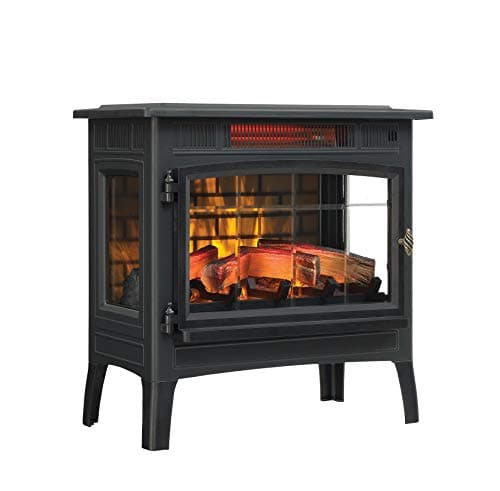 Duraflame DFI-5010-01 3D Infrared Fireplace StoveA freestanding stove that needs a socket and two feet of floor. No screws, no brackets, no conversation with anyone. | Asking nothing at all of the building | 27.5¢1,500 W · 5,118 BTU | |
| 2 | 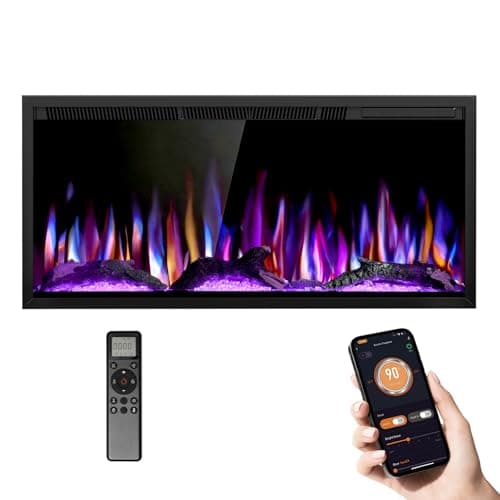 R.W.FLAME 36" Ultra-Thin Recessed & Wall-Mount FireplaceSold as recessed or wall-mounted, and the wall-mounted half of that is the one renters want. Four bracket holes, not a hole in the drywall. | Hanging on a wall without cutting into it | 27.5¢1,500 W · 5,118 BTU | |
| 3 | 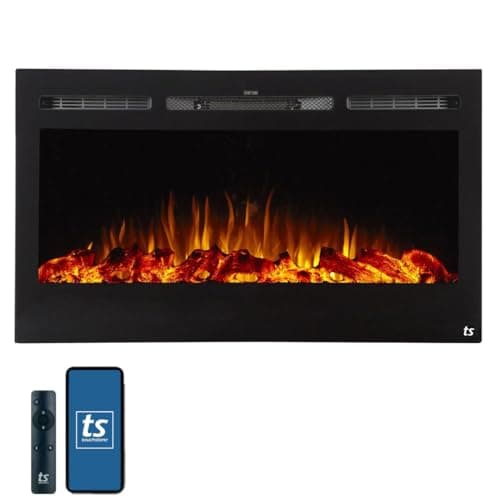 Touchstone The Sideline 36Recessed or wall-mounted, from the one brand here that publishes a real manual and a real heater specification. | A rental where you want it properly documented | 27.5¢1,500 W · 5,118 BTU | |
| 4 | 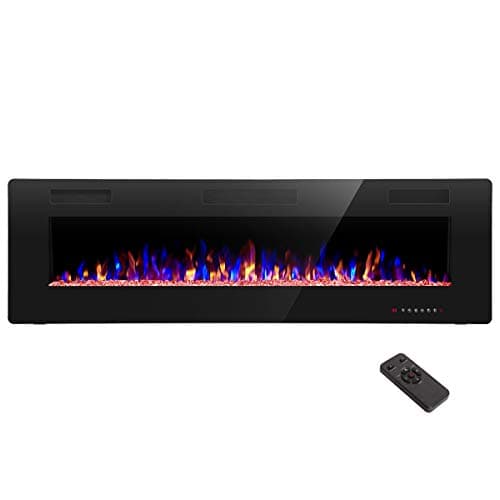 R.W.FLAME 60" Ultra-Thin Recessed & Wall-Mount FireplaceThe same surface-mount flexibility and two-stage heater at sixty inches, for anyone with a proper living room and a temporary lease. | A long wall in a bigger rental | 27.5¢1,500 W · 5,118 BTU | |
| 5 | TURBRO In-Flame INF36-W 36" Wall-Mounted FireplaceOne of the few linear units offered with an optional floor stand, which turns a wall-mount fireplace into something that needs no fixings at all. | A standing base instead of a bracket | 25.7¢1,400 W · 4,777 BTU | |
| — | 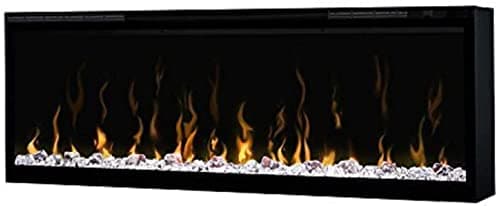 Dimplex IgniteXL 50" Linear Fireplace (XLF50)An excellent fireplace and the wrong one here — it wants 2x6 framing, a recessed cavity and ideally an electrician.Skip this one | Nothing in a rental | 27.5¢1,500 W · 5,118 BTU |
#ad Buy links are affiliate links — we earn a commission on Amazon purchases at no extra cost to you, and it never changes the ranking. How this site is funded. Running cost is computed at 18.34¢/kWh; see what these actually cost to run.
The shared-wall problem
A fan-forced fireplace makes two kinds of noise. The fan itself is airborne and stays largely in your room. The other kind is the heater assembly cycling — a click and a change in pitch every time the thermostat calls for heat — and when the unit is fixed to a party wall, that travels through the structure rather than the air.
There are three ways around it and they are all easy. Put the unit on an outside wall or an internal partition rather than the wall you share. Choose a freestanding stove, which is mechanically isolated from the structure by the floor. Or run a two-stage unit on its 750 W setting, which cycles far less often than a 1,500 W heater in a small room. Our page on infrared vs fan-forced covers the quieter mechanism if noise is your main concern.
The electrical question, briefly
Nothing on this page needs an electrician, and that is the point of it — every unit here runs on an ordinary 120 V socket. What does need attention is what else is on the circuit, particularly in an older building where one circuit may serve a whole room or more.
| Usage | Hours | Heat on (1,500 W) | Flame only (~100 W) |
|---|---|---|---|
| One evening | 4 | $1.10 | $0.07 |
| A week of evenings | 28 | $7.70 | $0.51 |
| A month, 4 hrs a night | 120 | $33.01 | $2.20 |
| A 90-day winter, 4 hrs a night | 360 | $99.04 | $6.60 |
| Per hour | 1 | 27.5¢ | 1.8¢ |
- Straight into a wall socket. Never an extension lead, never a power strip, never a multi-way adapter. A 12.5 amp continuous load is precisely what those are not built for.
- Not sharing with another heater, a microwave or anything else with a large continuous draw. Watts, amps and your circuit has the arithmetic.
- If the breaker trips, that is information rather than a fault — the circuit is telling you the load is too high. Move the fireplace to a different one.
Before you buy, check the lease
We are not going to pretend to know what your lease says, and it is worth thirty seconds rather than a deposit. Most standard leases are relaxed about a freestanding appliance and specific about fixings into walls. Some prohibit portable heaters outright, which an electric fireplace arguably is.
The practical version: a stove is almost never an issue, a bracket usually is not but is worth asking about, and anything that involves cutting into a wall needs written permission you will not get. If in doubt, the freestanding option at the top of this page removes the question entirely.
Questions people actually ask
Can I have an electric fireplace in an apartment?
In almost all cases yes. They have no combustion, no flue and no carbon monoxide, so they raise none of the issues that make landlords refuse wood or gas. The usual restrictions are about fixings into walls and, in some leases, portable heaters generally — worth checking the lease before buying.
Do electric fireplaces need to be installed by an electrician?
Not the ones on this page. Every unit here runs from an ordinary 120 V wall socket. An electrician is only needed for a hardwired install or a 240 V circuit, neither of which suits a rental.
What is the best electric fireplace for a renter?
A freestanding stove, because it needs nothing from the building at all — no brackets, no cutting, and it moves with you. A surface-mounted linear unit is the next best option if you want the wall-hung look and the lease allows fixings.
Will my neighbors hear an electric fireplace through the wall?
They may hear a fan-forced unit cycling if it is fixed to a shared wall, because that noise travels through the structure rather than the air. Mounting it on an outside wall, choosing a freestanding unit, or running a two-stage heater on its low setting all reduce it substantially.
Can I plug an electric fireplace into an extension cord in a flat?
No, and this matters more in older buildings where sockets are scarce. At 1,500 W these draw 12.5 amps continuously, which is beyond what extension leads and power strips are designed to carry. It must go directly into a wall socket.
Sources
Every figure on this page is either taken from one of these documents or computed from a formula shown on the page. Nothing here is recalled from memory.
- Duraflame DFI-5010 user manual — 120 V, 12.5 A
- R.W.FLAME recessed / wall-mount range — 3.86 in depth, 750/1500 W, 5,100 BTU
- R.W.FLAME 60 in recessed / wall-mount listing — 60 x 18.1 x 3.85 in, 750/1500 W, 120 V
- Touchstone Home Products — electric fireplace range and sizes
- Touchstone Sideline Series owner's manual — covers 80004/80011/80014/80015/80025, max 1,500 W at 12 A, heater fan runs 8-10 s before and after the element
- Home Depot — TURBRO INF36-W, 1,400 W, 4,780 BTU
- Dimplex IgniteXL XLF50 product page — 51.5 x 16.5 x 5 7/8 in, 73.96 lb, 120/240 V, 1,500/2,500 W, 5,118/8,530 BTU, 5-year warranty
- NFPA — National Electrical Code (NFPA 70), the standard behind US branch-circuit limits
- US Consumer Product Safety Commission — portable heater safety guidance
- EIA Electric Power Monthly, Table 5.3 — US residential average, June 2026
Read next
- Plug-in vs hardwired electric fireplaces
What hardwiring actually buys you, which units support both, and why one popular firebox produces less heat than a plug-in unit on a normal circuit.
- Wall-mounted vs recessed
The same fireplace, two installs. What each costs in work, and what each looks like when finished.
- Cheap electric fireplaces worth buying
Budget units produce the same 5,118 BTU as the flagships. Five worth buying, plus a clear list of what the extra money genuinely buys elsewhere.
- Watts, amps and your circuit
12.5 amps on a 15-amp circuit. Why the ceiling exists, and where we stop and an electrician starts.
- The best wall-mount electric fireplaces
Linear wall units ranked on recess depth, real wattage and running cost — including the one that is 100 W short.