Single-product review · updated for the 2026 heating season
Dimplex Revillusion RBF30: a specification review
The flame is the best argument in the category and the install is the hardest. Here is what Dimplex actually commits to in writing, and the two numbers that decide whether this is the right firebox for you.
By Scooter M.Published September 13, 2026Last reviewed September 13, 2026
Disclosure: the buy links below are affiliate links. We earn a commission on Amazon purchases at no extra cost to you. It has never changed a ranking on this site, and every roundup here names a unit we think you should skip. How this site is funded.
The short answer
Buy it for the flame, with your eyes open about the install. The mirror-free viewing area is the most convincing flame effect on this site and the reason the RBF30 has the reputation it does. But it is 12 1/8 inches deep, so it needs a purpose-built enclosure rather than a stud wall, and its headline output requires a higher-voltage hardwired supply. On an ordinary 120 V circuit, a log set costing far less will heat your room better.
What mirror-free actually means
Nearly every electric fireplace in this price range uses the same trick to make a small flame look like a large one: a partially reflective surface at the back of the firebox that duplicates the flame and doubles the apparent depth. It is cheap, effective from one angle, and the reason so many electric fires look convincing in photographs and obviously artificial in a room.
The failure is always off-axis. Stand to one side and the repeated flame separates from the original, and the illusion becomes a pair of lights behind glass. Since almost nobody sits directly in front of their fireplace all evening, this is the single biggest reason electric units disappoint people who liked them in the showroom.
Dimplex builds the Revillusion range without it. The flame you see is the flame that is there, presented against a herringbone brick interior rather than a black void. It costs more to do and it is the reason this firebox belongs in a conversation about realism at all. Our page on what makes a flame look fake covers the wider taxonomy.
The RBF30 and what to weigh it against
Ranked. The running cost column is computed from each unit's rated wattage, not quoted from a manufacturer. Tap a row for the full write-up.
| # | Product | Best for | Cost per hour | Price |
|---|---|---|---|---|
| 1 | 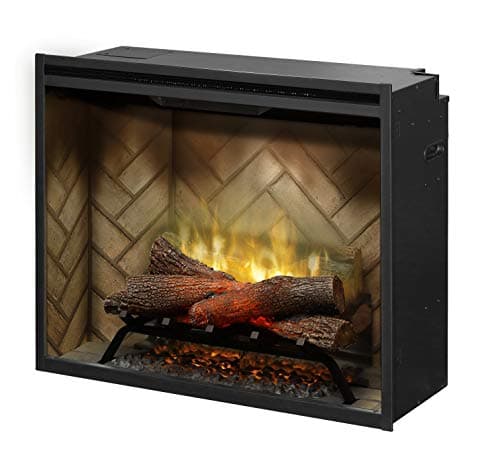 Dimplex Revillusion RBF30 30" Built-In FireboxThe most convincing flame on this site, in a firebox that demands a construction project and a careful read of the voltage table. | A purpose-built enclosure where the flame is the point | 27.5¢1,500 W · 5,118 BTU | |
| 2 | 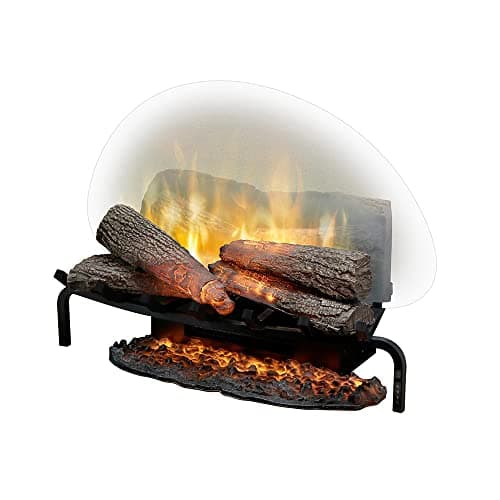 Dimplex Revillusion RLG25 25" Plug-In Log SetA plug-in log set with the same fan-forced approach and no building work at all. The sensible alternative for an existing firebox. | The same flame family, plugged in, for much less | 27.5¢1,500 W · 5,118 BTU | |
| 3 | 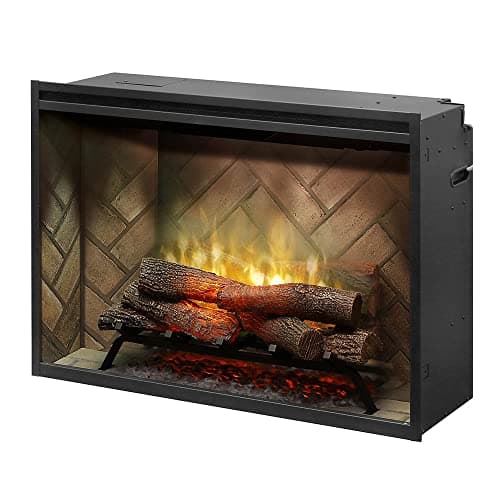 Dimplex Revillusion RBF36 36" Built-In FireboxThe larger sibling, with the same excellent flame and a more severe version of the voltage problem. | Six more inches, and a worse deal on 120 V | 25.2¢1,375 W · 4,692 BTU | |
| 4 | 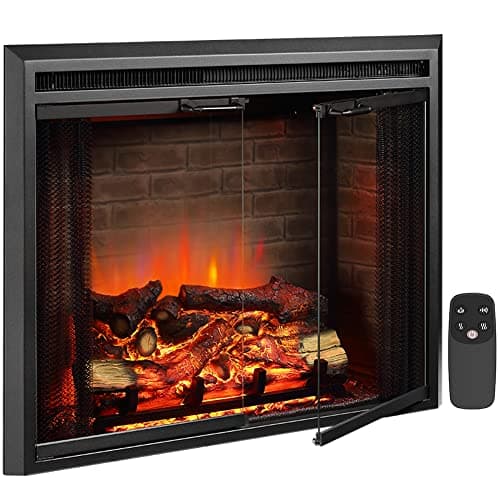 PuraFlame Klaus 33" Electric Fireplace InsertNot in the same class on flame, and it does not need an enclosure, a permit or an electrician. For many people that is the better trade. | A traditional opening, at a fraction of the cost | 27.5¢1,500 W · 5,118 BTU |
#ad Buy links are affiliate links — we earn a commission on Amazon purchases at no extra cost to you, and it never changes the ranking. How this site is funded. Running cost is computed at 18.34¢/kWh; see what these actually cost to run.
The voltage table, which is the whole story on heat
Dimplex quotes the RBF30 at up to 8,794 BTU per hour, and that figure has done a great deal of work in other people's roundups. It is real, and it is conditional on a supply most American homes do not have at the fireplace.
| Supply | What it means in practice | Output |
|---|---|---|
| 120 V | An ordinary household circuit. No electrician. | The standard class ceiling |
| Higher voltage, hardwired | Dedicated circuit, licensed electrician, usually a permit | Up to 8,794 BTU/hr |
The practical consequence is worth stating bluntly, because it inverts what the price tag suggests. Wired to a normal socket, this expensive firebox does not out-heat the far cheaper RLG25 log set from the same manufacturer. If more warmth is what you are buying, the honest path is a 240 V circuit and an electrician, and that cost is not in the price of the fireplace. Plug-in vs hardwired covers the decision in full.
| Usage | Hours | Heat on (1,500 W) | Flame only (~100 W) |
|---|---|---|---|
| One evening | 4 | $1.10 | $0.07 |
| A week of evenings | 28 | $7.70 | $0.51 |
| A month, 4 hrs a night | 120 | $33.01 | $2.20 |
| A 90-day winter, 4 hrs a night | 360 | $99.04 | $6.60 |
| Per hour | 1 | 27.5¢ | 1.8¢ |
The depth problem
Twelve and an eighth inches is the number that disqualifies this unit for most people, and it is easy to miss because the rest of the category has trained buyers to think in stud bays.
- A 2x4 wall gives about 3 1/2 inches of cavity. Not close.
- A 2x6 wall gives about 5 1/2 inches. Still not close.
- The RBF30 needs 12 1/8 inches, which means a purpose-built enclosure, an existing masonry chimney, or a framed chase projecting into the room.
That enclosure is a real project with a real cost that does not appear on any product page. If you are already building a feature wall, it is absorbed into work you were doing anyway and the RBF30 is a sensible thing to put in it. If you are not, add the construction to the price before you compare it with anything else. Depth and clearance explains why this number catches so many people out.
Who should buy it
- You are building or renovating anyway, and the enclosure is part of work already planned.
- The flame is the point. You have looked at cheaper units off-axis and been disappointed, and you know why.
- You are running a higher-voltage circuit, or an electrician is already on site.
- The fireplace is the focal point of the room, at eye level, looked at directly and often.
Who should not
- You have an existing masonry firebox. Buy the RLG25 — same family, plug-in, more heat on a normal circuit, no building work.
- You want it in a stud wall. It does not fit, and nothing makes it fit.
- You are buying for warmth on a 120 V circuit. You will get less heat than from a unit costing a fraction as much.
- You are renting. See apartments and rentals instead.
Questions people actually ask
Is the Dimplex Revillusion RBF30 worth the money?
For flame quality in a purpose-built enclosure, yes — the mirror-free viewing area is genuinely better than anything at a lower price and it holds up off-axis. For heat on an ordinary 120 V circuit, no. A plug-in log set costing far less produces more.
How deep is the Revillusion RBF30?
12 1/8 inches, with published dimensions of 31 1/8 wide by 26 5/8 high and a weight of 50 pounds. That depth rules out both 2x4 and 2x6 stud walls — it requires a purpose-built enclosure.
Does the RBF30 really produce 8,794 BTU?
Only on a higher-voltage hardwired supply, which requires a dedicated circuit, a licensed electrician and usually a permit. On a standard 120 V household circuit it produces the same class ceiling as the rest of the category.
What is the difference between the RBF30 and the RLG25?
The RBF30 is a built-in firebox needing a constructed enclosure; the RLG25 is a plug-in log set that drops into an existing masonry opening. Both are fan-forced with the same flame lineage, and on an ordinary 120 V circuit the much cheaper RLG25 produces more heat.
Have you tested the Revillusion RBF30?
No. We have not tested any unit on this site and we do not claim to. This review is a close reading of the published specifications, the owner's manual and the family installation guide, which is why there is no rating on the page.
Sources
Every figure on this page is either taken from one of these documents or computed from a formula shown on the page. Nothing here is recalled from memory.
- Dimplex Revillusion RBF30 owner's manual — built-in firebox installation and ratings
- Dimplex Revillusion family installation and user guide (Glen Dimplex Americas)
- Dimplex Revillusion RBF36 listing — 1375/1975/2575 W at 120/208/240 V, 4435/6739/8786 BTU
- Dimplex Revillusion RLG25 log set — 25.625 x 19 x 13 in, 1,500 W, 120 V, 12.5 A, 5,118 BTU
- PuraFlame Klaus 33 in insert — 750/1500 W, dimensions
- NFPA — National Electrical Code (NFPA 70), the standard behind US branch-circuit limits
- EIA Electric Power Monthly, Table 5.3 — US residential average, June 2026
Read next
- Electric fireplace inserts with a blower
Which inserts genuinely have a blower, sourced from the manufacturer rather than assumed — plus the 8-second quirk every fan-forced unit shares.
- 30-inch electric fireplace inserts
Why a 30-inch insert needs more than a 30-inch opening, and the four units worth considering in the 24 to 33-inch range.
- The most realistic electric fireplaces
Ranked by flame mechanism, not adjectives. Water vapor, layered LED and three-sided glass, with the trade-offs stated.
- Plug-in vs hardwired electric fireplaces
What hardwiring actually buys you, which units support both, and why one popular firebox produces less heat than a plug-in unit on a normal circuit.
- Depth and clearance
3.5 inches of cavity in a standard wall, and what fits it. Plus the clearances that actually matter.