Comparison · flame technology
LED vs LCD vs water vapor
Three mechanisms, three price tiers, three completely different failure modes. Choosing between them is easier than it looks once you know what each one physically is.
By Scooter M.Published September 2, 2026Last reviewed September 2, 2026
Disclosure: the buy links below are affiliate links. We earn a commission on Amazon purchases at no extra cost to you. It has never changed a ranking on this site, and every roundup here names a unit we think you should skip. How this site is funded.
One paragraph each
LED produces a lit surface: cheap, effective in a dim room, flattens in daylight and off-axis. LCD plays a video of a real fire: the best head-on still realism on mains power, behaves like a screen from an angle, and loops. Water vapor lights actual mist: the only flame with real volume, works from any angle, and produces no heat while needing a water refill.
| LED | LCD screen | Water vapor | |
|---|---|---|---|
| The flame is | Lit surfaces and layers | Recorded video of real fire | Illuminated water mist |
| Dimensionality | Two-dimensional with parallax | Two-dimensional | Genuinely three-dimensional |
| Head-on at night | Good to very good | Excellent | Excellent |
| Off-axis | Poor to fair | Poor — it is a panel | Excellent |
| Daylight | Poor | Fair | Good |
| Repeats? | A fixed flame rhythm | A finite video loop | Never — mist is chaotic |
| Heat | Usually 1,500 W | Usually 1,500 W | None from the flame effect |
| Maintenance | None | None | Refill the reservoir |
| Price tier | Entry to mid | Upper-mid to high | High |
The failure mode is what should decide it
Every one of these looks good in the conditions its marketing photography was shot in. What separates them in a real house is where each one breaks, and each breaks somewhere different.
- LED breaks in ambient light. A sunny afternoon defeats it. If the room is bright and used in daylight, LED is fighting a battle it cannot win.
- LCD breaks off-axis and on repetition. Fine if there is one sofa and everyone sits on it. Poor in a room people move through.
- Water vapor breaks on practicality. It needs water, it needs cleaning, and it does not heat. Nothing about the flame breaks.
Quick picks
Ranked. The running cost column is computed from each unit's rated wattage, not quoted from a manufacturer. Tap a row for the full write-up.
| # | Product | Best for | Cost per hour | Price |
|---|---|---|---|---|
| 1 | Dimplex Opti-Myst Revive 25" Water Vapor Fireplace120 V, 1,250 W, ultrasonic mist lit by LEDs. Real volume, no heat from the flame, and a reservoir to fill. | Water vapor | No heaterflame effect only | |
| 2 | 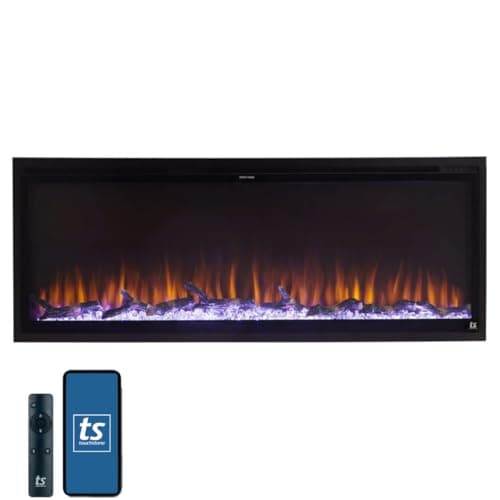 Touchstone Sideline Elite 50Frameless glass at 50 inches. The best LED presentation in this catalog, at a fraction of water-vapor money. | Layered LED, done well | 27.5¢1,500 W · 5,118 BTU | |
| 3 | 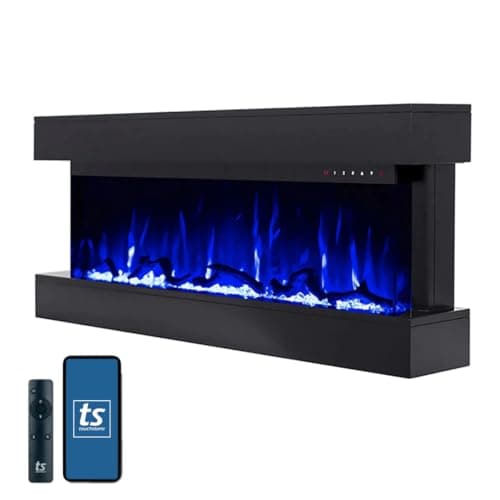 Touchstone Chesmont Black 50 (3-Sided)Three-sided glass, which is the structural answer to the one situation layered LED reliably fails in. | Layered LED that survives off-axis | 27.5¢1,500 W · 5,118 BTU | |
| — | 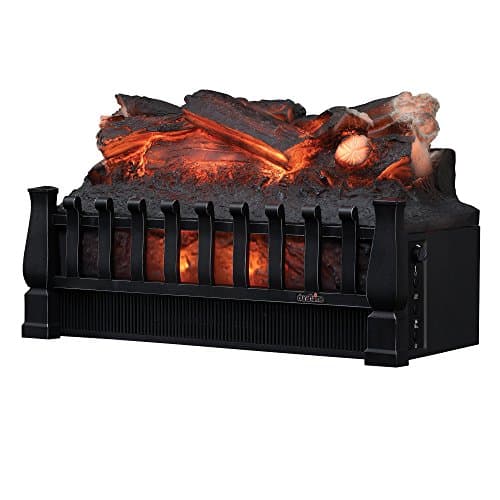 Duraflame DFI021ARU 20" Electric Fireplace Log SetThe oldest mechanism in the category. Fine at night in a firebox, and it will not stand up to this page's comparison.Skip this one | LED with a reflector, honestly priced | 27.5¢1,500 W · 5,118 BTU |
#ad Buy links are affiliate links — we earn a commission on Amazon purchases at no extra cost to you, and it never changes the ranking. How this site is funded. Running cost is computed at 18.34¢/kWh; see what these actually cost to run.
The honest recommendation
For most people, in most rooms: layered LED, chosen for its housing and its glass geometry rather than its electronics. The step up to LCD buys head-on realism you will notice from one seat. The step up to water vapor buys a genuinely different object, and costs you the heater.
Where we would spend differently is a bright, open room seen from many angles. That is the case where LED genuinely underperforms, and it is worth either paying for mist or accepting that the fireplace will be a piece of furniture during the day and a fire at night.
| Usage | Hours | Heat on (1,500 W) | Flame only (~100 W) |
|---|---|---|---|
| One evening | 4 | $1.10 | $0.07 |
| A week of evenings | 28 | $7.70 | $0.51 |
| A month, 4 hrs a night | 120 | $33.01 | $2.20 |
| A 90-day winter, 4 hrs a night | 360 | $99.04 | $6.60 |
| Per hour | 1 | 27.5¢ | 1.8¢ |
#1 · Water vapor
Dimplex Opti-Myst Revive 25" Water Vapor Fireplace
120 V, 1,250 W, ultrasonic mist lit by LEDs. Real volume, no heat from the flame, and a reservoir to fill.
The mainstream water-vapor implementation. Dimplex publishes 120 V and 1,250 W for the Revive 25, hardwired or on a compatible power cord, at 25 inches wide.
The flame is mist, which means it moves like a fluid and occupies space. It is also cool to the touch and produces no heat, so it is the only unit in this catalog you could genuinely describe as a light fitting.
Several times the price of a good LED unit, and it needs water. Both are the cost of being the only technology that works in three dimensions.
What it does not do: No heat from the flame effect at all, and it needs a water reservoir refilled. If you want warmth, this is the wrong product and no amount of enthusiasm changes that.
Published specs
- Electrical:
- 120 V, 1,250 W
- Width:
- 25 in
- Flame:
- Ultrasonic water mist from ordinary tap water, lit by LEDs
- Heat:
- The flame effect produces NO heat. Heaters are a separate option on some models
- Install:
- Hardwired, or a compatible 120 V power cord
What it costs to run
No heater. The flame effect alone draws far less than a heating unit — see what these cost to run.
Computed at 18.34¢/kWh (EIA, June 2026). Your rate will differ — work out your own.
#ad Dimplex is not a program we have joined, so we earn nothing here. How this is funded. Price as of October 17, 2026.
Specs from: Dimplex Optimyst water vapor fireplaces — how the mist flame works; Dimplex Opti-Myst Revive 25 in — 120 V, 1,250 W.
#2 · Layered LED, done well
Touchstone Sideline Elite 50
Frameless glass at 50 inches. The best LED presentation in this catalog, at a fraction of water-vapor money.
Layered LED is what most people should buy, and the variables that separate a good implementation from a poor one are depth, ember bed and framing. Removing the bezel addresses the third directly.
Same 1,500 W heater as the cheaper Sideline 50, which is the honest framing: the money buys the flame presentation.
In an evening room at normal viewing distance this is convincing. In daylight it is an LED unit, like every other LED unit.
What it does not do: The heater is the same 1,500 W ceiling as the cheaper Sideline 50. The extra money buys the glass front and the flame presentation, not warmth.
Published specs
- Width:
- 50 in
- Form:
- Recessed, frameless glass front
- Position in line:
- Above The Sideline 50, below the Elite Pro
What it costs to run
- 27.5¢/hr on full heat
- $99.04 across a 90-day winter at 4 hrs a night
- 5,118 BTU/hr · 12.5 A on a 120 V circuit
Computed at 18.34¢/kWh (EIA, June 2026). Your rate will differ — work out your own.
#ad We earn a commission on this link at no cost to you. How this is funded. Price as of October 17, 2026.
Specs from: Touchstone electric fireplaces collection — Sideline Elite 50.
#3 · Layered LED that survives off-axis
Touchstone Chesmont Black 50 (3-Sided)
Three-sided glass, which is the structural answer to the one situation layered LED reliably fails in.
LED units flatten from an angle because the flame is a lit surface. Give the viewer depth to look into from the side and the failure mode largely disappears.
That makes this the LED option to choose when the fireplace will be seen from the side — a corner, a peninsula, a room people walk through rather than sit in front of.
It needs a corner or a peninsula to be worth it. Flat against a wall, two of its three panes are decorative.
What it does not do: Three-sided glass needs a corner or a peninsula wall to make sense. Against a flat wall you pay for two panes nobody ever sees.
Published specs
- Width:
- 50 in
- Form:
- Three-sided wall-mount — glass on the front and both ends
- Why it matters:
- Three-sided glass is the cheapest fix for the off-axis flatness that gives LED units away
What it costs to run
- 27.5¢/hr on full heat
- $99.04 across a 90-day winter at 4 hrs a night
- 5,118 BTU/hr · 12.5 A on a 120 V circuit
Computed at 18.34¢/kWh (EIA, June 2026). Your rate will differ — work out your own.
#ad We earn a commission on this link at no cost to you. How this is funded. Price as of October 17, 2026.
Specs from: Touchstone electric fireplaces collection — Chesmont Black 50.
Skip this one
Duraflame DFI021ARU 20" Electric Fireplace Log Set
The oldest mechanism in the category. Fine at night in a firebox, and it will not stand up to this page's comparison.
We are flagging this on a technology-comparison page rather than criticizing the product. It is a good, cheap log set rated for 400 square feet of supplemental heat, and in a dim room inside a real masonry opening it does its job.
But it is the reflector generation of LED flame: a lit surface with no layered depth and no glass geometry. In daylight and from an angle it flattens, and there is nothing in the design to prevent that.
If you are choosing on flame technology, buy up a tier. If you are filling a firebox on a budget and use the room at night, it is genuinely fine — see inserts for an existing fireplace.
What it does not do: No enclosure, no glass, no trim. It sits inside the masonry opening you already have, so the old firebox is still visible around it.
Published specs
- Heater:
- Rated by the manufacturer for spaces up to 400 sq ft
- Width:
- 20 in
- Form:
- Drop-in log set — sits inside an existing firebox, no framing
- Flame:
- LED with resin cast logs and a glowing ember bed
- Control:
- Remote with independent flame and heat settings
What it costs to run
- 27.5¢/hr on full heat
- $99.04 across a 90-day winter at 4 hrs a night
- 5,118 BTU/hr · 12.5 A on a 120 V circuit
Computed at 18.34¢/kWh (EIA, June 2026). Your rate will differ — work out your own.
#ad We earn a commission on this link at no cost to you. How this is funded. Price as of October 17, 2026.
Specs from: Duraflame DFI021ARU listing — 400 sq ft rating; Mantels Direct product page — 20 in log set.
Questions people actually ask
Is LED or LCD better for an electric fireplace?
LCD is more realistic head-on, because the flame is recorded footage of a real fire. LED is better off-axis and much cheaper. If everyone sits in one place facing the fireplace, LCD wins; if people move around, the difference narrows considerably.
How does a water vapor fireplace work?
Ultrasonic transducers turn ordinary tap water into a fine cool mist, which rises through the firebox and is lit from below by LEDs. Because the mist is a real physical medium, the flame has actual volume and moves like smoke.
Do water vapor fireplaces need plumbing?
No — they use a reservoir you fill with ordinary tap water. Some larger installations offer plumbed options, but the standard product is filled by hand.
Is a water vapor fireplace safe around children?
The flame effect is cool to the touch and produces no combustion, smoke or emissions, which is unusual in this category. If a model has a separate heater fitted, the usual heater precautions apply to that part.
Sources
Every figure on this page is either taken from one of these documents or computed from a formula shown on the page. Nothing here is recalled from memory.
- Dimplex Optimyst water vapor fireplaces — ultrasonic mist and LED mechanism
- Dimplex Opti-Myst Revive 25 in — 120 V, 1,250 W
- Touchstone Home Products — electric fireplace range and sizes
- Duraflame DFI030ARU — infrared quartz log set, 1,000 sq ft rating
- Wikipedia — Electric fireplace (mechanism and history)
Read next
- Flame technology explained
The four flame mechanisms, how each physically works, and the exact conditions where each one gives itself away.
- Water vapor fireplaces
How ultrasonic mist flame works, why it beats every LED unit on realism, and the two things it cannot do at all.
- What makes a flame look fake
Six tells with physical causes — and the three you can fix in a minute with the remote.
- Do electric fireplaces look cheap?
Yes, in predictable conditions. What causes it, which rooms make it worse, and what genuinely fixes it.