Guide · the measurement that decides
Depth and clearance
A standard interior wall gives you about three and a half inches. Everything about a recessed install follows from that number.
By Scooter M.Published September 2, 2026Last reviewed September 2, 2026
Disclosure: the buy links below are affiliate links. We earn a commission on Amazon purchases at no extra cost to you. It has never changed a ranking on this site, and every roundup here names a unit we think you should skip. How this site is funded.
The number
A standard US interior wall framed with 2x4 studs gives about 3.5 inches of usable cavity depth, because a nominal 2x4 actually measures 1.5 by 3.5 inches. Every recessed fireplace install lives or dies by whether the unit is thinner than that.
| Wall type | Actual cavity depth | What fits flush |
|---|---|---|
| 2x4 interior wall | ~3.5 in | Units under about 3.5 in. Under 4 in with a slight reveal |
| 2x6 wall | ~5.5 in | Almost anything in the category |
| 2x4 with furring strips | 3.5 in + furring thickness | Built out to whatever you need |
| Masonry or exterior wall | Varies, and complicated | Ask a builder before cutting |
Why manufacturers publish depths under 4 inches
Because they know about the 3.5-inch number. R.W.FLAME publishing 3.86 inches across an entire range is not a coincidence; it is a product decision made specifically so the unit drops into the wall most American homes already have. When a manufacturer publishes a depth figure that precise, that is what it is for.
Not every manufacturer targets it, and the gap widens as units get longer. Compare the published depths at 60 inches: 3.85 inches on the R.W.FLAME, 4.6 on the TURBRO, and 5 1/2 on both Touchstone Sidelines. Only the first fits a stud bay — at that width, depth stops being a footnote and becomes the thing that decides which unit you can actually buy.
The 0.36-inch difference between 3.86 and 3.5 becomes a slight proud edge — the unit stands a third of an inch off the finished wall face. From a normal viewing distance it is invisible. From directly alongside it, you can see it if you are looking.
Clearances that actually matter
Combustible clearance is not the concern it is with a fuel-burning appliance, because nothing burns. What matters is airflow and what sits above the unit.
- Above the unit. Manufacturers specify a minimum clearance to a mantel or shelf, and it varies by model. Follow the manual, not a general rule.
- At the heat outlet. Whatever the manual says, and keep it genuinely clear. A blocked outlet is how overheat cutouts get exercised.
- Inside the cavity. Some units want air behind them. A tightly sealed recess with no gap is not always what the manufacturer intends.
- In front. Nothing structural, but a rug edge or a basket in the airflow takes away most of the benefit you are paying for.
- Around a television above it. Check the manufacturer's stated minimum. Heat rises even when the outlet points forward.
Quick picks
Ranked. The running cost column is computed from each unit's rated wattage, not quoted from a manufacturer. Tap a row for the full write-up.
| # | Product | Best for | Cost per hour | Price |
|---|---|---|---|---|
| 1 | 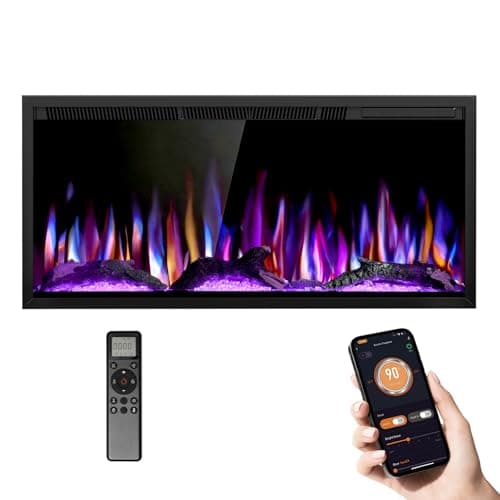 R.W.FLAME 36" Ultra-Thin Recessed & Wall-Mount Fireplace3.86 inches deep, published across the whole range. The unit most likely to fit the wall you already have. | A standard 2x4 wall | 27.5¢1,500 W · 5,118 BTU | |
| 2 | 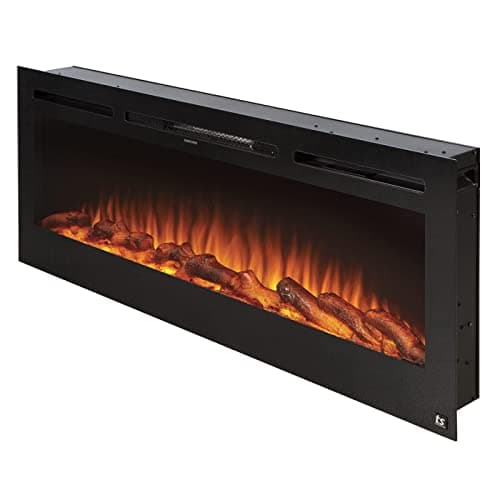 Touchstone The Sideline 50If you are building the cavity rather than working with an existing wall, depth stops being the constraint and housing quality starts mattering. | A recess you are framing anyway | 27.5¢1,500 W · 5,118 BTU |
#ad Buy links are affiliate links — we earn a commission on Amazon purchases at no extra cost to you, and it never changes the ranking. How this site is funded. Running cost is computed at 18.34¢/kWh; see what these actually cost to run.
What is inside the wall
Before cutting, know what the cavity contains. Electrical cable, plumbing, ductwork and fire blocking all live in wall cavities, and none of them announce themselves through drywall. Cut a small inspection hole and look with a flashlight before committing to a 50-inch opening.
Exterior walls are a different problem again: insulation, a possible vapor barrier, and a thermal performance you are about to reduce. That is a conversation with a builder, not something to work out from a product page.
#1 · A standard 2x4 wall
R.W.FLAME 36" Ultra-Thin Recessed & Wall-Mount Fireplace
3.86 inches deep, published across the whole range. The unit most likely to fit the wall you already have.
A 2x4 stud is nominally 3.5 inches deep. At 3.86 inches this sits nearly flush with a slight proud edge, which most people cannot see from more than a few feet away and which needs no furring, no false wall and no chase.
The same 3.86-inch figure holds across 30, 36, 42, 50, 60 and 68 inches, so the depth planning does not change with width.
750 W low, 1,500 W high, 120 V, 5,100 BTU per hour per the manufacturer.
What it does not do: No mantel, no surround and no trim for a masonry opening. Recessing it means cutting drywall and, in most homes, running a receptacle inside the cavity.
Published specs
- Heater:
- 750 W low / 1,500 W high
- Electrical:
- 120 V
- Heat output:
- 5,100 BTU/hr (manufacturer figure)
- Depth:
- 3.86 in — thin enough for a 2x4 stud bay
- Coverage:
- Rated by the manufacturer for up to 400 sq ft
- Flame:
- 12 flame colors, 12 ember-bed colors, 5 brightness levels, 5 speeds
- Sizes in the line:
- 30, 36, 42, 50, 60 and 68 in
What it costs to run
- 27.5¢/hr on full heat
- $99.04 across a 90-day winter at 4 hrs a night
- 5,118 BTU/hr · 12.5 A on a 120 V circuit
Computed at 18.34¢/kWh (EIA, June 2026). Your rate will differ — work out your own.
#ad We earn a commission on this link at no cost to you. How this is funded. Price as of October 17, 2026.
Specs from: R.W.FLAME recessed/wall-mount product page — full specifications.
#2 · A recess you are framing anyway
Touchstone The Sideline 50
If you are building the cavity rather than working with an existing wall, depth stops being the constraint and housing quality starts mattering.
When you are framing a false wall or a chase specifically for the fireplace, you can make the cavity whatever depth you like. At that point the thinness advantage disappears and you should choose on the housing and the flame instead.
The Sideline 50 is the reference linear unit in this category from a brand whose whole catalog is fireplaces.
Same 1,500 W ceiling, about 5,118 BTU per hour, 27.5 cents an hour.
What it does not do: At 5 1/2 in deep it does not sit flush in a standard 2x4 stud bay. Recessing needs a framed cavity; surface-mounting it works but leaves the unit standing proud of the wall, which reads very differently in a small room.
Published specs
- Dimensions:
- 50 3/8 in W x 21 1/2 in H x 5 1/2 in D
- Weight:
- 59 lb
- Heater:
- Coil wire heater with blower, 1,500 W — about 5,000 BTU/hr
- Electrical:
- 120 V — plug in or hardwire
- Form:
- Recessed or wall-mounted linear unit
- Line:
- The volume seller of the Sideline range (model 80004)
What it costs to run
- 27.5¢/hr on full heat
- $99.04 across a 90-day winter at 4 hrs a night
- 5,118 BTU/hr · 12.5 A on a 120 V circuit
Computed at 18.34¢/kWh (EIA, June 2026). Your rate will differ — work out your own.
#ad We earn a commission on this link at no cost to you. How this is funded. Price as of October 17, 2026.
Specs from: Touchstone Sideline 50 (80004) product page — 50 3/8 x 21 1/2 x 5 1/2 in, 59 lb, coil wire heater with blower.
Questions people actually ask
How deep does a wall need to be for a recessed electric fireplace?
About 3.5 inches, which is what a standard 2x4 stud wall provides. Units published under about 4 inches sit nearly flush in that with a small proud edge. Anything deeper needs furring strips, a 2x6 wall, or a built-out chase.
How thin can an electric fireplace be?
The thinnest mainstream recessed units publish figures under 4 inches — R.W.FLAME lists 3.86 across its whole range. That is a deliberate design target aimed at the 3.5-inch cavity in a standard wall.
What clearance does an electric fireplace need above it?
It is model-specific and the manufacturer publishes it. There is no combustion, so the concern is heat rising toward a mantel or television rather than ignition — but the figure still comes from the manual for your unit, not from a general rule.
Can I recess into a wall with wiring in it?
Not without moving the wiring, which is an electrician's job. Cut an inspection hole and look inside the cavity before you commit to the full opening — this is a ten-minute check that prevents a very bad afternoon.
Sources
Every figure on this page is either taken from one of these documents or computed from a formula shown on the page. Nothing here is recalled from memory.
Read next
- How to mount or recess an electric fireplace
Hanging one takes an afternoon. Recessing takes a weekend and an electrician. Both procedures, step by step.
- The best recessed electric fireplaces
Ranked by published depth against a real 3.5-inch cavity, with the built-in fireboxes that need a purpose-built enclosure instead.
- 60-inch electric fireplace inserts
Four 60-inch units ranked by recess depth, the one spec that actually differs at this width - plus the 65-inch model that keeps appearing in 60-inch results.
- 36-inch electric fireplace inserts
What fits a 36-inch opening, why nominal width is not actual width, and the units worth shortlisting.
- 72-inch electric fireplaces
Four 72-inch units from about $280 to $2,279, compared on depth, weight and rough opening — the specifications that decide a six-foot install.
- 42-inch electric fireplaces
Why 42 inches is dominated by unbranded ultra-thins, the one unit that publishes a full specification, and the branded alternatives either side of the size.