Comparison · updated for the 2026 heating season
Touchstone Sideline vs Sideline Elite
Same brand, same width, same 1,500 W heater, roughly double the price. This is a question about the front of the unit and the hole you are cutting for it, not about warmth.
By Scooter M.Published September 13, 2026Last reviewed September 13, 2026
Disclosure: the buy links below are affiliate links. We earn a commission on Amazon purchases at no extra cost to you. It has never changed a ranking on this site, and every roundup here names a unit we think you should skip. How this site is funded.
The short answer
The Elite does not heat better. It looks better, and only from directly in front. Both ranges are capped at 1,500 W by a 120 V circuit, so the heat, the running cost and the room they will warm are identical. What roughly doubling the price buys is a frameless glass front, a larger proportion of the width given over to flame, and on the 60-inch unit a timer and a tighter thermostat. If the fireplace sits at eye level in a finished wall, that is worth real money. If it does not, it is not.
The specifications, side by side
| Sideline 50 | Elite 50 | Sideline 60 | Elite 60 | |
|---|---|---|---|---|
| Width | 50 in | 50 in | 60 in | 59 3/4 in |
| Height | Not published | Not published | 21 1/2 in | 19 1/4 in |
| Depth | 5 1/2 in | 5 1/2 in | 5 1/2 in | 5 1/2 in |
| Heater | 1,500 W coil with blower | 1,500 W | 750 / 1,500 W | 750 / 1,500 W |
| Quoted output | about 5,000 BTU/hr | Same class ceiling | 5,000 BTU/hr | 5,118 BTU/hr |
| Front | Black bezel around glass | Frameless glass | Black bezel around glass | Frameless glass |
| Viewing area | Not published | Not published | Not published | 56 x 14 3/8 in |
| Timer | — | — | — | 8-hour |
| Thermostat | Yes | Yes | Yes | 68-88 °F |
| Wiring | Plug or hardwire | Plug or hardwire | Plug or hardwire | Plug or hardwire |
The four units, compared
Ranked. The running cost column is computed from each unit's rated wattage, not quoted from a manufacturer. Tap a row for the full write-up.
| # | Product | Best for | Cost per hour | Price |
|---|---|---|---|---|
| 1 | 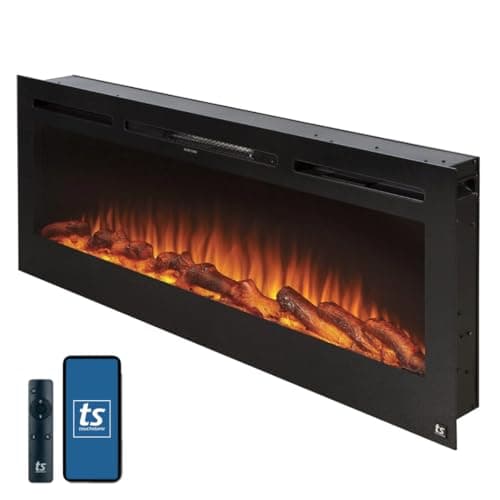 Touchstone The Sideline 50The volume seller of the range, and the unit the Elite has to justify itself against. Documented, flexible and considerably cheaper. | The one most people should buy | 27.5¢1,500 W · 5,118 BTU | |
| 2 | 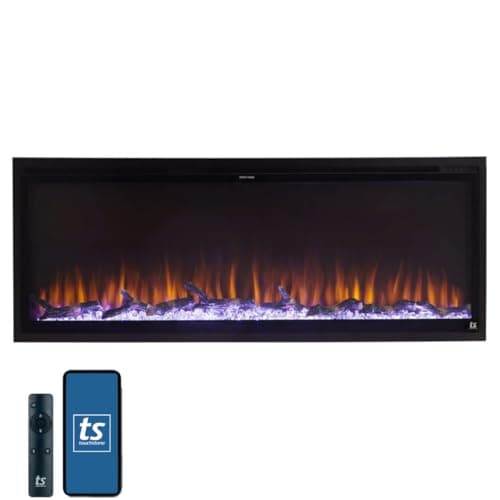 Touchstone Sideline Elite 50A frameless glass front and a larger apparent viewing area, for roughly double the money and exactly the same heat. | A finished wall at eye level | 27.5¢1,500 W · 5,118 BTU | |
| 3 | 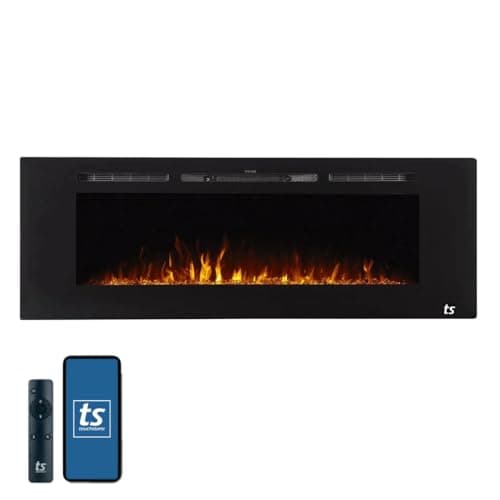 Touchstone The Sideline 60 (80011)Two-stage heat, a thermostat, WiFi and the full 60 inches, at a fraction of the Elite 60's price. | The value pick at the larger width | 27.5¢1,500 W · 5,118 BTU | |
| 4 | 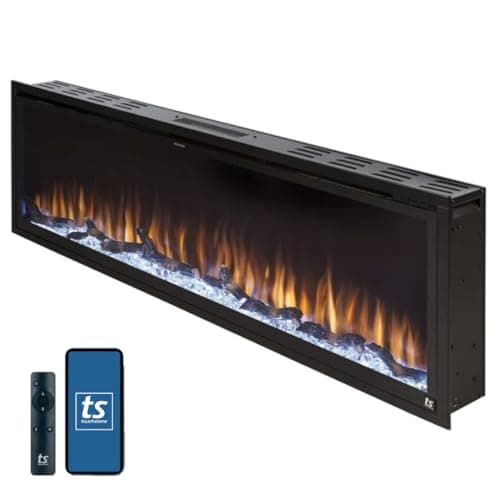 Touchstone Sideline Elite 60 (80037)A 56-inch viewing area in a 59 3/4-inch unit, plus a timer and a tighter thermostat. The best-specified unit here and the most expensive. | The most flame per inch of wall | 27.5¢1,500 W · 5,118 BTU | |
| 5 | 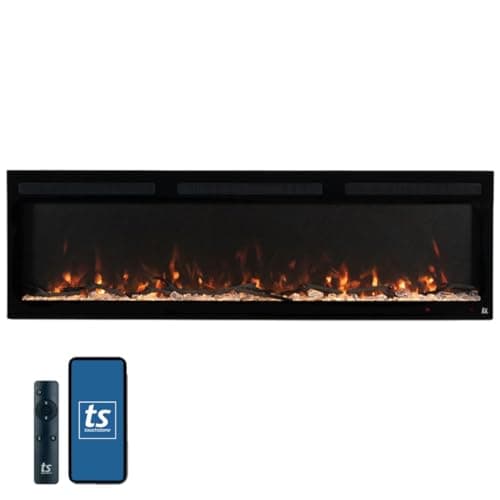 Touchstone Sideline Fury 65 (80056)Five inches wider than a 60, in slim-depth form. Worth knowing about before you cut, and useless afterwards. | If you are about to frame for a 60 and have the wall for more | 27.5¢1,500 W · 5,118 BTU |
#ad Buy links are affiliate links — we earn a commission on Amazon purchases at no extra cost to you, and it never changes the ranking. How this site is funded. Running cost is computed at 18.34¢/kWh; see what these actually cost to run.
The two BTU numbers are the same number
Touchstone quotes about 5,000 BTU per hour for the standard Sideline and 5,118 for the Elite 60, and it would be easy to read that as the Elite being marginally warmer. It is not. Watts convert to BTU at a fixed rate of 3.412142, so 1,500 W is 5,118 BTU per hour exactly. One figure is rounded down for marketing and the other is not.
| Usage | Hours | Heat on (1,500 W) | Flame only (~100 W) |
|---|---|---|---|
| One evening | 4 | $1.10 | $0.07 |
| A week of evenings | 28 | $7.70 | $0.51 |
| A month, 4 hrs a night | 120 | $33.01 | $2.20 |
| A 90-day winter, 4 hrs a night | 360 | $99.04 | $6.60 |
| Per hour | 1 | 27.5¢ | 1.8¢ |
Both ranges are also rated by Touchstone for about 400 square feet of supplemental heat. If you are choosing between these two on the basis of which will warm a room better, the honest answer is that the choice does not exist. Use BTU and room size to work out whether either will do what you need.
When the frameless front is worth it
- Recessed into a finished wall at seated eye level. This is the case the Elite is built for, and where the bezel on the standard unit is genuinely conspicuous.
- A dark or plastered wall with no surround. With nothing else framing the fireplace, the unit's own frame becomes the visual edge, and a frameless front reads as an opening rather than a product.
- A large room where the fireplace is the focal point. If people look at it directly and often, the detail earns its money.
When it is not
- Under a television. Nobody looks at the fireplace bezel when there is a screen above it, and the front vents matter more than the frame.
- Above a mantel or inside a surround. A surround already provides the visual frame, which is exactly what you would be paying to remove.
- Anywhere below about knee height. The frameless effect depends on looking at the unit straight on.
- If the budget could instead buy width. Going from 50 to 60 inches on the standard range changes the room more than going frameless at 50 does, and usually costs less.
The mistake that actually costs money
Not the choice between these two. The framing. All four units are 5 1/2 inches deep, which is deeper than a standard 2x4 stud bay, so every one of them needs furring, 2x6 framing or a built-out chase. And the Elite 60 is two and a quarter inches shorter than the standard Sideline 60, which means an opening framed for one will not correctly suit the other.
Decide the model before you cut, not after. Our guide to mounting and recessing covers the rough opening, and depth and clearance covers why 5 1/2 inches is the number that catches people out.
Questions people actually ask
Is the Touchstone Sideline Elite worth the extra money?
Only if the fireplace is recessed into a finished wall at eye level, where the frameless glass front is genuinely visible. The heater, the output and the running cost are identical to the standard Sideline, so there is no performance argument for it.
What is the difference between the Sideline and the Sideline Elite?
The front of the unit. The standard Sideline has a black bezel around the glass; the Elite is frameless, giving a larger proportion of flame across the width. The Elite 60 additionally has an 8-hour timer, a thermostat adjustable from 68 to 88 °F and more flame and media-bed colors.
Does the Sideline Elite produce more heat?
No. Both are 1,500 W on a 120 V circuit, which is about 5,118 BTU per hour. Touchstone quotes roughly 5,000 BTU for the standard range and 5,118 for the Elite 60, but that is the same wattage reported with different rounding.
Are the Sideline and Sideline Elite the same size?
Not exactly. The Elite 60 is 59 3/4 inches wide and 19 1/4 inches tall, against 60 by 21 1/2 for the standard Sideline 60. Both are 5 1/2 inches deep. The height difference matters if you are framing an opening.
Can both be hardwired?
Yes. Every unit in this comparison can be plugged into a 120 V receptacle or hardwired. Hardwiring does not change the heat output — see plug-in vs hardwired.
Sources
Every figure on this page is either taken from one of these documents or computed from a formula shown on the page. Nothing here is recalled from memory.
- Touchstone Sideline 50 (80004) product page — 1-year warranty, 2-year extension available
- Touchstone Sideline 60 (80011) product page — 60 x 21.5 x 5.5 in, 5,000 BTU, 400 sq ft
- Touchstone Sideline Elite 60 (80037) product page — 59.75 x 19.25 x 5.5 in, 5,118 BTU, 750/1500 W
- Touchstone Sideline Series owner's manual — covers 80004/80011/80014/80015/80025, max 1,500 W at 12 A, heater fan runs 8-10 s before and after the element
- Touchstone Home Products — electric fireplace range and sizes
- EIA Electric Power Monthly, Table 5.3 — US residential average, June 2026
Read next
- Dimplex vs Touchstone
They compete in one place: 50-inch linear wall units. Depth, the 240V heat path and warranty decide it — with sourced numbers for each.
- Depth and clearance
3.5 inches of cavity in a standard wall, and what fits it. Plus the clearances that actually matter.
- Plug-in vs hardwired electric fireplaces
What hardwiring actually buys you, which units support both, and why one popular firebox produces less heat than a plug-in unit on a normal circuit.
- The best wall-mount electric fireplaces
Linear wall units ranked on recess depth, real wattage and running cost — including the one that is 100 W short.
- 50-inch electric fireplace inserts
What fits at 50 inches, why wider does not mean warmer, and the units worth shortlisting.