Sized roundup · 50 inches
50-inch electric fireplace inserts
The size where a fireplace stops being a feature and starts being the wall. Also the size where people most often assume they are buying more heat. They are not.
By Scooter M.Published September 2, 2026Last reviewed September 2, 2026
Disclosure: the buy links below are affiliate links. We earn a commission on Amazon purchases at no extra cost to you. It has never changed a ranking on this site, and every roundup here names a unit we think you should skip. How this site is funded.
A wider fireplace is not a warmer one
Every unit on this page — 36 inches or 68 — runs at the same 1,500 W ceiling and produces the same 5,118 BTU per hour, because a 120 V, 15 A circuit caps the whole category. A 50-inch unit spreads that heat across a longer flame. It does not make more of it.
This is worth internalizing before you shop, because product pages at 50 inches routinely sit next to larger coverage claims than the same manufacturer's 36-inch model. When they do, the extra square footage is a marketing figure rather than a heat figure. Check the wattage. If it says 1,500, you are looking at the same heater in a longer box.
What 50 inches does change
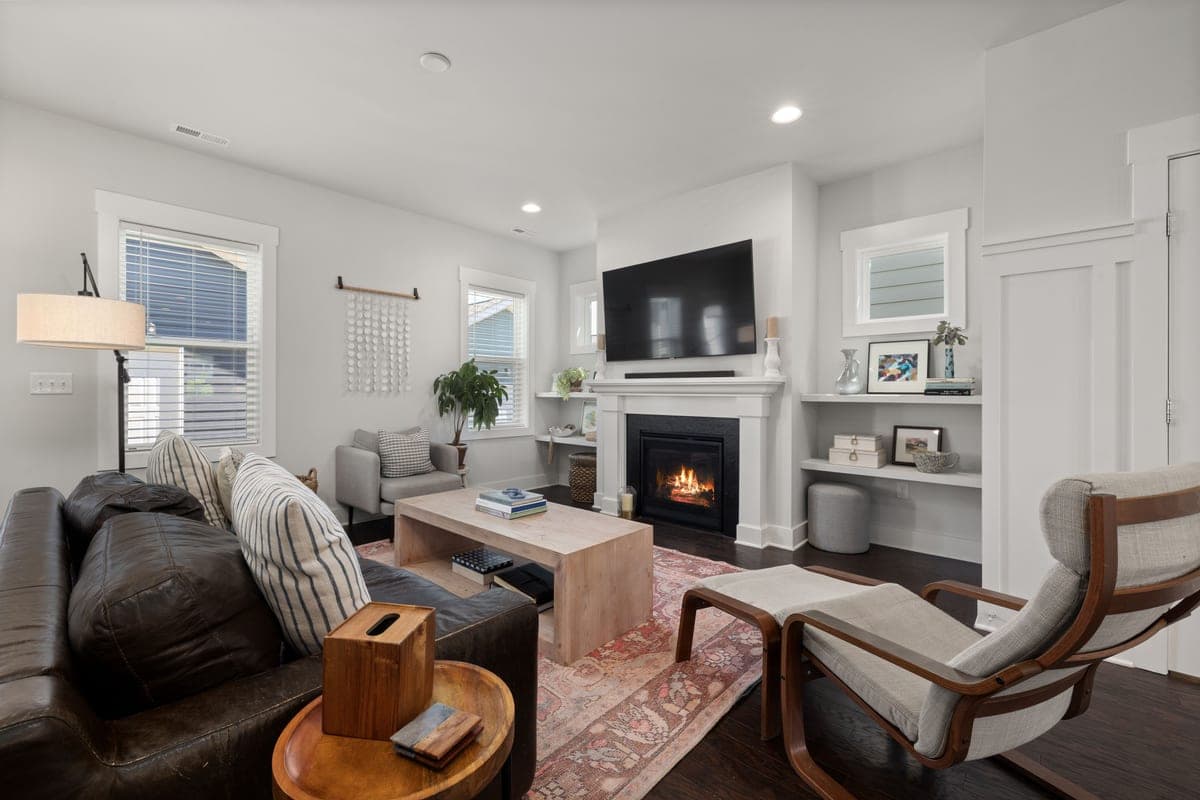
- Proportion. A 50-inch unit reads correctly on a wall from about 10 feet wide. Below that it starts to dominate.
- Framing. A 50-inch rough opening usually crosses at least three studs, which means a header and cripples rather than a simple cut between two.
- Weight. Wider units are heavier and the bracket load matters. Hit studs, not drywall anchors.
- Flame character. A long thin flame band looks different from a tall square one. Neither is more realistic; they are different objects.
- Cost. Purchase price scales with width. Running cost does not.
Quick picks at 50 inches
Ranked. The running cost column is computed from each unit's rated wattage, not quoted from a manufacturer. Tap a row for the full write-up.
| # | Product | Best for | Cost per hour | Price |
|---|---|---|---|---|
| 1 | 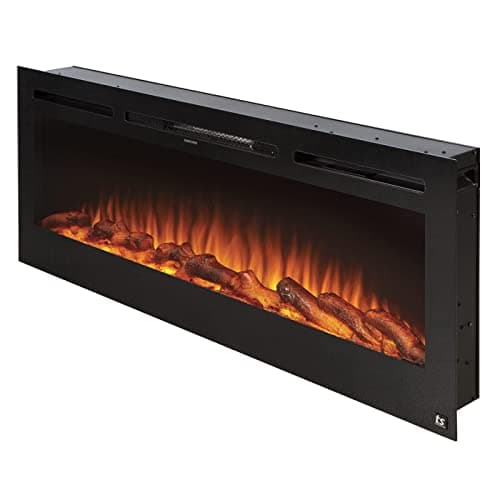 Touchstone The Sideline 50The volume seller of the Sideline range, and the size most people mean when they say they want a linear fireplace. | The default 50-inch recessed unit | 27.5¢1,500 W · 5,118 BTU | |
| 2 | 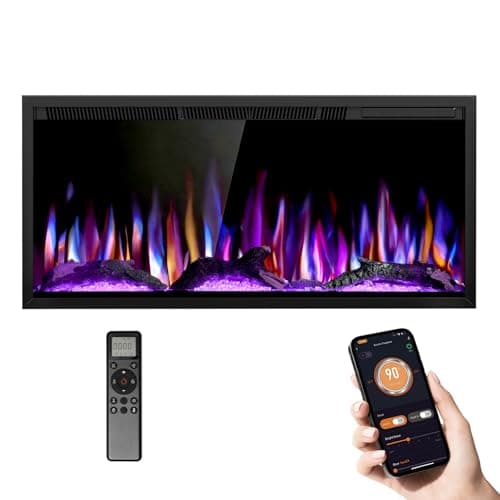 R.W.FLAME 36" Ultra-Thin Recessed & Wall-Mount FireplaceThe published 3.86-inch depth and the 750/1500 W spec are shared across the whole range, and the range includes a 50. | The same install at less money | 27.5¢1,500 W · 5,118 BTU | |
| 3 | 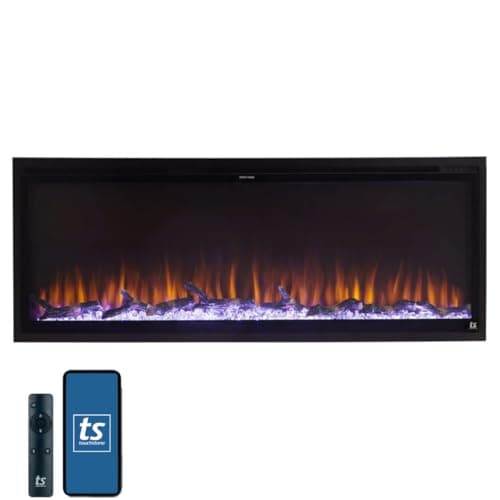 Touchstone Sideline Elite 50A frameless glass front at the same 50 inches and the same 1,500 W. The upgrade is entirely visual, and it is a real one. | Better glass at the same width | 27.5¢1,500 W · 5,118 BTU | |
| 4 | 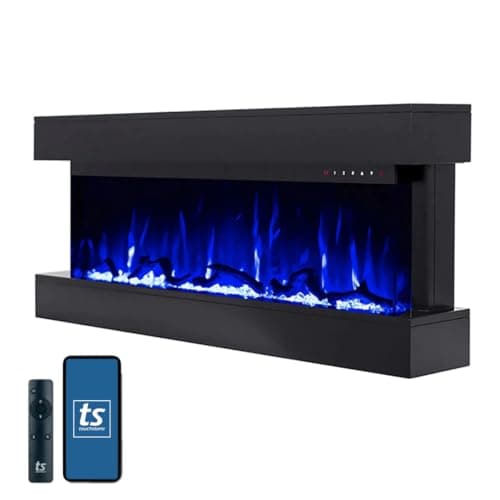 Touchstone Chesmont Black 50 (3-Sided)Three-sided glass at 50 inches. The most effective fix in the category for the off-axis flatness that gives LED flames away. | A corner or peninsula wall | 27.5¢1,500 W · 5,118 BTU | |
| — | TURBRO In-Flame INF60W 60" Smart WiFi FireplaceNot a 50-inch unit at all — 60 inches, with WiFi and a crackle speaker. It appears in 50-inch results constantly and it will not fit your opening.Skip this one | Sixty inches, if fifty turns out too small | 27.5¢1,500 W · 5,118 BTU |
#ad Buy links are affiliate links — we earn a commission on Amazon purchases at no extra cost to you, and it never changes the ranking. How this site is funded. Running cost is computed at 18.34¢/kWh; see what these actually cost to run.
| Usage | Hours | Heat on (1,500 W) | Flame only (~100 W) |
|---|---|---|---|
| One evening | 4 | $1.10 | $0.07 |
| A week of evenings | 28 | $7.70 | $0.51 |
| A month, 4 hrs a night | 120 | $33.01 | $2.20 |
| A 90-day winter, 4 hrs a night | 360 | $99.04 | $6.60 |
| Per hour | 1 | 27.5¢ | 1.8¢ |
#1 · The default 50-inch recessed unit
Touchstone The Sideline 50
The volume seller of the Sideline range, and the size most people mean when they say they want a linear fireplace.
Fifty inches is where linear fireplaces start to look deliberate rather than tentative, and the Sideline 50 is the model that defined the shape for a lot of American living rooms. It recesses or surface-mounts, and Touchstone's whole catalog is fireplaces rather than furniture with a fireplace in it.
The heater is the same 1,500 W as every other plug-in unit — 5,118 BTU per hour, 27.5 cents an hour. Fifty inches of flame costs exactly the same to run as thirty-six.
Recessing means a framed cavity and a receptacle inside it. Surface-mounting works and takes an afternoon, at the cost of the unit standing proud of the wall.
What it does not do: At 5 1/2 in deep it does not sit flush in a standard 2x4 stud bay. Recessing needs a framed cavity; surface-mounting it works but leaves the unit standing proud of the wall, which reads very differently in a small room.
Published specs
- Dimensions:
- 50 3/8 in W x 21 1/2 in H x 5 1/2 in D
- Weight:
- 59 lb
- Heater:
- Coil wire heater with blower, 1,500 W — about 5,000 BTU/hr
- Electrical:
- 120 V — plug in or hardwire
- Form:
- Recessed or wall-mounted linear unit
- Line:
- The volume seller of the Sideline range (model 80004)
What it costs to run
- 27.5¢/hr on full heat
- $99.04 across a 90-day winter at 4 hrs a night
- 5,118 BTU/hr · 12.5 A on a 120 V circuit
Computed at 18.34¢/kWh (EIA, June 2026). Your rate will differ — work out your own.
#ad We earn a commission on this link at no cost to you. How this is funded. Price as of October 17, 2026.
Specs from: Touchstone Sideline 50 (80004) product page — 50 3/8 x 21 1/2 x 5 1/2 in, 59 lb, coil wire heater with blower.
#2 · The same install at less money
R.W.FLAME 36" Ultra-Thin Recessed & Wall-Mount Fireplace
The published 3.86-inch depth and the 750/1500 W spec are shared across the whole range, and the range includes a 50.
R.W.FLAME publishes the same specification set across 30, 36, 42, 50, 60 and 68 inches: 3.86 inches deep, 750 W low and 1,500 W high at 120 V, 5,100 BTU per hour, 400 square feet supplemental, and the 12-color flame and ember configuration.
That consistency is genuinely useful. It means the install approach you plan at 36 inches transfers unchanged to 50, and if you decide mid-project that the wall wants more width, nothing about the framing logic changes.
The thin depth is the headline. At 3.86 inches this is one of the few units that will sit almost flush in a standard 2x4 wall without any building out.
What it does not do: No mantel, no surround and no trim for a masonry opening. Recessing it means cutting drywall and, in most homes, running a receptacle inside the cavity.
Published specs
- Heater:
- 750 W low / 1,500 W high
- Electrical:
- 120 V
- Heat output:
- 5,100 BTU/hr (manufacturer figure)
- Depth:
- 3.86 in — thin enough for a 2x4 stud bay
- Coverage:
- Rated by the manufacturer for up to 400 sq ft
- Flame:
- 12 flame colors, 12 ember-bed colors, 5 brightness levels, 5 speeds
- Sizes in the line:
- 30, 36, 42, 50, 60 and 68 in
What it costs to run
- 27.5¢/hr on full heat
- $99.04 across a 90-day winter at 4 hrs a night
- 5,118 BTU/hr · 12.5 A on a 120 V circuit
Computed at 18.34¢/kWh (EIA, June 2026). Your rate will differ — work out your own.
#ad We earn a commission on this link at no cost to you. How this is funded. Price as of October 17, 2026.
Specs from: R.W.FLAME recessed/wall-mount product page — full specifications.
#3 · Better glass at the same width
Touchstone Sideline Elite 50
A frameless glass front at the same 50 inches and the same 1,500 W. The upgrade is entirely visual, and it is a real one.
The Elite sits above the standard Sideline 50 in the range and below the Elite Pro. The difference is the front: a frameless glass presentation rather than a bezel, which removes the strongest visual cue that you are looking at an appliance.
It is worth being blunt about what the extra money buys, because the manufacturer's own range makes it obvious: the heater is the same 1,500 W ceiling as the cheaper Sideline 50. You are paying for the flame presentation and the housing. That is a legitimate thing to pay for — it is the only thing that varies in this category — but nobody should buy it expecting a warmer room.
If the fireplace is the focal point of a room you sit in every evening, the frameless front is noticeable. If it is in a hallway, it is not.
What it does not do: The heater is the same 1,500 W ceiling as the cheaper Sideline 50. The extra money buys the glass front and the flame presentation, not warmth.
Published specs
- Width:
- 50 in
- Form:
- Recessed, frameless glass front
- Position in line:
- Above The Sideline 50, below the Elite Pro
What it costs to run
- 27.5¢/hr on full heat
- $99.04 across a 90-day winter at 4 hrs a night
- 5,118 BTU/hr · 12.5 A on a 120 V circuit
Computed at 18.34¢/kWh (EIA, June 2026). Your rate will differ — work out your own.
#ad We earn a commission on this link at no cost to you. How this is funded. Price as of October 17, 2026.
Specs from: Touchstone electric fireplaces collection — Sideline Elite 50.
#4 · A corner or peninsula wall
Touchstone Chesmont Black 50 (3-Sided)
Three-sided glass at 50 inches. The most effective fix in the category for the off-axis flatness that gives LED flames away.
Every complaint about LED flame realism comes down to the same thing: from an angle, a flat unit stops reading as fire and starts reading as a lit panel. Three-sided glass attacks that directly by giving the flame depth you can see from the side.
It only makes sense on a corner or a peninsula wall, where people actually see those side panes. Fitted flat against a wall you are paying for two pieces of glass nobody will ever look through.
Same 1,500 W heater as everything else. The upgrade here is geometric, not thermal — and it is the geometry that fixes the realism problem, which is why it is on this list.
What it does not do: Three-sided glass needs a corner or a peninsula wall to make sense. Against a flat wall you pay for two panes nobody ever sees.
Published specs
- Width:
- 50 in
- Form:
- Three-sided wall-mount — glass on the front and both ends
- Why it matters:
- Three-sided glass is the cheapest fix for the off-axis flatness that gives LED units away
What it costs to run
- 27.5¢/hr on full heat
- $99.04 across a 90-day winter at 4 hrs a night
- 5,118 BTU/hr · 12.5 A on a 120 V circuit
Computed at 18.34¢/kWh (EIA, June 2026). Your rate will differ — work out your own.
#ad We earn a commission on this link at no cost to you. How this is funded. Price as of October 17, 2026.
Specs from: Touchstone electric fireplaces collection — Chesmont Black 50.
Skip this one
TURBRO In-Flame INF60W 60" Smart WiFi Fireplace
Not a 50-inch unit at all — 60 inches, with WiFi and a crackle speaker. It appears in 50-inch results constantly and it will not fit your opening.
The In-Flame INF60W is a 60-inch recessed or wall-mounted unit with a 1,500 W infrared quartz heater, app control and a crackling sound effect. It is a perfectly reasonable product.
It is here as a skip for a mechanical reason: it is ten inches wider than the section it keeps appearing in. If you have framed a 50-inch opening, this does not go in it, and no amount of feature comparison changes that.
It is also worth noticing what the premium buys. WiFi and a speaker are the upgrades; the heater is the same 1,500 W as a unit at a fraction of the price. If you genuinely want 60 inches, buy it deliberately at that width — our 60-inch inserts roundup ranks the options, and depth is a much bigger problem up there than it is at 50.
What it does not do: WiFi and a crackle speaker are the upgrade here. The heater is the same 1,500 W as a unit costing a fraction of it. At 4.6 in deep it will not sit flush in a standard 2x4 wall.
Published specs
- Heater:
- 1,500 W infrared quartz
- Heat output:
- 5,118 BTU/hr
- Dimensions:
- 60 in W x 18 in H x 4.6 in D
- Weight:
- 56.2 lb
- Mounting:
- Recessed or wall-mounted
- Flame:
- 12 flame colors, 13 ember-bed colors
- Extras:
- WiFi app control, Alexa and Google, crackling sound effect
- Cord:
- 5.9 ft
What it costs to run
- 27.5¢/hr on full heat
- $99.04 across a 90-day winter at 4 hrs a night
- 5,118 BTU/hr · 12.5 A on a 120 V circuit
Computed at 18.34¢/kWh (EIA, June 2026). Your rate will differ — work out your own.
#ad We earn a commission on this link at no cost to you. How this is funded. Price as of October 17, 2026.
Specs from: TURBRO In-Flames INF60W product page — 1,500 W quartz; TURBRO In-Flames INF60W-3D listing — dimensions, weight, 5,118 BTU.
Recessing at 50 inches
The depth rule is unchanged from smaller sizes — a standard 2x4 wall gives about 3.5 inches of cavity, so a unit published under about 4 inches deep sits nearly flush. What does change is the framing: a 50-inch opening will cross studs, and cutting studs means a proper header to carry the load above the opening. That is structural work in a way that a 36-inch opening between two studs often is not. Go up again to 60 inches and the depth options narrow sharply — most units at that width are 4.6 to 5.5 inches deep and will not go into a stud bay at all.
It is entirely doable, and it is genuinely a different job. The step-by-step is on how to mount and recess, and the honest boundary is on the electrical side: adding a receptacle inside the cavity is where a licensed electrician stops being optional.
Questions people actually ask
Is a 50-inch electric fireplace warmer than a 36-inch?
No. Both cap at 1,500 W and about 5,118 BTU per hour, because the limit is the household circuit rather than the size of the unit. A wider fireplace spreads the same heat over a longer flame.
What size room suits a 50-inch fireplace?
Visually, a wall of about 10 feet or more. Thermally, the same as every other unit: enough to be the sole heat source in roughly 256 square feet on the 20-BTU-per-square-foot rule of thumb, supplemental above that. Check your own room in the room size calculator.
Do I need a header to recess a 50-inch unit?
If the opening crosses a stud, yes — cutting a load-bearing stud without a header to carry the load above it is not something to improvise. This is the point at which a 50-inch install becomes meaningfully harder than a 36-inch one.
Sources
Every figure on this page is either taken from one of these documents or computed from a formula shown on the page. Nothing here is recalled from memory.
Read next
- 36-inch electric fireplace inserts
What fits a 36-inch opening, why nominal width is not actual width, and the units worth shortlisting.
- 60-inch electric fireplace inserts
Four 60-inch units ranked by recess depth, the one spec that actually differs at this width - plus the 65-inch model that keeps appearing in 60-inch results.
- How to mount or recess an electric fireplace
Hanging one takes an afternoon. Recessing takes a weekend and an electrician. Both procedures, step by step.
- BTU and room size
BTU-to-square-feet, banded — with a calculator that reports the shortfall as honestly as the fit.
- 42-inch electric fireplaces
Why 42 inches is dominated by unbranded ultra-thins, the one unit that publishes a full specification, and the branded alternatives either side of the size.