Guide · electrical load
Watts, amps and your circuit
The arithmetic behind why every unit in this category is 1,500 watts, why manufacturers ask for a dedicated circuit, and where our advice stops.
By Scooter M.Published September 2, 2026Last reviewed September 2, 2026
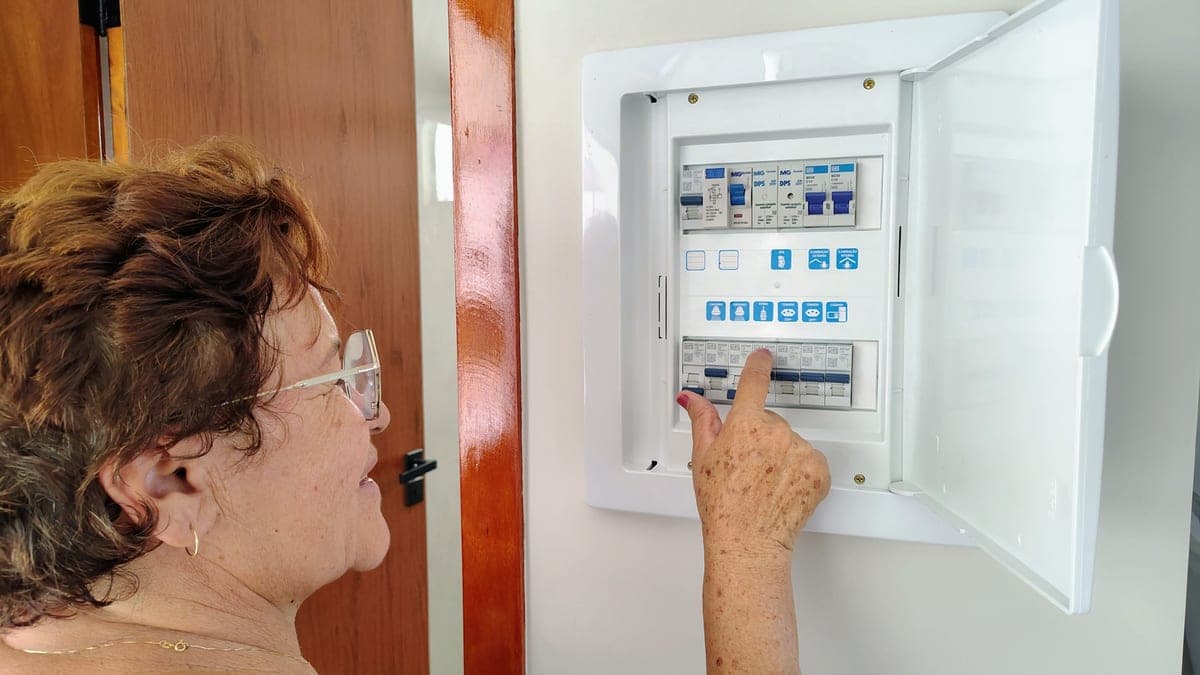
The arithmetic
Amps = watts ÷ volts. A 1,500 W fireplace on a 120 V circuit draws 12.5 amps. A standard US branch circuit is 15 amps, and continuous loads are conventionally limited to 80% of that — which is 12 amps. That is why 1,500 W is the ceiling for the entire category, and why manufacturers commonly specify a dedicated circuit. The one exception we have found is a direct-wired 240 V unit, which doubles the supply and so doubles the ceiling — covered on see-through electric fireplaces.
| Setting | Watts | Amps at 120 V | Share of a 15 A circuit |
|---|---|---|---|
| Flame only | ~100 W | 0.8 A | About 6% |
| Low heat | 750 W | 6.3 A | About 42% |
| Full heat | 1,500 W | 12.5 A | About 83% |
What that means in your house
A 15-amp circuit in a typical American living room may already be carrying a television, a streaming box, a soundbar, lamps and a phone charger. Individually those are small. Add a 12.5 amp continuous load and the circuit is at or over its practical limit, and the breaker will eventually tell you so — usually on the coldest evening of the year.
This is also the reason every manufacturer says not to use an extension cord or a power strip. It is not fussiness. A 12.5 amp continuous draw through a cord not rated for it is a genuine ignition source, and it is the failure mode behind a meaningful share of heater-related fires.
The rules to actually follow
- Plug directly into a wall receptacle. No extension cord, no power strip, no multi-outlet adapter.
- Know what else is on the circuit. Switch the fireplace on at full heat, then run the other things on that wall. If the breaker trips, you have your answer.
- Use the low setting when it is enough. 750 W is 6.3 amps — less than half the load, and half the running cost.
- Do not run it under a rug or behind furniture. Cord damage plus continuous high current is exactly the combination to avoid.
- Read the manual for your unit. If it specifies a dedicated circuit, treat that as a requirement rather than a suggestion.
Why you cannot buy a bigger one
Because the constraint is the receptacle. To exceed 1,500 W you need a 240 V circuit and a hardwired appliance — which exists, is a different product category, and requires an electrician and usually a permit. Everything sold as a plug-in electric fireplace in the United States stops at 1,500 W for this reason and no other.
So when you see two units at very different prices both rated 1,500 W, that is not one of them under-delivering. It is both of them hitting the same wall. The full consequence for shopping is on do they actually heat a room.
What the load costs
| Usage | Hours | Heat on (1,500 W) | Flame only (~100 W) |
|---|---|---|---|
| One evening | 4 | $1.10 | $0.07 |
| A week of evenings | 28 | $7.70 | $0.51 |
| A month, 4 hrs a night | 120 | $33.01 | $2.20 |
| A 90-day winter, 4 hrs a night | 360 | $99.04 | $6.60 |
| Per hour | 1 | 27.5¢ | 1.8¢ |
Work out your own running cost
Four numbers, no email address. The rate defaults to the US residential average; the number that matters is the one on your own bill.
1,500 W is the 120 V ceiling.
US average: 18.34¢.
- Per hour
- 27.5¢
- A month at this usage
- $33.01
- The whole season
- $99.04
At 1,500 W this unit produces about 5,118 BTU/hr and draws 12.5 A on a 120 V circuit. The formula is (watts ÷ 1000) × rate, applied for the hours you entered — the same function that renders every cost figure elsewhere on this site. Default rate from EIA Electric Power Monthly, Table 5.3 (June 2026).
Questions people actually ask
How many amps does an electric fireplace draw?
About 12.5 amps at 1,500 W on a 120 V circuit — amps equals watts divided by volts. On a 750 W low setting it is about 6.3 amps.
Does an electric fireplace need a dedicated circuit?
Many manufacturers specify one, because 12.5 amps is roughly 83% of a 15-amp circuit before anything else is plugged in. Whether you need to add one depends on what else shares that circuit in your house — an electrician can tell you quickly.
Can I plug an electric fireplace into a power strip?
No. Manufacturers prohibit it and the reason is sound: a continuous 12.5 amp load through a strip or extension cord not rated for it is a real fire risk. Wall receptacle only.
Will an electric fireplace trip my breaker?
It can, if the circuit is already loaded. At full heat it uses about 83% of a 15-amp circuit on its own. Test it: run the fireplace on high, then switch on everything else on that wall, and see what happens before you rely on it in January.
Why are all electric fireplaces 1500 watts?
Because 1,500 W at 120 V is 12.5 amps, which is the practical continuous limit for a standard 15-amp household circuit. Exceeding it requires 240 V hardwired equipment, which is a different category entirely.
Sources
Every figure on this page is either taken from one of these documents or computed from a formula shown on the page. Nothing here is recalled from memory.
- NFPA — National Electrical Code (NFPA 70), the standard behind US branch-circuit limits
- US Consumer Product Safety Commission — portable heater safety guidance
- EIA Electric Power Monthly, Table 5.3 — US residential average, June 2026
- EcoCostSavings — measured wattage and BTU across 117 electric fireplace models
- Duraflame DFI-5010 user manual — 120 V, 12.5 A
Read next
- BTU and room size
BTU-to-square-feet, banded — with a calculator that reports the shortfall as honestly as the fit.
- What installing an electric fireplace insert really costs
Trim kits, receptacles, framing and electrical work — the costs that arrive after the unit does.
- Are electric fireplaces safe?
No combustion, no carbon monoxide, no flue. The four electrical considerations that do matter.
- Electric fireplace running cost calculator
Put in your wattage, your rate and your hours. Per hour, per month and per season, computed.
- Plug-in vs hardwired electric fireplaces
What hardwiring actually buys you, which units support both, and why one popular firebox produces less heat than a plug-in unit on a normal circuit.
- Electric fireplaces for RVs and campers
Four RV-suitable units compared on cutout size and current draw — plus the 30-amp shore-power arithmetic that decides whether you can run one at all.