Roundup · updated for the 2026 heating season
See-through electric fireplaces
A fireplace built into the wall between two rooms, lit from both. It is the rarest format in the category by a wide margin — and most of what a search for it returns is something else entirely.
By Scooter M.Published September 26, 2026Last reviewed September 26, 2026
Disclosure: the buy links below are affiliate links. We earn a commission on Amazon purchases at no extra cost to you. It has never changed a ranking on this site, and every roundup here names a unit we think you should skip. How this site is funded.
A true see-through electric fireplace has glass on the front and the back and is built into the wall between two rooms. It is genuinely rare: when we searched the current catalog, the only ones we could find on sale were Napoleon's CLEARion Elite in 50 and 60 inches, at roughly three thousand dollars. Almost everything else returned for those searches is either a three-sided unit, which is glass on the front and both ends, or an ordinary single-sided fireplace. If you want to see from one room into the next, that is the family. If you want flame visible from more than one angle in a single room, a three-sided unit costs a fraction as much.
Three formats, one search box
The terms people type are not the terms manufacturers use, and the overlap is genuinely confusing rather than merely sloppy. "Double-sided", "2-sided", "multi-sided" and "see-through" all get typed by people who want different things, and listings use them interchangeably.
| Format | Glass on | Where it goes | What it costs |
|---|---|---|---|
| Single-sided | The front | Any flat wall | The cheapest format in the category |
| Two-sided (corner) | The front and one end | An external corner | A modest premium over single-sided |
| Three-sided | The front and both ends | A peninsula or a corner | A moderate premium |
| See-through | The front and the back | Inside a wall between two rooms | Several times any of the above |
If what you actually want is flame visible from more than one angle in a single room, you want a three-sided unit and they are plentiful and inexpensive by comparison — we compare them on corner electric fireplaces. The rest of this page is about the format that genuinely is hard to find.
Why see-through is the rare one
There is a mechanical reason, and understanding it explains both the scarcity and the price. An ordinary electric firebox puts its light engine against the back panel: LEDs, a reflector or a rotating rod, and the shaped surfaces that turn a strip of light into something that reads as flame. The heater and its blower usually sit there too. The back of the box is where the fireplace actually happens; the glass is just the window.
Take the back panel away and you have removed the place all of that lives. A see-through unit has to generate a convincing flame effect that looks right from both directions, with nowhere to hide the mechanism and no reflective surface behind it. That is a harder engineering problem than making a deeper box, and it is why the format commands a large premium rather than a small one. How the light engine works in a conventional unit is covered on flame technology explained.
The 1,500-watt ceiling, and the one unit that passes it
Everywhere else on this site we make the same point: a 120-volt household circuit caps an electric fireplace at 1,500 watts, or about 5,118 BTU per hour, and every unit from the cheapest to the most expensive lands on that same ceiling. The CLEARion is the one exception we have found, and the exception proves the rule rather than breaking it.
| Usage | Hours | Heat on (1,500 W) | Flame only (~100 W) |
|---|---|---|---|
| One evening | 4 | $1.10 | $0.07 |
| A week of evenings | 28 | $7.70 | $0.51 |
| A month, 4 hrs a night | 120 | $33.01 | $2.20 |
| A 90-day winter, 4 hrs a night | 360 | $99.04 | $6.60 |
| Per hour | 1 | 27.5¢ | 1.8¢ |
| Usage | Hours | Heat on (3,000 W) | Flame only (~100 W) |
|---|---|---|---|
| One evening | 4 | $2.20 | $0.07 |
| A week of evenings | 28 | $15.41 | $0.51 |
| A month, 4 hrs a night | 120 | $66.02 | $2.20 |
| A 90-day winter, 4 hrs a night | 360 | $198.07 | $6.60 |
| Per hour | 1 | 55.0¢ | 1.8¢ |
It reaches 3,000 watts because it is direct-wired to 240 volts rather than plugged into an outlet, and because it has a heater for each room rather than one heater for both. That is not a loophole in the physics — it is simply a bigger supply. Wire the same fireplace to ordinary 120-volt power and Napoleon rates it at 1,450 watts and about 5,000 BTU per hour, which is to say exactly where everything else sits. The arithmetic behind the ceiling is on watts, amps and your circuit, and the wiring decision itself on plug-in vs hardwired.
The practical consequence is that the headline heat figure is conditional on an electrical job most buyers have not priced. If a 240-volt run to that wall is not already there, you are paying an electrician before the fireplace does anything a cheaper one would not.
Quick picks: what you can actually buy
Ranked. The running cost column is computed from each unit's rated wattage, not quoted from a manufacturer. Tap a row for the full write-up.
| # | Product | Best for | Cost per hour | Price |
|---|---|---|---|---|
| 1 | 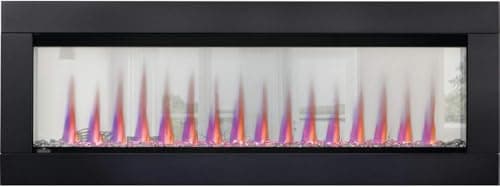 Napoleon CLEARion Elite 60 See-Thru (NEFBD60HE)Glass front and back, a privacy setting that turns it opaque, and the only heat output on this site that passes 1,500 watts — on 240 volts, wired in by an electrician. | The only true see-through at full size | 26.6¢1,450 W · 4,948 BTU | |
| 2 | 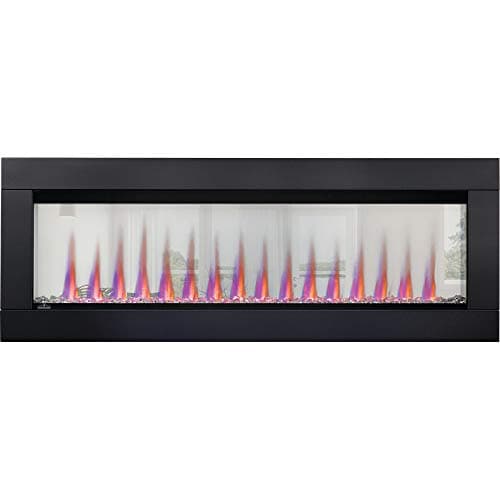 Napoleon CLEARion Elite 50 See-Thru (NEFBD50HE)Ten inches narrower and a little cheaper, with the same 240-volt rating and the same privacy glass — and a thinner published specification. | The same idea, seventy-five pounds lighter | 26.6¢1,450 W · 4,948 BTU | |
| 3 | 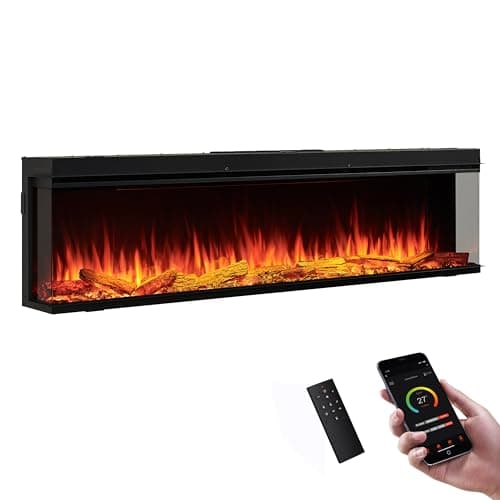 LegendFlame 71" Built-In Insert, 1-2-3 Sided (EF423B)Configurable as three-sided, corner or single-sided at under half the CLEARion's price — and not see-through in any of those settings. | What "2-sided" usually means on a listing | 27.5¢1,500 W · 5,118 BTU | |
| — | 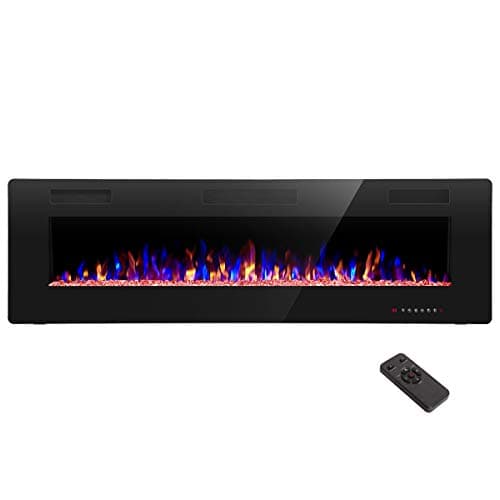 R.W.FLAME 60" Ultra-Thin Recessed & Wall-Mount FireplaceA competent single-sided wall fireplace that search engines keep returning for see-through queries. It has a solid back.Skip this one | Nothing, if you wanted to see through it | 27.5¢1,500 W · 5,118 BTU |
#ad Buy links are affiliate links — we earn a commission on Amazon purchases at no extra cost to you, and it never changes the ranking. How this site is funded. Running cost is computed at 18.34¢/kWh; see what these actually cost to run.
The four, side by side
| Unit | Faces lit | Dimensions (W x H x D) | Weight | Heat |
|---|---|---|---|---|
| Napoleon CLEARion 60 | Front and back | 60 x 20.43 x 9.18 in | 176.4 lb | 3,000 W on 240 V; 1,450 W on 120 V |
| Napoleon CLEARion 50 | Front and back | 50 x 19 x 9 in | 101.2 lb | 3,000 W on 240 V |
| LegendFlame EF423B 71 | Front, or front and one or both ends | 72 x 19.5 x 10.2 in | 105.4 lb | 750 / 1,500 W |
| R.W.FLAME 60 — our skip | Front only | 60 x 18.1 x 3.85 in | Not published | 750 / 1,500 W |
What the install actually costs
The fireplace price is the beginning of this one, in a way that is not true of a wall-mounted unit you hang on two brackets. Four things sit on top of it, and none is optional.
- A wall that can take it. Napoleon specifies framing into an 8-inch wall thickness, and the surround listing refers to a double 2x4 wall. If the wall between the two rooms is a standard single stud wall, it has to be rebuilt deeper before anything goes into it.
- Two surrounds, not one. Napoleon sells the four-sided surround separately and states that a double-sided installation requires two of them — one finished face per room. Budget for the pair.
- An electrician, if you want the headline heat. The 3,000-watt rating needs a 240-volt circuit. Without one you have bought a 1,450-watt fireplace at a see-through price.
- A second finished room. Everything you do to the back of this wall is visible from somewhere, which is not the case for a recessed fireplace on an external wall. The drywall, paint and trim on the far side are part of the job.
None of that is a reason not to do it. It is a reason to price it properly before the fireplace arrives, because a see-through installation is the one format in this category you genuinely cannot reverse cheaply. For the more ordinary version of this decision, depth and clearance covers what recessing costs on a normal wall.
Before you commit
- Decide whether you want two rooms or two angles. Two angles is a three-sided unit at a fraction of the cost; only two rooms needs see-through.
- Measure the wall's depth, not just its face. An 8-inch finished thickness is the requirement, and a standard partition wall is nowhere near it.
- Check what is already in that wall. Plumbing, ducting and structural studs are all likelier in an internal dividing wall than in the external wall most fireplaces go into.
- Find out what a 240-volt run to that point would cost before you buy, not after. It is the difference between the advertised heat and half of it.
- Remember the far side is a finished room too, and that the fire will be visible in it whether or not anyone in that room wanted a fireplace. The privacy glass exists because this is a real objection.
Questions people actually ask
What is the difference between a double-sided and a see-through electric fireplace?
In practice, the words are used interchangeably by buyers and inconsistently by sellers. In the showroom, a listing that says "2-sided" almost always means a corner unit with glass on the front and one end, visible from one room. A see-through unit has glass on the front and the back and is built into the wall between two rooms. If a listing does not say explicitly that you can see from one room into another, assume it is a corner or three-sided unit.
Are there any cheap see-through electric fireplaces?
Not that we could find. When we searched the current catalog the only true see-through units on sale were Napoleon's CLEARion Elite in 50 and 60 inches, both around three thousand dollars. There are specialist fireplace retailers outside Amazon that list multi-side-view ranges, so we would not claim the Napoleons are the only ones in existence — but at the ordinary retail end, this is not a format with a budget tier.
Can a see-through electric fireplace go in a normal stud wall?
No. Napoleon specifies framing into an 8-inch wall thickness for the CLEARion, and the surround is described for installation into a double 2x4 wall. A standard partition wall is about 4.5 inches finished, so the wall has to be built or rebuilt to suit. This is the single biggest difference between a see-through install and a normal recessed one.
Does a see-through electric fireplace heat both rooms?
The CLEARion can, because Napoleon states its heaters operate independently from each side. That is also why it is rated at 3,000 watts on a 240-volt supply rather than the 1,500 watts a 120-volt circuit allows — two heaters need roughly twice the supply of one. On ordinary 120-volt power it is rated at 1,450 watts, about the same as any other electric fireplace.
Why are see-through electric fireplaces so expensive?
Because removing the back panel removes the place the light engine and heater normally live. A conventional firebox builds its flame effect against a reflective rear surface; a see-through unit has to produce an effect that convinces from both directions with nothing behind it, in a deeper and heavier body. The engineering is genuinely harder, which is why the premium is several times rather than a few percent.
Is a three-sided fireplace a good substitute?
If what you wanted was flame visible from more than one angle, yes, and it will cost a fraction as much. If what you wanted was a fire shared between two rooms, no — no amount of side glass achieves that, because the back of a three-sided firebox is solid. We compare the three-sided options on corner electric fireplaces.
Sources
Every figure on this page is either taken from one of these documents or computed from a formula shown on the page. Nothing here is recalled from memory.
- Napoleon CLEARion Elite 60 (NEFBD60HE) retailer specification — true 2-sided see-thru electric fireplace, direct-wire 120 V or 240 V, up to 10,000 BTU and 3,000 W, warms up to 800 sq ft, privacy glass switching between transparent, semi-transparent and fully opaque, 3 flame colors, 5 flame speeds, 15 ember-bed colors, simple framing installation into an 8 in wall thickness, includes logs with topaz glass and crystal embers
- Amazon listing — Napoleon CLEARion 60 in built-in see-through electric fireplace (NEFBD60HE): 60 x 20.43 x 9.18 in, 176.4 lb, direct-wire to 120 V/240 V, up to 10,000 BTU and 3,000 W, 800 sq ft, privacy glass
- Napoleon CLEARion Elite 50 (NEFBD50HE) retailer specification — 50.0 x 19.0 x 9.0 in, viewing area 43.625 x 12.0 in, 3,000 W at 240 V, 15.0 A, up to 10,000 BTU, a standard 120 V plug is available but the unit can be hardwired to 240 V, 3 flame colors, 15 ember-bed colors, hand-painted logs with topaz glass embers and crystal media, privacy glass
- Amazon listing — Napoleon CLEARion 50 (NEFBD50HE): 50 x 18.38 x 8.06 in, 101.2 lb, "First true, 2-sided, see-thru electric fireplace", privacy glass, 3 flame color options, 5 flame speeds, 15 ember bed color options
- Amazon listing — Napoleon Four-Sided Surround for the 60 in CLEARion (NEFBD60HE-DTRM): 60 x 20 x 2 in, 19 lb, surround only with the fireplace sold separately, "Use for installations into a double 2x4 wall; must purchase two for double-sided installation"
- Amazon listing — LegendFlame 71 in smart built-in electric fireplace insert (model EF423B): overall 72 x 19.5 x 10.2 in, visible area 70.9 x 15.7 x 5.5 in, 105.4 lb, 750/1500 W, configurable in a three-sided, corner or single-sided view, Wi-Fi with Alexa and Google Assistant, 8 flame colors plus orange and 8 fuel-bed colors, CSA certified, 1 year limited warranty
- EIA Electric Power Monthly, Table 5.3 — US residential average, June 2026
Read next
- Corner electric fireplaces
Three-sided units ranked on what the corner actually buys you, and the wall-mount versus recessed split that decides the job.
- The best recessed electric fireplaces
Ranked by published depth against a real 3.5-inch cavity, with the built-in fireboxes that need a purpose-built enclosure instead.
- Depth and clearance
3.5 inches of cavity in a standard wall, and what fits it. Plus the clearances that actually matter.
- Plug-in vs hardwired electric fireplaces
What hardwiring actually buys you, which units support both, and why one popular firebox produces less heat than a plug-in unit on a normal circuit.
- Watts, amps and your circuit
12.5 amps on a 15-amp circuit. Why the ceiling exists, and where we stop and an electrician starts.