Comparison · heater type
Infrared vs fan-forced
Same watts, same BTU, genuinely different experience. One of the few places in this category where a specification difference is worth choosing on.
By Scooter M.Published September 2, 2026Last reviewed September 2, 2026
Disclosure: the buy links below are affiliate links. We earn a commission on Amazon purchases at no extra cost to you. It has never changed a ranking on this site, and every roundup here names a unit we think you should skip. How this site is funded.
The difference in one paragraph
Fan-forced blows air across a heating element: it warms a room faster, it is audible, and the warmth stops when the fan does. Infrared quartz radiates heat onto objects and people directly: it feels gentler, it does not dry the air the same way, and it works better across a distance or out of a recess. Both draw 1,500 W and produce about 5,118 BTU per hour. Neither is warmer.
Side by side
| Fan-forced | Infrared quartz | |
|---|---|---|
| How it works | Air blown across a heating element | Radiant energy onto objects and people |
| Speed | Faster to warm a whole room | Slower to feel general, immediate if you are in front of it |
| Noise | Audible fan, always | Silent, or a very quiet fan on some models |
| When it stops | The warmth stops with the fan | Surfaces stay warm for a while |
| Air humidity | Drying, particularly in winter | Less drying — it heats objects, not air |
| In a recess | Weaker. Convection has to escape the opening | Better. Radiates outward in a line |
| Big or drafty room | Loses to air movement | Warms what it points at regardless |
| Output | 1,500 W, ~5,118 BTU/hr | 1,500 W, ~5,118 BTU/hr |
| Running cost | ~27.5¢/hr | ~27.5¢/hr |
Choosing
- Masonry insert or deep recess → infrared. Convection struggles to leave a firebox. This is the clearest case on the page.
- Large or drafty room → infrared. Radiant heat reaches what it points at even when the air is moving.
- Dry house in winter → infrared. Fan-forced heat is noticeably drying and infrared is not.
- You want a cold room comfortable fast → fan-forced. Moving air is the quicker route to a warm room.
- A quiet room, or a bedroom → infrared. A fan you can hear at 2am is a fan you stop using.
- Console or TV stand → largely moot. At ankle height, placement dominates and heater type is a second-order effect.
Quick picks
Ranked. The running cost column is computed from each unit's rated wattage, not quoted from a manufacturer. Tap a row for the full write-up.
| # | Product | Best for | Cost per hour | Price |
|---|---|---|---|---|
| 1 | 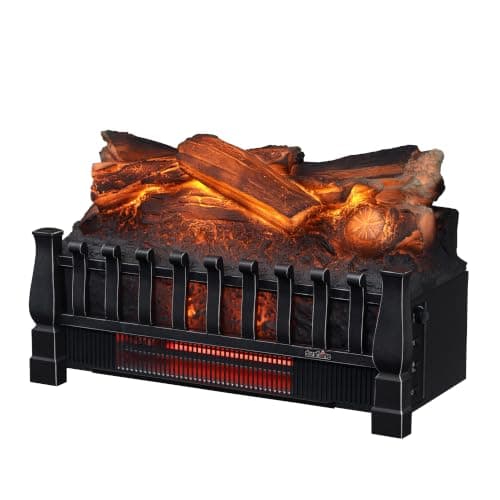 Duraflame DFI030ARU 20" Infrared Electric Fireplace Log SetInfrared quartz, rated to 1,000 square feet supplemental. The right heater type for a deep firebox, and it is not close. | Infrared in a masonry recess | 27.5¢1,500 W · 5,118 BTU | |
| 2 | TURBRO In-Flame INF60W 60" Smart WiFi Fireplace1,500 W infrared quartz at chest height on a wall. The best-delivered heat in this catalog. | Infrared on a wall | 27.5¢1,500 W · 5,118 BTU | |
| 3 | 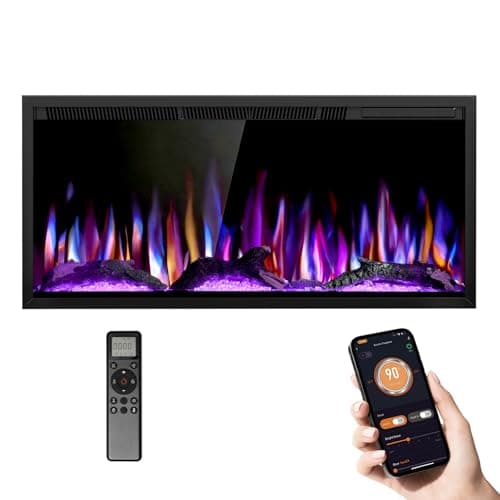 R.W.FLAME 36" Ultra-Thin Recessed & Wall-Mount FireplaceConventional convective heat with 750 W and 1,500 W stages — faster to warm a cold room, and cheaper on low. | Fan-forced with a low setting | 27.5¢1,500 W · 5,118 BTU |
#ad Buy links are affiliate links — we earn a commission on Amazon purchases at no extra cost to you, and it never changes the ranking. How this site is funded. Running cost is computed at 18.34¢/kWh; see what these actually cost to run.
The claims to be careful with
Infrared marketing routinely implies more heat, or better efficiency. Neither is true. Both technologies convert essentially 100% of their electrical input into heat, because that is what resistive heating does — there is no efficiency headroom for either to win. A 1,500 W infrared unit and a 1,500 W fan-forced unit put exactly the same energy into your room and cost exactly the same to run.
The humidity claim is more defensible: fan-forced heating moves large volumes of air across a hot element, which does reduce perceived humidity, and infrared does not do that to the same degree. That is a real comfort difference, and it is the strongest honest argument for infrared. If that argument lands, our infrared picks are the units where the manufacturer actually states the heater type.
| Usage | Hours | Heat on (1,500 W) | Flame only (~100 W) |
|---|---|---|---|
| One evening | 4 | $1.10 | $0.07 |
| A week of evenings | 28 | $7.70 | $0.51 |
| A month, 4 hrs a night | 120 | $33.01 | $2.20 |
| A 90-day winter, 4 hrs a night | 360 | $99.04 | $6.60 |
| Per hour | 1 | 27.5¢ | 1.8¢ |
#1 · Infrared in a masonry recess
Duraflame DFI030ARU 20" Infrared Electric Fireplace Log Set
Infrared quartz, rated to 1,000 square feet supplemental. The right heater type for a deep firebox, and it is not close.
Fan-forced heat has to escape a recess by convection before it reaches anybody, and a brick firebox is very good at absorbing it on the way out. Infrared radiates in a line and does not care about the recess.
Duraflame publishes a 1,000 square foot supplemental rating for this one — the largest figure of anything in our catalog, and still a supplemental rating rather than a coverage promise.
If you are heating from inside masonry, this is the technology to choose.
What it does not do: The 1,000 sq ft figure is the manufacturer's supplemental-heat rating, not a claim that it will hold temperature in a 1,000 sq ft room. See our BTU page for what the wattage actually buys.
Published specs
- Heater:
- Infrared quartz, rated by the manufacturer for up to 1,000 sq ft
- Width:
- 20 in
- Form:
- Drop-in log set for an existing firebox
- Flame:
- LED with resin cast logs and glowing embers
- Control:
- Remote with adjustable thermostat
What it costs to run
- 27.5¢/hr on full heat
- $99.04 across a 90-day winter at 4 hrs a night
- 5,118 BTU/hr · 12.5 A on a 120 V circuit
Computed at 18.34¢/kWh (EIA, June 2026). Your rate will differ — work out your own.
#ad We earn a commission on this link at no cost to you. How this is funded. Price as of October 17, 2026.
Specs from: Duraflame DFI030ARU listing — infrared, 1,000 sq ft rating; Bed Bath & Beyond product page — 20 in infrared log set.
#2 · Infrared on a wall
TURBRO In-Flame INF60W 60" Smart WiFi Fireplace
1,500 W infrared quartz at chest height on a wall. The best-delivered heat in this catalog.
Infrared plus wall placement is the strongest combination available: radiant heat that does not depend on air currents, released into the layer of the room where people actually are.
TURBRO publishes 1,500 W infrared quartz for this model, recessed or wall-mounted, at 60 inches.
The WiFi and crackle speaker are separate features and not part of the heating argument.
What it does not do: WiFi and a crackle speaker are the upgrade here. The heater is the same 1,500 W as a unit costing a fraction of it. At 4.6 in deep it will not sit flush in a standard 2x4 wall.
Published specs
- Heater:
- 1,500 W infrared quartz
- Heat output:
- 5,118 BTU/hr
- Dimensions:
- 60 in W x 18 in H x 4.6 in D
- Weight:
- 56.2 lb
- Mounting:
- Recessed or wall-mounted
- Flame:
- 12 flame colors, 13 ember-bed colors
- Extras:
- WiFi app control, Alexa and Google, crackling sound effect
- Cord:
- 5.9 ft
What it costs to run
- 27.5¢/hr on full heat
- $99.04 across a 90-day winter at 4 hrs a night
- 5,118 BTU/hr · 12.5 A on a 120 V circuit
Computed at 18.34¢/kWh (EIA, June 2026). Your rate will differ — work out your own.
#ad We earn a commission on this link at no cost to you. How this is funded. Price as of October 17, 2026.
Specs from: TURBRO In-Flames INF60W product page — 1,500 W quartz; TURBRO In-Flames INF60W-3D listing — dimensions, weight, 5,118 BTU.
#3 · Fan-forced with a low setting
R.W.FLAME 36" Ultra-Thin Recessed & Wall-Mount Fireplace
Conventional convective heat with 750 W and 1,500 W stages — faster to warm a cold room, and cheaper on low.
Fan-forced units warm a room faster because they move air. If you come home to a cold room and want it comfortable in fifteen minutes rather than forty, this is the technology that does it.
750 W low and 1,500 W high at 120 V, with a published 5,100 BTU per hour and a 400 square foot supplemental rating.
The trade is audible fan noise and heat that stops when the fan does. Neither is a defect; both are what convection costs you.
What it does not do: No mantel, no surround and no trim for a masonry opening. Recessing it means cutting drywall and, in most homes, running a receptacle inside the cavity.
Published specs
- Heater:
- 750 W low / 1,500 W high
- Electrical:
- 120 V
- Heat output:
- 5,100 BTU/hr (manufacturer figure)
- Depth:
- 3.86 in — thin enough for a 2x4 stud bay
- Coverage:
- Rated by the manufacturer for up to 400 sq ft
- Flame:
- 12 flame colors, 12 ember-bed colors, 5 brightness levels, 5 speeds
- Sizes in the line:
- 30, 36, 42, 50, 60 and 68 in
What it costs to run
- 27.5¢/hr on full heat
- $99.04 across a 90-day winter at 4 hrs a night
- 5,118 BTU/hr · 12.5 A on a 120 V circuit
Computed at 18.34¢/kWh (EIA, June 2026). Your rate will differ — work out your own.
#ad We earn a commission on this link at no cost to you. How this is funded. Price as of October 17, 2026.
Specs from: R.W.FLAME recessed/wall-mount product page — full specifications.
Questions people actually ask
Is infrared better than fan-forced for an electric fireplace?
Different rather than better. Infrared suits recesses, large rooms and dry houses; fan-forced warms a cold room faster. Both draw 1,500 W and produce the same roughly 5,118 BTU per hour.
Is infrared heat more efficient?
No. Both convert essentially all electrical input into heat, so there is no efficiency difference to have. Infrared can feel more effective because it warms you directly rather than warming the air around you first.
Does infrared dry the air less?
Yes, and it is the strongest honest argument for it. Fan-forced heating moves large volumes of air across a hot element, which reduces perceived humidity. Infrared heats objects rather than air and does this much less.
Which is quieter?
Infrared, usually — many infrared units have no fan at all, and those that do run it slowly. Fan-forced units are audible by design. In a bedroom this is often the deciding factor.
Sources
Every figure on this page is either taken from one of these documents or computed from a formula shown on the page. Nothing here is recalled from memory.
- EIA Electric Power Monthly, Table 5.3 — US residential average, June 2026
- Duraflame DFI030ARU — infrared quartz log set, 1,000 sq ft rating
- Home Depot — TURBRO INF36-W, 1,400 W, 4,780 BTU
- R.W.FLAME recessed / wall-mount range — 3.86 in depth, 750/1500 W, 5,100 BTU
- EcoCostSavings — measured wattage and BTU across 117 electric fireplace models
Read next
- Electric fireplace vs pellet stove
A pellet stove outputs 8,000 to 90,000 BTU/hr; the whole electric category caps at 5,118. Why the real decision is fuel, venting and ash rather than heat.
- The best electric fireplaces for heat
They all draw 1,500 W. Ranked instead by heat placement and heater type — and the one that is 100 W short.
- Do electric fireplaces actually heat a room?
Yes, up to about 256 square feet. Above that it is supplemental heat, and no plug-in unit does better.
- Electric fireplace inserts for an existing fireplace
What fits a real masonry firebox, why the rear width is the constraint, and the three units that suit brick.
- What an electric fireplace costs to run
27.5 cents an hour on heat, under two cents on flame alone — computed at the real 2026 rate, with the source.
- Electric fireplace inserts with a blower
Which inserts genuinely have a blower, sourced from the manufacturer rather than assumed — plus the 8-second quirk every fan-forced unit shares.
- The best infrared electric fireplaces
Five infrared units where the maker states the heater type, plus the hybrid problem that makes the word unreliable on a listing.