Roundup · updated for the 2026 heating season
The best electric fireplace inserts
Every unit here produces the same heat, because a 120 V circuit says it must. So this ranking is about what genuinely differs: what opening it fits, how the flame is made, and what it costs you an hour.
By Scooter M.Published September 2, 2026Last reviewed September 2, 2026
Disclosure: the buy links below are affiliate links. We earn a commission on Amazon purchases at no extra cost to you. It has never changed a ranking on this site, and every roundup here names a unit we think you should skip. How this site is funded.
What actually separates these six
Not heat. Every 1,500 W unit here produces about 5,118 BTU per hour and costs about 27.5 cents an hour to run, because a 120 V circuit caps the whole category at the same number. What separates them is the opening each one fits, how the flame is produced, and whether the housing suits the room you are putting it in.
That is an unusual thing for a roundup to lead with, because it removes the obvious ranking axis. But it is true, it is checkable, and every page in this category that ranks inserts by "heating power" is ranking them by a number they all share. Once heat is off the table the real questions are simple: does it fit, does the flame look right to you, and what will you spend to run it.
Quick picks: electric fireplace inserts
Ranked. The running cost column is computed from each unit's rated wattage, not quoted from a manufacturer. Tap a row for the full write-up.
| # | Product | Best for | Cost per hour | Price |
|---|---|---|---|---|
| 1 | 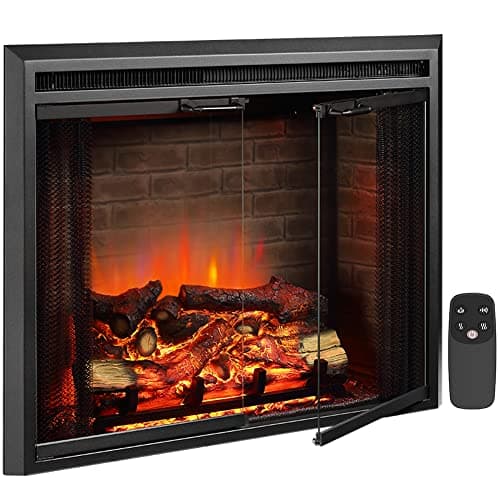 PuraFlame Klaus 33" Electric Fireplace InsertThe one that looks right in an actual brick firebox, because it brings glass, mesh and a brick-lined interior with it. | A traditional masonry opening | 27.5¢1,500 W · 5,118 BTU | |
| 2 | 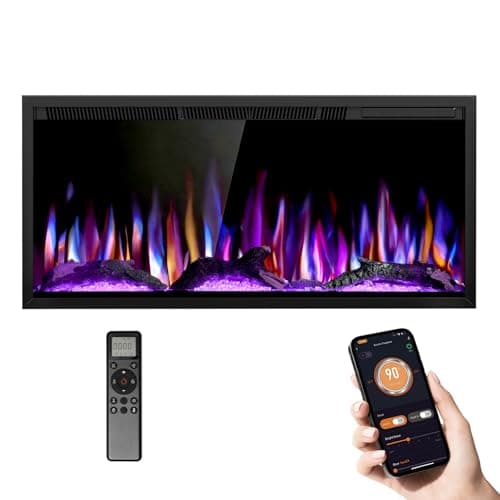 R.W.FLAME 36" Ultra-Thin Recessed & Wall-Mount FireplaceGenuinely 3.86 inches deep, which is the whole argument — it fits a standard 2x4 stud bay with almost nothing sticking out. | A framed cavity, not masonry | 27.5¢1,500 W · 5,118 BTU | |
| 3 | 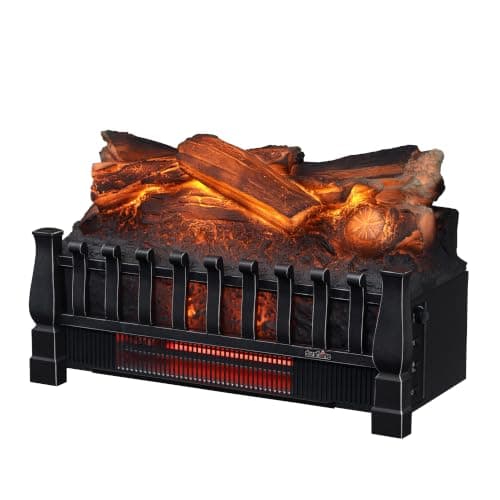 Duraflame DFI030ARU 20" Infrared Electric Fireplace Log SetA bare log set with an infrared heater. No enclosure, no glass — and in a real masonry opening that is an advantage, not a compromise. | The cheapest honest way to fill a firebox | 27.5¢1,500 W · 5,118 BTU | |
| 4 | 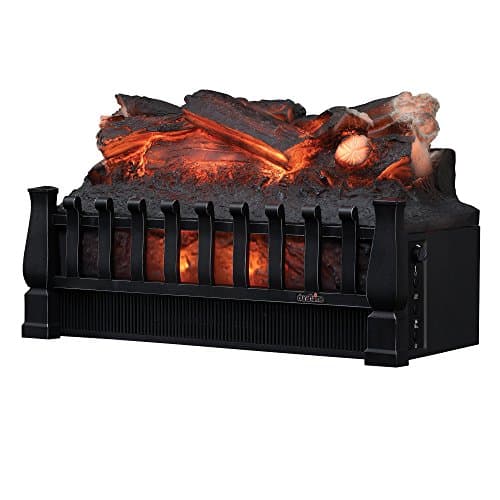 Duraflame DFI021ARU 20" Electric Fireplace Log SetThe same idea as the infrared model above with a plain heating element and a 400 square foot rating. Cheaper, and honest about it. | A small opening on a tight budget | 27.5¢1,500 W · 5,118 BTU | |
| 5 | Touchstone Fireplug Pro 33 InsertA 33-inch insert from a brand that only makes fireplaces, at a considerably higher price than the Klaus. On the list because a reader comparing 33-inch inserts should know it exists. | The fireplace-only brand's alternative to the Klaus | 27.5¢1,500 W · 5,118 BTU | |
| — | 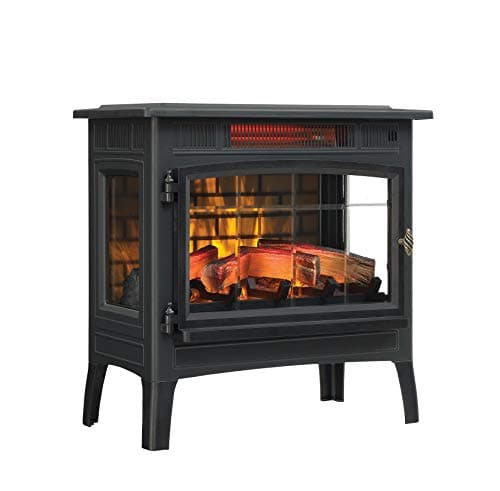 Duraflame DFI-5010-01 3D Infrared Fireplace StoveA good stove that keeps turning up in insert roundups. It is freestanding — it will not fill your opening, and buying it as an insert is the mistake this page exists to prevent.Skip this one | Nothing, if you came here for an insert | 27.5¢1,500 W · 5,118 BTU |
#ad Buy links are affiliate links — we earn a commission on Amazon purchases at no extra cost to you, and it never changes the ranking. How this site is funded. Running cost is computed at 18.34¢/kWh; see what these actually cost to run.
The running cost, computed rather than quoted
Every unit on this page except the Dimplex water-vapor models runs 1,500 W on high. Here is what that means on a bill, at the June 2026 US residential average of 18.34 cents per kWh:
| Usage | Hours | Heat on (1,500 W) | Flame only (~100 W) |
|---|---|---|---|
| One evening | 4 | $1.10 | $0.07 |
| A week of evenings | 28 | $7.70 | $0.51 |
| A month, 4 hrs a night | 120 | $33.01 | $2.20 |
| A 90-day winter, 4 hrs a night | 360 | $99.04 | $6.60 |
| Per hour | 1 | 27.5¢ | 1.8¢ |
The right-hand column is the one worth staring at. Run the flame with the heater off — which is a switch on every unit here — and an evening costs about seven cents. If what you want is a fire to look at on a winter night, the expensive part of owning one of these is optional. Nobody in this category publishes that column, and we think it is the single most useful figure on the page.
#1 · A traditional masonry opening
PuraFlame Klaus 33" Electric Fireplace Insert
The one that looks right in an actual brick firebox, because it brings glass, mesh and a brick-lined interior with it.
Most inserts are trying to look modern. This one is trying to look like the fireplace that used to be there, and in a room with original masonry that is usually the correct instinct. It ships with a glass door, a mesh screen and a three-sided brick interior, which is the combination that stops an insert reading as an appliance dropped into a hole.
The published dimensions are 33 1/16 inches wide by 25 9/16 inches high, and it runs 750 W or 1,500 W on two settings. At the full 1,500 W that is the category ceiling — about 5,118 BTU per hour and 27.5 cents an hour at the June 2026 US average rate.
The resin log sits on a grate above the ember bed rather than flat on the floor of the box, which is a small detail that matters more than it sounds: light gets underneath the log, and the flame has somewhere to go. It is the same trick that makes a real fire look three-dimensional. There is also a crackling sound effect, which people either turn on once and forget or switch off permanently within a week.
What it does not do: No trim kit in the base version — an existing masonry opening wider than 33 in leaves a visible gap unless you buy the trim separately.
Published specs
- Heater:
- 750 W / 1,500 W, two settings
- Width:
- 33 1/16 in
- Height:
- 25 9/16 in
- Flame:
- LED, three intensity settings, runs with heat off
- Front:
- Glass door, mesh screen, three-sided brick interior
- Log:
- Resin cast log, 11 13/16 in high, on a grate over the ember bed
What it costs to run
- 27.5¢/hr on full heat
- $99.04 across a 90-day winter at 4 hrs a night
- 5,118 BTU/hr · 12.5 A on a 120 V circuit
Computed at 18.34¢/kWh (EIA, June 2026). Your rate will differ — work out your own.
#ad We earn a commission on this link at no cost to you. How this is funded. Price as of October 17, 2026.
Specs from: PuraFlame Klaus insert listing (specifications and dimensions); Walmart product listing — 750/1500 W rating confirmed.
#2 · A framed cavity, not masonry
R.W.FLAME 36" Ultra-Thin Recessed & Wall-Mount Fireplace
Genuinely 3.86 inches deep, which is the whole argument — it fits a standard 2x4 stud bay with almost nothing sticking out.
If your opening is a wall rather than a firebox, depth is the specification that decides everything, and this range publishes 3.86 inches. A standard interior wall framed with 2x4 studs gives about 3.5 inches of cavity, so this sits nearly flush with only a slight proud edge — no furring strips, no built-out false wall, no chase.
The heater is 750 W low and 1,500 W high on 120 V, with a manufacturer figure of 5,100 BTU per hour and a 400 square foot supplemental rating. The flame side gets 12 flame colors, 12 ember-bed colors, five brightness levels and five speeds, which is more configuration than anyone needs and does mean you can settle on something that is not the default orange.
The line runs 30, 36, 42, 50, 60 and 68 inches, so the same install approach scales if you decide 36 is too modest for the wall. What it does not solve is the receptacle: recessing anything means power inside the cavity, and that is the part of the job that needs an electrician.
What it does not do: No mantel, no surround and no trim for a masonry opening. Recessing it means cutting drywall and, in most homes, running a receptacle inside the cavity.
Published specs
- Heater:
- 750 W low / 1,500 W high
- Electrical:
- 120 V
- Heat output:
- 5,100 BTU/hr (manufacturer figure)
- Depth:
- 3.86 in — thin enough for a 2x4 stud bay
- Coverage:
- Rated by the manufacturer for up to 400 sq ft
- Flame:
- 12 flame colors, 12 ember-bed colors, 5 brightness levels, 5 speeds
- Sizes in the line:
- 30, 36, 42, 50, 60 and 68 in
What it costs to run
- 27.5¢/hr on full heat
- $99.04 across a 90-day winter at 4 hrs a night
- 5,118 BTU/hr · 12.5 A on a 120 V circuit
Computed at 18.34¢/kWh (EIA, June 2026). Your rate will differ — work out your own.
#ad We earn a commission on this link at no cost to you. How this is funded. Price as of October 17, 2026.
Specs from: R.W.FLAME recessed/wall-mount product page — full specifications.
#3 · The cheapest honest way to fill a firebox
Duraflame DFI030ARU 20" Infrared Electric Fireplace Log Set
A bare log set with an infrared heater. No enclosure, no glass — and in a real masonry opening that is an advantage, not a compromise.
A log set is the least product-shaped thing in this category: a tray of resin logs with a heater behind it, which you place inside the existing firebox and plug in. The old brick stays visible around it. In a period fireplace that is exactly right, and it is why log sets outsell full inserts in older housing stock.
Duraflame rates this one for supplemental heating up to 1,000 square feet, using an infrared quartz element rather than a fan blowing across a coil. Infrared warms objects rather than air, which feels gentler and does not dry the room the way fan-forced heat can. Treat the 1,000 square foot figure as a supplemental rating and not a promise to hold that space at temperature — the arithmetic on do they actually heat a room explains why.
The trade-off is honest and obvious: with no enclosure, everything you already dislike about the old firebox is still there. If the brick is stained or the opening is ragged, a log set puts a nice fire inside an unattractive hole.
What it does not do: The 1,000 sq ft figure is the manufacturer's supplemental-heat rating, not a claim that it will hold temperature in a 1,000 sq ft room. See our BTU page for what the wattage actually buys.
Published specs
- Heater:
- Infrared quartz, rated by the manufacturer for up to 1,000 sq ft
- Width:
- 20 in
- Form:
- Drop-in log set for an existing firebox
- Flame:
- LED with resin cast logs and glowing embers
- Control:
- Remote with adjustable thermostat
What it costs to run
- 27.5¢/hr on full heat
- $99.04 across a 90-day winter at 4 hrs a night
- 5,118 BTU/hr · 12.5 A on a 120 V circuit
Computed at 18.34¢/kWh (EIA, June 2026). Your rate will differ — work out your own.
#ad We earn a commission on this link at no cost to you. How this is funded. Price as of October 17, 2026.
Specs from: Duraflame DFI030ARU listing — infrared, 1,000 sq ft rating; Bed Bath & Beyond product page — 20 in infrared log set.
#4 · A small opening on a tight budget
Duraflame DFI021ARU 20" Electric Fireplace Log Set
The same idea as the infrared model above with a plain heating element and a 400 square foot rating. Cheaper, and honest about it.
This is the entry point of the whole category. It is a 20-inch log set, it heats, the flame is LED with resin logs and a glowing ember bed, and the remote handles flame and heat independently so you can run the look without the warmth.
The published rating is 400 square feet of supplemental heat rather than the 1,000 square feet on the infrared version. Both are supplemental-heat ratings computed from the same physical ceiling, so read the difference as a claim about heater type rather than a claim about output.
For a bedroom firebox, a guest room, or a fireplace you want to stop looking like a black hole in the wall, this does the job for the least money of anything here. It will not impress anyone up close, and it is not trying to.
What it does not do: No enclosure, no glass, no trim. It sits inside the masonry opening you already have, so the old firebox is still visible around it.
Published specs
- Heater:
- Rated by the manufacturer for spaces up to 400 sq ft
- Width:
- 20 in
- Form:
- Drop-in log set — sits inside an existing firebox, no framing
- Flame:
- LED with resin cast logs and a glowing ember bed
- Control:
- Remote with independent flame and heat settings
What it costs to run
- 27.5¢/hr on full heat
- $99.04 across a 90-day winter at 4 hrs a night
- 5,118 BTU/hr · 12.5 A on a 120 V circuit
Computed at 18.34¢/kWh (EIA, June 2026). Your rate will differ — work out your own.
#ad We earn a commission on this link at no cost to you. How this is funded. Price as of October 17, 2026.
Specs from: Duraflame DFI021ARU listing — 400 sq ft rating; Mantels Direct product page — 20 in log set.
#5 · The fireplace-only brand's alternative to the Klaus
Touchstone Fireplug Pro 33 Insert
A 33-inch insert from a brand that only makes fireplaces, at a considerably higher price than the Klaus. On the list because a reader comparing 33-inch inserts should know it exists.
Touchstone is one of the few names in this space whose entire catalog is fireplaces, and the Fireplug Pro 33 is its insert-shaped product at the same nominal width as the PuraFlame Klaus. It is stocked on Amazon and sold direct by Touchstone.
A correction, since this page once said otherwise: when it was first written the Fireplug Pro was not on Amazon and we linked to the brand's store untracked. It is stocked there now, so the button is an ordinary affiliate link like every other on this page. It sits in this roundup because a reader comparing 33-inch inserts should know it exists, and its position has not moved because the link now pays.
Touchstone publishes less granular specification detail on its collection pages than the Amazon-stocked units do, so verify the opening dimensions with the brand before ordering. We are not going to quote you a wattage the manufacturer has not published.
What it does not do: Touchstone publishes less specification detail for this unit than for its linear range — no opening dimensions on the collection page — so verify the exact width and depth with the brand before ordering. It was not on Amazon when this catalog was first written; it is now, and the link is a tagged one.
Published specs
- Form:
- Insert, sized for a masonry firebox opening
- Width:
- 33 in
- Sold:
- Amazon, and direct from Touchstone Home Products
What it costs to run
- 27.5¢/hr on full heat
- $99.04 across a 90-day winter at 4 hrs a night
- 5,118 BTU/hr · 12.5 A on a 120 V circuit
Computed at 18.34¢/kWh (EIA, June 2026). Your rate will differ — work out your own.
#ad We earn a commission on this link at no cost to you. How this is funded. Price as of October 17, 2026.
Specs from: Touchstone electric fireplaces collection — Fireplug Pro 33.
Skip this one
Duraflame DFI-5010-01 3D Infrared Fireplace Stove
A good stove that keeps turning up in insert roundups. It is freestanding — it will not fill your opening, and buying it as an insert is the mistake this page exists to prevent.
There is nothing wrong with this product. It is a well-specified freestanding stove: 5,200 BTU per hour, 120 V at 12.5 A per the manual, 24 by 23.4 by 13.1 inches, with a layered 3D flame effect across five brightness settings and an overheat shutoff. As a stove it is a reasonable buy.
It is on this list as a skip because it is not an insert and it appears in insert roundups constantly, usually because it shares a model family and a brand with products that are. It stands on the floor. It has a footprint and needs clearance in front of the glass door. Put it in a masonry opening and you have a stove sitting inside a fireplace, which is a look, but it is not the one you were shopping for.
If a freestanding stove is genuinely what you want, buy this one and enjoy it. If you have an opening to fill, every other unit on this page is a better answer.
What it does not do: It is a freestanding stove, not an insert. It will not fill a masonry opening and it needs floor space plus clearance in front of the glass door.
Published specs
- Heat output:
- 5,200 BTU/hr
- Electrical:
- 120 V, 12.5 A
- Dimensions:
- 24 in W x 23.4 in H x 13.1 in D
- Weight:
- 28.6 lb
- Flame:
- Layered 3D flame effect, five brightness settings
- Safety:
- Overheat shutoff, adjustable digital thermostat
What it costs to run
- 27.5¢/hr on full heat
- $99.04 across a 90-day winter at 4 hrs a night
- 5,118 BTU/hr · 12.5 A on a 120 V circuit
Computed at 18.34¢/kWh (EIA, June 2026). Your rate will differ — work out your own.
#ad We earn a commission on this link at no cost to you. How this is funded. Price as of October 17, 2026.
Specs from: Duraflame DFI-5010-02-3A user manual — 120 V, 12.5 A; Walmart product page — 5,200 BTU, dimensions, weight.
How to choose between them in ninety seconds
- Measure the opening — width at the front, width at the back, height, depth. The back is usually the constraint in masonry.
- Decide enclosure or log set. If the existing firebox is attractive, a log set is cheaper and looks more appropriate. If it is not, you want a full insert with its own front.
- Check the receptacle. Everything here plugs into a standard outlet, but at 12.5 amps a 1,500 W unit is most of a 15-amp circuit on its own. See watts, amps and your circuit.
- Pick the flame, not the heat. They are all the same heater. Read flame technology explained and decide what you are actually paying for.
- Run your own numbers. Your electricity rate is not the national average. Put it in the running cost calculator.
What we did not do
We have not tested these units. We do not own them, we have no lab, and we have not run a meter on any of them. Every specification above was read off the manufacturer's or a major retailer's own page, and every cost figure was computed from rated wattage at a rate whose source is linked. That is a weaker claim than "we tested twelve models in our living room" and it has the advantage of being true — and of being something you can verify yourself in about five minutes. How we pick sets out the whole method.
Questions people actually ask
Which electric fireplace insert gives off the most heat?
Practically speaking, none of them — they tie. Every plug-in unit here runs at the 1,500 W ceiling imposed by a 120 V, 15 A circuit, which is about 5,118 BTU per hour. A unit advertising more heat is either rated for 240 V hardwiring or is quoting a supplemental-coverage figure rather than an output figure.
Are electric fireplace inserts worth it?
Worth it if you have a dead firebox you want to look alive again, want zero venting and zero maintenance, and treat the heat as a bonus. Not worth it if you are buying it to reduce a heating bill across a whole house — at 5,118 BTU per hour it is a room appliance. The full conditional answer is on are inserts worth it.
Can I put an electric insert into a working wood fireplace?
Yes, and it is common. The chimney can stay in place and capped; there is nothing to vent because there is no combustion. What you should not do is block a flue you intend to use again later without knowing how to reverse it — that is a question for a chimney professional, not for us.
Do I need a trim kit?
If the insert is narrower than your opening, yes, or you will see a gap around it. Trim kits are usually sold separately even when the product photography shows one fitted, which is a common and irritating surprise. Confirm before ordering.
Sources
Every figure on this page is either taken from one of these documents or computed from a formula shown on the page. Nothing here is recalled from memory.
- EIA Electric Power Monthly, Table 5.3 — US residential average, June 2026
- PuraFlame Klaus 33 in insert — 750/1500 W, dimensions
- R.W.FLAME recessed / wall-mount range — 3.86 in depth, 750/1500 W, 5,100 BTU
- Duraflame DFI030ARU — infrared quartz log set, 1,000 sq ft rating
- Duraflame DFI-5010 user manual — 120 V, 12.5 A
- Touchstone Home Products — electric fireplace range and sizes
- EcoCostSavings — measured wattage and BTU across 117 electric fireplace models
Read next
- Electric fireplace inserts for an existing fireplace
What fits a real masonry firebox, why the rear width is the constraint, and the three units that suit brick.
- 36-inch electric fireplace inserts
What fits a 36-inch opening, why nominal width is not actual width, and the units worth shortlisting.
- What an electric fireplace costs to run
27.5 cents an hour on heat, under two cents on flame alone — computed at the real 2026 rate, with the source.
- Flame technology explained
The four flame mechanisms, how each physically works, and the exact conditions where each one gives itself away.
- Electric fireplace inserts with a blower
Which inserts genuinely have a blower, sourced from the manufacturer rather than assumed — plus the 8-second quirk every fan-forced unit shares.