Roundup · updated for the 2026 heating season
Freestanding electric fireplace stoves
The answer for a room with no hearth, no chimney and no wall you are willing to cut. They need a socket and about two feet of floor, and that is the entire installation.
By Scooter M.Published September 13, 2026Last reviewed September 13, 2026
Disclosure: the buy links below are affiliate links. We earn a commission on Amazon purchases at no extra cost to you. It has never changed a ranking on this site, and every roundup here names a unit we think you should skip. How this site is funded.
The short answer
A freestanding stove is the answer when there is no opening to fill. No chimney, no hearth, no wall you are willing to cut, no landlord to ask. It needs a 120 V socket and roughly two feet of floor, and the installation consists of putting it down. Everything else in this category — inserts, log sets, recessed linear units — assumes a hole already exists or that you are prepared to make one.
What you are actually choosing between
The heat is settled before you start. Three of the four units here are 1,500 W, which is the ceiling a 120 V circuit allows, and the fourth is 1,400 W. So the decision is about the object, not the output, and it comes down to three things.
| Heater | Flame | Footprint | |
|---|---|---|---|
| Duraflame DFI-5010-01 | 1,500 W, 5,200 BTU/hr | Layered 3D, five brightness settings | 24 x 13.1 in |
| Duraflame DFI-470-04 | Infrared quartz, 5,200 BTU/hr | 3D, five color/brightness/speed settings | 17 1/2 x 10.7 in |
| Duraflame Infrared Quartz Stove | Infrared quartz, 5,200 BTU/hr | Log and ember bed, runs without heat | Not published |
| Tangkula 25 in | 1,400 W, 4,777 BTU/hr | Three-sided panoramic | 25 x 15 in |
Quick picks: freestanding electric stoves
Ranked. The running cost column is computed from each unit's rated wattage, not quoted from a manufacturer. Tap a row for the full write-up.
| # | Product | Best for | Cost per hour | Price |
|---|---|---|---|---|
| 1 | 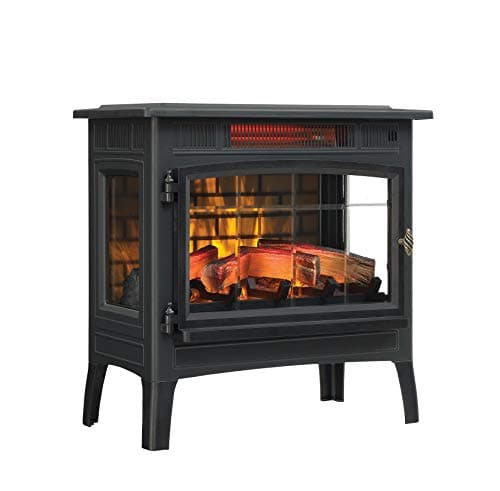 Duraflame DFI-5010-01 3D Infrared Fireplace StoveA layered 3D flame with five brightness settings, a real thermostat and 5,200 BTU. The one to buy if you will be sitting close to it. | The best flame in the format | 27.5¢1,500 W · 5,118 BTU | |
| 2 | 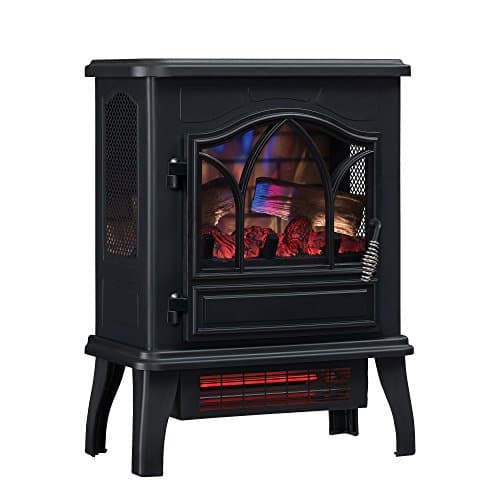 Duraflame DFI-470-04 3D Infrared Quartz StoveInfrared quartz and a 3D flame at the lowest price on this page, in a body about seventeen inches wide. | Best value, and the smallest footprint | 27.5¢1,500 W · 5,118 BTU | |
| 3 | 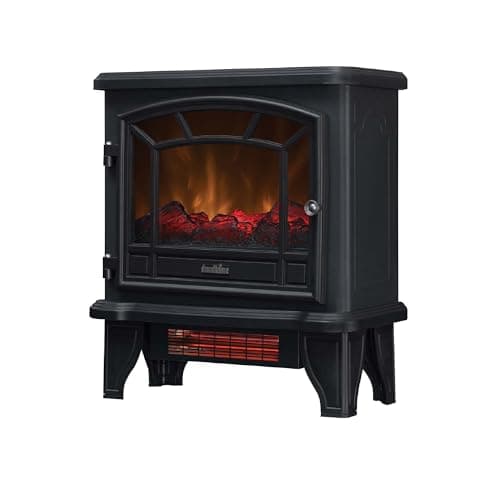 Duraflame Infrared Quartz Electric Fireplace Stove HeaterA metal body with an operable door, mullions and arched detailing — the one that reads as a stove rather than as a heater with a picture in it. | Looking like an actual wood stove | 27.5¢1,500 W · 5,118 BTU | |
| 4 | 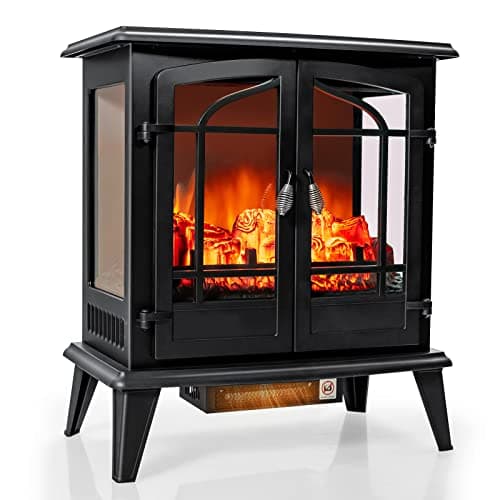 Tangkula 25" Freestanding Electric Fireplace StoveThe alternative to buying a Duraflame — three-sided viewing, a 68-95 °F thermostat, and 1,400 W rather than the usual 1,500. | Three-sided glass, and a wider thermostat range | 25.7¢1,400 W · 4,777 BTU | |
| — | 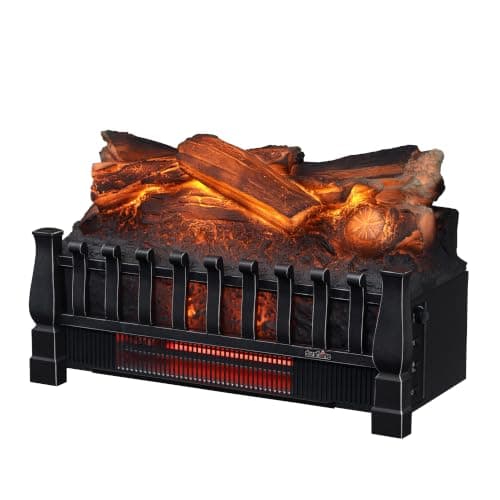 Duraflame DFI030ARU 20" Infrared Electric Fireplace Log SetNot a stove, and on this page that is the point. If you have a masonry opening, a log set is the better buy and it costs less.Skip this one | Nothing, if you already have a fireplace | 27.5¢1,500 W · 5,118 BTU |
#ad Buy links are affiliate links — we earn a commission on Amazon purchases at no extra cost to you, and it never changes the ranking. How this site is funded. Running cost is computed at 18.34¢/kWh; see what these actually cost to run.
Infrared or not, in this format specifically
Two of the stoves here use infrared quartz and the others use a conventional element. In a wall-mounted fireplace the difference is mostly about noise. In a stove it matters more, for a reason particular to the format: you sit close to it.
Infrared heats objects and people directly rather than warming the air and circulating it. Sitting three feet from an infrared stove, you feel it on your skin almost immediately, in the way you feel sunlight through a window. A fan-forced unit at the same distance has to warm the room's air first, which takes longer and is accompanied by a fan. For an armchair beside a stove, radiant heat is the better experience, and it is quieter. Infrared vs fan-forced has the fuller comparison.
About that 1,000 square foot figure
Three of these units are rated by Duraflame for supplemental heating up to 1,000 square feet, and that number needs reading correctly rather than dismissing. It is a supplemental-heat rating: what the unit can contribute to a space that is already heated, not what it can hold at temperature on its own.
| Usage | Hours | Heat on (1,500 W) | Flame only (~100 W) |
|---|---|---|---|
| One evening | 4 | $1.10 | $0.07 |
| A week of evenings | 28 | $7.70 | $0.51 |
| A month, 4 hrs a night | 120 | $33.01 | $2.20 |
| A 90-day winter, 4 hrs a night | 360 | $99.04 | $6.60 |
| Per hour | 1 | 27.5¢ | 1.8¢ |
At around 20 BTU per square foot, 5,200 BTU per hour genuinely warms something closer to 250 to 260 square feet — a bedroom, a home office, a small sitting room. That is what these are for and they do it well. The arithmetic is on BTU and room size, and the room size calculator will do it for your own dimensions.
Floor space is the real cost
This is the trade-off nobody mentions, and it is the one people notice after a week rather than in the shop. A wall-mounted fireplace occupies no floor at all. A stove occupies its own footprint plus clearance in front of the door, which in practice means it cannot be tucked flat against furniture and it cannot be walked past closely.
- Measure the footprint, then add clearance. The manufacturer's clearance instruction is in the manual and it is not optional.
- Think about the traffic route. A stove in a doorway path is a stubbed toe waiting to happen, and a hot one at that.
- Check the cord reaches a wall socket. The Tangkula publishes 67.5 inches. Never solve a short cord with an extension lead.
- Consider the surface. These are heavy enough to mark a soft floor, and a stove needs to sit level.
Safety, briefly
There is no combustion, no flue and no carbon monoxide, which removes the reasons a real wood stove needs a hearth and a chimney. What remains is that the glass front gets warm and the unit draws 12.5 amps continuously.
- Straight into a wall socket, never an extension cord or a power strip. This is the single most important rule and it applies to every unit on this site.
- Keep the clearance in front of the door clear of rugs, furniture, pet beds and drying laundry.
- Not on a circuit shared with another heater. See watts, amps and your circuit.
- Overheat shutoff is standard, but it is a backstop rather than a license to cover the vents.
The fuller version, including what the CPSC advises about portable heaters, is on are electric fireplaces safe.
Questions people actually ask
Do freestanding electric stoves need any installation?
No. They need a 120 V wall socket and enough floor space for the unit plus clearance in front of the door. There is no chimney, no flue, no framing and no electrician. On some models you attach the legs.
Are electric stoves as warm as an electric fireplace?
Yes. Three of the four here are 1,500 W, which is the same ceiling a 120 V circuit imposes on every electric fireplace, producing around 5,200 BTU per hour. The Tangkula is 1,400 W, which is roughly 340 BTU per hour less.
Can a freestanding electric stove heat a 1,000 square foot room?
Not on its own. The 1,000 square foot figure is a supplemental-heat rating — what the unit contributes to a space that is already heated. At about 20 BTU per square foot, 5,200 BTU per hour comfortably warms something nearer 250 square feet.
Are electric stoves safe around children and pets?
There is no combustion, no flue and no carbon monoxide, and overheat shutoff is standard. The glass front does get warm, so the clearance in front of the door should be kept clear, and the unit must be plugged directly into a wall socket rather than an extension cord.
Should I buy a stove or an insert?
It depends on one thing: whether you have an opening. If there is a masonry firebox, a log set or insert is cheaper, takes no floor space and looks more at home. If there is no opening at all, a stove is the only option that does not involve building work.
Sources
Every figure on this page is either taken from one of these documents or computed from a formula shown on the page. Nothing here is recalled from memory.
- Duraflame DFI-5010 user manual — 120 V, 12.5 A
- Duraflame DFI-470-04 3D infrared quartz stove — 17 1/2 x 23 x 10.7 in, 5,200 BTU, 1,000 sq ft
- Twin-Star Home — Duraflame Infrared Quartz Electric Fireplace Stove Heater, 5,200 BTU, 1,000 sq ft, adjustable thermostat
- Tangkula 25 in electric fireplace stove — 25 x 15 x 28.5 in, 1,400 W, 4,777 BTU, 35.5 lb, 68-95 °F
- Duraflame DFI030ARU — infrared quartz log set, 1,000 sq ft rating
- US Consumer Product Safety Commission — portable heater safety guidance
- EIA Electric Power Monthly, Table 5.3 — US residential average, June 2026
Read next
- Cheap electric fireplaces worth buying
Budget units produce the same 5,118 BTU as the flagships. Five worth buying, plus a clear list of what the extra money genuinely buys elsewhere.
- Infrared vs fan-forced
Identical output, different delivery. Which one suits a recess, a big room, or a dry house.
- Electric fireplaces for apartments and rentals
No cutting, no hardwiring, nothing to repair at move-out. Five units ranked by reversibility, plus the shared-wall noise problem nobody mentions.
- BTU and room size
BTU-to-square-feet, banded — with a calculator that reports the shortfall as honestly as the fit.
- Electric log sets vs fireplace inserts
One leaves your firebox visible, one covers it. Depth, effort and cost compared, with the units that suit each.