Decision guide · updated for the 2026 heating season
Can you leave an electric fireplace on all night?
There are two appliances inside one box, on two separate switches, and the honest answer is different for each. Mixing them up is what makes this question so confusing.
By Scooter M.Published October 23, 2026Last reviewed October 23, 2026
Disclosure: the buy links below are affiliate links. We earn a commission on Amazon purchases at no extra cost to you. It has never changed a ranking on this site, and every roundup here names a unit we think you should skip. How this site is funded.
Not the heater. The US Consumer Product Safety Commission is explicit — "Never leave the heater operating while unattended or while you are sleeping" — and the manufacturers agree in their own quiet way: the longest timer you can set on a Touchstone Sideline is 8 hours, and it only turns the unit off. But the flame is a separate circuit on a separate switch, and on a unit whose fire runs independently of its heater, leaving that on all night is a different question with a different answer: yes, and it costs pennies. Our pick for a fire that genuinely runs all night is the heaterless Touchstone Sideline Outdoor 50, which draws 50 watts total — about seven cents for an eight-hour night.
Two appliances, one box
This question gets confusing answers because it is really two questions, and almost every page that tries to answer it conflates them. An electric fireplace is a resistance heater and an LED light show sharing a case, and on most units they are on separate controls. One of them is a 1,500-watt appliance that the CPSC groups with portable space heaters. The other is a lighting fixture.
| The heater | The flame | |
|---|---|---|
| Typical draw | 750 - 1,500 W | Tens of watts; this site uses 100 W as a conservative ceiling |
| Cost for an 8-hour night | $1.10 on low, $2.20 on high | About 15 cents at 100 W, 7 cents at the 50 W one maker publishes |
| Across a 90-night winter | $99.04 on low, $198.07 on high | About $6.60 at 50 W |
| Safe to leave unattended overnight? | No — CPSC guidance is explicit | This is a lighting load, and the makers build units that do only this |
| Can it be run alone? | n/a | On most units yes; on some cheap ones the flame and heater share one switch |
What the safety guidance actually says
The CPSC publishes a short list of portable heater rules, and two of the seven are directly on point. "Never leave the heater operating while unattended or while you are sleeping." And in its January 2026 winter release, more briefly: "Turn off heaters when sleeping." There is no qualification for electric fireplaces, and we are not going to invent one.
It is worth knowing the scale behind the advice rather than treating it as boilerplate. The CPSC estimates that portable heaters, including electric space heaters, are involved in an average of 1,600 fires per year, causing an average of 70 deaths and 150 injuries annually across 2020 to 2022. That is the number the rule exists to reduce.
The manufacturers' answer is the timer
No maker in this category tells you to leave the heater on all night, and you can see that in the hardware rather than in the warnings. Touchstone's Sideline manual documents timer settings "from 0.5 hours to 8 hours" in one-hour steps. Eight hours is the ceiling, it is the only direction the timer works in, and it is roughly a night's sleep — which is the point. The appliance is designed to outlast your evening and expire before your morning.
The thermostat is the other piece of hardware doing this job, and its published behavior is more useful than its absent numbers. Touchstone states that "If the room temperature is ABOVE the temperature listed on the display, the heater will not turn ON." In practice a correctly set thermostat means the element spends most of a mild night off, which is both cheaper and the mechanism by which the appliance avoids running continuously. It is not a substitute for turning it off, and the CPSC does not treat it as one.
One more detail from the same manual that argues against overnight running: the heater "blows cool air for 10 seconds before the heater turns on, and after it turns off". That purge is how the element is brought down safely, and it only happens if the unit is allowed to shut itself down properly rather than losing power mid-cycle at a wall switch or a smart plug.
How we judged
- Can the flame run with the heater off? This is the whole question, and it is a published specification or it is nothing.
- A published wattage for the low-heat stage, or ideally for the flame alone. Without a number there is no honest cost.
- A published timer range and thermostat behavior, so the unit's own shut-down path is documented rather than assumed.
- A safety listing — CSA, ETL or UL — named by the manufacturer.
- A live, buyable listing with a real photograph. Nothing featured here was out of stock when we checked.
Quick picks: units whose fire can genuinely run all night
Ranked. The running cost column is computed from each unit's rated wattage, not quoted from a manufacturer. Tap a row for the full write-up.
| # | Product | Best for | Cost per hour | Price |
|---|---|---|---|---|
| 1 | 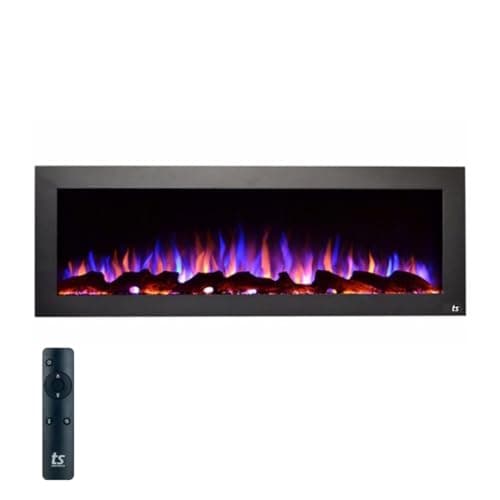 Touchstone Sideline Outdoor/Indoor 50 (80017)Fifty watts, no heater, nothing to shut off. The only unit here where leaving it on all night raises no question at all, because there is no heating element in the box. | A fire that is actually designed to be left on | No heaterflame effect only | |
| 2 | 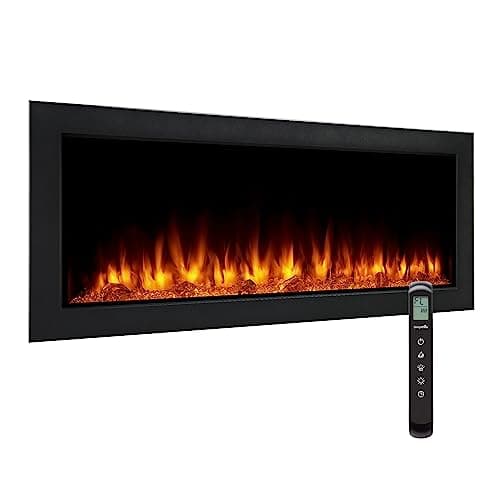 SimpliFire Forum 43" Outdoor Linear (SF-OD43)Thirty-six watts and half an amp, with an IP33 rating. A premium heaterless unit for a wall you are building rather than a bracket you are hanging. | The same idea, built into finished joinery | No heaterflame effect only | |
| 3 | 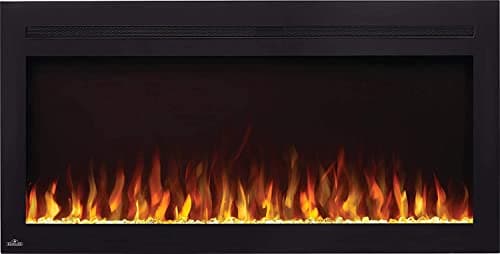 Napoleon Purview 42 (NEFL42HI)Napoleon states the Purview can be used with or without heat, so the heater goes off at bedtime and the fire stays on. The compromise that suits most rooms. | Heat in the evening, flame overnight, one unit | 27.5¢1,500 W · 5,118 BTU | |
| 4 | 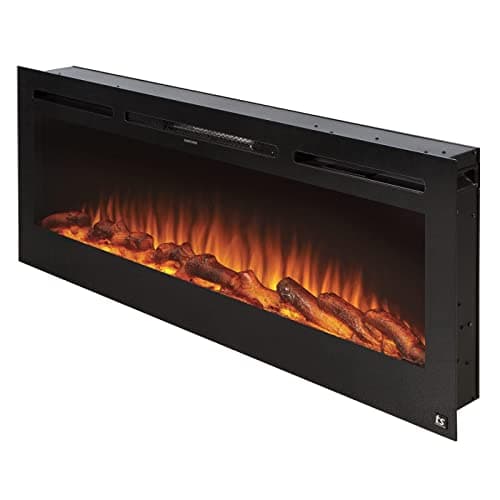 Touchstone The Sideline 50A documented two-stage heater on an 8-hour maximum timer, a thermostat that will not restart in a warm room, and a flame you can run on its own. The best-documented compromise. | The mainstream unit, used correctly | 27.5¢1,500 W · 5,118 BTU | |
| — | 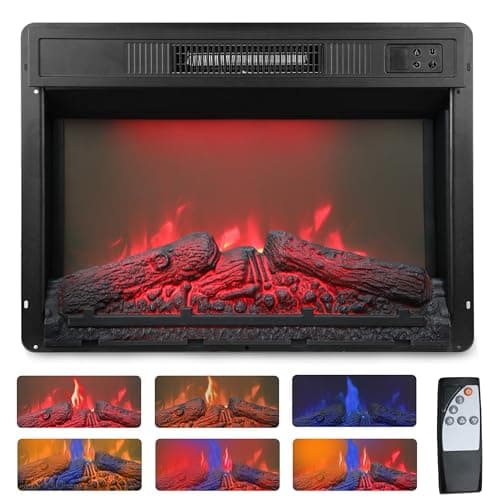 RoyalCraft 23" Recessed Insert (ZEP001)1,400 watts with no low setting at all — on at full power or off. The worst possible unit to leave running, and it is also the cheapest, which is how people end up doing it.Skip this one | Nothing you intend to leave running | 25.7¢1,400 W · 4,777 BTU |
#ad Buy links are affiliate links — we earn a commission on Amazon purchases at no extra cost to you, and it never changes the ranking. How this site is funded. Running cost is computed at 18.34¢/kWh; see what these actually cost to run.
The four, side by side
| Unit | Heat settings | Flame-only draw | Cost per 8-hour night, fire only | Timer |
|---|---|---|---|---|
| Touchstone Sideline Outdoor 50 | None — no heater fitted | 50 W, published (whole unit) | About 7 cents | Not published |
| SimpliFire Forum 43 | None — no heater fitted | 36 W, published (whole unit) | About 5 cents | Not published |
| Napoleon Purview 42 | 1,500 W | Not published | About 15 cents at the 100 W ceiling | Not published |
| Touchstone Sideline 50 | 750 / 1,500 W | Not published | About 15 cents at the 100 W ceiling | 0.5 - 8 hours |
| RoyalCraft 23 — our skip | 1,400 W only, no low stage | Not published | n/a — flame and heat not separable on the listing | 30 min - 6 hours |
The full write-ups
#1 · A fire that is actually designed to be left on
Touchstone Sideline Outdoor/Indoor 50 (80017)
Fifty watts, no heater, nothing to shut off. The only unit here where leaving it on all night raises no question at all, because there is no heating element in the box.
Every warning on this page is about a heater. This unit does not have one, and that is not a compromise in this context — it is the answer to the question. Touchstone publishes 50 watts total for the whole appliance across three flame colors and five settings, in a 50 by 17 1/2 by 5 3/4-inch sealed case with a GFI plug. There is no element to overheat, no fan to seize and no thermostat to defeat.
The cost of running it all night is the part that surprises people. At 50 watts and 18.34 cents per kilowatt hour, eight hours comes to about seven cents. A full 90-night winter of leaving the fire on from dusk to morning is roughly $6.60. The same eight hours on a 1,500-watt heater is $2.20 a night and $198.07 across the same winter — thirty times as much for something you are asleep for.
The sealed case is why there is no heater, and Touchstone says so plainly: the unit is weatherproofed, and a weatherproof enclosure and a 1,500-watt fan heater are not compatible designs. The practical benefit indoors is that it is the one unit on this page with no clearance requirement above it, which also makes it the easiest thing to put under a television — see can you put a TV above an electric fireplace?
The honest cost is total and you should take it seriously before buying. It produces no heat, ever, and it costs more than the heated Sideline 50 does. If there is any chance you wanted this unit to warm a room, this is the wrong purchase; electric fireplaces without heat is blunt about who should and should not buy a heaterless unit.
What it does not do: It produces no heat at all — that is the design, not a fault. Touchstone also warns that direct sunlight can push the temperature behind the glass past the 70 °C limit and damage the unit, so it should be kept covered when not in use in hot weather or full sun. Stock has been showing as low-quantity on Amazon.
Published specs
- Dimensions:
- 50 in W x 17 1/2 in H x 5 3/4 in D
- Heat:
- None — this is a decorative flame effect only
- Electrical:
- 120 V AC, 50 W total draw; GFI plug for outdoor use, hardwire compatible
- Flame:
- 3 flame colors (blue, orange, combined) across 5 settings — 15 combinations
- Media bed:
- Logs and crystals included
- Mounting:
- Recessed or wall-mounted; designed for hanging on brick, stone or siding
- Temperature limit:
- Rated for use in ambient temperatures up to 70 °C (158 °F)
What it costs to run
No heater. The flame effect alone draws far less than a heating unit — see what these cost to run.
Computed at 18.34¢/kWh (EIA, June 2026). Your rate will differ — work out your own.
#ad We earn a commission on this link at no cost to you. How this is funded. Price as of October 23, 2026.
Specs from: Touchstone 80017 Sideline Outdoor/Indoor 50 in — 50 x 17 1/2 x 5 3/4 in, 120 V, 50 W, no heat, GFI plug, 3 flame colors across 5 settings; Touchstone 80017 owner's manual — outdoor installation, temperature limit and covering guidance.
#2 · The same idea, built into finished joinery
SimpliFire Forum 43" Outdoor Linear (SF-OD43)
Thirty-six watts and half an amp, with an IP33 rating. A premium heaterless unit for a wall you are building rather than a bracket you are hanging.
SimpliFire publishes 120 volts, 36 watts and 0.5 amps for the Forum 43 — the lowest draw of anything this site covers. Across a 90-night winter of running from dusk until morning that is about $4.75 of electricity in total. It is a 43-inch viewing glass, 15 inches high, with four flame colors and thirteen ember-bed colors.
The IP33 rating is the reason to choose it over a plain indoor unit for a porch, a pergola or a three-season room: it is rated against falling water at an angle, which an ordinary linear fireplace is not. Indoors the rating does nothing for you, but the half-amp draw does — it means the unit can share a circuit with anything without thought, which is the opposite of the situation a 12-amp heater creates.
This is the right product when the fire is architectural. It is designed to be built in and carries the finish quality to sit in good millwork, and because it has no heater it imposes none of the enclosure-venting problems a heated built-in does.
The honest cost is the price, and it is a large one: this is the most expensive unit on the page by a wide margin, several times the heaterless Touchstone, and it does strictly less than a $110 insert in terms of function. You are buying a 43-inch linear flame and a rating, nothing else. If the budget is the binding constraint and the fire is going on a flat indoor wall, the Touchstone above does the same job for a fraction of it.
What it does not do: The most expensive unit we cover and it produces no heat whatsoever. Its IP33 rating is the only published weather rating in this group, and it means protection against spraying water rather than immersion or driving rain — a covered patio, not open sky. Stock has been showing as low-quantity on Amazon.
Published specs
- Viewing glass:
- 43 in wide, 15 in high
- Heat:
- None — flame effect only
- Electrical:
- 120 V, 36 W, 0.5 A
- Weather rating:
- IP33
- Flame:
- 4 flame colors (blue, orange, orange-blue, blue-orange), 13 ember-bed colors, 4 brightness levels
- Media bed:
- Clear crystal and driftwood logs with glowing embers
- Control:
- Multi-function remote
What it costs to run
No heater. The flame effect alone draws far less than a heating unit — see what these cost to run.
Computed at 18.34¢/kWh (EIA, June 2026). Your rate will differ — work out your own.
#ad We earn a commission on this link at no cost to you. How this is funded. Price as of October 23, 2026.
#3 · Heat in the evening, flame overnight, one unit
Napoleon Purview 42 (NEFL42HI)
Napoleon states the Purview can be used with or without heat, so the heater goes off at bedtime and the fire stays on. The compromise that suits most rooms.
Most people asking this question do not want a heaterless fireplace — they want a normal one they can leave the fire running on. Napoleon publishes that the Purview 42 can be used with or without heat, which is exactly that: 1,500 watts and 5,000 BTU for up to 400 square feet when you want warmth, and flame alone when you do not.
It is 42 by 21.4 by 5.5 inches and 42 pounds, surface-mount or recessed, with three flame colors over a glass crystal ember bed and a remote included. The 5.5-inch depth fits a standard stud wall, which matters because this is the unit most likely of the four to end up recessed into a finished wall.
Napoleon's warranty is the best documented of the mainstream brands here: two years on electrical and wearable parts, with the covered list published — fan/heaters, motors, switches, nylon bearing components, remote controls and LED lights — and labor covered in the first year. Light bulbs and fuses are excluded. Two years is double what Touchstone gives you.
The honest costs. Napoleon does not publish a flame-only wattage, so we cannot tell you what running the fire alone actually draws; this site uses 100 watts as a deliberately conservative upper bound for an LED flame assembly, which would be about 15 cents for an eight-hour night. Nor does Napoleon publish a timer range or a thermostat range for this model. The dual-mode operation is stated and that is the feature that matters here, but the surrounding numbers are thinner than Touchstone's.
What it does not do: Three flame colors is a small menu next to the twelve that two-hundred-dollar units now advertise, and Napoleon publishes no amperage, no thermostat range and no timer figure. It is also taller than it is deep by a wide margin at 21.4 in, so it reads as a panel rather than a linear slot. Stock has been intermittent on this model.
Published specs
- Dimensions:
- 42 in W x 21.4 in H x 5.5 in D
- Weight:
- 42 lb
- Heater:
- 1,500 W, and Napoleon states it runs with or without heat
- Heat output:
- 5,000 BTU/hr
- Coverage:
- Rated by the manufacturer for up to 400 sq ft
- Flame:
- 3 flame colors
- Media:
- Glass crystal ember bed, glass front
What it costs to run
- 27.5¢/hr on full heat
- $99.04 across a 90-day winter at 4 hrs a night
- 5,118 BTU/hr · 12.5 A on a 120 V circuit
Computed at 18.34¢/kWh (EIA, June 2026). Your rate will differ — work out your own.
#ad We earn a commission on this link at no cost to you. How this is funded. Price as of October 23, 2026.
#4 · The mainstream unit, used correctly
Touchstone The Sideline 50
A documented two-stage heater on an 8-hour maximum timer, a thermostat that will not restart in a warm room, and a flame you can run on its own. The best-documented compromise.
This is the unit whose paperwork actually answers the question, which is why it is here rather than on the strength of any feature. Touchstone's manual documents a two-stage heater — "Low heat (750w)" and "High heat(1500w)" — a timer with settings "from 0.5 hours to 8 hours", and a thermostat whose published behavior is that "If the room temperature is ABOVE the temperature listed on the display, the heater will not turn ON."
Read together, those three facts describe the correct way to use any heated electric fireplace overnight, and it is not "leave it on". It is: run the flame all night if you like, set the heater on the 750-watt low stage, and put it on a timer that expires. The manual also records a 10-second cool-air purge before the element comes on and after it goes off, which is a real safety feature and a real reason not to cut power to the unit at the wall mid-cycle.
The arithmetic is the other half of the argument. Eight hours of the 1,500-watt stage is $2.20 and 90 nights of it is $198.07. The 750-watt stage halves that to $1.10 a night. The flame on its own, at this site's conservative 100-watt figure, is about 15 cents. Nobody is asleep for the part they are paying for.
The honest costs are documentation gaps and a short warranty. Touchstone publishes no thermostat temperature range at all, only the behavior above, so you cannot set it to a known number. The product page contradicts the manual on the timer ("30 minutes to 7.5 hours" in one place, "1-8 hrs." in another) and on the weight. And the warranty is one year, where Napoleon gives two and Dimplex gives five on its IgniteXL range.
What it does not do: At 5 1/2 in deep it does not sit flush in a standard 2x4 stud bay. Recessing needs a framed cavity; surface-mounting it works but leaves the unit standing proud of the wall, which reads very differently in a small room.
Published specs
- Dimensions:
- 50 3/8 in W x 21 1/2 in H x 5 1/2 in D
- Weight:
- 59 lb
- Heater:
- Coil wire heater with blower, 1,500 W — about 5,000 BTU/hr
- Electrical:
- 120 V — plug in or hardwire
- Form:
- Recessed or wall-mounted linear unit
- Line:
- The volume seller of the Sideline range (model 80004)
What it costs to run
- 27.5¢/hr on full heat
- $99.04 across a 90-day winter at 4 hrs a night
- 5,118 BTU/hr · 12.5 A on a 120 V circuit
Computed at 18.34¢/kWh (EIA, June 2026). Your rate will differ — work out your own.
#ad We earn a commission on this link at no cost to you. How this is funded. Price as of October 23, 2026.
Specs from: Touchstone Sideline 50 (80004) product page — 50 3/8 x 21 1/2 x 5 1/2 in, 59 lb, coil wire heater with blower.
Skip this one
RoyalCraft 23" Recessed Insert (ZEP001)
1,400 watts with no low setting at all — on at full power or off. The worst possible unit to leave running, and it is also the cheapest, which is how people end up doing it.
We recommend this insert elsewhere on the site and we are skipping it here for one specific reason. It has no low heat stage: the heater is on at 1,400 watts or it is off, with nothing in between. Every other unit on this page either has a 750-watt stage or has no heater at all, and that single missing setting is what makes this the wrong choice for anybody whose actual question is "can I leave it on?"
What it does have is better than its price suggests: a thermostat with twenty-two settings between 62 and 82 °F, a timer, a remote, six flame colors, three brightness levels and — importantly — a CSA listing. For replacing a dead firebox in a 23-inch console cutout it remains a sensible buy, and that is the job it is on replacement inserts for.
The cost of using it the way this page is about: 1,400 watts for eight hours is 25.7 cents an hour, $2.05 a night, and about $185 across a 90-night winter, with no option to halve it. And because the only way to moderate the output is the thermostat cycling the element fully on and fully off, the room swings rather than settles.
Two further honest marks against it in this role. RoyalCraft's listing claims 5,000 BTU, which does not follow from 1,400 watts — the correct figure is about 4,777 — so the one number a buyer might use to compare it is wrong on the maker's own page. And the identical specification is sold under the Heynemo name, which tells you there is a rebadged body here rather than a brand with its own engineering behind the warranty.
What it does not do: The published 5,000 BTU/hr does not follow from the published 1,400 W: 1,400 W is 4,777 BTU/hr, so treat the round number as marketing and the wattage as the real figure. RoyalCraft publishes no rough opening and no weight, the timer stops at 6 hours where most rivals reach 8, and 1,400 W is the lowest heat ceiling on this page. The identical specification is also sold under the Heynemo name, which tells you this is a rebadged body rather than a brand with its own engineering.
Published specs
- Dimensions:
- 23 in W x 17 in H x 5 in D
- Heater:
- 1,400 W — a single setting, with no low mode
- Electrical:
- 120 V, 60 Hz
- Heat output:
- 5,000 BTU/hr (manufacturer claim — see below)
- Coverage:
- Rated by the manufacturer for up to 400 sq ft
- Thermostat:
- 22 settings from 62 to 82 °F
- Flame:
- 6 flame colors, 3 brightness levels
- Timer:
- 30 minutes to 6 hours
- Noise:
- 45 dB (manufacturer figure)
- Safety:
- CSA certified, overheat protection
- Body:
- Carbon steel
What it costs to run
- 25.7¢/hr on full heat
- $92.43 across a 90-day winter at 4 hrs a night
- 4,777 BTU/hr · 11.7 A on a 120 V circuit
Computed at 18.34¢/kWh (EIA, June 2026). Your rate will differ — work out your own.
#ad We earn a commission on this link at no cost to you. How this is funded. Price as of October 23, 2026.
Specs from: RoyalCraft specification page — 23 x 17 x 5 in, 120 V/1400 W/60 Hz, 5,000 BTU claimed, 400 sq ft, 6 flame colors, 3 brightness levels, 22 settings from 62-82 °F, 30 min to 6 h timer, 45 dB, carbon steel, CSA certified; Amazon listing — Royalcraft 23 in electric fireplace insert for TV stand (model ZEP001), 1400 W.
What it costs to get this wrong
The money is the least of it, but it is the part people notice first and it is worth seeing. A 1,500-watt heater left running from eleven at night to seven in the morning costs $2.20. Do that every night of a 90-night winter and it is $198.07 — more than the cheapest unit on this page costs to buy, spent entirely while you were unconscious.
| Usage | Hours | Heat on (1,500 W) | Flame only (~100 W) |
|---|---|---|---|
| One evening | 4 | $1.10 | $0.07 |
| A week of evenings | 28 | $7.70 | $0.51 |
| A month, 4 hrs a night | 120 | $33.01 | $2.20 |
| A 90-day winter, 4 hrs a night | 360 | $99.04 | $6.60 |
| Per hour | 1 | 27.5¢ | 1.8¢ |
| Usage | Hours | Heat on (750 W) | Flame only (~100 W) |
|---|---|---|---|
| One evening | 4 | $0.55 | $0.07 |
| A week of evenings | 28 | $3.85 | $0.51 |
| A month, 4 hrs a night | 120 | $16.51 | $2.20 |
| A 90-day winter, 4 hrs a night | 360 | $49.52 | $6.60 |
| Per hour | 1 | 13.8¢ | 1.8¢ |
The tables above are built on four-hour evenings, which is the honest way to show a fireplace's running cost. Double the hours and you double the money. What an electric fireplace costs to run sets out the full arithmetic, and the running cost calculator will price any of these against your own tariff and your own hours.
If the room is cold at night, this is the wrong fix
A fair number of people asking this question are really asking something else: can this appliance heat my bedroom through the night? The answer is no, and not because of a safety rule. A 120-volt circuit caps the unit at 1,500 watts, or about 5,118 BTU per hour, which is supplemental heat for a single room by anyone's measure. Do electric fireplaces actually heat a room? is the unflattering version, and the best electric fireplaces for a bedroom covers what the format is genuinely good at.
What an electric fireplace is unusually good at is being the only light and the only sound in a dark room for very little money. That is an ambience purchase, and the units that serve it best are the ones with no heater in them at all — which is also why they are the only ones that answer this page's question with an unqualified yes.
Before you leave it running
- Turn the heater off. Not down — off. The CPSC guidance has no exception for this appliance and neither do we.
- Check that your unit's flame runs independently. On cheaper models it does not, and then the answer to the whole question is no.
- Use the fireplace's own timer rather than a smart plug or a wall switch, so the cool-down purge completes.
- Plug it straight into a wall receptacle. Not a surge strip, not an extension cord, not a power tap — the maker and the regulator agree on this one.
- Keep three feet clear at the front. CPSC: "Keep portable heaters at least three feet away from drapes, furniture, bedding and other combustible materials." Touchstone asks for 36 inches from the front of the glass, which is the same number.
Questions people actually ask
Can you leave an electric fireplace on all night?
The heater, no. The CPSC says "Never leave the heater operating while unattended or while you are sleeping," and the longest timer Touchstone fits to a Sideline is 8 hours. The flame is a separate matter: on a unit whose fire runs independently of its heater it draws tens of watts rather than 1,500, and leaving that on overnight costs single-digit cents.
Is it safe to sleep with an electric fireplace on?
Not with the heater running — that is the specific thing the safety guidance rules out, and it applies to electric fireplaces because they are resistance heaters. Running the flame effect alone while you sleep is a lighting load, and manufacturers sell units that do nothing else, which is as close to an endorsement of that use as this category offers.
How long can you run an electric fireplace continuously?
As long as the timer allows, which on a Touchstone Sideline is a maximum of 8 hours, and then it shuts off. Most units in the category top out somewhere between 7 and 9 hours. That ceiling is a design decision, not a limitation — the appliance is built to expire rather than to run indefinitely while unattended.
Will leaving the flame on all night wear out the LEDs?
We cannot give you a figure, because no manufacturer this site covers publishes a rated hour life for its flame assembly. What we can tell you is what is covered if it fails: Napoleon's two-year terms explicitly include LED lights but exclude light bulbs and fuses, and Dimplex covers its IgniteXL range for five years. Warranty length is the only published proxy for longevity in this category, and we go through it on how long do electric fireplaces last?
Can I put my electric fireplace on a smart plug to turn it off at bedtime?
We would not. A smart plug is a relocatable power tap, which is exactly what Touchstone's manual and the CPSC both tell you not to power a heater through. It also cuts power mid-cycle, which defeats the 10-second cool-air purge Touchstone documents for before and after the element runs. The unit's own timer does the same job and was designed for it.
Does the thermostat mean it is safe to leave on?
No. A thermostat changes how much the element runs, not whether the appliance should be unattended — Touchstone's published behavior is only that the heater will not start if the room is already above the set temperature. It saves you money on a mild night. The CPSC guidance does not treat a thermostat as an exception and neither should you.
Sources
Every figure on this page is either taken from one of these documents or computed from a formula shown on the page. Nothing here is recalled from memory.
- US Consumer Product Safety Commission, "7 Highly Effective Portable Heater Safety Habits" (Neighborhood Safety Network) — "Keep all sides of the heater at least 3 feet from beds, clothes, curtains, papers, sofas and other items that can catch fire"; "Never run the heater's cord under rugs or carpeting and never power the heater with an extension cord or power strip"; "Place the heater on a stable, level surface, located where it will not be knocked over"; "Never leave the heater operating while unattended or while you are sleeping"
- US Consumer Product Safety Commission news release, 23 January 2026 — "Turn off heaters when sleeping"; "Keep portable heaters at least three feet away from drapes, furniture, bedding and other combustible materials"; "Plug electric space heaters directly into a wall outlet - never into an extension cord or power strip"; CPSC estimates portable heaters are involved in an average of 1,600 fires per year, causing an average of 70 deaths and 150 injuries annually from 2020 to 2022
- Touchstone Sideline Series owner's manual (rev. 251114), Operation and Specifications — all Sideline models 120 V AC, max 1500 W, 12 AMP; the heater runs in two stages, "Low heat (750w)" and "High heat(1500w)", and "the heater blows cool air for 10 seconds before the heater turns on, and after it turns off"; timer settings range from 0.5 hours to 8 hours (30, 1H-8H); "If the room temperature is ABOVE the temperature listed on the display, the heater will not turn ON"; tested to CSA standards for fixed and location-dedicated electric room appliances; one-year warranty with replacement parts free of charge in the first year, replacement parts then covered 90 days or the remainder of the original year, whichever is greater; "This fireplace is not intended for outdoor use. Use of this fireplace outdoors voids this warranty"
- Touchstone Sideline Series owner's manual (rev. 251114), Safety Information and 3-prong Outlet Installation — "Always plug this fireplace into a wall outlet or receptacle. Never plug this fireplace into a surge protector, extension cord, or relocatable power tap"; "Only use this fireplace on a 120V AC, 15-Amp grounded circuit. Never overload the circuit"; "Avoid plugging other appliances into the same circuit as this fireplace"; "To prevent a possible fire, do not block the air intakes or exhaust in any manner. Do not use on soft surfaces, like a carpet, where openings may be blocked"; "Do not place the cord under carpeting. Do not cover cord with throw rugs, runners, or the like"
- Touchstone Sideline Series owner's manual (rev. 251114), Choosing Installation Location — minimum clearances measured from the front of the glass panel: bottom of fireplace to floor 6 in, sides 0 in, back 0 in, top of fireplace 8 in to mantel, 8 in to TV and 8 in to ceiling; combustible materials such as furniture, pillows, bedding, papers, clothes and curtains at least 36 in from the front; "Ensure clearances to combustibles are maintained when building a mantel or shelves above the fireplace. Elevated temperatures on the wall or in the air above the fireplace can cause melting, discoloration or damage to decorations, television or other electronic components"
- Touchstone Sideline 50 (80004) product page — 50 3/8 x 21 1/2 x 5 1/2 in, firebox 46 7/8 x 20 1/4 x 5 1/4 in, rough opening 47 1/8 x 20 1/2 x 5 3/4 in, fire 45 in wide x 12 in tall, 59 lb (62 lb shipping), 120 V, 1,500 W, 5,000 BTU, 400 sq ft "under ideal conditions", coil wire heater with blower, "Designed with front heating vent so that the unit can be flush mounted into wall", 3 flame colors with 5 levels of variable flame speed, pulsating 10-color ember bed, recommended placement 8 in below the ceiling or mounted flat screen TV and at least 6 in from the floor, 1-year warranty with 1- and 2-year extensions offered
- Touchstone 80017 Sideline Outdoor/Indoor 50 in — 50 x 17 1/2 x 5 3/4 in, 120 V, 50 W total, no heat, GFI plug, 3 flame colors across 5 settings
- SimpliFire Forum 43 (SF-OD43) — 43 in viewing glass, 15 in high, 120 V, 36 W, 0.5 A, no heat, IP33, 4 flame colors, 13 ember-bed colors
- Amazon listing (Napoleon) — Purview 42 (NEFL42HI): 42 x 21.4 x 5.5 in, 42 lb, 1,500 W, 5,000 BTU, up to 400 sq ft, 3 flame colors, glass crystal ember bed, use with or without heat
- Napoleon Entice retailer specification quoting Napoleon's warranty terms — 2-year limited warranty supplying replacement parts at no cost for two years on electrical and wearable components including fan/heaters, motors, switches, nylon bearing components, remote controls and LED lights; light bulbs and fuses are not covered; "In the first year only, any labour related to warranty repair is covered"
- RoyalCraft 23 in electric fireplace insert for TV stand (model ZEP001) specification page — 23 x 17 x 5 in, 120 V/1400 W/60 Hz, 5,000 BTU claimed, 400 sq ft, 6 flame colors, 3 brightness levels, 22 temperature settings from 62 to 82 F, 30 min to 6 h timer, 45 dB, carbon steel, CSA certified
- Amazon listing — Royalcraft 23 in electric fireplace insert for TV stand (model ZEP001), 1400 W, 23 x 17 x 5 in
- NFPA — National Electrical Code (NFPA 70), the standard behind US branch-circuit limits
- EIA Electric Power Monthly, Table 5.3 — US residential average, June 2026
Read next
- Are electric fireplaces safe?
No combustion, no carbon monoxide, no flue. The four electrical considerations that do matter.
- What an electric fireplace costs to run
27.5 cents an hour on heat, under two cents on flame alone — computed at the real 2026 rate, with the source.
- Electric fireplaces without heat
Why nearly every electric fireplace already runs without heat, what flame-only actually costs to run, and the three situations that genuinely need a heaterless unit.
- Can you put a TV above an electric fireplace?
Yes — and Touchstone publishes the number: 8 inches from the top of the fireplace to the TV. The condition is vent direction: front or bottom is safe under a screen, top is not.
- The best electric fireplaces for a bedroom
Bedrooms need about 2,500 BTU, not 5,100. Six units picked on silence, a real 750 W low stage and the ability to run flame with no heat.
- How long do electric fireplaces last?
No maker publishes a service life, so buy on the only number they do publish: the warranty. Dimplex gives five years on IgniteXL, Napoleon two, Touchstone one.