Roundup · linear wall units
The best wall-mount electric fireplaces
The shape with the best heat placement in the category — chest height, straight at where people sit. Ranked on depth, real wattage, and what each one costs to run.
By Scooter M.Published September 2, 2026Last reviewed September 2, 2026
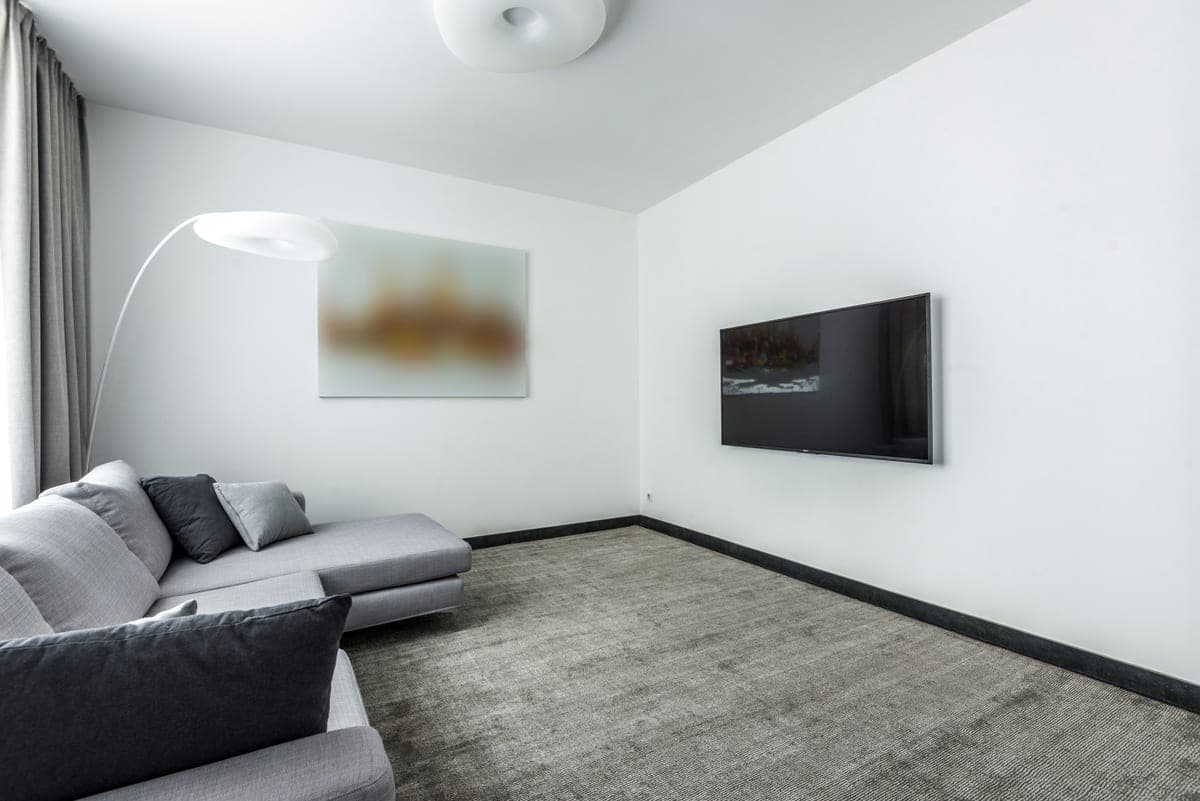
Disclosure: the buy links below are affiliate links. We earn a commission on Amazon purchases at no extra cost to you. It has never changed a ranking on this site, and every roundup here names a unit we think you should skip. How this site is funded.
Why this shape has the best heat placement
Every plug-in electric fireplace produces the same roughly 5,118 BTU per hour at the 1,500 W ceiling. What differs between form factors is where that heat leaves the box — and a wall unit at 40 to 50 inches releases it at seated chest height, straight into the part of the room where people are. A console releases it at ankle level; an insert releases it into a masonry recess.
Same energy, better delivery. It is the strongest practical argument for this shape and it is almost never made, because the specification sheets all say the same number and nobody thinks about geometry.
Depth is the specification that decides your install
| Unit depth | What it needs | Difficulty |
|---|---|---|
| Under 3.5 in | Fits a standard 2x4 cavity flush | Cut, frame, fit. A weekend |
| 3.5–5 in | A small proud reveal, or furring strips to build out | A weekend plus finishing |
| Over 5 in | A 2x6 wall, a false wall, or a chase | Construction, not DIY |
| Any depth, surface-mounted | Studs and a bracket | An afternoon |
Quick picks: wall-mount and recessed
Ranked. The running cost column is computed from each unit's rated wattage, not quoted from a manufacturer. Tap a row for the full write-up.
| # | Product | Best for | Cost per hour | Price |
|---|---|---|---|---|
| 1 | 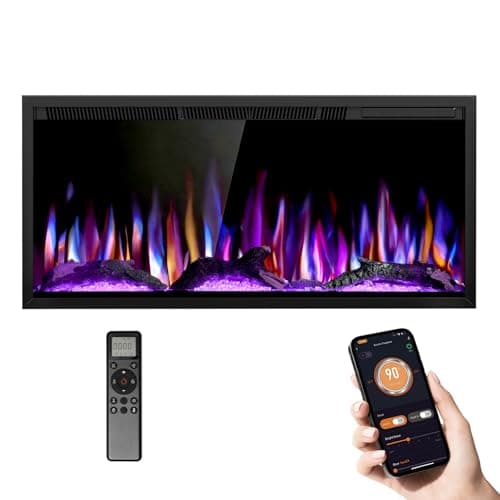 R.W.FLAME 36" Ultra-Thin Recessed & Wall-Mount Fireplace3.86 inches deep, published. That single number is why this is the default recommendation for a flush install. | Recessing into a standard wall | 27.5¢1,500 W · 5,118 BTU | |
| 2 | 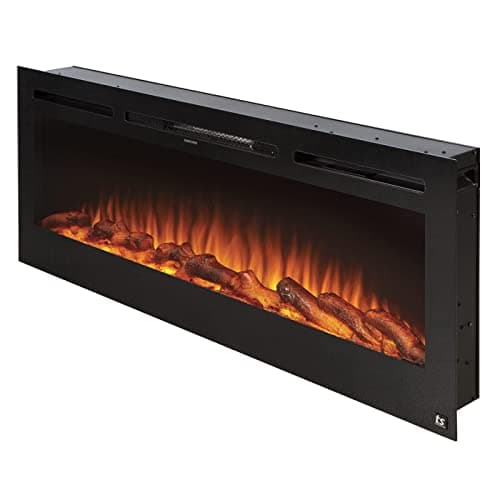 Touchstone The Sideline 50The model that defined this shape for a lot of American living rooms, from a company that makes nothing but fireplaces. | The standard-issue 50-inch wall unit | 27.5¢1,500 W · 5,118 BTU | |
| 3 | 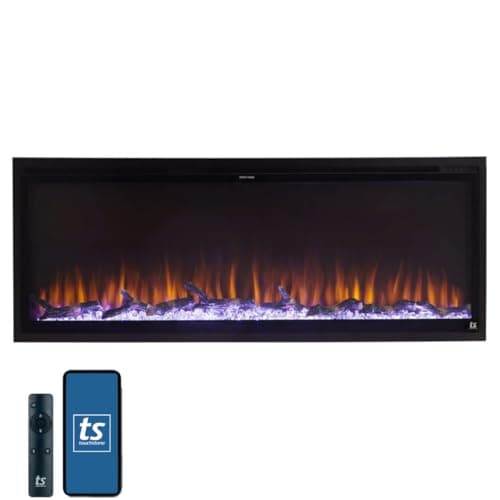 Touchstone Sideline Elite 50The frameless glass version. Same width, same heater — the upgrade is entirely in how the flame presents, and it is real. | A frameless front at the same width | 27.5¢1,500 W · 5,118 BTU | |
| 4 | 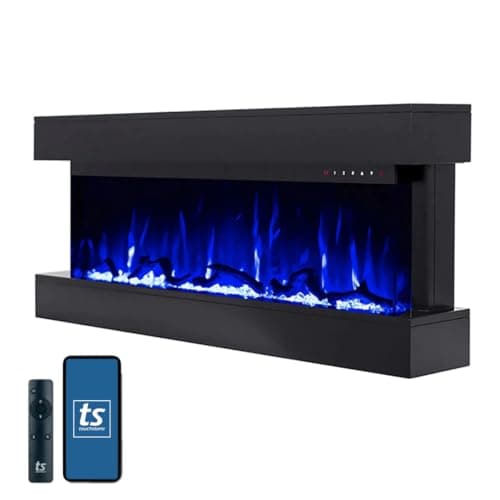 Touchstone Chesmont Black 50 (3-Sided)Three-sided glass. The most effective structural fix in the category for the off-axis flatness that gives LED flames away. | A corner or peninsula wall | 27.5¢1,500 W · 5,118 BTU | |
| 5 | TURBRO In-Flame INF60W 60" Smart WiFi Fireplace1,500 W infrared quartz at 60 inches, with WiFi and a crackle speaker. Good unit; be clear about what the premium buys. | Sixty inches with app control | 27.5¢1,500 W · 5,118 BTU | |
| — | TURBRO In-Flame INF36-W 36" Wall-Mounted Fireplace1,400 W, not 1,500 — the only unit in this catalog genuinely below the class ceiling, for no compensating advantage.Skip this one | Nothing we would recommend over the alternatives | 25.7¢1,400 W · 4,777 BTU |
#ad Buy links are affiliate links — we earn a commission on Amazon purchases at no extra cost to you, and it never changes the ranking. How this site is funded. Running cost is computed at 18.34¢/kWh; see what these actually cost to run.
| Usage | Hours | Heat on (1,500 W) | Flame only (~100 W) |
|---|---|---|---|
| One evening | 4 | $1.10 | $0.07 |
| A week of evenings | 28 | $7.70 | $0.51 |
| A month, 4 hrs a night | 120 | $33.01 | $2.20 |
| A 90-day winter, 4 hrs a night | 360 | $99.04 | $6.60 |
| Per hour | 1 | 27.5¢ | 1.8¢ |
The 1,400 W TURBRO runs slightly cheaper in exact proportion to its slightly lower output — about 25.7 cents an hour. Everything else on this page is 27.5 cents.
#1 · Recessing into a standard wall
R.W.FLAME 36" Ultra-Thin Recessed & Wall-Mount Fireplace
3.86 inches deep, published. That single number is why this is the default recommendation for a flush install.
A standard interior wall framed with 2x4 studs gives about 3.5 inches of cavity. At a published 3.86 inches this sits nearly flush with a slight proud edge — no furring strips, no built-out false wall, no chase. That is the difference between an afternoon's work and a construction project.
The heater is 750 W low and 1,500 W high at 120 V, with a manufacturer figure of 5,100 BTU per hour and a 400 square foot supplemental rating. Flame configuration is unusually broad: 12 flame colors, 12 ember-bed colors, five brightness levels and five speeds.
The line runs 30, 36, 42, 50, 60 and 68 inches on the same specification, so whatever width the wall wants, the install logic is identical. The receptacle is still the part that needs an electrician.
What it does not do: No mantel, no surround and no trim for a masonry opening. Recessing it means cutting drywall and, in most homes, running a receptacle inside the cavity.
Published specs
- Heater:
- 750 W low / 1,500 W high
- Electrical:
- 120 V
- Heat output:
- 5,100 BTU/hr (manufacturer figure)
- Depth:
- 3.86 in — thin enough for a 2x4 stud bay
- Coverage:
- Rated by the manufacturer for up to 400 sq ft
- Flame:
- 12 flame colors, 12 ember-bed colors, 5 brightness levels, 5 speeds
- Sizes in the line:
- 30, 36, 42, 50, 60 and 68 in
What it costs to run
- 27.5¢/hr on full heat
- $99.04 across a 90-day winter at 4 hrs a night
- 5,118 BTU/hr · 12.5 A on a 120 V circuit
Computed at 18.34¢/kWh (EIA, June 2026). Your rate will differ — work out your own.
#ad We earn a commission on this link at no cost to you. How this is funded. Price as of October 17, 2026.
Specs from: R.W.FLAME recessed/wall-mount product page — full specifications.
#2 · The standard-issue 50-inch wall unit
Touchstone The Sideline 50
The model that defined this shape for a lot of American living rooms, from a company that makes nothing but fireplaces.
Fifty inches is where a linear fireplace stops looking tentative, and the Sideline 50 is the volume seller of Touchstone's range — recessed or surface-mounted, and the reference point most other units get compared against. Its closest rival is Dimplex's IgniteXL at the same width; we put the two side by side on Dimplex vs Touchstone.
Same 1,500 W ceiling as everything else, so about 5,118 BTU per hour and 27.5 cents an hour to run. What you are paying for is the housing, the glass, and a brand whose entire catalog is fireplaces rather than furniture.
Touchstone publishes less numeric specification on its collection pages than the retailer listings do for mass-market units. Confirm dimensions with the brand before you cut anything.
What it does not do: At 5 1/2 in deep it does not sit flush in a standard 2x4 stud bay. Recessing needs a framed cavity; surface-mounting it works but leaves the unit standing proud of the wall, which reads very differently in a small room.
Published specs
- Dimensions:
- 50 3/8 in W x 21 1/2 in H x 5 1/2 in D
- Weight:
- 59 lb
- Heater:
- Coil wire heater with blower, 1,500 W — about 5,000 BTU/hr
- Electrical:
- 120 V — plug in or hardwire
- Form:
- Recessed or wall-mounted linear unit
- Line:
- The volume seller of the Sideline range (model 80004)
What it costs to run
- 27.5¢/hr on full heat
- $99.04 across a 90-day winter at 4 hrs a night
- 5,118 BTU/hr · 12.5 A on a 120 V circuit
Computed at 18.34¢/kWh (EIA, June 2026). Your rate will differ — work out your own.
#ad We earn a commission on this link at no cost to you. How this is funded. Price as of October 17, 2026.
Specs from: Touchstone Sideline 50 (80004) product page — 50 3/8 x 21 1/2 x 5 1/2 in, 59 lb, coil wire heater with blower.
#3 · A frameless front at the same width
Touchstone Sideline Elite 50
The frameless glass version. Same width, same heater — the upgrade is entirely in how the flame presents, and it is real.
The Elite removes the bezel. That sounds cosmetic and it is the single most effective change to how convincing a linear unit looks, because a visible frame is the strongest cue that you are looking at an appliance rather than an opening.
It sits between the standard Sideline 50 and the Elite Pro in the range, at 50 inches.
Being blunt about the trade: the heater is the same 1,500 W as the cheaper Sideline 50. Nobody should buy this expecting a warmer room. Buy it because the fireplace is the focal point of a room you sit in every evening, which is a legitimate reason.
What it does not do: The heater is the same 1,500 W ceiling as the cheaper Sideline 50. The extra money buys the glass front and the flame presentation, not warmth.
Published specs
- Width:
- 50 in
- Form:
- Recessed, frameless glass front
- Position in line:
- Above The Sideline 50, below the Elite Pro
What it costs to run
- 27.5¢/hr on full heat
- $99.04 across a 90-day winter at 4 hrs a night
- 5,118 BTU/hr · 12.5 A on a 120 V circuit
Computed at 18.34¢/kWh (EIA, June 2026). Your rate will differ — work out your own.
#ad We earn a commission on this link at no cost to you. How this is funded. Price as of October 17, 2026.
Specs from: Touchstone electric fireplaces collection — Sideline Elite 50.
#4 · A corner or peninsula wall
Touchstone Chesmont Black 50 (3-Sided)
Three-sided glass. The most effective structural fix in the category for the off-axis flatness that gives LED flames away.
Every complaint about LED realism reduces to the same thing: from an angle, a flat unit stops reading as fire and starts reading as a lit panel. Three-sided glass attacks that directly, because there is genuine depth to see into from the side.
It only earns its money on a corner or a peninsula, where the side panes are actually in someone's line of sight. Against a flat wall you are paying for two pieces of glass nobody will ever look through.
Same 1,500 W heater. The upgrade is geometric, and geometry is exactly what fixes the realism problem — which is why it is on this list rather than filed under styling.
What it does not do: Three-sided glass needs a corner or a peninsula wall to make sense. Against a flat wall you pay for two panes nobody ever sees.
Published specs
- Width:
- 50 in
- Form:
- Three-sided wall-mount — glass on the front and both ends
- Why it matters:
- Three-sided glass is the cheapest fix for the off-axis flatness that gives LED units away
What it costs to run
- 27.5¢/hr on full heat
- $99.04 across a 90-day winter at 4 hrs a night
- 5,118 BTU/hr · 12.5 A on a 120 V circuit
Computed at 18.34¢/kWh (EIA, June 2026). Your rate will differ — work out your own.
#ad We earn a commission on this link at no cost to you. How this is funded. Price as of October 17, 2026.
Specs from: Touchstone electric fireplaces collection — Chesmont Black 50.
#5 · Sixty inches with app control
TURBRO In-Flame INF60W 60" Smart WiFi Fireplace
1,500 W infrared quartz at 60 inches, with WiFi and a crackle speaker. Good unit; be clear about what the premium buys.
TURBRO publishes 1,500 W infrared quartz for this one, recessed or wall-mounted, at 60 inches, with app control and a crackling sound effect.
Infrared is a genuine difference in how the heat feels — it warms objects and people rather than blowing hot air, which is gentler and does not dry the room. It is not more heat. Same 1,500 W, same roughly 5,118 BTU per hour.
WiFi on a fireplace is a feature you will use twice and then forget, in our honest view, but the crackle speaker is the kind of thing people either love or switch off in the first week. Both are the premium here — not warmth.
What it does not do: WiFi and a crackle speaker are the upgrade here. The heater is the same 1,500 W as a unit costing a fraction of it. At 4.6 in deep it will not sit flush in a standard 2x4 wall.
Published specs
- Heater:
- 1,500 W infrared quartz
- Heat output:
- 5,118 BTU/hr
- Dimensions:
- 60 in W x 18 in H x 4.6 in D
- Weight:
- 56.2 lb
- Mounting:
- Recessed or wall-mounted
- Flame:
- 12 flame colors, 13 ember-bed colors
- Extras:
- WiFi app control, Alexa and Google, crackling sound effect
- Cord:
- 5.9 ft
What it costs to run
- 27.5¢/hr on full heat
- $99.04 across a 90-day winter at 4 hrs a night
- 5,118 BTU/hr · 12.5 A on a 120 V circuit
Computed at 18.34¢/kWh (EIA, June 2026). Your rate will differ — work out your own.
#ad We earn a commission on this link at no cost to you. How this is funded. Price as of October 17, 2026.
Specs from: TURBRO In-Flames INF60W product page — 1,500 W quartz; TURBRO In-Flames INF60W-3D listing — dimensions, weight, 5,118 BTU.
Skip this one
TURBRO In-Flame INF36-W 36" Wall-Mounted Fireplace
1,400 W, not 1,500 — the only unit in this catalog genuinely below the class ceiling, for no compensating advantage.
Home Depot lists the INF36-W at 4,780 BTU per hour on a 1,400 W convective heater. Every other unit on this page is 1,500 W and about 5,118 BTU. That is a real shortfall of roughly 340 BTU per hour, or about 7%.
Seven percent is not a catastrophe and we are not claiming it is. But it is the only unit here that gives up anything on the one specification the whole category shares, and it does so without a compensating advantage — it is a wall-hung design with an optional standing base, not a thin recessed unit, so it does not win on depth either.
If you specifically want a hanging unit with a standing-base option, it does that job. If you are choosing on the merits, the R.W.FLAME at 36 inches is thinner, more configurable and carries the full 1,500 W.
What it does not do: It is 1,400 W, not 1,500 W. That is 100 W less than the class ceiling — a real difference of about 340 BTU/hr, and the only unit in this catalog where the number is not the usual maximum.
Published specs
- Heater:
- 1,400 W convective
- Heat output:
- 4,780 BTU/hr
- Width:
- 36 in
- Mounting:
- Wall-mounted, with an optional standing base
- Control:
- Thermostat, timer, remote
What it costs to run
- 25.7¢/hr on full heat
- $92.43 across a 90-day winter at 4 hrs a night
- 4,777 BTU/hr · 11.7 A on a 120 V circuit
Computed at 18.34¢/kWh (EIA, June 2026). Your rate will differ — work out your own.
#ad We earn a commission on this link at no cost to you. How this is funded. Price as of October 17, 2026.
Specs from: Home Depot product page — TURBRO INF36-W, 4,780 BTU; TURBRO 36 in wall-mounted fireplace listing — 1,400 W heater.
Surface-mount or recess?
Surface-mounting takes an afternoon: find studs, hang a bracket, hook the unit on, plug it in. Recessing means cutting drywall, checking the cavity, framing an opening, adding a receptacle inside it, and patching and painting afterward. The finished result is dramatically better — flush reads as architecture, hung reads as an appliance — and the work is genuinely more involved than the listings suggest. The full comparison is on wall-mounted vs recessed, and the units ranked by whether they actually fit a standard wall are on best recessed electric fireplaces.
Questions people actually ask
How deep does a wall need to be for a recessed electric fireplace?
A standard interior wall framed with 2x4 studs gives about 3.5 inches of usable cavity. Units published under about 4 inches deep — R.W.FLAME lists 3.86 — sit nearly flush in that. Anything deeper needs furring, a 2x6 wall, or a built-out chase.
Do wall mounted electric fireplaces give off heat?
Yes, and it is the best-placed heat in the category. Output is the same 1,500 W ceiling as every plug-in unit — about 5,118 BTU per hour — but it is released at seated chest height rather than at ankle level.
Can I mount one on drywall without hitting studs?
No. These units are heavy and the bracket load is real. Find studs, or add blocking behind the drywall before you mount anything.
Does a wall mount fireplace need its own circuit?
At 1,500 W it draws about 12.5 amps, which is most of a 15-amp circuit on its own, and manufacturers commonly specify a dedicated one. Whether your existing wiring can carry it is a question for a licensed electrician.
Sources
Every figure on this page is either taken from one of these documents or computed from a formula shown on the page. Nothing here is recalled from memory.
- EIA Electric Power Monthly, Table 5.3 — US residential average, June 2026
- R.W.FLAME recessed / wall-mount range — 3.86 in depth, 750/1500 W, 5,100 BTU
- Touchstone Home Products — electric fireplace range and sizes
- Home Depot — TURBRO INF36-W, 1,400 W, 4,780 BTU
- EcoCostSavings — measured wattage and BTU across 117 electric fireplace models
Read next
- Wall-mounted vs recessed
The same fireplace, two installs. What each costs in work, and what each looks like when finished.
- The best linear electric fireplaces
Linear units ranked on width against your wall, flame area and glass treatment — with the traditional insert that keeps appearing in linear results.
- Insert vs wall-mount
Your existing room decides this, not the specifications. How to tell which side of the fork you are on.
- What an electric fireplace costs to run
27.5 cents an hour on heat, under two cents on flame alone — computed at the real 2026 rate, with the source.
- Electric fireplaces for apartments and rentals
No cutting, no hardwiring, nothing to repair at move-out. Five units ranked by reversibility, plus the shared-wall noise problem nobody mentions.
- Tall and vertical electric fireplaces
Portrait-format fireplaces for a narrow pier or chimney chase, the two Napoleon units that define the category, and honest alternatives when neither is in stock.
- Outdoor electric fireplaces
Outdoor-rated units are decorative by design — 36 to 50 W, no heater. Why the weatherproof case rules one out, and the three worth considering.