Roundup · updated for the 2026 heating season
Electric fireplaces for RVs and campers
The fireplace is the easy part. Fitting one into a coach wall means a cutout you cannot patch and an amp budget you are already sharing with the air conditioner.
By Scooter M.Published September 21, 2026Last reviewed September 21, 2026
Disclosure: the buy links below are affiliate links. We earn a commission on Amazon purchases at no extra cost to you. It has never changed a ranking on this site, and every roundup here names a unit we think you should skip. How this site is funded.
The short answer
Buy a fireplace made for RVs, or buy one you do not have to cut in for. The flame is identical across the category; what differs is whether the manufacturer publishes a cutout dimension appropriate to a coach wall and whether you have the amps to run it. RecPro and Furrion do the first. A freestanding stove sidesteps both. A household linear unit does neither, which is why the popular suggestion is usually the wrong one.
The amp budget is the real constraint
In a house, 1,500 W is a circuit consideration. In an RV it is a much larger share of everything you have. A 30-amp hookup gives you 30 amps in total at 120 V — for the converter, the fridge, the water heater, the microwave, the air conditioner and anything you plug in.
| Hookup | Total available | A 1,500 W fireplace takes | Leaves you |
|---|---|---|---|
| 30 A, 120 V | 30 A | about 12.5 A | roughly 17 A for everything else |
| 50 A, 120/240 V | 50 A per leg | about 12.5 A on one leg | comfortable |
| 20 A household extension | 20 A | about 12.5 A | very little — not advisable |
| Inverter / battery | Depends entirely on the bank | about 1,500 W continuous | usually not viable for long |
The practical consequence: on a 30-amp hookup, running the fireplace and the air conditioner together is frequently not possible, and the fireplace is the one you will be switching off. Every unit here runs its flame independently of the heater, and the flame alone draws a tiny fraction of the heater — which is how most people actually use these in a coach.
Quick picks: RV and camper fireplaces
Ranked. The running cost column is computed from each unit's rated wattage, not quoted from a manufacturer. Tap a row for the full write-up.
| # | Product | Best for | Cost per hour | Price |
|---|---|---|---|---|
| 1 | 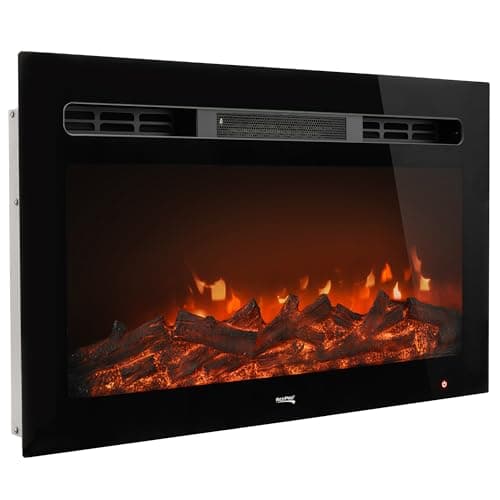 RecPro RV 26" Recessed Electric FireplaceAn RV supplier that publishes the cutout, the amperage and a proximity cut-off sensor — which is more than almost any household unit gives you. | The one built for the job | 27.5¢1,500 W · 5,118 BTU | |
| 2 | 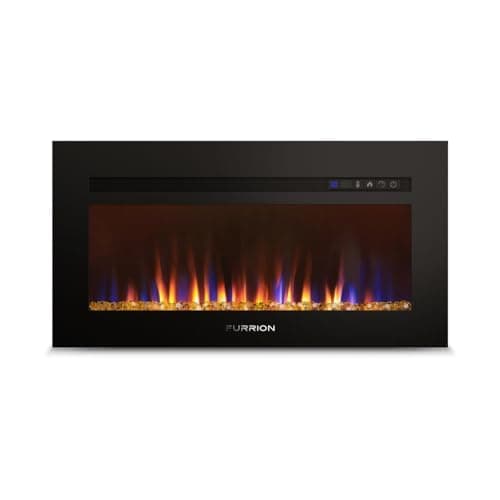 Furrion 30" Built-In RV Electric Fireplace (FF30SC15A-BL)The brand fitted as original equipment in a great many trailers, at 1,400 W rather than 1,500 — which on shore power is a point in its favor. | Matching what the coach already had | 25.7¢1,400 W · 4,777 BTU | |
| 3 | 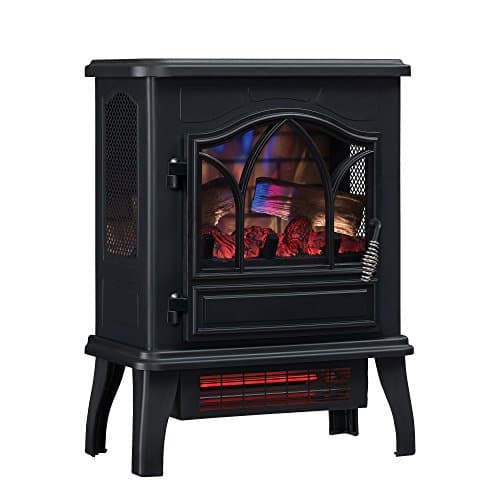 Duraflame DFI-470-04 3D Infrared Quartz StoveA freestanding stove that needs a socket and some floor — the only option here that does not involve putting a hole in your coach. | No cutting at all | 27.5¢1,500 W · 5,118 BTU | |
| — | 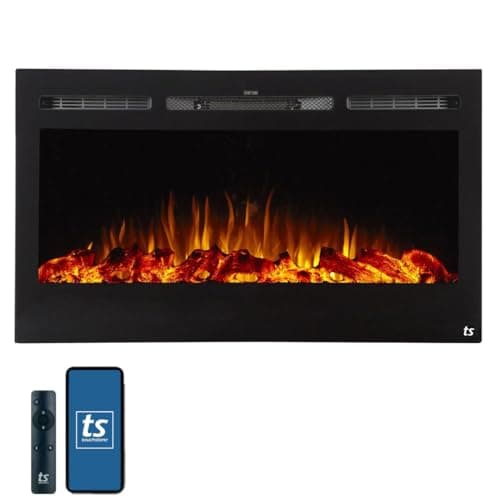 Touchstone The Sideline 36A good household fireplace and the wrong shape for a coach: 5 1/2 inches deep, 12 amps, and no cutout figure written for a vehicle.Skip this one | Nothing in an RV | 27.5¢1,500 W · 5,118 BTU |
#ad Buy links are affiliate links — we earn a commission on Amazon purchases at no extra cost to you, and it never changes the ranking. How this site is funded. Running cost is computed at 18.34¢/kWh; see what these actually cost to run.
The cutout is the part you cannot undo
This is where RV-specific products earn their money. In a house, a rough opening that is half an inch out is a trim problem. In a coach, the wall is thin, the framing is light, and there may be wiring or plumbing in places no stud finder will warn you about — and the panel you cut is often structural in a way a drywall partition is not.
- Get the cutout figure before you buy, not after. RecPro publishes 22 1/8 by 16 1/8 by 5 1/2 inches for the 26-inch unit. That is the number that matters, not the 26.
- Check depth behind the wall, not just the opening. Six inches of body needs six inches of somewhere to go.
- Confirm the variant. RecPro alone sells flat and curved 26-inch versions with different cutouts. The width in the product name is not the rough opening.
- If you are replacing an existing unit, measure the hole you already have first and shop to that — starting with the incumbent brand usually saves a rebuild.
- If any of this is uncertain, buy the stove. No cutout, no permanent change, and it moves to the next coach with you.
What it costs to run on hookup
If you are on metered shore power or paying for a site with electricity included up to a cap, the arithmetic matters more than it does at home. At the June 2026 US residential average of 18.34 cents per kilowatt-hour:
| Usage | Hours | Heat on (1,500 W) | Flame only (~100 W) |
|---|---|---|---|
| One evening | 4 | $1.10 | $0.07 |
| A week of evenings | 28 | $7.70 | $0.51 |
| A month, 4 hrs a night | 120 | $33.01 | $2.20 |
| A 90-day winter, 4 hrs a night | 360 | $99.04 | $6.60 |
| Per hour | 1 | 27.5¢ | 1.8¢ |
| Usage | Hours | Heat on (750 W) | Flame only (~100 W) |
|---|---|---|---|
| One evening | 4 | $0.55 | $0.07 |
| A week of evenings | 28 | $3.85 | $0.51 |
| A month, 4 hrs a night | 120 | $16.51 | $2.20 |
| A 90-day winter, 4 hrs a night | 360 | $49.52 | $6.60 |
| Per hour | 1 | 13.8¢ | 1.8¢ |
Campground electricity is frequently billed differently from home supply, so treat these as a baseline rather than a quote. The running cost calculator will take whatever rate you are actually paying.
Safety, in a vehicle specifically
- Stow anything freestanding before driving. A 20-pound stove is a projectile in a hard stop.
- Respect the clearance sensors. RecPro's six-inch proximity cut-off exists because RV interiors put soft furnishings close to everything.
- Never run one through an extension lead from a pedestal. At 12.5 amps continuous that is the exact failure mode these are known for.
- Remember there is no combustion — no carbon monoxide from the fireplace itself, unlike a propane furnace. That is a genuine advantage of electric in a sealed space.
- Check your converter's load before assuming the fireplace and everything else can coexist.
Questions people actually ask
Can you put an electric fireplace in an RV?
Yes, and several manufacturers make units specifically for it. The two things that decide whether it works are the cutout dimension — coach walls are thin and the hole is permanent — and your amp budget, since a 1,500 W fireplace takes about 12.5 of a 30-amp hookup's 30 amps.
How many amps does an RV electric fireplace use?
About 12.5 amps at 1,500 W on 120 V, or roughly 11.7 amps for a 1,400 W unit like the Furrion. On a 30-amp hookup that leaves around 17 amps for everything else, which usually rules out running the air conditioner at the same time.
Can I run an RV fireplace off an inverter or batteries?
Only with a substantial battery bank and inverter, and not for long — the heater draws around 1,500 W continuously. Most owners run the flame effect alone off battery, which uses a small fraction of that, and save the heater for shore power.
What size cutout does an RV electric fireplace need?
It varies by model and is not the same as the unit's width. RecPro publishes a 22 1/8 by 16 1/8 by 5 1/2 inch rough opening for its 26-inch fireplace. Always work from the manufacturer's cutout figure, and confirm which variant you are buying.
Are household electric fireplaces safe to install in a camper?
The electrical safety is comparable, but the fit usually is not: household units are designed around 2x4 or 2x6 framing and publish rough openings for it, while coach walls are thinner and lighter. A unit built for RVs comes with a cutout figure meant for your application.
Sources
Every figure on this page is either taken from one of these documents or computed from a formula shown on the page. Nothing here is recalled from memory.
- RecPro — RV electric fireplace 26 in (RP-FP-26L): 26 x 17 x 6 in, cutout 22 1/8 x 16 1/8 x 5 1/2 in, 750/1500 W, 120 V 15 A, 68-82 °F, 30 min-9 h timer, 6 in proximity cut-off
- Furrion FF30SC15A-BL — 30 x 17.75 x 6.25 in, 37.5 lb, 750/1400 W, up to 500 sq ft, 3 flame colors, slide-out and overheat shut-off
- Duraflame DFI-470-04 3D infrared quartz stove — 17 1/2 x 23 x 10.7 in, 5,200 BTU, 1,000 sq ft
- Touchstone Sideline Series owner's manual — covers 80004/80011/80014/80015/80025, max 1,500 W at 12 A, heater fan runs 8-10 s before and after the element
- NFPA — National Electrical Code (NFPA 70), the standard behind US branch-circuit limits
- US Consumer Product Safety Commission — portable heater safety guidance
- EIA Electric Power Monthly, Table 5.3 — US residential average, June 2026
Read next
- Electric fireplaces for apartments and rentals
No cutting, no hardwiring, nothing to repair at move-out. Five units ranked by reversibility, plus the shared-wall noise problem nobody mentions.
- Freestanding electric fireplace stoves
No opening, no framing, no electrician. Four stoves compared on heater type, flame depth and the floor space they genuinely need.
- Watts, amps and your circuit
12.5 amps on a 15-amp circuit. Why the ceiling exists, and where we stop and an electrician starts.
- Depth and clearance
3.5 inches of cavity in a standard wall, and what fits it. Plus the clearances that actually matter.
- Are electric fireplaces safe?
No combustion, no carbon monoxide, no flue. The four electrical considerations that do matter.