Roundup · flame quality
The most realistic electric fireplaces
Ranked by the mechanism that produces the flame, because that is the only thing that predicts whether it will convince you — and it is the thing nobody else states.
By Scooter M.Published September 2, 2026Last reviewed September 2, 2026
Disclosure: the buy links below are affiliate links. We earn a commission on Amazon purchases at no extra cost to you. It has never changed a ranking on this site, and every roundup here names a unit we think you should skip. How this site is funded.
How this page is ranked
By flame mechanism, and then by the structural features that improve one — depth, glass geometry, and whether there is a frame around the effect. Not by adjectives. "Incredibly realistic" appears on the packaging of every unit in this category, including the worst ones, so it carries no information at all.
The single most useful thing to know before shopping is that realism has one clear technological tier break in it, and everything else is refinement. Water vapor produces a flame with real volume. Everything else produces a lit surface, refined to varying degrees. Once you know which side of that line you are shopping on, the rest is manageable.
Quick picks: flame realism
Ranked. The running cost column is computed from each unit's rated wattage, not quoted from a manufacturer. Tap a row for the full write-up.
| # | Product | Best for | Cost per hour | Price |
|---|---|---|---|---|
| 1 | Dimplex Opti-Myst Revive 25" Water Vapor FireplaceUltrasonic mist lit by LEDs. The flame occupies actual three-dimensional space, which no LED unit can do at any price. | The only flame with real volume | No heaterflame effect only | |
| 2 | Dimplex Opti-Myst Aura 28" Water Vapor Fireplace28 inches of ultrasonic mist flame. Cool to the touch, no combustion, no emissions, and no heat either. | The same mechanism, three inches wider | No heaterflame effect only | |
| 3 | 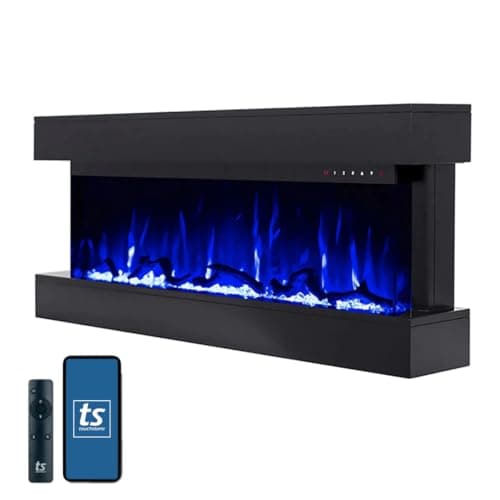 Touchstone Chesmont Black 50 (3-Sided)Three-sided glass. It attacks the exact failure mode that gives LED flames away, and it is the cheapest way to do so. | The best LED fix for off-axis viewing | 27.5¢1,500 W · 5,118 BTU | |
| 4 | 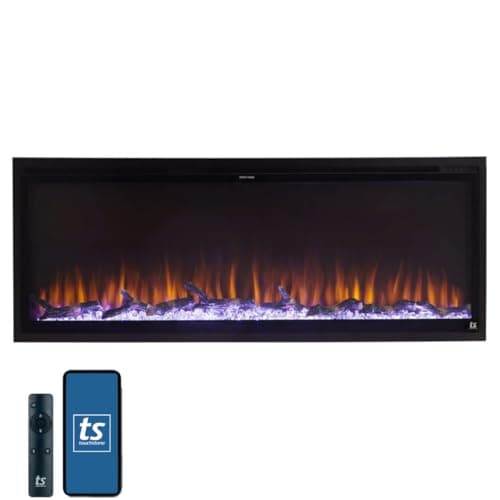 Touchstone Sideline Elite 50A frameless glass front. Sounds cosmetic; is the single strongest visual cue that separates an opening from an appliance. | Removing the frame | 27.5¢1,500 W · 5,118 BTU | |
| 5 | 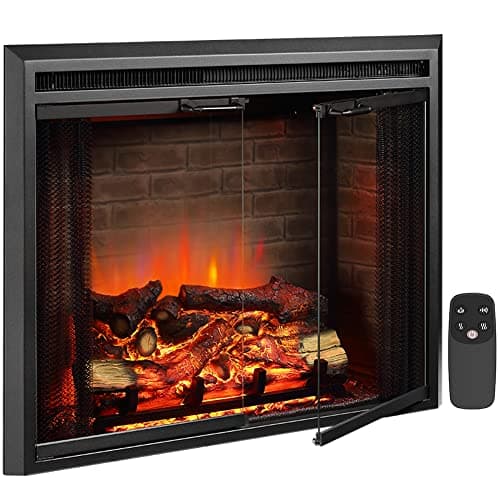 PuraFlame Klaus 33" Electric Fireplace InsertGlass, mesh screen, brick interior and a log raised on a grate. Old-fashioned tricks, and they work. | Traditional realism, cheaply | 27.5¢1,500 W · 5,118 BTU | |
| — | TURBRO In-Flame INF36-W 36" Wall-Mounted FireplaceA plain hanging unit with no depth features, no frameless front and no three-sided glass. On a realism ranking there is nothing here to rank.Skip this one | Nothing on this page | 25.7¢1,400 W · 4,777 BTU |
#ad Buy links are affiliate links — we earn a commission on Amazon purchases at no extra cost to you, and it never changes the ranking. How this site is funded. Running cost is computed at 18.34¢/kWh; see what these actually cost to run.
The three cheap things that improve any flame
- Depth behind the flame. Something to look into. A flame with an inch behind it is a picture; a flame with six inches behind it is a fire.
- A separately lit ember bed. Real fires glow from underneath. A unit that lights only the flame and not the bed reads wrong even when you cannot say why.
- Glass in front, and ideally on the sides. Glass adds reflection and refraction, which the eye reads as heat and movement. Three-sided glass adds depth from off-axis, which is where LED units fail.
A unit with all three at $400 usually looks better than one with none at $900. That is a genuinely useful shopping heuristic and it is why the Chesmont's three-sided geometry ranks above units with more expensive electronics. Where the money does start buying realism again is set out on high-end electric fireplaces.
#1 · The only flame with real volume
Dimplex Opti-Myst Revive 25" Water Vapor Fireplace
Ultrasonic mist lit by LEDs. The flame occupies actual three-dimensional space, which no LED unit can do at any price.
This is the one genuine step change in the category. Dimplex's Opti-Myst mechanism uses ultrasonic transducers to make a fine mist from ordinary tap water, then lights it from below with LEDs. The result is a flame that has real physical volume — it moves through space, it curls, and it reads as smoke and fire because it is behaving like a fluid rather than a picture of one.
Every LED unit, however good, is producing a lit surface. This is producing a lit object. From an angle, in daylight, from above — it holds up in situations where LED units flatten out.
The trade-offs are real and worth stating plainly. Dimplex publishes 120 V and 1,250 W for the Revive 25, and the flame effect produces no heat at all — heaters are a separate option on some models. It needs a water reservoir refilled. And it costs several times what a good LED unit costs. If you want warmth, this is the wrong product and no enthusiasm changes that.
What it does not do: No heat from the flame effect at all, and it needs a water reservoir refilled. If you want warmth, this is the wrong product and no amount of enthusiasm changes that.
Published specs
- Electrical:
- 120 V, 1,250 W
- Width:
- 25 in
- Flame:
- Ultrasonic water mist from ordinary tap water, lit by LEDs
- Heat:
- The flame effect produces NO heat. Heaters are a separate option on some models
- Install:
- Hardwired, or a compatible 120 V power cord
What it costs to run
No heater. The flame effect alone draws far less than a heating unit — see what these cost to run.
Computed at 18.34¢/kWh (EIA, June 2026). Your rate will differ — work out your own.
#ad Dimplex is not a program we have joined, so we earn nothing here. How this is funded. Price as of October 17, 2026.
Specs from: Dimplex Optimyst water vapor fireplaces — how the mist flame works; Dimplex Opti-Myst Revive 25 in — 120 V, 1,250 W.
#2 · The same mechanism, three inches wider
Dimplex Opti-Myst Aura 28" Water Vapor Fireplace
28 inches of ultrasonic mist flame. Cool to the touch, no combustion, no emissions, and no heat either.
The same technology as the Revive at a slightly larger width. Dimplex describes the flame as safe to touch — there is no combustion, no smell, no smoke and no emissions of any kind, because the visible flame is illuminated water vapor.
That is a genuinely unusual property in this category and it changes where you can put one. A mist fireplace can sit at floor level in a room with small children in a way that a heated glass front cannot.
Same caveat: the flame effect produces no heat. Buy it as a flame, not as a fireplace.
What it does not do: Refilling. Every water-vapor unit is a small appliance you maintain, not something you switch on and forget about for a season.
Published specs
- Width:
- 28 in
- Flame:
- Ultrasonic mist plus LED — a flame with real three-dimensional volume
- Heat:
- Flame effect produces no heat
- Safety:
- No combustion, no smoke, no emissions; the flame is cool to the touch
What it costs to run
No heater. The flame effect alone draws far less than a heating unit — see what these cost to run.
Computed at 18.34¢/kWh (EIA, June 2026). Your rate will differ — work out your own.
#ad Dimplex is not a program we have joined, so we earn nothing here. How this is funded. Price as of October 17, 2026.
Specs from: Dimplex Opti-Myst Aura 28 in product page; Dimplex Optimyst overview — cool flame, no emissions.
#3 · The best LED fix for off-axis viewing
Touchstone Chesmont Black 50 (3-Sided)
Three-sided glass. It attacks the exact failure mode that gives LED flames away, and it is the cheapest way to do so.
The single most common realism complaint about LED fireplaces is that they flatten from an angle. That happens because the flame is a lit surface with nothing behind it — move off-center and you are looking at the surface rather than into the effect.
Three-sided glass gives you depth to look into from the side, which is a structural fix rather than a cosmetic one. It is the reason corner electric fireplaces frequently look more convincing than flat ones despite using identical flame technology.
It only works where the side panes are actually visible — a corner or a peninsula wall. Fitted flat against a wall you are paying for two panes nobody will look through. Same 1,500 W heater as everything else.
What it does not do: Three-sided glass needs a corner or a peninsula wall to make sense. Against a flat wall you pay for two panes nobody ever sees.
Published specs
- Width:
- 50 in
- Form:
- Three-sided wall-mount — glass on the front and both ends
- Why it matters:
- Three-sided glass is the cheapest fix for the off-axis flatness that gives LED units away
What it costs to run
- 27.5¢/hr on full heat
- $99.04 across a 90-day winter at 4 hrs a night
- 5,118 BTU/hr · 12.5 A on a 120 V circuit
Computed at 18.34¢/kWh (EIA, June 2026). Your rate will differ — work out your own.
#ad We earn a commission on this link at no cost to you. How this is funded. Price as of October 17, 2026.
Specs from: Touchstone electric fireplaces collection — Chesmont Black 50.
#4 · Removing the frame
Touchstone Sideline Elite 50
A frameless glass front. Sounds cosmetic; is the single strongest visual cue that separates an opening from an appliance.
A bezel around a flame tells your eye it is looking at a screen or a box. Remove the bezel and the same flame reads as an opening in the wall. It is a surprisingly large effect for what is, on paper, a trim change.
The Elite sits above the standard Sideline 50 in Touchstone's range at the same 50-inch width.
The heater is identical to the cheaper model — same 1,500 W, same 27.5 cents an hour. Everything you pay extra for here is visual, which on a realism page is exactly the right thing to be paying for.
What it does not do: The heater is the same 1,500 W ceiling as the cheaper Sideline 50. The extra money buys the glass front and the flame presentation, not warmth.
Published specs
- Width:
- 50 in
- Form:
- Recessed, frameless glass front
- Position in line:
- Above The Sideline 50, below the Elite Pro
What it costs to run
- 27.5¢/hr on full heat
- $99.04 across a 90-day winter at 4 hrs a night
- 5,118 BTU/hr · 12.5 A on a 120 V circuit
Computed at 18.34¢/kWh (EIA, June 2026). Your rate will differ — work out your own.
#ad We earn a commission on this link at no cost to you. How this is funded. Price as of October 17, 2026.
Specs from: Touchstone electric fireplaces collection — Sideline Elite 50.
#5 · Traditional realism, cheaply
PuraFlame Klaus 33" Electric Fireplace Insert
Glass, mesh screen, brick interior and a log raised on a grate. Old-fashioned tricks, and they work.
Realism in a traditional fireplace comes from different cues than in a linear one: a log that sits above the ember bed rather than on it, so light gets underneath; a mesh screen that breaks up the light; and a brick-look interior that gives the fire a plausible place to be.
The Klaus does all three, at 33 1/16 inches wide with 750/1500 W heat. In a real masonry opening those cues do a lot of work.
It is LED with a reflector, so the honest caveat applies: convincing at night, head-on, and much less so in daylight or from an angle.
What it does not do: No trim kit in the base version — an existing masonry opening wider than 33 in leaves a visible gap unless you buy the trim separately.
Published specs
- Heater:
- 750 W / 1,500 W, two settings
- Width:
- 33 1/16 in
- Height:
- 25 9/16 in
- Flame:
- LED, three intensity settings, runs with heat off
- Front:
- Glass door, mesh screen, three-sided brick interior
- Log:
- Resin cast log, 11 13/16 in high, on a grate over the ember bed
What it costs to run
- 27.5¢/hr on full heat
- $99.04 across a 90-day winter at 4 hrs a night
- 5,118 BTU/hr · 12.5 A on a 120 V circuit
Computed at 18.34¢/kWh (EIA, June 2026). Your rate will differ — work out your own.
#ad We earn a commission on this link at no cost to you. How this is funded. Price as of October 17, 2026.
Specs from: PuraFlame Klaus insert listing (specifications and dimensions); Walmart product listing — 750/1500 W rating confirmed.
Skip this one
TURBRO In-Flame INF36-W 36" Wall-Mounted Fireplace
A plain hanging unit with no depth features, no frameless front and no three-sided glass. On a realism ranking there is nothing here to rank.
There is nothing wrong with this as a wall heater. Home Depot lists it at 1,400 W and 4,780 BTU per hour with a thermostat, timer and remote.
But this page ranks on flame mechanism, and this unit has none of the features that improve one: no frameless presentation, no three-sided glass, no layered depth, no mist. It is a lit panel in a frame.
If realism is your criterion, spend the same money on any of the units above it. If you want a wall heater with a flame effect, it is fine and belongs in the wall-mount roundup instead.
What it does not do: It is 1,400 W, not 1,500 W. That is 100 W less than the class ceiling — a real difference of about 340 BTU/hr, and the only unit in this catalog where the number is not the usual maximum.
Published specs
- Heater:
- 1,400 W convective
- Heat output:
- 4,780 BTU/hr
- Width:
- 36 in
- Mounting:
- Wall-mounted, with an optional standing base
- Control:
- Thermostat, timer, remote
What it costs to run
- 25.7¢/hr on full heat
- $92.43 across a 90-day winter at 4 hrs a night
- 4,777 BTU/hr · 11.7 A on a 120 V circuit
Computed at 18.34¢/kWh (EIA, June 2026). Your rate will differ — work out your own.
#ad We earn a commission on this link at no cost to you. How this is funded. Price as of October 17, 2026.
Specs from: Home Depot product page — TURBRO INF36-W, 4,780 BTU; TURBRO 36 in wall-mounted fireplace listing — 1,400 W heater.
What we can and cannot tell you
We have not watched these fireplaces burn. We do not own them, we have no viewing room, and we have not compared them side by side in daylight. What we have done is classify each one by the mechanism its manufacturer documents and explain what that mechanism physically can and cannot do.
That is a smaller claim than "we tested twelve models", and it has the advantage of being true and checkable. Everything here traces to a manufacturer's own description of how their product works. How we pick sets out the whole method, including what we do instead of testing.
| Usage | Hours | Heat on (1,500 W) | Flame only (~100 W) |
|---|---|---|---|
| One evening | 4 | $1.10 | $0.07 |
| A week of evenings | 28 | $7.70 | $0.51 |
| A month, 4 hrs a night | 120 | $33.01 | $2.20 |
| A 90-day winter, 4 hrs a night | 360 | $99.04 | $6.60 |
| Per hour | 1 | 27.5¢ | 1.8¢ |
Questions people actually ask
Which electric fireplace looks the most real?
Mechanically, water-vapor units such as the Dimplex Opti-Myst range, because the flame is illuminated mist occupying real three-dimensional space rather than a lit surface. They cost several times more than LED units, need refilling, and on most models the flame effect produces no heat at all.
Are electric fireplaces realistic?
In evening light, viewed head-on, modern layered-LED units are convincing enough that most visitors do not question them. In bright daylight or from a sharp angle, most are not. Which of those describes your room is a more useful question than any general answer.
Do electric fireplaces have real flames?
No. There is no combustion in any electric fireplace, which is why they need no chimney and produce no carbon monoxide. The flame is LEDs, a video screen, or lit water vapor — and in the last case it is genuinely cool to the touch.
Is a water vapor fireplace worth the money?
If flame realism is your priority and heat is not, yes — it is the only mechanism in the category that produces a flame with real volume. If you want warmth, no: Dimplex is explicit that the Opti-Myst flame effect produces no heat, and heaters are a separate option on some models.
Sources
Every figure on this page is either taken from one of these documents or computed from a formula shown on the page. Nothing here is recalled from memory.
- Dimplex Optimyst water vapor fireplaces — ultrasonic mist and LED mechanism
- Dimplex Opti-Myst Revive 25 in — 120 V, 1,250 W
- Touchstone Home Products — electric fireplace range and sizes
- PuraFlame Klaus 33 in insert — 750/1500 W, dimensions
- Home Depot — TURBRO INF36-W, 1,400 W, 4,780 BTU
- EIA Electric Power Monthly, Table 5.3 — US residential average, June 2026
Read next
- Flame technology explained
The four flame mechanisms, how each physically works, and the exact conditions where each one gives itself away.
- LED vs LCD vs water vapor
Three mechanisms, three price tiers, three failure modes — and how to tell which one your room needs.
- What makes a flame look fake
Six tells with physical causes — and the three you can fix in a minute with the remote.
- The most realistic electric fireplaces under $500
What genuinely improves a flame at the entry tier, and the units that carry those features.
- Dimplex Revillusion RBF30: a specification review
The best flame in its class, a 12-inch depth that rules out stud walls, and a headline BTU figure that needs a higher-voltage supply.
- Electric fireplaces with crackling sound
Which units include a crackle speaker, what separates a good loop from a bad one, and an honest answer to whether owners keep it on.