Roundup · heat delivery
The best electric fireplaces for heat
Every unit here is capped at the same wattage by the same circuit. So this is not a ranking by power. It is a ranking by where the heat goes and how it feels when it gets there.
By Scooter M.Published September 2, 2026Last reviewed September 2, 2026
Disclosure: the buy links below are affiliate links. We earn a commission on Amazon purchases at no extra cost to you. It has never changed a ranking on this site, and every roundup here names a unit we think you should skip. How this site is funded.
Why this is not a ranking by power
Because there is nothing to rank. A US household circuit is 120 volts and 15 amps, continuous loads are limited to about 12 amps, and 12.5 amps at 120 volts is 1,500 watts — so essentially every plug-in electric fireplace sold here is 1,500 W, producing about 5,118 BTU per hour. The $180 unit and the $1,800 unit make identical heat.
Which leaves three things that genuinely differ, and this page ranks on them: where the heat leaves the box, what kind of heater it is, and whether the unit gives you a low setting worth using.
Placement: the biggest real difference
| Form factor | Outlet height | Effectiveness for a seated person |
|---|---|---|
| Wall-mounted | 40–50 in | Best. Releases into the layer where torsos are |
| Freestanding stove | 20–24 in | Very good in a small room; radiates from the whole face |
| Masonry insert | Varies | Depends on heater type. Infrared clearly better than fan-forced |
| TV console | ~12 in | Weakest. Releases into the coldest layer of the room |
Heater type: real difference, same quantity
Fan-forced units blow air across a heating element. They warm a room faster, they are audible, and the warmth stops when the fan does. Infrared quartz units radiate onto surfaces and people directly, which feels gentler, does not dry the air the same way, and works better across a recess or a distance because it does not rely on air movement to reach you.
Both draw 1,500 W. Both produce 5,118 BTU per hour. The difference is entirely in how the heat is transported to you, and it is worth choosing deliberately — full comparison on infrared vs fan-forced.
Quick picks: heat delivery
Ranked. The running cost column is computed from each unit's rated wattage, not quoted from a manufacturer. Tap a row for the full write-up.
| # | Product | Best for | Cost per hour | Price |
|---|---|---|---|---|
| 1 | TURBRO In-Flame INF60W 60" Smart WiFi FireplaceInfrared quartz at 1,500 W, on a wall, at chest height. The best combination of heater type and placement in this catalog. | The best heat delivery available | 27.5¢1,500 W · 5,118 BTU | |
| 2 | 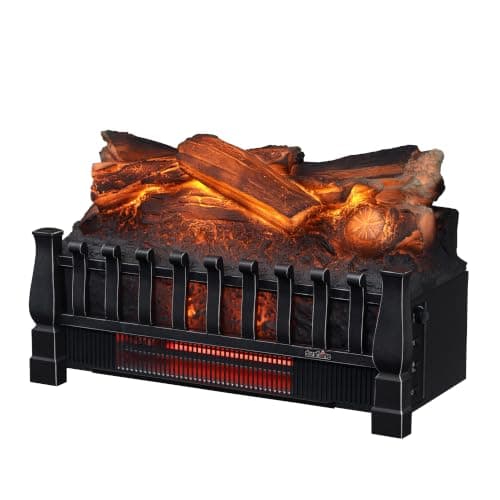 Duraflame DFI030ARU 20" Infrared Electric Fireplace Log SetThe infrared answer for a masonry opening — and infrared genuinely matters more in a recess than anywhere else. | Infrared in an existing firebox | 27.5¢1,500 W · 5,118 BTU | |
| 3 | 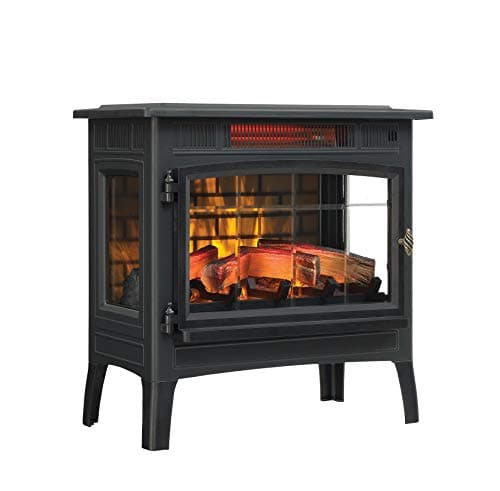 Duraflame DFI-5010-01 3D Infrared Fireplace Stove5,200 BTU per hour published, 120 V at 12.5 A per the manual, radiating from a whole front face at about two feet off the floor. | A small room or a corner | 27.5¢1,500 W · 5,118 BTU | |
| 4 | 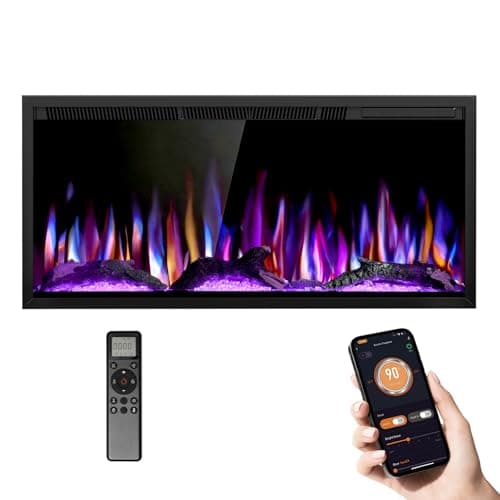 R.W.FLAME 36" Ultra-Thin Recessed & Wall-Mount Fireplace750 W low and 1,500 W high, with a published 5,100 BTU per hour. The low setting is the underrated feature. | Two-stage control | 27.5¢1,500 W · 5,118 BTU | |
| — | TURBRO In-Flame INF36-W 36" Wall-Mounted Fireplace1,400 W and 4,780 BTU per hour, per Home Depot. On a page about heat, the one unit that gives some up.Skip this one | Not a heat purchase | 25.7¢1,400 W · 4,777 BTU |
#ad Buy links are affiliate links — we earn a commission on Amazon purchases at no extra cost to you, and it never changes the ranking. How this site is funded. Running cost is computed at 18.34¢/kWh; see what these actually cost to run.
What it costs, on both settings
| Usage | Hours | Heat on (1,500 W) | Flame only (~100 W) |
|---|---|---|---|
| One evening | 4 | $1.10 | $0.07 |
| A week of evenings | 28 | $7.70 | $0.51 |
| A month, 4 hrs a night | 120 | $33.01 | $2.20 |
| A 90-day winter, 4 hrs a night | 360 | $99.04 | $6.60 |
| Per hour | 1 | 27.5¢ | 1.8¢ |
| Usage | Hours | Heat on (750 W) | Flame only (~100 W) |
|---|---|---|---|
| One evening | 4 | $0.55 | $0.07 |
| A week of evenings | 28 | $3.85 | $0.51 |
| A month, 4 hrs a night | 120 | $16.51 | $2.20 |
| A 90-day winter, 4 hrs a night | 360 | $49.52 | $6.60 |
| Per hour | 1 | 13.8¢ | 1.8¢ |
Two tables rather than one, because the low setting is the most underused feature in this category. Half the cost, half the heat, and for a room that is nearly comfortable already, half is the right answer.
#1 · The best heat delivery available
TURBRO In-Flame INF60W 60" Smart WiFi Fireplace
Infrared quartz at 1,500 W, on a wall, at chest height. The best combination of heater type and placement in this catalog.
If you rank purely on how effectively the heat reaches a seated person, this wins — not because it makes more heat, but because it makes the same heat and puts it in a better place.
TURBRO publishes 1,500 W infrared quartz, recessed or wall-mounted, at 60 inches. Infrared radiates onto people and objects rather than blowing air, which means it does not depend on convection currents finding you.
The WiFi and the crackle speaker are the premium. The heat is the same 5,118 BTU per hour as everything else. Buy it for the placement and the heater type, not for a number.
What it does not do: WiFi and a crackle speaker are the upgrade here. The heater is the same 1,500 W as a unit costing a fraction of it. At 4.6 in deep it will not sit flush in a standard 2x4 wall.
Published specs
- Heater:
- 1,500 W infrared quartz
- Heat output:
- 5,118 BTU/hr
- Dimensions:
- 60 in W x 18 in H x 4.6 in D
- Weight:
- 56.2 lb
- Mounting:
- Recessed or wall-mounted
- Flame:
- 12 flame colors, 13 ember-bed colors
- Extras:
- WiFi app control, Alexa and Google, crackling sound effect
- Cord:
- 5.9 ft
What it costs to run
- 27.5¢/hr on full heat
- $99.04 across a 90-day winter at 4 hrs a night
- 5,118 BTU/hr · 12.5 A on a 120 V circuit
Computed at 18.34¢/kWh (EIA, June 2026). Your rate will differ — work out your own.
#ad We earn a commission on this link at no cost to you. How this is funded. Price as of October 17, 2026.
Specs from: TURBRO In-Flames INF60W product page — 1,500 W quartz; TURBRO In-Flames INF60W-3D listing — dimensions, weight, 5,118 BTU.
#2 · Infrared in an existing firebox
Duraflame DFI030ARU 20" Infrared Electric Fireplace Log Set
The infrared answer for a masonry opening — and infrared genuinely matters more in a recess than anywhere else.
A fan-forced unit set deep inside a brick firebox spends part of its output warming brick, because convection has to escape a recess before it reaches anyone. Infrared does not have that problem: it radiates outward in a line.
Duraflame rates this for supplemental heating up to 1,000 square feet on infrared quartz. Read that as a supplemental rating rather than a coverage promise — the physical ceiling is still 5,118 BTU per hour.
For anyone putting heat into a masonry fireplace, this is the correct heater technology and it is not close.
What it does not do: The 1,000 sq ft figure is the manufacturer's supplemental-heat rating, not a claim that it will hold temperature in a 1,000 sq ft room. See our BTU page for what the wattage actually buys.
Published specs
- Heater:
- Infrared quartz, rated by the manufacturer for up to 1,000 sq ft
- Width:
- 20 in
- Form:
- Drop-in log set for an existing firebox
- Flame:
- LED with resin cast logs and glowing embers
- Control:
- Remote with adjustable thermostat
What it costs to run
- 27.5¢/hr on full heat
- $99.04 across a 90-day winter at 4 hrs a night
- 5,118 BTU/hr · 12.5 A on a 120 V circuit
Computed at 18.34¢/kWh (EIA, June 2026). Your rate will differ — work out your own.
#ad We earn a commission on this link at no cost to you. How this is funded. Price as of October 17, 2026.
Specs from: Duraflame DFI030ARU listing — infrared, 1,000 sq ft rating; Bed Bath & Beyond product page — 20 in infrared log set.
#3 · A small room or a corner
Duraflame DFI-5010-01 3D Infrared Fireplace Stove
5,200 BTU per hour published, 120 V at 12.5 A per the manual, radiating from a whole front face at about two feet off the floor.
This is the best-documented heat specification of anything on this site, which is worth something on a page about heat: 5,200 BTU per hour, 120 V, 12.5 A, straight out of the manual and the retailer listing.
A stove radiates from its entire front face and both side windows rather than through a single outlet, and it sits in the room rather than on a wall — which in a small room or an alcove is a real advantage.
It has feet and needs clearance. It is not going in your wall or your firebox.
What it does not do: It is a freestanding stove, not an insert. It will not fill a masonry opening and it needs floor space plus clearance in front of the glass door.
Published specs
- Heat output:
- 5,200 BTU/hr
- Electrical:
- 120 V, 12.5 A
- Dimensions:
- 24 in W x 23.4 in H x 13.1 in D
- Weight:
- 28.6 lb
- Flame:
- Layered 3D flame effect, five brightness settings
- Safety:
- Overheat shutoff, adjustable digital thermostat
What it costs to run
- 27.5¢/hr on full heat
- $99.04 across a 90-day winter at 4 hrs a night
- 5,118 BTU/hr · 12.5 A on a 120 V circuit
Computed at 18.34¢/kWh (EIA, June 2026). Your rate will differ — work out your own.
#ad We earn a commission on this link at no cost to you. How this is funded. Price as of October 17, 2026.
Specs from: Duraflame DFI-5010-02-3A user manual — 120 V, 12.5 A; Walmart product page — 5,200 BTU, dimensions, weight.
#4 · Two-stage control
R.W.FLAME 36" Ultra-Thin Recessed & Wall-Mount Fireplace
750 W low and 1,500 W high, with a published 5,100 BTU per hour. The low setting is the underrated feature.
A two-stage heater is more useful than it sounds. Most rooms most evenings do not need 1,500 W — they need to stop being slightly cold. 750 W does that at half the running cost, which is about 13.8 cents an hour instead of 27.5.
R.W.FLAME publishes 750/1500 W at 120 V, 5,100 BTU per hour and a 400 square foot supplemental rating, across a range from 30 to 68 inches at 3.86 inches deep.
Wall placement, published numbers, and a genuinely useful low setting. It is the sensible choice on this page.
What it does not do: No mantel, no surround and no trim for a masonry opening. Recessing it means cutting drywall and, in most homes, running a receptacle inside the cavity.
Published specs
- Heater:
- 750 W low / 1,500 W high
- Electrical:
- 120 V
- Heat output:
- 5,100 BTU/hr (manufacturer figure)
- Depth:
- 3.86 in — thin enough for a 2x4 stud bay
- Coverage:
- Rated by the manufacturer for up to 400 sq ft
- Flame:
- 12 flame colors, 12 ember-bed colors, 5 brightness levels, 5 speeds
- Sizes in the line:
- 30, 36, 42, 50, 60 and 68 in
What it costs to run
- 27.5¢/hr on full heat
- $99.04 across a 90-day winter at 4 hrs a night
- 5,118 BTU/hr · 12.5 A on a 120 V circuit
Computed at 18.34¢/kWh (EIA, June 2026). Your rate will differ — work out your own.
#ad We earn a commission on this link at no cost to you. How this is funded. Price as of October 17, 2026.
Specs from: R.W.FLAME recessed/wall-mount product page — full specifications.
Skip this one
TURBRO In-Flame INF36-W 36" Wall-Mounted Fireplace
1,400 W and 4,780 BTU per hour, per Home Depot. On a page about heat, the one unit that gives some up.
Everywhere else on this site we point out that wattage is identical across the category, so nobody should pay more for heat. This is the exception in the other direction: it is 100 W below the ceiling, which is about 340 BTU per hour.
That is roughly a 7% shortfall. In absolute terms it is small — you would struggle to feel it. In the context of a page specifically about which unit heats best, it is the one that heats least.
There is no compensating advantage: it is not thinner, and it is a wall-hung design rather than a flush one. If heat is your criterion, every other unit on this page is a better answer.
What it does not do: It is 1,400 W, not 1,500 W. That is 100 W less than the class ceiling — a real difference of about 340 BTU/hr, and the only unit in this catalog where the number is not the usual maximum.
Published specs
- Heater:
- 1,400 W convective
- Heat output:
- 4,780 BTU/hr
- Width:
- 36 in
- Mounting:
- Wall-mounted, with an optional standing base
- Control:
- Thermostat, timer, remote
What it costs to run
- 25.7¢/hr on full heat
- $92.43 across a 90-day winter at 4 hrs a night
- 4,777 BTU/hr · 11.7 A on a 120 V circuit
Computed at 18.34¢/kWh (EIA, June 2026). Your rate will differ — work out your own.
#ad We earn a commission on this link at no cost to you. How this is funded. Price as of October 17, 2026.
Specs from: Home Depot product page — TURBRO INF36-W, 4,780 BTU; TURBRO 36 in wall-mounted fireplace listing — 1,400 W heater.
Questions people actually ask
Which electric fireplace produces the most heat?
Practically, they tie. Any unit rated 1,500 W produces about 5,118 BTU per hour, and that is the ceiling for a 120 V plug-in appliance. A unit claiming more is either 240 V hardwired or is quoting a coverage rating rather than an output figure.
Is 5,000 BTU enough to heat a room?
About enough for 256 square feet as the only heat source, on the common 20-BTU-per-square-foot rule of thumb. In a larger or draftier room it is supplemental heat. Check your own room in the room size calculator.
Are infrared electric fireplaces warmer?
No — same wattage, same BTU. Infrared feels different because it heats objects and people directly rather than heating air, which many people find more comfortable and which works better across a distance or out of a recess.
Should I use the 750 W or 1,500 W setting?
750 W if the room is nearly comfortable and you want to keep it that way — it costs half as much and is frequently enough. 1,500 W to warm a cold room up. Running on high in an already-warm room just costs more.
Sources
Every figure on this page is either taken from one of these documents or computed from a formula shown on the page. Nothing here is recalled from memory.
- EIA Electric Power Monthly, Table 5.3 — US residential average, June 2026
- Home Depot — TURBRO INF36-W, 1,400 W, 4,780 BTU
- R.W.FLAME recessed / wall-mount range — 3.86 in depth, 750/1500 W, 5,100 BTU
- Duraflame DFI-5010 user manual — 120 V, 12.5 A
- Duraflame DFI030ARU — infrared quartz log set, 1,000 sq ft rating
- EcoCostSavings — measured wattage and BTU across 117 electric fireplace models
Read next
- Do electric fireplaces actually heat a room?
Yes, up to about 256 square feet. Above that it is supplemental heat, and no plug-in unit does better.
- Infrared vs fan-forced
Identical output, different delivery. Which one suits a recess, a big room, or a dry house.
- BTU and room size
BTU-to-square-feet, banded — with a calculator that reports the shortfall as honestly as the fit.
- What an electric fireplace costs to run
27.5 cents an hour on heat, under two cents on flame alone — computed at the real 2026 rate, with the source.
- Electric fireplace inserts with a blower
Which inserts genuinely have a blower, sourced from the manufacturer rather than assumed — plus the 8-second quirk every fan-forced unit shares.