Roundup · updated for the 2026 heating season
Cheap electric fireplaces worth buying
This is the one category where the budget option is not a compromise on the headline number. A cheap unit and a flagship produce identical heat. Here is what you actually give up, and what you do not.
By Scooter M.Published September 13, 2026Last reviewed September 13, 2026
Disclosure: the buy links below are affiliate links. We earn a commission on Amazon purchases at no extra cost to you. It has never changed a ranking on this site, and every roundup here names a unit we think you should skip. How this site is funded.
The short answer
A cheap electric fireplace produces exactly as much heat as an expensive one. Every unit on this site, from the least expensive log set to a flagship costing twenty times as much, is capped at 1,500 W by a 120 V household circuit — about 5,118 BTU per hour. That is not a budget compromise. It is the wiring. What the extra money buys is how it looks, how it is documented and how it is built, and this page is about deciding whether you want those things.
What the cheap end does not cost you
- Heat. Identical ceiling, identical BTU, identical running cost per hour. This is the big one and it is genuinely true.
- Safety mechanisms. Overheat cutoffs and thermostatic control are standard across the category, not premium features. There is no combustion, no flue and no carbon monoxide at any price.
- Independent flame. Every unit here runs the flame with the heater off, which is how most owners use them for most of the year.
- Remote control. Standard even at the bottom of the range.
What it does cost you
- Enclosure and trim. Budget units are log sets and bare panels. They fill an opening; they do not finish one. A gap around the unit is yours to solve.
- Flame depth. The cheapest flame is LED bounced off a reflector, which looks flat off-axis. Layered and three-dimensional flames cost more, and the difference is visible. What makes a flame look fake covers why.
- Documentation. The single clearest difference in researching this page. Premium brands publish heater types, manuals and electrical tables. Budget brands frequently publish a wattage and stop.
- Warranty. One year is normal at the bottom. Five years with in-home service exists at the top.
- Two-stage heat, sometimes. Though not reliably — one of the cheapest units here has a 750 W low setting and one of the most expensive does not.
Quick picks: the budget end, ranked
Ranked. The running cost column is computed from each unit's rated wattage, not quoted from a manufacturer. Tap a row for the full write-up.
| # | Product | Best for | Cost per hour | Price |
|---|---|---|---|---|
| 1 | 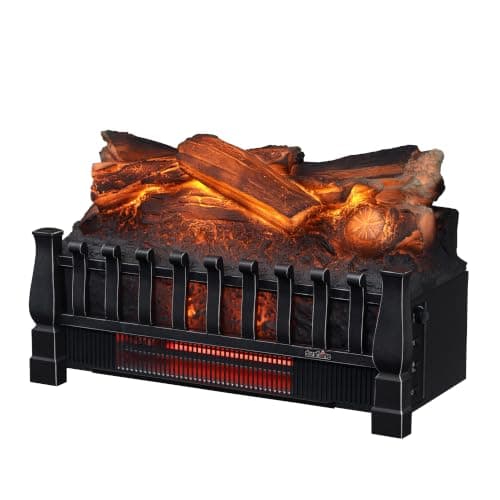 Duraflame DFI030ARU 20" Infrared Electric Fireplace Log SetInfrared quartz, silent, and rated for supplemental heat up to 1,000 square feet — at a price nearer a space heater than a fireplace. | Best value in the whole catalog | 27.5¢1,500 W · 5,118 BTU | |
| 2 | 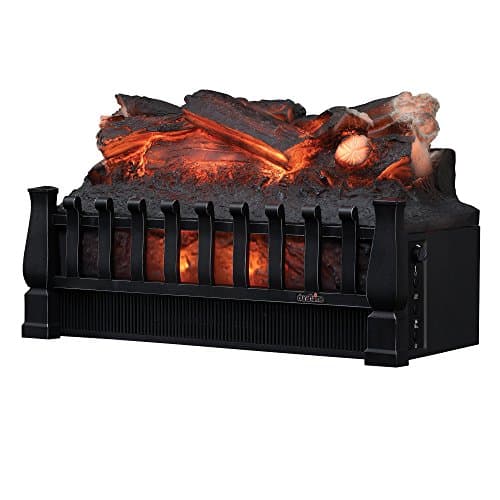 Duraflame DFI021ARU 20" Electric Fireplace Log SetThe entry point of the entire category. A conventional element instead of infrared, and honest about being the cheap one. | The least money that still works | 27.5¢1,500 W · 5,118 BTU | |
| 3 | 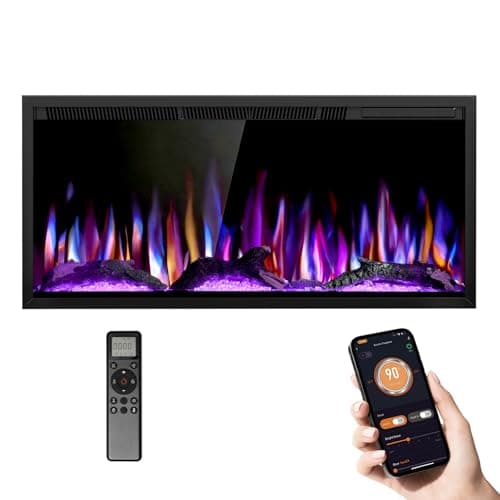 R.W.FLAME 36" Ultra-Thin Recessed & Wall-Mount FireplaceTwo-stage heat, a thermostat and 3.86 inches of depth, which is the specification that normally costs several times this. | The cheapest wall unit that fits a 2x4 wall | 27.5¢1,500 W · 5,118 BTU | |
| 4 | 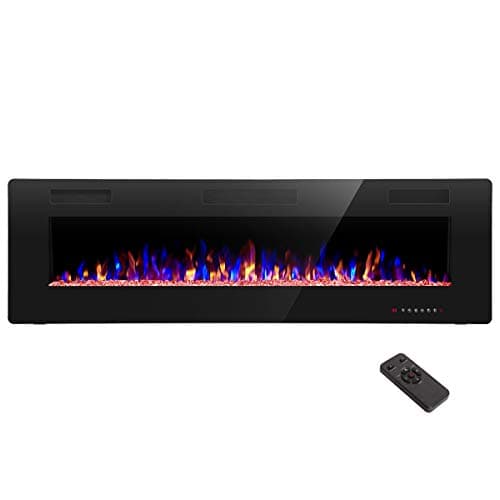 R.W.FLAME 60" Ultra-Thin Recessed & Wall-Mount FireplaceSixty inches of flame for close to what a 36-inch unit costs elsewhere, with the same two-stage heater and thermostat. | The most width per dollar | 27.5¢1,500 W · 5,118 BTU | |
| 5 | 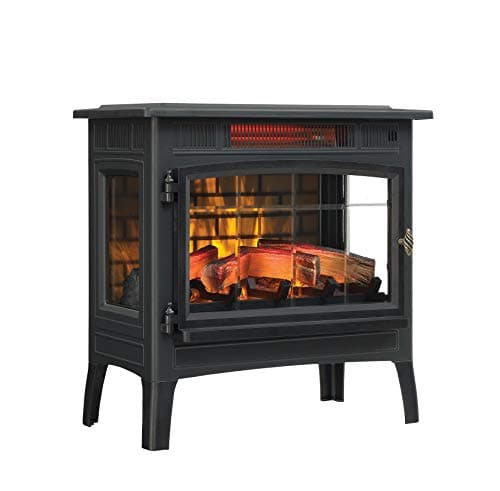 Duraflame DFI-5010-01 3D Infrared Fireplace StoveA freestanding stove that needs nothing but a socket and some floor space — the cheapest way to have a fire in a room with no fireplace at all. | No installation of any kind | 27.5¢1,500 W · 5,118 BTU | |
| 6 | 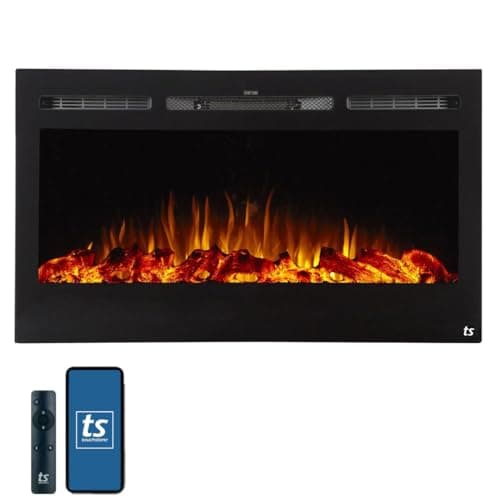 Touchstone The Sideline 36Not a budget unit, and included to show where the extra money actually goes: documentation, a published heater spec and a brand that only makes fireplaces. | The first step up worth taking | 27.5¢1,500 W · 5,118 BTU |
#ad Buy links are affiliate links — we earn a commission on Amazon purchases at no extra cost to you, and it never changes the ranking. How this site is funded. Running cost is computed at 18.34¢/kWh; see what these actually cost to run.
The number that makes this whole category unusual
It is worth seeing the arithmetic rather than taking the claim on trust. A 120 V branch circuit limits a portable appliance to 1,500 W, which is 12.5 amps. Watts convert to BTU at a fixed rate of 3.412142, so 1,500 W is 5,118 BTU per hour no matter whose badge is on the front. Running cost follows the same way: watts multiplied by your tariff.
| Usage | Hours | Heat on (1,500 W) | Flame only (~100 W) |
|---|---|---|---|
| One evening | 4 | $1.10 | $0.07 |
| A week of evenings | 28 | $7.70 | $0.51 |
| A month, 4 hrs a night | 120 | $33.01 | $2.20 |
| A 90-day winter, 4 hrs a night | 360 | $99.04 | $6.60 |
| Per hour | 1 | 27.5¢ | 1.8¢ |
This is why we are comfortable recommending budget units without hedging. In most categories the cheap option is worse at the main job. Here the main job is fixed by the National Electrical Code, and the cheap option does it identically. The running cost calculator will confirm it against your own tariff.
Where cheap genuinely goes wrong
Three failure modes account for most of the disappointment at this end of the market, and all three are avoidable at the point of purchase rather than afterwards.
- Buying an undersized width. The most common regret, and the most expensive to fix, because the fix is another fireplace. Measure the wall, then buy for the wall.
- Buying a stove when you needed an insert. They share brands, model families and search results. A freestanding stove will not fill a masonry opening. See log sets vs inserts.
- Assuming the depth figure. Recessed units live or die on whether they fit a 2x4 stud bay. Several list a depth that suggests they do while referencing 2x6 framing elsewhere. Confirm before cutting.
What we would actually buy
If there is an existing firebox: the infrared log set, without much hesitation. It is the best value on the site and the silence is a genuine upgrade rather than a specification.
If the fireplace is going into a wall: the 36-inch R.W.FLAME for a small room, the 60-inch for anything large, on the strength of the two-stage heater and the shallow depth. And if there is nowhere to put anything, the freestanding stove, which needs no permission from the building.
Questions people actually ask
Do cheap electric fireplaces heat as well as expensive ones?
Yes. A 120 V household circuit caps every unit at 1,500 W, or about 5,118 BTU per hour, so a budget log set and a flagship firebox produce the same heat and cost the same per hour to run. The only exceptions are units wired to 240 V, which requires an electrician and a dedicated circuit.
What is the catch with a cheap electric fireplace?
Finish and documentation rather than performance. Budget units usually have no enclosure or trim, a flatter LED flame that looks less convincing off-axis, a one-year warranty, and manufacturers who publish a wattage and little else.
Are cheap electric fireplaces safe?
The safety mechanisms that matter — overheat cutouts and thermostatic control — are standard across the category rather than premium features, and no electric fireplace has combustion, a flue or carbon monoxide. The real precaution at any price is electrical: plug directly into a wall receptacle, never an extension cord.
What is the cheapest type of electric fireplace?
A drop-in log set, because it has no enclosure, no glass and no trim — it uses the firebox you already have. It is the least product for the money in the literal sense, which in a period fireplace is an advantage rather than a compromise.
Is it worth paying more for an electric fireplace?
Only for flame quality, finish, published specifications and warranty. If you are paying more expecting a warmer room on a standard circuit, you are paying for something you will not receive.
Sources
Every figure on this page is either taken from one of these documents or computed from a formula shown on the page. Nothing here is recalled from memory.
- Duraflame DFI030ARU — infrared quartz log set, 1,000 sq ft rating
- Duraflame DFI-5010 user manual — 120 V, 12.5 A
- R.W.FLAME recessed / wall-mount range — 3.86 in depth, 750/1500 W, 5,100 BTU
- R.W.FLAME 60 in recessed / wall-mount listing — 60 x 18.1 x 3.85 in, 750/1500 W, 120 V
- Touchstone Home Products — electric fireplace range and sizes
- Touchstone Sideline Series owner's manual — covers 80004/80011/80014/80015/80025, max 1,500 W at 12 A, heater fan runs 8-10 s before and after the element
- NFPA — National Electrical Code (NFPA 70), the standard behind US branch-circuit limits
- EIA Electric Power Monthly, Table 5.3 — US residential average, June 2026
- EcoCostSavings — measured wattage and BTU across 117 electric fireplace models
Read next
- The most realistic electric fireplaces under $500
What genuinely improves a flame at the entry tier, and the units that carry those features.
- The best electric fireplace inserts
Six inserts ranked by opening fit, flame mechanism and computed running cost — plus the one we would not buy.
- The electric fireplace buying guide
Five decisions in order, the specs that matter, and the four that do not differ between units at all.
- What an electric fireplace costs to run
27.5 cents an hour on heat, under two cents on flame alone — computed at the real 2026 rate, with the source.
- Electric log sets vs fireplace inserts
One leaves your firebox visible, one covers it. Depth, effort and cost compared, with the units that suit each.