Roundup · updated for the 2026 heating season
Electric fireplaces with crackling sound
Sound is the sense electric fireplaces usually ignore, which is odd, because a real fire is as recognizable with your eyes shut as open. A few units try. Here is how well, and how long the novelty lasts.
By Scooter M.Published September 21, 2026Last reviewed September 21, 2026
Disclosure: the buy links below are affiliate links. We earn a commission on Amazon purchases at no extra cost to you. It has never changed a ranking on this site, and every roundup here names a unit we think you should skip. How this site is funded.
The short answer
A crackle speaker is a real feature and a small one. It costs the manufacturer very little, it genuinely helps at first, and most owners either leave it on permanently or switch it off within a week — there is not much middle ground. Two things decide which camp you land in: whether the loop is short enough to notice repeating, and whether the fireplace's own fan is louder than the effect. Buy it as a bonus on a unit you already want, never as the reason to choose one.
Why sound is the neglected sense here
This whole category is built around one sense. Manufacturers spend their engineering budget on flame technology — mirror-free fireboxes, layered LEDs, ultrasonic mist — and our own realism taxonomy is entirely about how the flame is produced, because that is what predicts whether a unit convinces you.
But a real fire is instantly recognizable with your eyes closed, and the reason is the irregularity: sharp cracks at unpredictable intervals over a low continuous rustle. That irregularity is exactly what a cheap loop cannot reproduce, which is why a bad crackle effect is worse than none. Your ear finds the repeat in about ninety seconds and then cannot unhear it.
What separates a good effect from a bad one
- Loop length. The single biggest factor. A short sample repeats audibly; a long one does not. Almost nobody publishes the length, which tells you something.
- Whether the speaker is real hardware. Touchstone calls out a premium crackle speaker on the Elite Pro. Most units route the sound through whatever small transducer was cheapest.
- Independent volume. You want the crackle adjustable separately from everything else. Tangkula's stove range offers three volume levels; several units offer on or off.
- Whether the heater drowns it. A fan-forced unit at full output is louder than any crackle speaker in this class. On an infrared unit it is not.
- Whether it runs with the flame alone. Most people run flame-only for most of the year, so the sound needs to work in that mode rather than only with the heater on.
Quick picks: units with a crackle effect
Ranked. The running cost column is computed from each unit's rated wattage, not quoted from a manufacturer. Tap a row for the full write-up.
| # | Product | Best for | Cost per hour | Price |
|---|---|---|---|---|
| 1 | 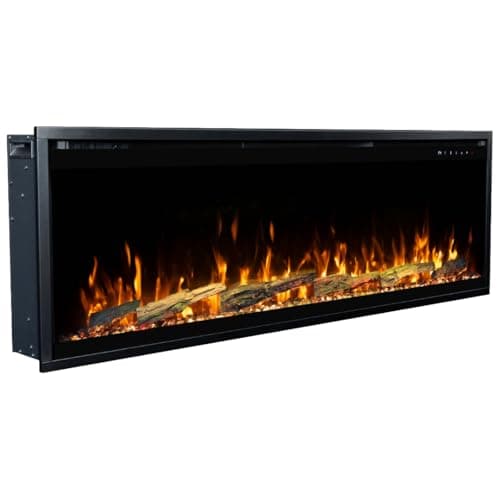 Touchstone Sideline Elite Pro 60 (80058)Touchstone calls it a premium crackle speaker and gives it its own hardware — the only unit here where the sound was clearly designed rather than added. | The best-integrated crackle | 27.5¢1,500 W · 5,118 BTU | |
| 2 | 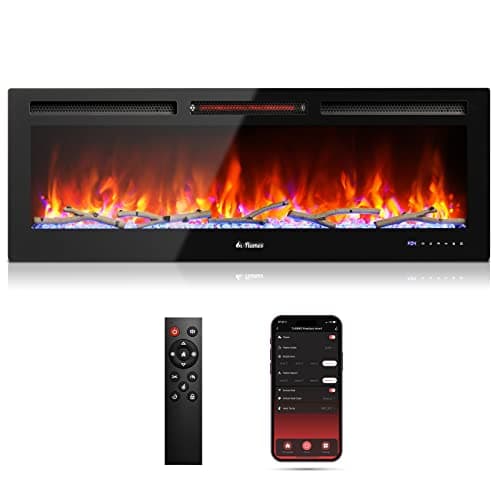 TURBRO In-Flame INF50W-3D 50" Smart WiFi Infrared FireplaceThe only unit here whose own heater will not drown the effect — infrared, with a published 42 dB noise figure. | Crackle on a silent heater | 27.5¢1,500 W · 5,118 BTU | |
| 3 | 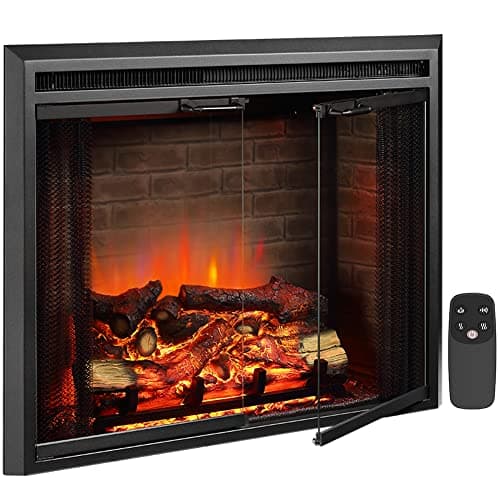 PuraFlame Klaus 33" Electric Fireplace InsertThe cheapest way to get the effect where it makes most sense — inside a masonry opening, behind a glass door. | Crackle in a traditional firebox | 27.5¢1,500 W · 5,118 BTU | |
| 4 | 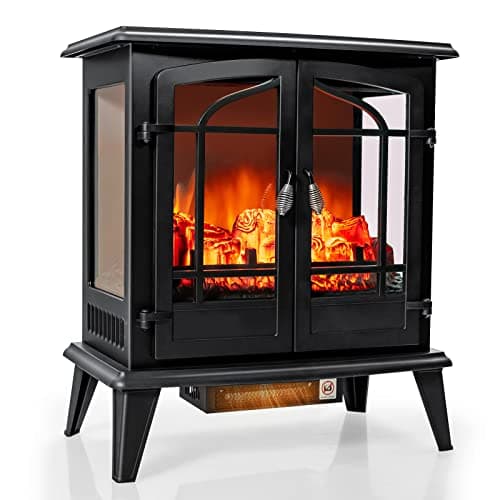 Tangkula 25" Freestanding Electric Fireplace StoveA three-sided freestanding stove with a wide thermostat range — the format where a quiet room and a nearby speaker suit each other. | Sitting close to it | 25.7¢1,400 W · 4,777 BTU | |
| — | Dimplex Opti-Myst Revive 25" Water Vapor FireplaceThe most convincing flame made, and it has no crackle at all — because it is solving realism a completely different way.Skip this one | Nothing, if you want sound | No heaterflame effect only |
#ad Buy links are affiliate links — we earn a commission on Amazon purchases at no extra cost to you, and it never changes the ranking. How this site is funded. Running cost is computed at 18.34¢/kWh; see what these actually cost to run.
The fan problem, stated plainly
This is the thing to understand before paying extra for a crackle effect. Most electric fireplaces are fan-forced, and their heaters are audible in a quiet room — somewhere between a bathroom extractor and a laptop under load, depending on the unit. The crackle speaker is not loud enough to compete with that.
So on a fan-forced fireplace, the crackle is a flame-only feature in practice. Switch the heater on and you are listening to a blower. That is not a defect, it is physics, and it is why the one infrared unit here — with a published 42 dB figure — is the only one on which the effect survives the heater being on. The full comparison is on infrared vs fan-forced.
What these cost to run
The speaker draws a negligible amount; the heater is the whole cost. At the June 2026 US residential average of 18.34 cents per kilowatt-hour:
| Usage | Hours | Heat on (1,500 W) | Flame only (~100 W) |
|---|---|---|---|
| One evening | 4 | $1.10 | $0.07 |
| A week of evenings | 28 | $7.70 | $0.51 |
| A month, 4 hrs a night | 120 | $33.01 | $2.20 |
| A 90-day winter, 4 hrs a night | 360 | $99.04 | $6.60 |
| Per hour | 1 | 27.5¢ | 1.8¢ |
| Usage | Hours | Heat on (1,400 W) | Flame only (~100 W) |
|---|---|---|---|
| One evening | 4 | $1.03 | $0.07 |
| A week of evenings | 28 | $7.19 | $0.51 |
| A month, 4 hrs a night | 120 | $30.81 | $2.20 |
| A 90-day winter, 4 hrs a night | 360 | $92.43 | $6.60 |
| Per hour | 1 | 25.7¢ | 1.8¢ |
Running the flame and the crackle with the heater off costs a small fraction of either figure, and that is how most owners use these for most of the year — which is also the mode in which the sound effect actually works. The running cost calculator will price your own tariff.
Will you keep it switched on?
We would rather answer this honestly than sell the feature. In our reading of how these units get described by the people who own them, the crackle divides sharply: a group who leave it on every evening and would miss it, and a larger group who demonstrate it twice and never touch it again.
What seems to separate them is the room. In a quiet room where the fireplace is the focus — a snug, a bedroom, a chair beside a stove — the sound adds something. In a room with a television on, it is competing with better audio and loses immediately. Buy accordingly: crackle belongs on the fireplace you sit and look at, not the one under the screen.
Questions people actually ask
Which electric fireplaces have crackling sound?
On this site: the Touchstone Sideline Elite Pro 60, which specifies a built-in premium crackle speaker; TURBRO's In-Flame units; the PuraFlame Klaus, which names the fire crackling sound in the product title; and Tangkula's stove range, which offers three crackle volume levels.
Does the crackling sound on an electric fireplace sound real?
At first, usually yes. Whether it keeps sounding real depends on the loop length — a short sample repeats audibly within a minute or two and becomes hard to ignore. Almost no manufacturer publishes the loop length, which is itself worth noting.
Can you turn the crackling sound off?
Yes, on every unit we cover that has one — it is always an independent setting rather than tied to the flame. Some units, including Tangkula's stoves, offer multiple volume levels rather than just on and off.
Why can't I hear the crackle when the heater is running?
Because on a fan-forced fireplace the blower is louder than the speaker. It is not a fault. The crackle effect is really a flame-only feature on most units; the exception is an infrared model, which has no fan — TURBRO publishes 42 dB or lower for its In-Flame unit.
Is a crackling sound feature worth paying extra for?
Not on its own. It is a cheap feature for a manufacturer to add and it is genuinely nice in a quiet room, but it should be a bonus on a fireplace you already want rather than the deciding factor. Flame quality does far more for realism — see what makes a flame look fake.
Sources
Every figure on this page is either taken from one of these documents or computed from a formula shown on the page. Nothing here is recalled from memory.
- Touchstone Sideline Elite Pro 60 (80058) product page — 60 x 19 1/4 x 6 5/16 in, 66 lb, 750/1500 W, 5,000 BTU, 400 sq ft, coil wire heater with blower, spacer kit for 2x4 walls
- Home Depot — TURBRO INF50W-3D, 50 in, 1,500 W infrared quartz, 50 x 16 x 4.6 in, 47.6 lb, 400-1,000 sq ft, 42 dB
- PuraFlame Klaus 33 in insert — 750/1500 W, dimensions
- Tangkula 25 in electric fireplace stove — 25 x 15 x 28.5 in, 1,400 W, 4,777 BTU, 35.5 lb, 68-95 °F
- Dimplex Opti-Myst Revive 25 in — 120 V, 1,250 W
- EIA Electric Power Monthly, Table 5.3 — US residential average, June 2026
Read next
- What makes a flame look fake
Six tells with physical causes — and the three you can fix in a minute with the remote.
- The most realistic electric fireplaces
Ranked by flame mechanism, not adjectives. Water vapor, layered LED and three-sided glass, with the trade-offs stated.
- Infrared vs fan-forced
Identical output, different delivery. Which one suits a recess, a big room, or a dry house.
- Water vapor fireplaces
How ultrasonic mist flame works, why it beats every LED unit on realism, and the two things it cannot do at all.
- Smart and WiFi electric fireplaces
The units with real WiFi and voice control, what smart features are genuinely worth having, and the 2.4 GHz band issue that breaks setup on dual-band routers.