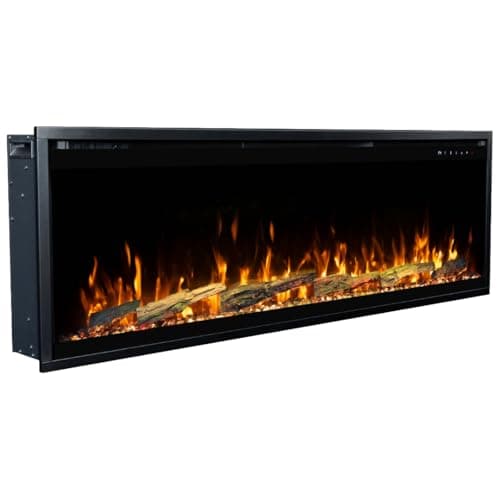
Everyone selling one of these says it looks incredibly realistic. Nobody says how the flame is produced, which is the only thing that predicts whether it will convince you. Here is the taxonomy.
Everything in flame realism
Each roundup below shows its top pick with a buy link, so you never have to dig three pages deep to find one.
Four technologies, and they are not close to each other
"Realistic flame" is a marketing phrase attached to products that work in fundamentally different ways. There are four mechanisms in commercial production, they differ by an order of magnitude in price, and they fail in completely different situations. Knowing which one you are buying tells you more than any adjective on the box.
Technology
How the flame is made
Where it convinces
Where it gives itself away
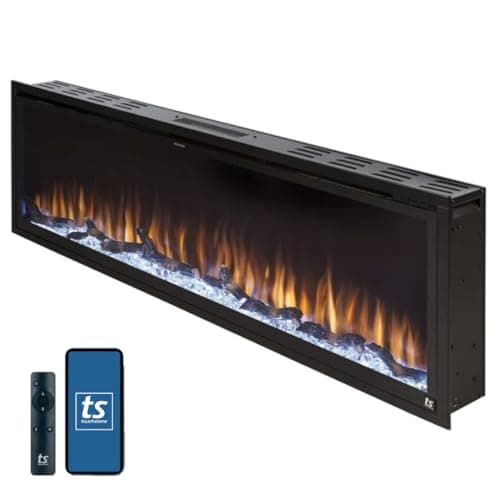
LED + reflector
LEDs shine onto a rotating reflector; the moving light reads as flicker
At night, viewed head-on, with the room lights low
Daylight, and any angle off center — the flame flattens into a lit panel
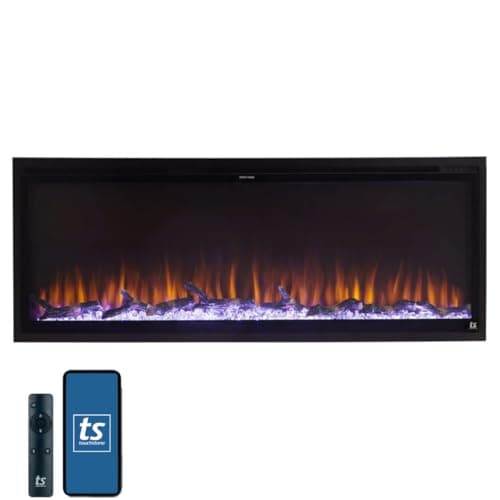
LED + layered flame ribbon
Multiple LED layers behind a depth diffuser, with a separately lit ember bed
Most evening viewing, at normal seating distance
Bright daylight, and very close inspection
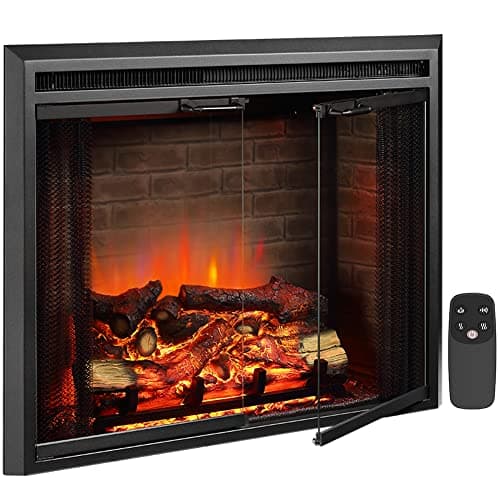
LCD screen
Recorded video of a real fire, played on a screen behind glass
Still-image realism — the best in the category at a fixed viewing position
Off-axis, where the panel behaves like any screen; and it loops
Water vapor / mist
Ultrasonic mist from tap water, lit from below by LEDs
Genuine three-dimensional volume — the flame occupies real space
It needs refilling, and on most models the effect produces no heat at all
The water-vapor row is Dimplex's Opti-Myst mechanism, described from the manufacturer's own documentation. Full detail on LED vs LCD vs water vapor.
The thing that actually gives a cheap flame away
It is almost never the flame shape. It is the light spill and the off-axis view. A basic LED unit produces a flame that looks acceptable dead ahead and collapses into a flat orange glow the moment you move to one side — because there is no depth to the effect, only a lit surface. The second giveaway is daylight: a flame that reads well against a dark room is competing with the sun at two in the afternoon, and losing.
Which means the honest question is not "is this realistic" but "realistic when, and from where". If the fireplace lives in a room you use in the evening, with the lamps low, and you sit in front of it, an entry-level LED unit is genuinely convincing and you can stop spending. If it is in a bright open-plan room people walk past all day, no amount of money fixes the daylight problem, and you should spend your budget on the housing instead. We work through this on do they look cheap.
What we can and cannot tell you here
We have not watched these fireplaces burn. We do not own them, and we have no viewing room to compare them in. What we can do — and what nobody else in this category appears to be doing — is classify each unit by the mechanism its manufacturer documents, explain what that mechanism physically can and cannot do, and be specific about the conditions where each one fails. That is a claim you can check, which is more than "we tested twelve models" from a site whose other categories are cocktails and cell biology.
Where owner reports contradict a spec sheet, we say so and label it as owner reporting rather than our own observation. Where the honest answer is "this depends on your room and we cannot see your room", we say that too. The reasoning is set out on how we pick.
No. There is no combustion in any electric fireplace — that is why they need no chimney, produce no carbon monoxide and can be run in a room with no ventilation. The flame is an optical effect made with LEDs, a video screen, or lit water vapor. Water-vapor units come closest to occupying real three-dimensional space, but the 'flame' is illuminated mist and is cool to the touch.
+Do electric fireplaces look cheap?
Some do, in some conditions. Entry-level LED units look convincing head-on in a dim room and flatten out in daylight or when viewed from an angle. The variables that predict this are the flame technology, whether there is depth behind the flame, and whether there is a lit ember bed — not the price on its own.
+Which electric fireplace looks the most real?
Mechanically, water-vapor units such as the Dimplex Opti-Myst range, because the flame occupies genuine three-dimensional space rather than being a lit surface. They also cost several times more than an LED unit, need refilling, and on most models the flame effect produces no heat at all. LCD-screen units are the best of the mains-only options for a fixed viewing position.
+Are electric fireplaces realistic?
In evening light, viewed from the front, modern layered-LED units are convincing enough that most visitors do not question them. In bright daylight, or viewed from a sharp angle, most are not. Deciding which of those situations describes your room is more useful than any general answer.
Sources
Every figure on this page is either taken from one of these documents or computed from a formula shown on the page. Nothing here is recalled from memory.