Comparison · the awkward one
Electric fireplace vs space heater
Thermally these are the same appliance. Same watts, same BTU, same cost per hour. The difference is entirely what it looks like — and that is a real thing to buy, as long as you know that is what you are buying.
By Scooter M.Published September 6, 2026Last reviewed September 6, 2026

Disclosure: the buy links below are affiliate links. We earn a commission on Amazon purchases at no extra cost to you. It has never changed a ranking on this site, and every roundup here names a unit we think you should skip. How this site is funded.
The uncomfortable answer first
They are the same appliance. A 1,500 W electric fireplace and a 1,500 W space heater both produce about 5,118 BTU per hour and both cost about 27.5 cents an hour to run, because both are resistive heaters capped by the same 120 V household circuit. There is no efficiency difference to have — both convert essentially all their electrical input into heat.
We would rather lead with that than bury it, because a lot of writing in this category implies a fireplace is somehow a better heater. It is not. What it is, is a better-looking object that happens to contain the same heating element. The most famous version of that implication is unpicked on Amish electric fireplaces.
Side by side
| Electric fireplace | Space heater | |
|---|---|---|
| Heat output | ~5,118 BTU/hr at 1,500 W | ~5,118 BTU/hr at 1,500 W |
| Running cost | ~27.5¢/hr | ~27.5¢/hr |
| Circuit load | ~12.5 A | ~12.5 A |
| Efficiency | Essentially 100% at the point of use | Essentially 100% at the point of use |
| Flame effect | Yes — the entire point | No |
| Placement | Wall, firebox, console or floor | Floor, mostly |
| Looks like | Furniture, or architecture | An appliance |
| Runs without heat | Yes — flame only, under 2¢/hr | No. The heat is all it does |
| Price | Entry to very high | Low |
| Portability | Usually fixed once installed | Genuinely portable |
Quick picks
Ranked. The running cost column is computed from each unit's rated wattage, not quoted from a manufacturer. Tap a row for the full write-up.
| # | Product | Best for | Cost per hour | Price |
|---|---|---|---|---|
| 1 | 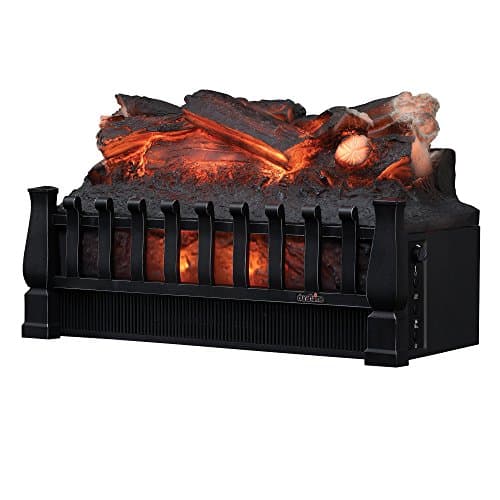 Duraflame DFI021ARU 20" Electric Fireplace Log SetA 20-inch log set at the entry tier. Close enough to space-heater money that the flame is nearly free. | The smallest gap between the two | 27.5¢1,500 W · 5,118 BTU | |
| 2 | 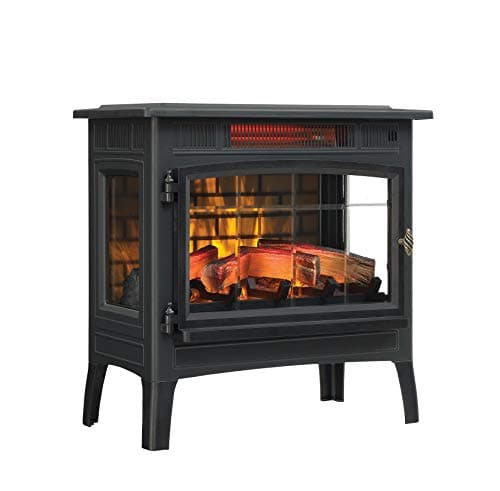 Duraflame DFI-5010-01 3D Infrared Fireplace Stove5,200 BTU per hour, 120 V at 12.5 A, published. A stove that radiates from its whole front face rather than a plastic box on the floor. | When you want the heater to look like furniture | 27.5¢1,500 W · 5,118 BTU | |
| 3 | TURBRO In-Flame INF60W 60" Smart WiFi FireplaceInfrared quartz on a wall at chest height. A space heater cannot go there, and placement is the one thing that actually differs. | The case where the fireplace genuinely wins | 27.5¢1,500 W · 5,118 BTU | |
| — | 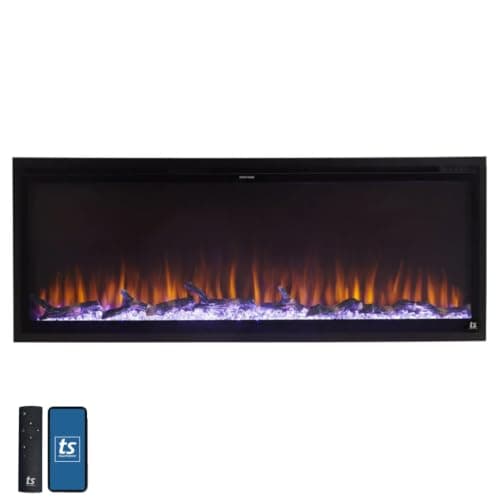 Touchstone Sideline Elite 50A frameless glass front and the same 1,500 W as a $40 space heater. Excellent product; wrong page to be reading about it.Skip this one | Nothing, if this comparison is your starting point | 27.5¢1,500 W · 5,118 BTU |
#ad Buy links are affiliate links — we earn a commission on Amazon purchases at no extra cost to you, and it never changes the ranking. How this site is funded. Running cost is computed at 18.34¢/kWh; see what these actually cost to run.
The three things a fireplace genuinely does better
- It runs without heat. This is the real answer and almost nobody states it. Flame and heater are independent controls on essentially every unit, and running the flame alone costs under two cents an hour. A space heater has one mode: hot. For nine months of the year that difference is the whole product.
- Placement. A wall unit puts its heat out at seated chest height rather than at floor level, and a fireplace can go in a firebox or a wall where a space heater cannot. Same energy, better delivery — the detail is on do wall mounted units give off heat.
- It is a permanent object in the room. A space heater gets put away in April. A fireplace is furniture, which is a real thing to want and a legitimate thing to pay for.
The three things a space heater does better
- Price. Comprehensively. The same heat for a small fraction of the money.
- Portability. You can carry it to whichever room is cold today. Most fireplaces are installed once and stay there.
- Honesty of form. It does not pretend to be anything. Nobody is ever disappointed that their space heater looks like a space heater in daylight, which is more than can be said for the cheaper end of the fireplace category.
What both of them cost
| Usage | Hours | Heat on (1,500 W) | Flame only (~100 W) |
|---|---|---|---|
| One evening | 4 | $1.10 | $0.07 |
| A week of evenings | 28 | $7.70 | $0.51 |
| A month, 4 hrs a night | 120 | $33.01 | $2.20 |
| A 90-day winter, 4 hrs a night | 360 | $99.04 | $6.60 |
| Per hour | 1 | 27.5¢ | 1.8¢ |
About 27.5 cents an hour on full heat and roughly $99 across a 90-day winter at four hours a night. The flame-only column is the one that belongs to the fireplace alone — about seven cents for a whole evening — and it is the single strongest argument in this comparison.
The safety point that applies to both
Both draw about 12.5 amps continuously, which is roughly 83% of a standard 15-amp circuit before anything else is plugged in. Both should go directly into a wall receptacle rather than a power strip or extension cord, and neither should have its cord run under a rug. These are the same precautions for the same reason — the arithmetic is on watts, amps and your circuit.
#1 · The smallest gap between the two
Duraflame DFI021ARU 20" Electric Fireplace Log Set
A 20-inch log set at the entry tier. Close enough to space-heater money that the flame is nearly free.
This is where the comparison is least awkward. At the bottom of the fireplace category the price premium over a decent space heater is small, and what you get for it is a flame effect, an LED ember bed and a remote that runs the two independently.
Rated for 400 square feet of supplemental heat, 1,500 W, with resin logs and a glowing ember bed.
The con is that it is plainly a lit tray of plastic in daylight, and a space heater at least does not pretend otherwise. In a dim room at night it does the job it exists for.
What it does not do: No enclosure, no glass, no trim. It sits inside the masonry opening you already have, so the old firebox is still visible around it.
Published specs
- Heater:
- Rated by the manufacturer for spaces up to 400 sq ft
- Width:
- 20 in
- Form:
- Drop-in log set — sits inside an existing firebox, no framing
- Flame:
- LED with resin cast logs and a glowing ember bed
- Control:
- Remote with independent flame and heat settings
What it costs to run
- 27.5¢/hr on full heat
- $99.04 across a 90-day winter at 4 hrs a night
- 5,118 BTU/hr · 12.5 A on a 120 V circuit
Computed at 18.34¢/kWh (EIA, June 2026). Your rate will differ — work out your own.
#ad We earn a commission on this link at no cost to you. How this is funded. Price as of October 22, 2026.
Specs from: Duraflame DFI021ARU listing — 400 sq ft rating; Mantels Direct product page — 20 in log set.
#2 · When you want the heater to look like furniture
Duraflame DFI-5010-01 3D Infrared Fireplace Stove
5,200 BTU per hour, 120 V at 12.5 A, published. A stove that radiates from its whole front face rather than a plastic box on the floor.
A freestanding stove is the fairest like-for-like against a portable space heater, because both stand on the floor and both can be moved. The difference is that one of them is a piece of furniture.
The specification is the best-documented of anything in our catalog: 5,200 BTU per hour, 120 V at 12.5 A per the manual, 24 by 23.4 by 13.1 inches, 28.6 pounds, a layered 3D flame across five brightness settings, an adjustable digital thermostat and an overheat shutoff.
Two cons. It is considerably heavier and bulkier than a space heater, so "portable" is generous — it is movable, not carried. And it costs several times what an equivalent-output space heater costs, for output that is genuinely equivalent.
What it does not do: It is a freestanding stove, not an insert. It will not fill a masonry opening and it needs floor space plus clearance in front of the glass door.
Published specs
- Heat output:
- 5,200 BTU/hr
- Electrical:
- 120 V, 12.5 A
- Dimensions:
- 24 in W x 23.4 in H x 13.1 in D
- Weight:
- 28.6 lb
- Flame:
- Layered 3D flame effect, five brightness settings
- Safety:
- Overheat shutoff, adjustable digital thermostat
What it costs to run
- 27.5¢/hr on full heat
- $99.04 across a 90-day winter at 4 hrs a night
- 5,118 BTU/hr · 12.5 A on a 120 V circuit
Computed at 18.34¢/kWh (EIA, June 2026). Your rate will differ — work out your own.
#ad We earn a commission on this link at no cost to you. How this is funded. Price as of October 22, 2026.
Specs from: Duraflame DFI-5010-02-3A user manual — 120 V, 12.5 A; Walmart product page — 5,200 BTU, dimensions, weight.
#3 · The case where the fireplace genuinely wins
TURBRO In-Flame INF60W 60" Smart WiFi Fireplace
Infrared quartz on a wall at chest height. A space heater cannot go there, and placement is the one thing that actually differs.
If there is a thermal argument for a fireplace over a space heater, this is it — and it is about geometry rather than output. A wall-mounted unit vents at seated chest height, straight into the layer of the room where people are. A space heater sits on the floor and heats the coldest layer first.
Published as 60 by 18 by 4.6 inches, 56.2 pounds, 1,500 W infrared quartz, 5,118 BTU per hour, with WiFi, Alexa and Google support.
The con is that you are paying a large premium for a placement advantage you could partly get by putting a space heater on a shelf. It is a real difference; it is not a large one.
What it does not do: WiFi and a crackle speaker are the upgrade here. The heater is the same 1,500 W as a unit costing a fraction of it. At 4.6 in deep it will not sit flush in a standard 2x4 wall.
Published specs
- Heater:
- 1,500 W infrared quartz
- Heat output:
- 5,118 BTU/hr
- Dimensions:
- 60 in W x 18 in H x 4.6 in D
- Weight:
- 56.2 lb
- Mounting:
- Recessed or wall-mounted
- Flame:
- 12 flame colors, 13 ember-bed colors
- Extras:
- WiFi app control, Alexa and Google, crackling sound effect
- Cord:
- 5.9 ft
What it costs to run
- 27.5¢/hr on full heat
- $99.04 across a 90-day winter at 4 hrs a night
- 5,118 BTU/hr · 12.5 A on a 120 V circuit
Computed at 18.34¢/kWh (EIA, June 2026). Your rate will differ — work out your own.
#ad We earn a commission on this link at no cost to you. How this is funded. Price as of October 22, 2026.
Specs from: TURBRO In-Flames INF60W product page — 1,500 W quartz; TURBRO In-Flames INF60W-3D listing — dimensions, weight, 5,118 BTU.
Skip this one
Touchstone Sideline Elite 50
A frameless glass front and the same 1,500 W as a $40 space heater. Excellent product; wrong page to be reading about it.
The Sideline Elite 50 is genuinely good and we recommend it elsewhere. Frameless glass, the best presentation in the Touchstone range at that width, from a company that makes nothing but fireplaces.
It is the skip here because of what asking this question reveals. If you are seriously weighing a fireplace against a space heater, warmth is your priority and budget is a live constraint — and this unit answers neither. It produces the identical 5,118 BTU per hour as the cheapest heater in any hardware store, at many times the price.
Buy it when you have decided you want a fireplace and the question is which one. Do not buy it while still asking whether a space heater would do, because the honest answer to that question is often yes.
What it does not do: The heater is the same 1,500 W ceiling as the cheaper Sideline 50. The extra money buys the glass front and the flame presentation, not warmth.
Published specs
- Width:
- 50 in
- Form:
- Recessed, frameless glass front
- Position in line:
- Above The Sideline 50, below the Elite Pro
What it costs to run
- 27.5¢/hr on full heat
- $99.04 across a 90-day winter at 4 hrs a night
- 5,118 BTU/hr · 12.5 A on a 120 V circuit
Computed at 18.34¢/kWh (EIA, June 2026). Your rate will differ — work out your own.
#ad We earn a commission on this link at no cost to you. How this is funded. Price as of October 22, 2026.
Specs from: Touchstone electric fireplaces collection — Sideline Elite 50.
Questions people actually ask
Is an electric fireplace better than a space heater?
Not thermally — they produce identical heat at an identical running cost, because both are 1,500 W resistive heaters on the same household circuit. A fireplace is better at being an object in the room and can run its flame without heat; a space heater is cheaper and portable.
Is an electric fireplace cheaper to run than a space heater?
No. Both cost about 27.5 cents an hour at 1,500 W and the June 2026 US average of 18.34 cents per kWh. The one genuine saving is that a fireplace can run its flame effect with the heater off for under two cents an hour, which a space heater cannot do at all.
Do electric fireplaces heat better than space heaters?
They deliver the same heat, sometimes from a better position. A wall-mounted fireplace vents at seated chest height while a space heater sits on the floor heating the coldest layer of the room first, so the fireplace can feel more effective without producing any more heat.
Is a space heater safer than an electric fireplace?
They carry the same considerations because they are the same kind of load: about 12.5 amps continuous, a wall receptacle only, never an extension cord or a power strip, and never a cord under a rug. Neither produces carbon monoxide, because neither burns anything.
Should I buy a fireplace if I only want heat?
Probably not. If the flame does not matter to you, a space heater does the identical job for far less money. Buy the fireplace when you want the fire.
Sources
Every figure on this page is either taken from one of these documents or computed from a formula shown on the page. Nothing here is recalled from memory.
- EIA Electric Power Monthly, Table 5.3 — US residential average, June 2026
- EcoCostSavings — measured wattage and BTU across 117 electric fireplace models
- Wikipedia — Electric fireplace (mechanism and history)
- Duraflame DFI-5010 user manual — 120 V, 12.5 A
- TURBRO In-Flames INF60W-3D listing — 60 x 18 x 4.6 in, 56.2 lb, 1,500 W, 5,118 BTU
- US Consumer Product Safety Commission — portable heater safety guidance
Read next
- What an electric fireplace costs to run
27.5 cents an hour on heat, under two cents on flame alone — computed at the real 2026 rate, with the source.
- Are electric fireplace inserts worth it?
Worth it if you want a dead firebox to look alive with no venting. Not worth it as a heating strategy. The arithmetic for both.
- Electric vs gas fireplace
Install cost, running cost, heat, realism and venting — with an honest account of where gas wins.
- Watts, amps and your circuit
12.5 amps on a 15-amp circuit. Why the ceiling exists, and where we stop and an electrician starts.
- Electric fireplace vs baseboard heater
Same cost per BTU, because both are resistance heat. Baseboard can be built past 1,500 W; a plug-in fireplace cannot. Which one that favors depends on the room.