Comparison · the arithmetic one
Electric fireplace vs baseboard heater
Per unit of heat these cost exactly the same, and no amount of marketing changes that. What separates them is how many watts each one can physically deliver, and whether you want to look at it.
By Scooter M.Published October 6, 2026Last reviewed October 6, 2026
Disclosure: the buy links below are affiliate links. We earn a commission on Amazon purchases at no extra cost to you. It has never changed a ranking on this site, and every roundup here names a unit we think you should skip. How this site is funded.
The answer first
Per unit of heat they cost exactly the same. A 1,500 W electric fireplace and a 1,500 W length of electric baseboard both produce about 5,118 BTU per hour and both cost about 27.5 cents an hour to run, because both are electric resistance heaters and there is no efficiency difference left to win. The two differences that are real: a baseboard can be built past 1,500 W and a plug-in fireplace cannot, and only one of the two is worth looking at.
We would rather lead with that than bury it. A great deal of writing in this category implies that one electric heater is cheaper to run than another, and at the same wattage that is arithmetically impossible. Both appliances turn essentially all of the electricity they draw into heat in your room. The meter cannot tell them apart.
Why the running cost is identical, and why that is not a dodge
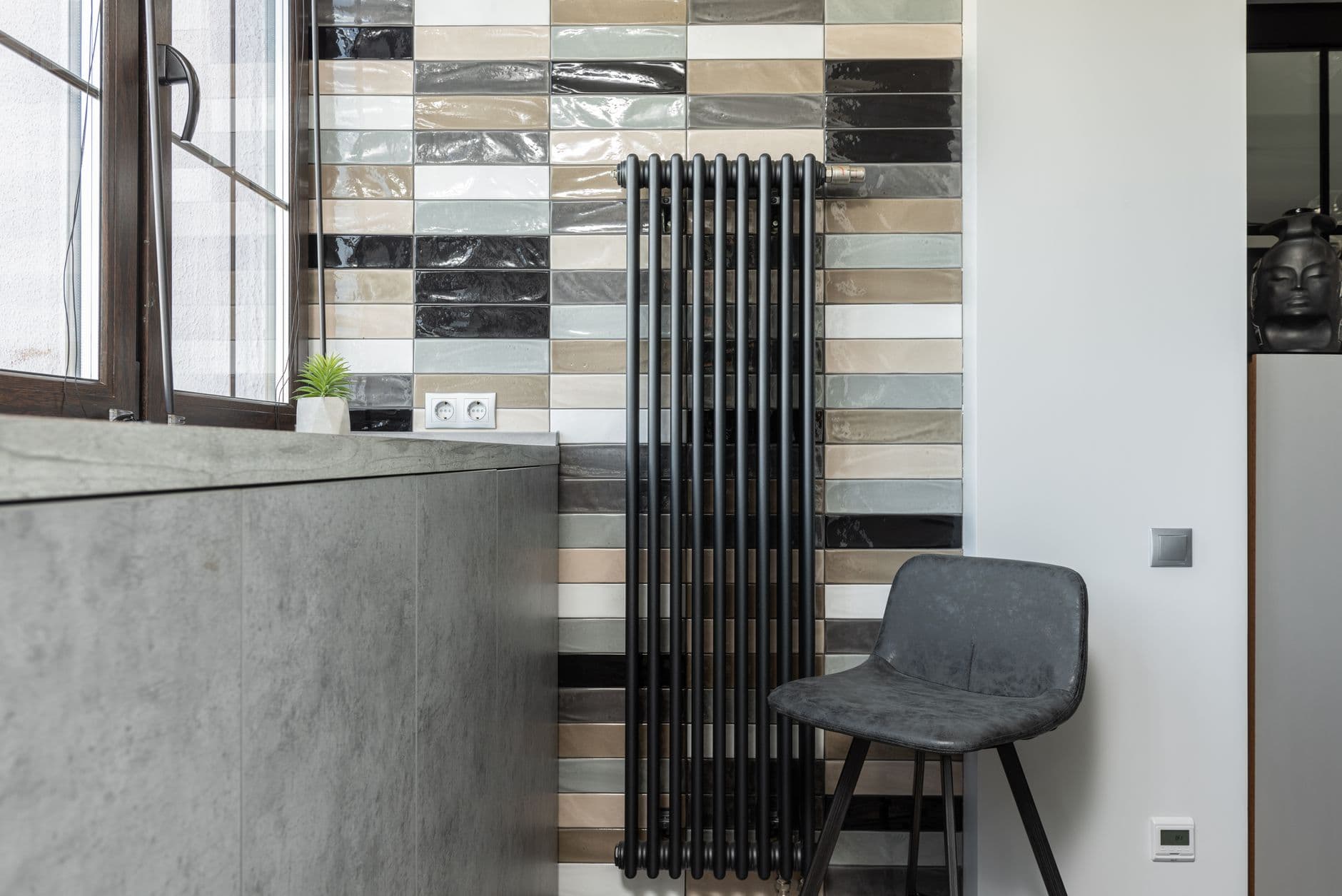
Electric resistance heating converts essentially all of its electrical input into heat at the point of use. That is true of a baseboard element, a fireplace's heater coil, an infrared quartz tube and a hardware-store space heater alike. There is no combustion to tune and no heat to lose up a flue, so there is no efficiency figure to compete on — which means the only lever either appliance has on your bill is how many watts it draws and for how long. The full arithmetic, and the rate it is built on, is on what these actually cost to run.
So the useful question is never which one is cheaper per hour. It is this: how many watts does this room need, and can the appliance physically deliver them?
The number that actually separates them: watts available
A plug-in electric fireplace lives on a standard 120 V household receptacle, and that caps it. 1,500 W, about 12.5 amps, about 5,118 BTU per hour — the same ceiling for the cheapest log set and the most expensive linear unit on the market. No electric fireplace you can plug in beats it, and the detail is on watts, amps and your circuit.
A baseboard heater is not plugged in. It is hardwired, usually at 240 V, and it is sized by length: a 240 V baseboard produces roughly 250 watts per linear foot. That changes the whole comparison, because length is something you can simply add. Six feet of baseboard is 1,500 W — a dead heat with the fireplace ceiling. Eight feet is 2,000 W. Cadet's high-output 96-inch F Series unit is rated 2,000/2,500 W. A second run on another wall doubles it again.
| Appliance | Watts | BTU/hr | Cost per hour | Rule-of-thumb room |
|---|---|---|---|---|
| Electric fireplace, flame only | ~100 W | ~341 | 1.8¢ | not a heater |
| Electric fireplace on high (the category ceiling) | 1,500 W | 5,118 | 27.5¢ | ~256 sq ft |
| Baseboard, 72 in at 240 V | 1,500 W | 5,118 | 27.5¢ | ~256 sq ft |
| Baseboard, 96 in at 240 V | 2,000 W | 6,824 | 36.7¢ | ~341 sq ft |
| Baseboard, 96 in high-output (Cadet 8F2025W) | 2,500 W | 8,530 | 45.9¢ | ~427 sq ft |
What to buy if the fireplace is the answer
Ranked. The running cost column is computed from each unit's rated wattage, not quoted from a manufacturer. Tap a row for the full write-up.
| # | Product | Best for | Cost per hour | Price |
|---|---|---|---|---|
| 1 | 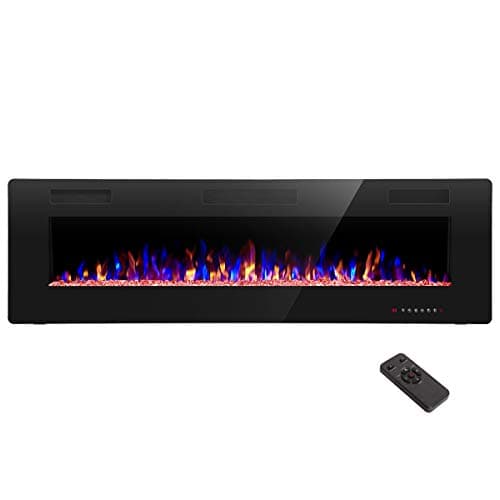 R.W.FLAME 60" Ultra-Thin Recessed & Wall-Mount FireplaceThe cheapest honest way to get a 60-inch flame onto a wall. You are buying the view, because the heat is already handled. | A room the baseboard already heats | 27.5¢1,500 W · 5,118 BTU | |
| 2 | 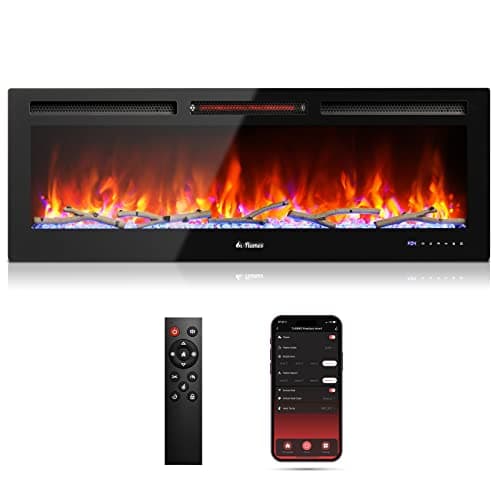 TURBRO In-Flame INF50W-3D 50" Smart WiFi Infrared Fireplace1,500 W of infrared quartz at seated chest height. A baseboard is fixed at floor level by definition, and that is a real difference. | The one argument a baseboard cannot answer | 27.5¢1,500 W · 5,118 BTU | |
| 3 | 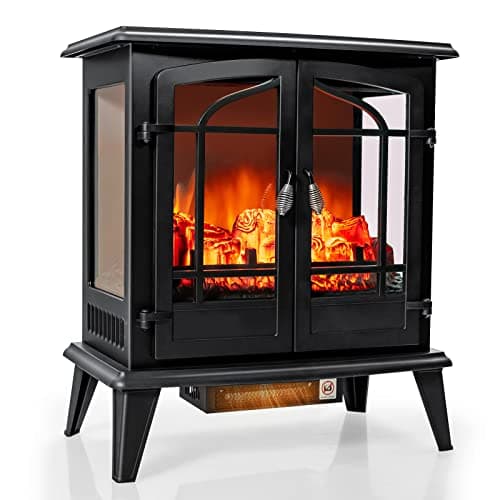 Tangkula 25" Freestanding Electric Fireplace Stove4,777 BTU per hour, published, from a freestanding stove you can move. Nothing to wire, nothing to frame, nothing permanent. | A room with no baseboard run in it at all | 25.7¢1,400 W · 4,777 BTU | |
| — | 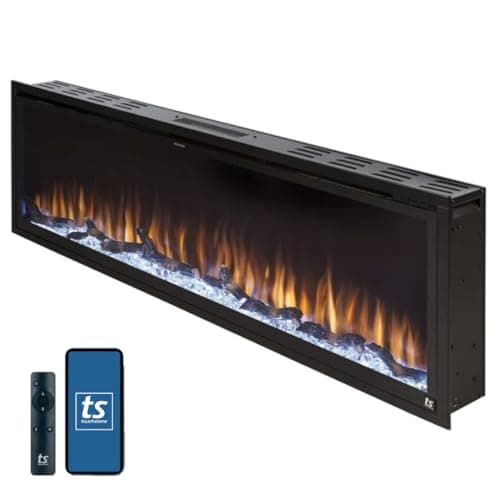 Touchstone Sideline Elite 60 (80037)A 56-inch flame viewing area and the same 5,118 BTU as a six-foot baseboard costing a fraction of it. Excellent unit; wrong question.Skip this one | Nothing, if heat is why you are on this page | 27.5¢1,500 W · 5,118 BTU |
#ad Buy links are affiliate links — we earn a commission on Amazon purchases at no extra cost to you, and it never changes the ranking. How this site is funded. Running cost is computed at 18.34¢/kWh; see what these actually cost to run.
Side by side
| Electric fireplace | Electric baseboard | |
|---|---|---|
| Heat per watt | Identical | Identical |
| Cost per BTU | Identical | Identical |
| Practical maximum | 1,500 W, about 5,118 BTU/hr | Limited by length, not by the plug |
| Power | 120 V receptacle, about 12.5 A | Hardwired, usually 240 V |
| Install | Plug it in, or hardwire by choice | Electrician, dedicated circuit, thermostat |
| Control | Onboard thermostat and remote | Line-voltage thermostat, per room |
| Runs without heat | Yes — flame only, under 2¢/hr | No. Heat is all it does |
| Heat delivery | Convection or infrared, at whatever height you mount it | Convection at floor level, under a window |
| Wall space | Takes a feature wall | Takes a floor-level run; furniture must clear it |
| Looks like | The thing you look at | Nothing. By design |
| Portability | Freestanding models move; recessed do not | Permanent |
Where a baseboard genuinely wins
- It can be bigger than 1,500 W. This is the whole ballgame, and it is the one thing no plug-in fireplace can answer. If your room genuinely needs more heat than the category ceiling, a longer baseboard run delivers it and a fireplace simply cannot. Our room size calculator will tell you which side of that line you are on in about ten seconds.
- Per-room zone control. Each run gets its own line-voltage thermostat, wired directly into the heater's supply, so you heat the rooms you are in and leave the rest cold. That is a genuine running-cost advantage, and it is about *where* the watts go rather than how efficient they are.
- It disappears. A baseboard asks nothing of the room's design. No feature wall, no sight lines, nothing above it. For a bedroom, a hallway or a rental you are not redecorating, that is a feature.
- Price per watt delivered. Comprehensively. Even counting the electrician, heating a cold room properly with baseboard costs less than trying and failing to do it with an appliance capped at 1,500 W.
Where the fireplace genuinely wins
- It runs with the heat off. Flame and heater are independent controls on essentially every unit, and the flame alone draws on the order of 100 watts — under two cents an hour, and about $6.60 across a 90-day winter at four hours a night. A baseboard has exactly one mode, and in April that mode is useless. For most of the year this is the entire difference between the two products.
- It is the thing you look at. A baseboard is deliberately invisible. If what you want is a focal point for the room, a baseboard cannot supply one at any length, and that is a legitimate thing to spend money on as long as you know it is what you are spending it on.
- Placement. You can mount it where the people are. Infrared at seated chest height warms a person faster than floor-level convection warms a room, which is why the wall-mount heat question has a more interesting answer than it looks.
- No electrician, for the plug-in kind. It arrives, it goes into a receptacle, it works tonight. Adding a baseboard run to a room that has none is a wiring job, with a permit attached in many jurisdictions.
What both of them cost at 1,500 W
| Usage | Hours | Heat on (1,500 W) | Flame only (~100 W) |
|---|---|---|---|
| One evening | 4 | $1.10 | $0.07 |
| A week of evenings | 28 | $7.70 | $0.51 |
| A month, 4 hrs a night | 120 | $33.01 | $2.20 |
| A 90-day winter, 4 hrs a night | 360 | $99.04 | $6.60 |
| Per hour | 1 | 27.5¢ | 1.8¢ |
About 27.5 cents an hour, and roughly $99 across a 90-day winter at four hours a night. Scale it linearly for a longer baseboard: 2,000 W is about $132 over the same winter, and 2,500 W about $165. The flame-only row is the column that belongs to the fireplace alone, and across a full year it is the strongest number on this page.
If you already have baseboard heat
This is the most common version of this question, and it is not really a comparison. Your heat is solved. What you are shopping for is a focal point, which means you should buy on flame quality, width and depth, and treat the heater inside as a bonus you will rarely switch on. Run it flame-only through the shoulder seasons and it costs less than a lamp.
One practical note. Your baseboard sits on its own dedicated circuit, so a plug-in fireplace will be sharing a general receptacle circuit with whatever else is on it — and on high it is a continuous 12.5 A draw, roughly 83% of a 15-amp circuit before anything else is plugged in. Give it a wall receptacle of its own rather than a power strip.
The wiring and clearance difference that does matter
These are wired differently, and that has consequences beyond the install bill. A baseboard is hardwired to a line-voltage thermostat that switches the heater's own supply, which is why it needs an electrician and a dedicated branch circuit. A plug-in fireplace is a 12.5 A continuous load on a receptacle, which means a wall outlet directly — never an extension cord, never a power strip, and never a cord run under a rug. The choice between plugging in and hardwiring a fireplace, where the unit supports both, is covered on plug-in vs hardwired.
Clearance is the quieter difference. A baseboard occupies floor-level wall length and works by drawing cool air in underneath, so furniture, full-length curtains and anything combustible have to stay clear of it by whatever margin the manufacturer's manual specifies — and that run of wall is then spoken for permanently. A wall-mounted fireplace takes vertical space instead and leaves the floor alone. Neither appliance burns anything, so neither can produce carbon monoxide; the rest of the safety picture is on are electric fireplaces safe?.
The case where the answer is neither
If you are heating a room of any real size for a whole winter, both of these are electric resistance and both are an expensive way to make heat. A heat pump moves heat rather than making it, and beats any resistance appliance per unit delivered. We would rather say that than sell you something: buy an electric fireplace for the fire, and buy heating for the heat.
#1 · A room the baseboard already heats
R.W.FLAME 60" Ultra-Thin Recessed & Wall-Mount Fireplace
The cheapest honest way to get a 60-inch flame onto a wall. You are buying the view, because the heat is already handled.
This is the pick for the most common version of this question, which is not really a comparison at all: the room already has baseboard heat that works, and what it does not have is anything to look at. In that situation the heater inside the fireplace is close to irrelevant, and you should buy on flame width, depth and price.
Published as 60 by 18.1 by 3.85 inches, 750 W low and 1,500 W high on 120 V AC, with 12 flame colors, 12 ember-bed colors, five speeds and five brightness levels, a touchscreen panel and remote, and a manufacturer coverage rating of up to 400 square feet. Run it flame-only and it costs under two cents an hour.
Two cons, and the second one matters. There is no mantel and no surround, so a recessed install has to be framed and finished by somebody. And while the published depth is 3.85 inches, R.W.FLAME's own listing also references 2x6 framing — confirm the rough-opening requirement in writing before you cut a 60-inch hole in a wall. The warranty is one year, which is short for the category.
What it does not do: No mantel and no surround. The published depth is 3.85 in, but the manufacturer's own listing also references 2x6 framing — confirm the rough-opening requirement with R.W.FLAME before you cut a 60-inch hole in anything.
Published specs
- Dimensions:
- 60 in L x 18.1 in H x 3.85 in D
- Heater:
- 750 W low / 1,500 W high
- Electrical:
- 120 V AC, 60 Hz
- Coverage:
- Rated by the manufacturer for up to 400 sq ft
- Flame:
- 12 flame colors, 12 ember-bed colors, 5 speeds, 5 brightness levels
- Control:
- Touchscreen panel and remote, adjustable thermostat
- Warranty:
- 1 year
What it costs to run
- 27.5¢/hr on full heat
- $99.04 across a 90-day winter at 4 hrs a night
- 5,118 BTU/hr · 12.5 A on a 120 V circuit
Computed at 18.34¢/kWh (EIA, June 2026). Your rate will differ — work out your own.
#ad We earn a commission on this link at no cost to you. How this is funded. Price as of October 6, 2026.
Specs from: R.W.FLAME 60 in listing — 60 x 18.1 x 3.85 in, 750/1500 W, 120 V, 400 sq ft; R.W.FLAME recessed / wall-mount range page.
#2 · The one argument a baseboard cannot answer
TURBRO In-Flame INF50W-3D 50" Smart WiFi Infrared Fireplace
1,500 W of infrared quartz at seated chest height. A baseboard is fixed at floor level by definition, and that is a real difference.
If there is a genuine thermal case for a fireplace over baseboard heat, it is geometry rather than output, and this unit is the clearest version of it. A baseboard works by convection: it takes cool air in at the bottom, warms it and lets it rise, which is exactly why it is installed on an exterior wall under a window. That is good at stirring a whole room and poor at warming a specific person quickly.
A wall-mounted infrared unit does the opposite. Published as 50 by 16 by 4.6 inches, 47.6 pounds, 1,500 W infrared quartz, with an adjustable thermostat from 60 to 99 degrees F, a 30-minute to 12-hour timer, a media bed of five birch logs and crystals, and app, Alexa and Google Assistant control over 2.4 GHz WiFi. Mounted at chest height it radiates into the layer of the room where people actually sit.
Three cons. TURBRO does not publish a BTU figure for this model, so we do not quote one — plan from the 1,500 W rating. At 4.6 inches deep it will not sit flush in a standard 2x4 stud bay. And the app needs a 2.4 GHz network, which catches people out on modern dual-band routers. The manufacturer's 400 to 1,000 square foot coverage range is a supplemental-heat claim, and the top of it is not a figure we would plan a cold room around.
What it does not do: TURBRO does not publish a BTU figure for this model, so we do not quote one — the 1,500 W rating is the number to plan from. At 4.6 in deep it will not sit flush in a standard 2x4 stud bay, and the app needs a 2.4 GHz network, which catches people out on modern dual-band routers.
Published specs
- Heater:
- 1,500 W infrared quartz
- Coverage:
- Rated by the manufacturer for 400-1,000 sq ft
- Dimensions:
- 50 in L x 16 in H x 4.6 in D
- Weight:
- 47.6 lb
- Noise:
- 42 dB or lower (manufacturer figure)
- Thermostat:
- Adjustable, 60-99 °F
- Timer:
- 30 minutes to 12 hours
- Media bed:
- Five birch logs and crystals
- Mounting:
- Recessed or wall-mounted
- Smart control:
- App, Alexa and Google Assistant over 2.4 GHz WiFi
What it costs to run
- 27.5¢/hr on full heat
- $99.04 across a 90-day winter at 4 hrs a night
- 5,118 BTU/hr · 12.5 A on a 120 V circuit
Computed at 18.34¢/kWh (EIA, June 2026). Your rate will differ — work out your own.
#ad We earn a commission on this link at no cost to you. How this is funded. Price as of October 6, 2026.
Specs from: Home Depot — TURBRO INF50W-3D, 50 in, 1,500 W infrared quartz, WiFi and voice control; TURBRO In-Flames INF50W-3D product page — 50 x 16 x 4.6 in, 47.6 lb, 400-1,000 sq ft, 42 dB, 60-99 °F.
#3 · A room with no baseboard run in it at all
Tangkula 25" Freestanding Electric Fireplace Stove
4,777 BTU per hour, published, from a freestanding stove you can move. Nothing to wire, nothing to frame, nothing permanent.
A baseboard heater is an electrical installation. If the room you are trying to warm has no baseboard in it, adding one means an electrician, a dedicated circuit, a line-voltage thermostat and holes in finished walls. A freestanding stove is the honest alternative to that project rather than to the appliance itself: it plugs into a receptacle and it is done.
Published as 25 by 15 by 28.5 inches, 35.5 pounds, 1,400 W at 120 V, a stated 4,777 BTU per hour, an adjustable thermostat from 68 to 95 degrees F, a three-sided panoramic flame effect, a 67.5-inch cord and automatic shutoff if the internal temperature runs high. It is one of the few units in our catalog where the manufacturer publishes a BTU figure at all.
The cons are honest and arithmetic. At 1,400 W it sits below the 1,500 W class ceiling — roughly 340 BTU per hour less than most units here, which is a real difference rather than a rounding one. It is freestanding, so it needs floor space rather than an opening. And it is the weakest heater on this page, which matters precisely because the page is about heat.
What it does not do: At 1,400 W it sits below the 1,500 W class ceiling — roughly 340 BTU/hr less than most units here. That is a real difference, not a rounding one. Freestanding, so it needs floor space rather than an opening.
Published specs
- Heater:
- 1,400 W
- Heat output:
- 4,777 BTU/hr
- Dimensions:
- 25 in L x 15 in W x 28.5 in H
- Weight:
- 35.5 lb
- Electrical:
- 120 V, 60 Hz
- Thermostat:
- Adjustable, 68-95 °F
- Viewing:
- Three-sided panoramic flame effect
- Safety:
- Automatic shutoff if internal temperature runs high
- Cord:
- 67.5 in
What it costs to run
- 25.7¢/hr on full heat
- $92.43 across a 90-day winter at 4 hrs a night
- 4,777 BTU/hr · 11.7 A on a 120 V circuit
Computed at 18.34¢/kWh (EIA, June 2026). Your rate will differ — work out your own.
#ad We earn a commission on this link at no cost to you. How this is funded. Price as of October 6, 2026.
Specs from: Tangkula product page — 25 x 15 x 28.5 in, 1,400 W, 4,777 BTU, 35.5 lb, 68-95 °F; Amazon listing — Tangkula 25 in electric fireplace stove, 1,400 W.
Skip this one
Touchstone Sideline Elite 60 (80037)
A 56-inch flame viewing area and the same 5,118 BTU as a six-foot baseboard costing a fraction of it. Excellent unit; wrong question.
The Sideline Elite 60 is genuinely one of the better linear units sold and we recommend it elsewhere without hesitation. Published at 59 3/4 by 19 1/4 by 5 1/2 inches, 5,118 BTU per hour, a 750 W and 1,500 W heater with a 68 to 88 degree F thermostat, a 56 by 14 3/8 inch flame viewing area, six flame colors, ten media-bed colors, an eight-hour timer, WiFi, and the option to plug in or hardwire.
It is the skip here for the same reason the arithmetic above exists. If you arrived at this page weighing a fireplace against baseboard heat, heat is your priority — and this unit produces the identical 5,118 BTU per hour as a 72-inch baseboard, while a 96-inch baseboard beats it outright at about 6,824. Everything the extra money buys is on the front of the unit, which is the right thing to pay for only once you have stopped shopping for warmth.
Its own stated con applies too: the same 5 1/2 inch depth problem as the standard Sideline 60, and the same 1,500 W heater as everything else in the category. Buy it when you have decided you want a fireplace and the question is which one — not while you are still asking whether baseboard would do, because on heat alone the answer is often yes.
What it does not do: The same 5 1/2 in depth problem as the standard Sideline 60, and the same 1,500 W heater. Everything the extra money buys is on the front of the unit.
Published specs
- Dimensions:
- 59 3/4 in W x 19 1/4 in H x 5 1/2 in D
- Heat output:
- 5,118 BTU/hr
- Heater:
- 750 W / 1,500 W, thermostat 68-88 °F
- Flame viewing area:
- 56 in x 14 3/8 in
- Flame:
- 6 flame colors, 10 media-bed colors, 5 intensities, 3 speeds
- Coverage:
- Rated by the manufacturer for up to 400 sq ft
- Extras:
- 8-hour timer, WiFi, plug-in or hardwire
What it costs to run
- 27.5¢/hr on full heat
- $99.04 across a 90-day winter at 4 hrs a night
- 5,118 BTU/hr · 12.5 A on a 120 V circuit
Computed at 18.34¢/kWh (EIA, June 2026). Your rate will differ — work out your own.
#ad We earn a commission on this link at no cost to you. How this is funded. Price as of October 6, 2026.
Specs from: Touchstone Sideline Elite 60 (80037) product page; Retailer listing — 59 3/4 x 19 1/4 x 5 1/2 in, 5,118 BTU, 56 in flame area.
Questions people actually ask
Is an electric fireplace cheaper to run than baseboard heat?
No. At the same wattage they cost exactly the same — about 27.5 cents an hour at 1,500 W and the EIA US residential average of 18.34 cents per kWh — because both are electric resistance heaters that turn essentially all their input into heat. The one genuine saving is that a fireplace can run its flame with the heater off for under two cents an hour, which a baseboard cannot do at all.
Can an electric fireplace replace baseboard heat?
Only in a small room. A plug-in fireplace is capped at 1,500 W and about 5,118 BTU per hour, which is roughly a 256 square foot room on the usual 20 BTU per square foot rule of thumb. A baseboard run is sized by length at about 250 watts per linear foot, so it can be built past that ceiling and a fireplace cannot.
Which puts out more heat, a baseboard heater or an electric fireplace?
Whichever draws more watts, and that is usually the baseboard. Six feet of 240 V baseboard matches the 1,500 W fireplace ceiling exactly at about 5,118 BTU per hour; eight feet produces about 6,824, and high-output 96-inch units are rated to 2,500 W, or about 8,530 BTU per hour. No plug-in fireplace goes above 1,500 W.
Is baseboard heat more efficient than an electric fireplace?
Neither is more efficient — both convert essentially all of the electricity they draw into heat at the point of use, so there is no efficiency gap to have. Where a baseboard can save money is zoning: a line-voltage thermostat in each room means you heat only the rooms you are using.
Do I need an electrician to install either one?
For a baseboard, yes — it is hardwired, usually at 240 V, on a dedicated circuit with a line-voltage thermostat. A plug-in electric fireplace needs no electrician at all, though a recessed install still needs the wall framed and finished, and some units can be hardwired by choice.
Can I use an electric fireplace in a room that already has baseboard heat?
Yes, and it is the most sensible version of this purchase. The heat is already handled, so buy for the flame and leave the heater off for most of the year. Put the fireplace on a wall receptacle of its own rather than a power strip, since on high it draws about 12.5 amps continuously.
Sources
Every figure on this page is either taken from one of these documents or computed from a formula shown on the page. Nothing here is recalled from memory.
- EIA Electric Power Monthly, Table 5.3 — US residential average, June 2026
- EcoCostSavings — measured wattage and BTU across 117 electric fireplace models
- Wikipedia — Electric fireplace (mechanism and history)
- InspectAPedia — electric baseboard heat sizing: "Each linear foot of a typical electric heat baseboard provides 250 Watts of energy or electric heat output", and about 5-8 watts of electric heat per square foot of room heated
- ThermostatGuide — baseboard heater sizing: a 240 V baseboard "will produce 250 watts for every foot"; 30 in = 500 W, 36 in = 750 W, 72 in = 1,500 W; 10 watts per square foot for a standard modern home, 12.5 for older and 7.5 for ultra-insulated
- Hunker — baseboard heaters: 250 watts per foot of heater, 240 V hardwired units preferred over plug-in 120 V, convection draws cool air in at the bottom which is why units sit on an exterior wall below a window, and line-voltage thermostats wired directly into the heater supply
- Home Depot — Cadet F Series electric baseboard heaters: 8F2025W is 96 in at 240/208 V and 2,000/2,500 W, the 72 in model is 1,500 W, and the 4P1500W is a 49 in 120 V 1,500 W portable
- R.W.FLAME recessed / wall-mount range — 3.86 in depth, 750/1500 W, 5,100 BTU
- Touchstone Home Products — electric fireplace range and sizes
- US Consumer Product Safety Commission — portable heater safety guidance
- NFPA — National Electrical Code (NFPA 70), the standard behind US branch-circuit limits
Read next
- Electric fireplace vs space heater
Identical heat, identical running cost. What the price difference actually buys, and when a space heater is the honest answer.
- What an electric fireplace costs to run
27.5 cents an hour on heat, under two cents on flame alone — computed at the real 2026 rate, with the source.
- Do electric fireplaces actually heat a room?
Yes, up to about 256 square feet. Above that it is supplemental heat, and no plug-in unit does better.
- Watts, amps and your circuit
12.5 amps on a 15-amp circuit. Why the ceiling exists, and where we stop and an electrician starts.
- Electric fireplace room size calculator
Room dimensions in, BTU and shortfall out. Reports the gap as honestly as the fit.