Roundup · updated for the 2026 heating season
Amish electric fireplaces
One of the most heavily advertised products this category has ever produced, and the clearest case of a claim that is true about the furniture and silent about the fire. Both halves are worth understanding before you spend.
By Scooter M.Published October 3, 2026Last reviewed October 3, 2026

Disclosure: the buy links below are affiliate links. We earn a commission on Amazon purchases at no extra cost to you. It has never changed a ranking on this site, and every roundup here names a unit we think you should skip. How this site is funded.
An "Amish fireplace" is an ordinary electric fireplace insert fitted into a wooden mantel built by Amish craftsmen. The mantel claim is true; the fire is not special. NBC News reported that the mantels for the best-known of these, the Heat Surge Roll-n-Glow, are made by Amish workers in Ohio while the heating units are manufactured in China — a split the advertising did not disclose. Consumer Reports found the heater reasonably convenient, quiet and safe, but no more miraculous than other space heaters. If you want a solid wooden mantel with a fire in it, that is a perfectly good thing to want, and you can buy one today without the miracle-heater story attached.
The claim is about the furniture
This category produced one of the most recognizable advertising campaigns in American home retail: full-page newspaper ads offering a free "miracle heater" that would slash your heating bills, available with the purchase of a hand-built Amish mantel.
Read that sentence again, because the commercial structure of the offer answers the question the whole page is asking. The heater was the giveaway. The mantel was the product — NBC News reported the price as $298 plus shipping. A company does not give away the part it wants paid for, and this one was telling you, in its own pricing, which half of the fireplace it considered valuable.
The advertised BTU number gives the heater away
You do not need a laboratory to work out what is inside one of these. The advertising quoted a figure of roughly 5,110 BTU per hour, alongside a 750-watt low setting. Those two numbers together identify the appliance completely.
A 1,500-watt electric heater produces 5,118 BTU per hour. That is not a brand's measurement, it is a unit conversion — one watt is 3.412 BTU per hour, and every electric heater converts essentially all of its electricity to heat. So a quoted 5,110 BTU, with a 750-watt half setting beneath it, is the arithmetic signature of a completely ordinary 1,500-watt element: the same one in a Touchstone, a Duraflame, and a hundred-and-forty-dollar insert. BTU and room size has the full conversion.
That ceiling is not a choice any manufacturer makes. A standard 120-volt household circuit limits a plug-in appliance to 1,500 watts, which is why every electric fireplace on this site — from the cheapest to a three-thousand-dollar built-in — lands on the same figure. We go through the wiring on watts, amps and your circuit.
The coffee-maker comparison, checked properly
The advertising compared the heater's electricity use to a coffee maker's. That comparison is worth taking seriously rather than dismissing, because it is true in one sense and misleading in another, and the difference is the single most useful thing on this page.
It is true about power. A drip coffee maker draws roughly 1,000 to 1,500 watts while it is brewing, so the two appliances pull a comparable load from the wall. It is misleading about energy, which is power multiplied by time. A coffee maker brews for about ten minutes. A fireplace runs for an evening. Same draw, very different bill.
| Usage | Hours | Heat on (1,500 W) | Flame only (~100 W) |
|---|---|---|---|
| One evening | 4 | $1.10 | $0.07 |
| A week of evenings | 28 | $7.70 | $0.51 |
| A month, 4 hrs a night | 120 | $33.01 | $2.20 |
| A 90-day winter, 4 hrs a night | 360 | $99.04 | $6.60 |
| Per hour | 1 | 27.5¢ | 1.8¢ |
Ten minutes of coffee at 1,500 watts costs about five cents. Four hours of fireplace at the same 1,500 watts costs about $1.10, and across a ninety-day winter of four-hour evenings it is roughly $99. The appliance is not unusually hungry; it simply runs twenty-four times longer than the thing it was being compared to. Our running cost calculator will do this against your own tariff.
Can it cut a heating bill?
Sometimes, and only by a mechanism the advertising did not describe. Zone heating genuinely works: heat the one room you are sitting in, turn the whole-house thermostat down, and you can come out ahead. But it requires actually turning the central heating down, and it depends on what you heat with.
NBC News made the point that matters: in much of the country, electricity costs roughly two and a half times more than natural gas per unit of heat delivered. Where that holds, an electric fireplace running alongside a gas furnace adds cost rather than removing it, and the saving only appears if the furnace runs meaningfully less. None of that is unique to an Amish mantel — it applies to every product on this site, and we set it out in full on what an electric fireplace costs to run.
How we judged the ones below
Having established that the fire is a constant, the criteria for a mantel fireplace are almost entirely about the cabinet. These are the four we used, in order.
- What the wood actually is. Solid hardwood, veneer over MDF, or a printed imitation finish are three different products at three different lifespans. Most listings do not say, and a brand that does say is worth more than a brand that photographs well.
- Whether the firebox is replaceable. The cabinet will outlive the electronics. A mantel built around a replaceable insert is a repair in ten years; a sealed one is a disposal.
- What the mantel shelf will carry. Published load limits in this category are lower than people expect — commonly 30 pounds — and a mantel you cannot put anything on is a shelf-shaped decoration.
- Published certification. CSA or ETL listing on a 12.5-amp appliance that sits inside a wooden cabinet is not a luxury. We note where a brand declines to state one.
Heat is deliberately absent from that list. Every unit below is the same 1,500 watts, and ranking them on warmth would be ranking them on a number they share.
Quick picks: wood-mantel fireplaces worth buying
Ranked. The running cost column is computed from each unit's rated wattage, not quoted from a manufacturer. Tap a row for the full write-up.
| # | Product | Best for | Cost per hour | Price |
|---|---|---|---|---|
| 1 | 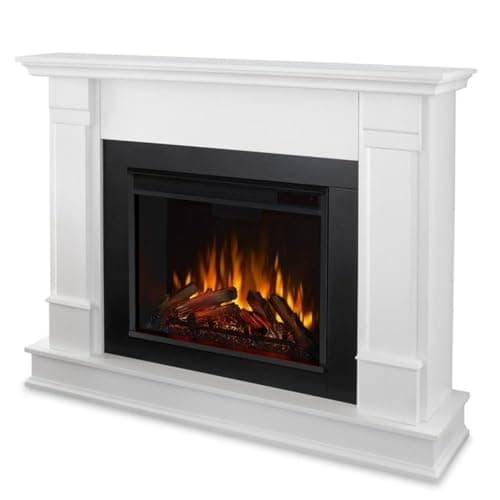 Real Flame Silverton 48" Mantel (G8600E-W)A proper mantel with a fire in it, at half the price the Amish pitch asked — and the firebox is a replaceable part rather than a sealed unit. | The honest version of the pitch | 27.5¢1,500 W · 5,118 BTU | |
| 2 |  BOWERY HILL 48" Traditional Mantel Surround (BH-4752)The only unit here that makes a construction claim at all — and its own specification immediately qualifies it. | The one that says solid wood out loud | 27.5¢1,500 W · 5,118 BTU | |
| 3 | 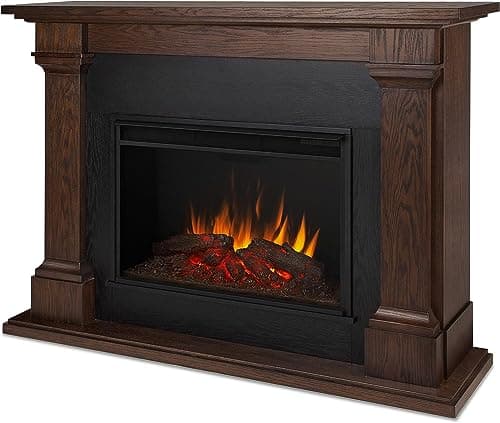 Real Flame Callaway 63" Grand Mantel (8011E-CO)Sixty-three inches and 173 pounds of chestnut oak cabinetry around exactly the same fire as the 48-inch model. | A big wall, and a mantel you will actually notice | 27.5¢1,500 W · 5,118 BTU | |
| — |  R.W.FLAME 43" Mantel Surround (M027)Its title says wooden surround. Its own feature text says imitative wood frame. On this page, that distinction is the whole point.Skip this one | Nothing, if the woodwork is why you are here | 27.5¢1,500 W · 5,118 BTU |
#ad Buy links are affiliate links — we earn a commission on Amazon purchases at no extra cost to you, and it never changes the ranking. How this site is funded. Running cost is computed at 18.34¢/kWh; see what these actually cost to run.
The four, side by side
| Unit | Size (W x H x D) | Weight | Stated construction | Certification |
|---|---|---|---|---|
| Real Flame Silverton 48 | 48 x 41 x 13 in | 102 lb | Not published | CSA and FCC |
| BOWERY HILL 48 | 48.03 x 41.25 x 13.78 in | 97 lb | Solid wood, veneered MDF and powder-coated steel | CSA and FCC |
| Real Flame Callaway 63 | 63 x 48 x 17.25 in | 173 lb | Not published | CSA and FCC |
| R.W.FLAME 43 — our skip | 43.3 x 39.6 x 13.7 in | 72.13 lb | Imitative wood frame | Not published |
Solid wood, veneer, or imitation
The Amish pitch is really a claim about this distinction, so it is worth being precise about it. Solid hardwood is milled from the tree and can be sanded and refinished for decades. A veneer is a thin layer of real wood bonded to engineered board — it looks like the real thing because it is the real thing, but only a fraction of a millimeter of it, and it cannot be refinished. An imitation finish is a printed or laminated surface with no wood in the visible layer at all.
All three are legitimate at the right price. What is not legitimate is a listing that implies the first while supplying the third, which is why the R.W.FLAME is our skip despite being a perfectly reasonable cheap fireplace. If a mantel listing does not state its construction, assume engineered board with a veneer or a finish, because a manufacturer who had milled solid hardwood would be saying so in the title.
Before you buy one
- Decide whether you want furniture or heat. If it is heat, nothing here beats anything else, and a wall unit at a quarter of the price produces identical warmth.
- Ask what the cabinet is made of, and treat silence as an answer. The brands that mill solid hardwood advertise it.
- Check whether the firebox can be replaced on its own, and whether the maker still sells that part.
- Read the mantel load limit before planning what goes on top of it. Thirty pounds is common and is not very much.
- If you are comparing against a mantel-and-console format rather than a surround, the best electric fireplaces with mantels covers that shape, and how to size a mantel package covers the measuring.
Questions people actually ask
What is an Amish electric fireplace?
An ordinary electric fireplace insert fitted into a wooden mantel built by Amish craftsmen. The term describes who made the furniture, not the technology inside it. NBC News reported that for the best-known product of this type the mantels are made by Amish workers in Ohio while the heating units are manufactured in China.
Do Amish fireplaces really save money on heating?
Only through zone heating, and only in some homes. Heating one occupied room while turning the whole-house thermostat down can save money — but electricity costs roughly two and a half times more than natural gas per unit of heat in much of the country, so running an electric fireplace alongside a gas furnace usually adds to the bill unless the furnace genuinely runs less. This is true of every electric fireplace, not just this one.
Is the Heat Surge a miracle heater?
Consumer Reports found it reasonably convenient, quiet and safe, but no more miraculous than other space heaters. The advertised output of roughly 5,110 BTU per hour is simply what a 1,500-watt element produces — the same as nearly every electric fireplace sold, because a 120-volt circuit caps them all at 1,500 watts.
Are Amish fireplaces actually made by the Amish?
The mantels are. The heaters are not — they are manufactured in China, which the original advertising did not disclose. Religion News Service pointed out the irony that most Old Order Amish households do not use grid electricity and so could not run the appliance their woodwork was wrapped around.
How many BTUs does an Amish fireplace produce?
About 5,100 BTU per hour, like almost everything else. That figure is a direct conversion of 1,500 watts rather than a measurement — one watt is 3.412 BTU per hour — and 1,500 watts is the ceiling a standard 120-volt household circuit imposes on any plug-in heater.
What should I buy instead?
If you want the look, buy a wood-mantel fireplace on its own merits — the three above are current, purchasable and cost less than the original offer did. If you want heat, buy on price, because every unit in the category produces the same 5,118 BTU per hour. And if you want the fire to look convincing, spend the money on firebox depth and flame technology instead, which is the subject of the most realistic electric fireplaces.
Sources
Every figure on this page is either taken from one of these documents or computed from a formula shown on the page. Nothing here is recalled from memory.
- NBC News — "Are Amish fireplace claims a bunch of hot air?": the advertising offered a free heater with the purchase of a wooden mantel at $298 plus shipping and promised to slash heating bills; the wooden mantels are made by Amish workers in Ohio while the heating units are manufactured in China, which the advertisements did not disclose; Consumer Reports found the unit reasonably convenient, quiet and safe but no more miraculous than other space heaters
- Religion News Service — "An 'Amish' heater the Amish couldn't use themselves", on the gap between the Amish-built mantel and an electric appliance that requires the grid electricity most Old Order Amish households do not use
- Heat Surge Original Roll-n-Glow owner's manual (model documentation for the Amish-mantel fireplace range)
- EIA Electric Power Monthly, Table 5.3 — US residential average, June 2026
Read next
- The best electric fireplaces with mantels
Mantel packages and consoles ranked on footprint, flame and running cost, with the one to avoid.
- How to size a mantel package
The wall ratio, the TV rule and the seating distance — four measurements that decide whether a console fits the room.
- What an electric fireplace costs to run
27.5 cents an hour on heat, under two cents on flame alone — computed at the real 2026 rate, with the source.
- Cheap electric fireplaces worth buying
Budget units produce the same 5,118 BTU as the flagships. Five worth buying, plus a clear list of what the extra money genuinely buys elsewhere.
- Replacement electric fireplace inserts
Replacing a dead firebox in a TV stand or mantel: the four measurements that decide the fit, why replacement insert means two incompatible products, and three units that fit real cutouts.