Guide · the failure modes
What makes a flame look fake
Six specific tells, each with a physical cause. Three of them you can fix in under a minute with the remote you already have.
By Scooter M.Published September 2, 2026Last reviewed September 2, 2026
Disclosure: the buy links below are affiliate links. We earn a commission on Amazon purchases at no extra cost to you. It has never changed a ranking on this site, and every roundup here names a unit we think you should skip. How this site is funded.
The six tells
In roughly the order people notice them: flatness from an angle, a repeating rhythm, too much brightness, too much speed, a dark ember bed, and a visible frame. Three of those — brightness, speed and often the ember bed — are settings you can change right now. The other three are properties of the unit.
1. Flatness from an angle
Cause: the flame is a lit surface, not a lit object. Move off-center and you see the surface edge-on rather than looking into the effect. Fixable? No, not with a setting. It needs depth behind the flame, three-sided glass, or a mechanism that produces a real volume of light-scattering material — which means water vapor.
2. A repeating rhythm
Cause: LED flame effects run a cycle. A rotating reflector has a fixed rotation period; a layered LED assembly runs a program; an LCD unit plays a finite video. Real fire is chaotic and never repeats. Fixable? Partly — slower flame settings make the cycle less obvious, and units with longer or randomized cycles are better. Only water vapor eliminates it, because mist is genuinely chaotic.
3. Too much brightness
Cause: the factory default. Units are configured to look impressive under showroom lighting, and a real fire in a dim room is far dimmer than any default setting. Fixable? Yes, immediately. Turn it down two steps. This is the single highest-return adjustment available and it costs nothing.
4. Too much speed
Cause: same reason. Fast flame movement reads as energetic on a shop floor and as frantic in a living room. Real flames move more slowly than people remember. Fixable? Yes. One or two steps down from default on almost any unit.
5. A dark ember bed
Cause: the unit lights the flame but not what is underneath it. Real fires glow from the bed upward — the hottest, brightest part of a fire is at the bottom. A bright flame above an unlit bed inverts that, which is why it reads as wrong even to people who cannot say what is wrong. Fixable? Sometimes: many units have independent ember-bed lighting that is off by default. Check the remote before assuming yours does not.
6. A visible frame
Cause: a bezel around a flame is the same visual cue as a bezel around a television, and your brain has a lifetime of training on what that means. Fixable? No, but it is buyable — frameless fronts exist specifically for this, and recessing a unit hides the edge that surface-mounting exposes.
The summary table
| Tell | Cause | Fix | Free? |
|---|---|---|---|
| Flat from an angle | Lit surface, no depth | Three-sided glass, or water vapor | No |
| Repeats | A finite effect cycle | Slower settings; water vapor eliminates it | Partly |
| Too bright | Factory default | Turn brightness down two steps | Yes |
| Too fast | Factory default | Turn speed down one step | Yes |
| Dark ember bed | Bed lighting off or absent | Switch bed lighting on if the unit has it | Often |
| Visible frame | Bezel around the flame | Frameless front, or recess the unit | No |
Quick picks
Ranked. The running cost column is computed from each unit's rated wattage, not quoted from a manufacturer. Tap a row for the full write-up.
| # | Product | Best for | Cost per hour | Price |
|---|---|---|---|---|
| 1 | 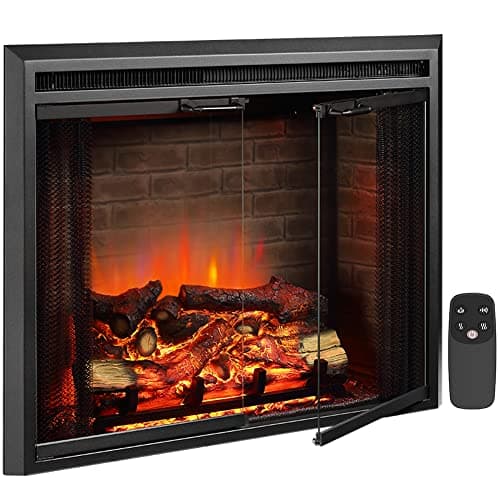 PuraFlame Klaus 33" Electric Fireplace InsertA resin log raised on a grate above the ember bed, so light gets underneath it. That detail fixes two tells at once. | The traditional cues, done right | 27.5¢1,500 W · 5,118 BTU | |
| 2 | 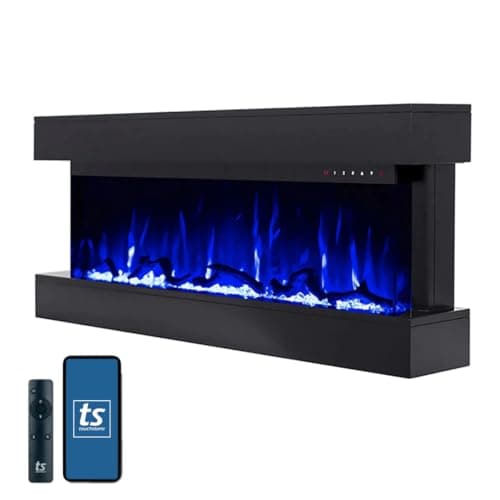 Touchstone Chesmont Black 50 (3-Sided)Three-sided glass. The only fix for flatness that works from a side angle, and it is geometry rather than electronics. | Fixing the off-axis tell structurally | 27.5¢1,500 W · 5,118 BTU | |
| 3 | 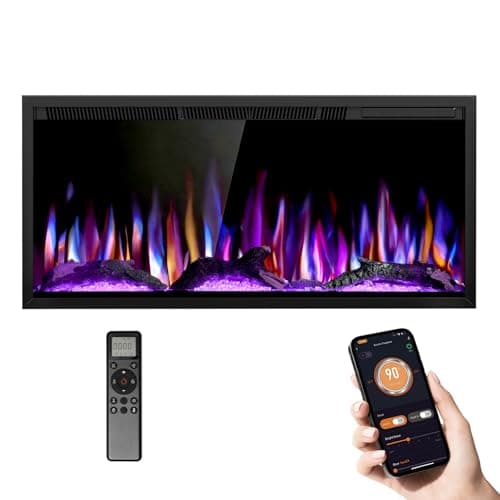 R.W.FLAME 36" Ultra-Thin Recessed & Wall-Mount FireplaceFive brightness levels and five flame speeds. Three of the six tells are settings, and this gives you room to fix them. | Settings you can actually adjust | 27.5¢1,500 W · 5,118 BTU |
#ad Buy links are affiliate links — we earn a commission on Amazon purchases at no extra cost to you, and it never changes the ranking. How this site is funded. Running cost is computed at 18.34¢/kWh; see what these actually cost to run.
#1 · The traditional cues, done right
PuraFlame Klaus 33" Electric Fireplace Insert
A resin log raised on a grate above the ember bed, so light gets underneath it. That detail fixes two tells at once.
A log sitting flat on the floor of a firebox is lit from the front and dark underneath, which reads immediately as an object rather than as something burning. Raising it on a grate lets light through from below.
The Klaus does this, and adds a mesh screen that breaks up the light and a three-sided brick interior that gives the fire a plausible place to be.
Old-fashioned cues, and they do more work than most of what gets marketed as flame technology.
What it does not do: No trim kit in the base version — an existing masonry opening wider than 33 in leaves a visible gap unless you buy the trim separately.
Published specs
- Heater:
- 750 W / 1,500 W, two settings
- Width:
- 33 1/16 in
- Height:
- 25 9/16 in
- Flame:
- LED, three intensity settings, runs with heat off
- Front:
- Glass door, mesh screen, three-sided brick interior
- Log:
- Resin cast log, 11 13/16 in high, on a grate over the ember bed
What it costs to run
- 27.5¢/hr on full heat
- $99.04 across a 90-day winter at 4 hrs a night
- 5,118 BTU/hr · 12.5 A on a 120 V circuit
Computed at 18.34¢/kWh (EIA, June 2026). Your rate will differ — work out your own.
#ad We earn a commission on this link at no cost to you. How this is funded. Price as of October 17, 2026.
Specs from: PuraFlame Klaus insert listing (specifications and dimensions); Walmart product listing — 750/1500 W rating confirmed.
#2 · Fixing the off-axis tell structurally
Touchstone Chesmont Black 50 (3-Sided)
Three-sided glass. The only fix for flatness that works from a side angle, and it is geometry rather than electronics.
Flatness from an angle is tell number one and it is not fixable with a setting. It is a property of looking at a lit surface from the side.
Depth to look into from the side is the answer, and three panes of glass is how you get it.
It needs a corner or a peninsula to be worth the money. Same 1,500 W heater as everything else.
What it does not do: Three-sided glass needs a corner or a peninsula wall to make sense. Against a flat wall you pay for two panes nobody ever sees.
Published specs
- Width:
- 50 in
- Form:
- Three-sided wall-mount — glass on the front and both ends
- Why it matters:
- Three-sided glass is the cheapest fix for the off-axis flatness that gives LED units away
What it costs to run
- 27.5¢/hr on full heat
- $99.04 across a 90-day winter at 4 hrs a night
- 5,118 BTU/hr · 12.5 A on a 120 V circuit
Computed at 18.34¢/kWh (EIA, June 2026). Your rate will differ — work out your own.
#ad We earn a commission on this link at no cost to you. How this is funded. Price as of October 17, 2026.
Specs from: Touchstone electric fireplaces collection — Chesmont Black 50.
#3 · Settings you can actually adjust
R.W.FLAME 36" Ultra-Thin Recessed & Wall-Mount Fireplace
Five brightness levels and five flame speeds. Three of the six tells are settings, and this gives you room to fix them.
Most units ship with the flame far too bright and far too fast, because that is what sells in a showroom. A unit with genuine adjustment range lets you correct it.
R.W.FLAME publishes 12 flame colors, 12 ember-bed colors, five brightness levels and five speed settings across its range.
Turn the speed down one step and the brightness down two. It is the cheapest realism upgrade available and it takes ten seconds.
What it does not do: No mantel, no surround and no trim for a masonry opening. Recessing it means cutting drywall and, in most homes, running a receptacle inside the cavity.
Published specs
- Heater:
- 750 W low / 1,500 W high
- Electrical:
- 120 V
- Heat output:
- 5,100 BTU/hr (manufacturer figure)
- Depth:
- 3.86 in — thin enough for a 2x4 stud bay
- Coverage:
- Rated by the manufacturer for up to 400 sq ft
- Flame:
- 12 flame colors, 12 ember-bed colors, 5 brightness levels, 5 speeds
- Sizes in the line:
- 30, 36, 42, 50, 60 and 68 in
What it costs to run
- 27.5¢/hr on full heat
- $99.04 across a 90-day winter at 4 hrs a night
- 5,118 BTU/hr · 12.5 A on a 120 V circuit
Computed at 18.34¢/kWh (EIA, June 2026). Your rate will differ — work out your own.
#ad We earn a commission on this link at no cost to you. How this is funded. Price as of October 17, 2026.
Specs from: R.W.FLAME recessed/wall-mount product page — full specifications.
Questions people actually ask
Why does my electric fireplace flame look fake?
Most often because it is too bright and too fast — both factory defaults set to look good in a showroom. Turn brightness down two steps and speed down one, and switch on the ember-bed lighting if your unit has it. Those three changes cost nothing.
Can you make an electric fireplace flame look more realistic?
Yes, considerably. Lower the flame brightness and speed, light the ember bed, dim the room, and recess the unit rather than hanging it. The first three take under a minute.
Why do electric fireplaces look flat from the side?
Because the flame is a lit surface rather than a lit object, so from an angle you see the surface edge-on instead of looking into the effect. Three-sided glass or a water-vapor mechanism are the only real fixes.
Do all electric fireplaces repeat?
Every LED and LCD unit does — the effect runs a finite cycle. Water-vapor units do not, because the mist is genuinely chaotic and never produces the same shape twice.
Sources
Every figure on this page is either taken from one of these documents or computed from a formula shown on the page. Nothing here is recalled from memory.
- Dimplex Optimyst water vapor fireplaces — ultrasonic mist and LED mechanism
- R.W.FLAME recessed / wall-mount range — 3.86 in depth, 750/1500 W, 5,100 BTU
- Touchstone Home Products — electric fireplace range and sizes
- PuraFlame Klaus 33 in insert — 750/1500 W, dimensions
- Wikipedia — Electric fireplace (mechanism and history)
Read next
- Do electric fireplaces look cheap?
Yes, in predictable conditions. What causes it, which rooms make it worse, and what genuinely fixes it.
- Logs vs crystals vs glass
Logs, crystals or glass — what each one does to the flame, and why whether the bed is lit matters more than what it is made of.
- LED vs LCD vs water vapor
Three mechanisms, three price tiers, three failure modes — and how to tell which one your room needs.
- The most realistic electric fireplaces
Ranked by flame mechanism, not adjectives. Water vapor, layered LED and three-sided glass, with the trade-offs stated.
- Electric fireplaces with crackling sound
Which units include a crackle speaker, what separates a good loop from a bad one, and an honest answer to whether owners keep it on.