Roundup · updated for the 2026 heating season
High-end electric fireplaces
A $3,000 electric fireplace produces exactly as much heat as a $150 one. That is not a criticism — it is the fact that makes this tier legible, once you know what you are actually buying instead.
By Scooter M.Published September 27, 2026Last reviewed September 27, 2026
Disclosure: the buy links below are affiliate links. We earn a commission on Amazon purchases at no extra cost to you. It has never changed a ranking on this site, and every roundup here names a unit we think you should skip. How this site is funded.
Above roughly $1,500 an electric fireplace stops getting warmer, because every unit in the category is capped at 1,500 watts by a 120-volt circuit — about 5,118 BTU per hour — whatever it costs. What a premium price still buys is flame technology, firebox depth, a format you cannot get cheaply, and the quality of the finish where the fireplace meets the wall. What it does not buy is heat, running cost, coverage, or in several cases a published rough opening. Decide which of the four things you are actually paying for before you shortlist anything.
How we judged this tier
A premium roundup is easy to do badly, because at this price every unit photographs well and every brand uses the same adjectives. So we fixed the criteria before we ranked anything, and they are deliberately narrow: only the things that genuinely differ above $1,500.
- Flame technology. Does the fire look different from a budget unit, or merely better framed? Only one thing on this page changes the former.
- Firebox depth. Depth is the most reliable predictor of a convincing flame effect, because it separates the light source from the glass and gives the effect somewhere to happen.
- Format. Can you buy this shape cheaply? See-through and true clean-face built-in cannot be had at budget prices; a 60-inch linear panel can.
- Finish and documentation. How the unit meets the wall, and whether the manufacturer publishes what you need in order to install it. These turn out to pull in opposite directions at the top of the market.
Everything else — flame color counts, remote features, app support, claimed square footage — either does not differ meaningfully at this level or is not a reason to spend thousands. We have excluded them from the ranking entirely.
What a higher price never buys
This is the part the category does not advertise. A 120-volt household circuit limits any plug-in appliance to 1,500 watts, and 1,500 watts is about 5,118 BTU per hour regardless of the badge. Modern Flames prints 5,000 BTU on its own page. So does Napoleon. So does a $140 three-sided insert.
| Usage | Hours | Heat on (1,500 W) | Flame only (~100 W) |
|---|---|---|---|
| One evening | 4 | $1.10 | $0.07 |
| A week of evenings | 28 | $7.70 | $0.51 |
| A month, 4 hrs a night | 120 | $33.01 | $2.20 |
| A 90-day winter, 4 hrs a night | 360 | $99.04 | $6.60 |
| Per hour | 1 | 27.5¢ | 1.8¢ |
That table is identical for a three-thousand-dollar fireplace and a two-hundred-dollar one, and it is the single most useful thing to understand before spending in this tier. The exception on this page is the CLEARion, and only because it direct-wires to 240 volts and carries two heaters. Do they actually heat a room? is the general version of this argument, and the running cost calculator will price any of these against your own tariff.
The four things that do still change
| What changes | Budget unit | Premium unit | Worth paying for? |
|---|---|---|---|
| Heat output | About 5,000 BTU/hr | About 5,000 BTU/hr | No — identical |
| Running cost | About 27.5 cents an hour | About 27.5 cents an hour | No — identical |
| Flame technology | LED against a rear panel | Concealed-source or layered systems | Yes, if realism is the reason you are here |
| Firebox depth | 3 to 5 in | 4 to 12 in | Yes — the best predictor of a convincing fire |
| Format | Single-sided linear | See-through, three-sided, clean-face built-in | Yes, when no cheap unit does the shape |
| Finish at the wall | Visible frame and bracket | Trim kit, full-frame, flush | Yes, at close viewing distances |
Quick picks: where the premium earns its money
Ranked. The running cost column is computed from each unit's rated wattage, not quoted from a manufacturer. Tap a row for the full write-up.
| # | Product | Best for | Cost per hour | Price |
|---|---|---|---|---|
| 1 | 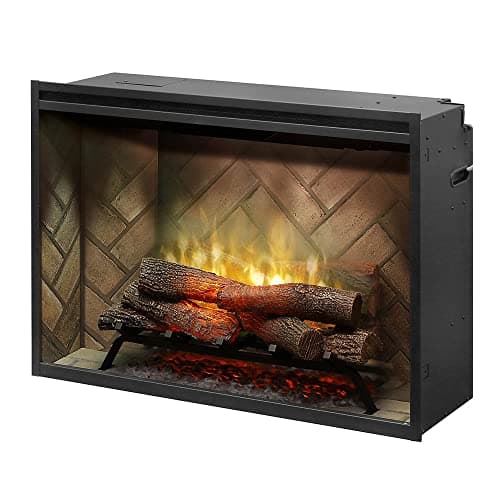 Dimplex Revillusion RBF36 36" Built-In FireboxThe only unit here whose fire looks different rather than merely better-finished — a twelve-inch-deep firebox with no visible light source. | The flame, and nothing else | 25.2¢1,375 W · 4,692 BTU | |
| 2 | 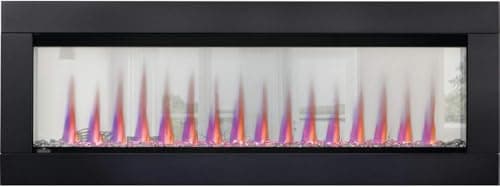 Napoleon CLEARion Elite 60 See-Thru (NEFBD60HE)The only true see-through unit in general circulation, and the only fireplace on this site that exceeds 1,500 watts. | A format you cannot buy cheaply | 26.6¢1,450 W · 4,948 BTU | |
| 3 | 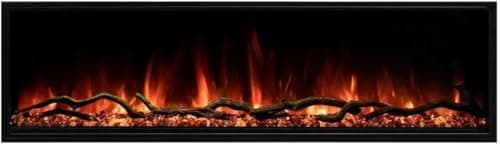 Modern Flames Landscape Pro Slim 68 (LPS-6814)A clean-face built-in with the trim kit in the box and layered Hybrid-FX flame — the best-integrated install here, at the same 5,000 BTU as everything else. | Finishing into the wall properly | 27.5¢1,500 W · 5,118 BTU | |
| 4 | 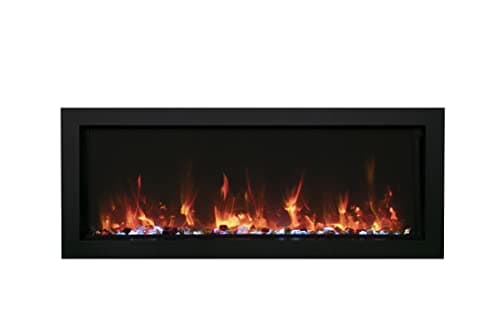 Amantii Panorama BI-60 Extra Slim (BI-60-XTRASLIM)Four inches deep with a full-frame finish and an indoor/outdoor rating — the premium unit that does not require rebuilding the wall. | Premium finish in a wall you already have | 27.5¢1,500 W · 5,118 BTU | |
| 5 | 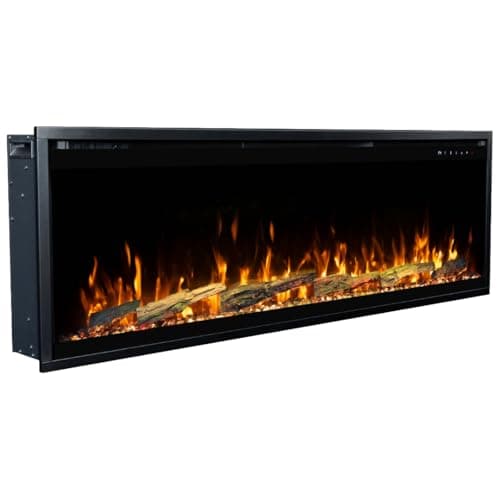 Touchstone Sideline Elite Pro 60 (80058)Most of what the pricier units offer — frameless glass, two-stage heat, smart control, a published rough opening — at roughly half the money. | The point where spending more stops helping | 27.5¢1,500 W · 5,118 BTU |
#ad Buy links are affiliate links — we earn a commission on Amazon purchases at no extra cost to you, and it never changes the ranking. How this site is funded. Running cost is computed at 18.34¢/kWh; see what these actually cost to run.
Where we would draw the line
If the fireplace is going above a mantel or under a television, where nobody looks at it from three feet away, we would not spend in this tier at all — the frame and the flame subtleties are invisible at that distance, and the best wall-mount units do the job. If it is at eye level in a room people sit in, the finish and the flame are the first things anyone notices, and the money is well spent.
And if the reason you are shopping premium is that you want a fireplace to actually heat the room, the honest answer is that no amount of money solves that on a 120-volt circuit. That is a different appliance and a different page: do electric fireplaces actually heat a room?.
Questions people actually ask
Do expensive electric fireplaces produce more heat?
No. Almost every electric fireplace, at any price, is capped at 1,500 watts by a standard 120-volt circuit — about 5,118 BTU per hour. The only exception we have found is a unit that direct-wires to 240 volts and carries two heaters. A $3,000 fireplace and a $150 one warm a room identically.
What makes a high-end electric fireplace worth the money?
Four things, and only four: flame technology that conceals its light source or layers the flame and ember bed, firebox depth, a format you cannot buy cheaply such as see-through or clean-face built-in, and the finish where the unit meets the wall. If none of those is your reason for shopping, the premium is not buying you anything.
What is the most realistic expensive electric fireplace?
Of the units here, the Dimplex Revillusion is the only one whose flame effect works differently rather than simply being better finished — a deep firebox with no visible light source, which is why it holds up when viewed from below or from the side. We go through the mechanism on what makes a flame look fake.
Why do premium brands publish less information than cheap ones?
We do not know why, but it is consistently true in this category and worth planning around. Touchstone publishes a rough opening, weight, heater type and amperage at around $1,500; Modern Flames, Amantii and Napoleon publish no rough opening on the units featured here. If you are framing a wall around a premium built-in, expect to ask the manufacturer directly for the dimension.
Is a cheaper electric fireplace just as good?
For heat, yes — exactly as good. For everything else it depends on viewing distance. Above a mantel or under a television the differences are invisible and a budget unit is the rational buy; at eye level in a room people sit in, the frame, the depth and the flame system are the first things noticed. Our buying guide works through the decision in full.
Sources
Every figure on this page is either taken from one of these documents or computed from a formula shown on the page. Nothing here is recalled from memory.
- Modern Flames Landscape Pro Slim series page — available in 44, 56, 68, 80 and 96 in, 5,000 BTU heater, hand-painted Canyon Driftwood log set, 15 in high viewing area, simple slide-in or wall-mounted installation, starting at $2,299
- Amazon listings (Amantii) — Panorama BI-30-XTRASLIM and BI-60-XTRASLIM: 4 in deep, rated for indoor or outdoor use, two-stage heater on the 60, hardwire ready, flame operates without heat, up to 5,000 BTU, 11 canopy and ember-bed lighting colors, optional black steel surround included in the box
- Napoleon CLEARion Elite 60 (NEFBD60HE) retailer specification — true 2-sided see-thru electric fireplace, direct-wire 120 V or 240 V, up to 10,000 BTU and 3,000 W, warms up to 800 sq ft, privacy glass switching between transparent, semi-transparent and fully opaque, 3 flame colors, 5 flame speeds, 15 ember-bed colors, simple framing installation into an 8 in wall thickness, includes logs with topaz glass and crystal embers
- Touchstone Sideline Elite Pro 60 (80058) product page — 60 x 19 1/4 x 6 5/16 in, 66 lb, 750/1500 W, 5,000 BTU, 400 sq ft, coil wire heater with blower, spacer kit for 2x4 walls
- EIA Electric Power Monthly, Table 5.3 — US residential average, June 2026
Read next
- The electric fireplace buying guide
Five decisions in order, the specs that matter, and the four that do not differ between units at all.
- Modern Flames electric fireplaces: which one to buy
The Landscape Pro Slim and Spectrum Slimline ranges decoded — what Hybrid-FX and a PTC ceramic heater actually change, and which specification Modern Flames leaves in a PDF.
- Amantii electric fireplaces: which one to buy
Panorama Extra Slim against Panorama Deep — what four inches versus twelve and three-quarters changes, the indoor/outdoor rating, and the specification Amantii never publishes.
- The most realistic electric fireplaces
Ranked by flame mechanism, not adjectives. Water vapor, layered LED and three-sided glass, with the trade-offs stated.
- Cheap electric fireplaces worth buying
Budget units produce the same 5,118 BTU as the flagships. Five worth buying, plus a clear list of what the extra money genuinely buys elsewhere.