Guide · the honest assessment
Do electric fireplaces look cheap?
Some do, in some conditions, and the conditions are predictable enough that you can decide before you buy rather than after.
By Scooter M.Published September 2, 2026Last reviewed September 2, 2026
Disclosure: the buy links below are affiliate links. We earn a commission on Amazon purchases at no extra cost to you. It has never changed a ranking on this site, and every roundup here names a unit we think you should skip. How this site is funded.
The honest answer
Some do, and it is predictable. The variables are ambient light, viewing angle, and distance — not price. A $300 unit in a dim room viewed head-on looks better than a $1,200 unit in a bright open-plan space viewed from the side, and no amount of money changes that ordering.
The five specific things that read as cheap
- Flatness from an angle. The commonest complaint by a wide margin. The flame is a lit surface, so from the side you see the surface rather than into the effect.
- Daylight washout. LED flame competes with sunlight and loses. In a bright room it reads as an orange panel.
- A visible frame. A bezel around the flame is the same cue as a bezel around a television, and your eye is extremely well trained on it.
- A repeating rhythm. Every LED flame has a cycle. Once you notice it, you cannot un-notice it, and cheap reflector units have the shortest cycles.
- A dark ember bed. Real fires glow from underneath. A flame with an unlit bed under it looks wrong in a way most people cannot articulate.
Which room you have decides most of it
| Your room | How LED performs | What to do |
|---|---|---|
| Dim, used in the evening, one seating position | Genuinely convincing | Buy entry or mid LED and stop spending |
| Normal living room, evening use, some movement | Good | Layered LED with a lit ember bed |
| People approach from the side | Weak — this is the flatness case | Three-sided glass, or a corner install |
| Bright, large windows, daytime use | Poor, at every price | Water vapor, or accept a daytime-off fireplace |
| Open-plan, seen from everywhere | Hardest case in the category | Water vapor, or spend on housing instead |
Quick picks
Ranked. The running cost column is computed from each unit's rated wattage, not quoted from a manufacturer. Tap a row for the full write-up.
| # | Product | Best for | Cost per hour | Price |
|---|---|---|---|---|
| 1 | 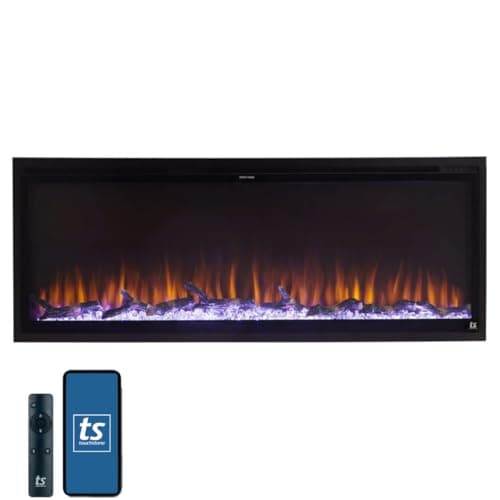 Touchstone Sideline Elite 50The frameless front. A visible bezel is the clearest signal that you are looking at an appliance, and this deletes it. | Removing the strongest giveaway | 27.5¢1,500 W · 5,118 BTU | |
| 2 | 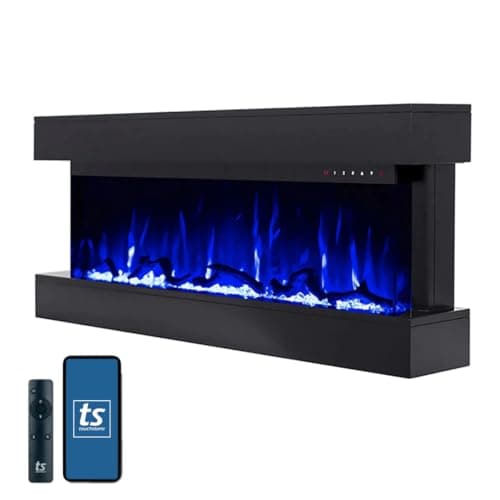 Touchstone Chesmont Black 50 (3-Sided)Three-sided glass fixes the off-axis flatness that causes most of the 'it looks fake' reaction in real houses. | Rooms people walk through | 27.5¢1,500 W · 5,118 BTU | |
| 3 | Dimplex Opti-Myst Revive 25" Water Vapor FireplaceIf the room is bright and seen from everywhere, mist is the only mechanism that holds up. It also produces no heat. | A bright room where nothing else works | No heaterflame effect only |
#ad Buy links are affiliate links — we earn a commission on Amazon purchases at no extra cost to you, and it never changes the ranking. How this site is funded. Running cost is computed at 18.34¢/kWh; see what these actually cost to run.
What genuinely fixes it, in order of effect
- Turn the room lights down. Free, and it is the single biggest improvement available. These are evening objects.
- Recess it rather than hanging it. A flush unit reads as an opening; a hung one reads as an object. See wall-mounted vs recessed.
- Choose a frameless or three-sided front. Structural fixes to structural problems.
- Position it where people look at it head-on, not where they walk past it side-on.
- Turn the flame speed and brightness down. Most units default to too fast and too bright. Real fires are slower and dimmer than the factory setting.
- Light the media bed, and pick the right media for the unit. Real fires glow from underneath, and logs, crystals or glass each suit a different shape of fireplace.
The expectation to set
An electric fireplace at any price will not be mistaken for a wood fire in daylight, by anyone, at any distance. What a good one will do is look like a fire in the evening, from the sofa, well enough that nobody comments — and that is genuinely most of what people want from one.
The buyers who end up disappointed are almost always the ones who expected the first thing. The ones who are happy expected the second, and got it for a few hundred dollars.
#1 · Removing the strongest giveaway
Touchstone Sideline Elite 50
The frameless front. A visible bezel is the clearest signal that you are looking at an appliance, and this deletes it.
If you ask people what makes an electric fireplace look cheap, they usually describe the flame. If you watch what their eye actually catches, it is frequently the frame.
A bezel around a flame is the same visual cue as the bezel around a television, and your brain has decades of training on what that means. Removing it is a disproportionate improvement.
Same 1,500 W heater as the standard Sideline 50 at the same 50 inches. The whole difference is presentation, which is what this page is about.
What it does not do: The heater is the same 1,500 W ceiling as the cheaper Sideline 50. The extra money buys the glass front and the flame presentation, not warmth.
Published specs
- Width:
- 50 in
- Form:
- Recessed, frameless glass front
- Position in line:
- Above The Sideline 50, below the Elite Pro
What it costs to run
- 27.5¢/hr on full heat
- $99.04 across a 90-day winter at 4 hrs a night
- 5,118 BTU/hr · 12.5 A on a 120 V circuit
Computed at 18.34¢/kWh (EIA, June 2026). Your rate will differ — work out your own.
#ad We earn a commission on this link at no cost to you. How this is funded. Price as of October 17, 2026.
Specs from: Touchstone electric fireplaces collection — Sideline Elite 50.
#2 · Rooms people walk through
Touchstone Chesmont Black 50 (3-Sided)
Three-sided glass fixes the off-axis flatness that causes most of the 'it looks fake' reaction in real houses.
In a photograph, every electric fireplace is viewed head-on. In a house, people approach from the side, walk past, and glance at it from the kitchen. That is where LED units lose.
Three-sided glass gives depth to look into from the side. It is a structural fix, and it is the reason corner installations frequently look better than flat ones using identical technology.
It requires a corner or a peninsula to earn its money. Against a flat wall, two panes are decorative.
What it does not do: Three-sided glass needs a corner or a peninsula wall to make sense. Against a flat wall you pay for two panes nobody ever sees.
Published specs
- Width:
- 50 in
- Form:
- Three-sided wall-mount — glass on the front and both ends
- Why it matters:
- Three-sided glass is the cheapest fix for the off-axis flatness that gives LED units away
What it costs to run
- 27.5¢/hr on full heat
- $99.04 across a 90-day winter at 4 hrs a night
- 5,118 BTU/hr · 12.5 A on a 120 V circuit
Computed at 18.34¢/kWh (EIA, June 2026). Your rate will differ — work out your own.
#ad We earn a commission on this link at no cost to you. How this is funded. Price as of October 17, 2026.
Specs from: Touchstone electric fireplaces collection — Chesmont Black 50.
#3 · A bright room where nothing else works
Dimplex Opti-Myst Revive 25" Water Vapor Fireplace
If the room is bright and seen from everywhere, mist is the only mechanism that holds up. It also produces no heat.
Ambient light is what defeats LED. In a room with large windows used during the day, no amount of LED refinement solves the problem, because the effect is competing with the sun.
Water vapor holds up because the flame is a physical object being lit rather than a light pretending to be an object. Dimplex publishes 120 V and 1,250 W for the Revive 25.
The flame produces no heat. If that is acceptable, this is the answer to the hardest realism case in the category.
What it does not do: No heat from the flame effect at all, and it needs a water reservoir refilled. If you want warmth, this is the wrong product and no amount of enthusiasm changes that.
Published specs
- Electrical:
- 120 V, 1,250 W
- Width:
- 25 in
- Flame:
- Ultrasonic water mist from ordinary tap water, lit by LEDs
- Heat:
- The flame effect produces NO heat. Heaters are a separate option on some models
- Install:
- Hardwired, or a compatible 120 V power cord
What it costs to run
No heater. The flame effect alone draws far less than a heating unit — see what these cost to run.
Computed at 18.34¢/kWh (EIA, June 2026). Your rate will differ — work out your own.
#ad Dimplex is not a program we have joined, so we earn nothing here. How this is funded. Price as of October 17, 2026.
Specs from: Dimplex Optimyst water vapor fireplaces — how the mist flame works; Dimplex Opti-Myst Revive 25 in — 120 V, 1,250 W.
Questions people actually ask
Do electric fireplaces look cheap?
Some do, in predictable conditions: bright daylight, viewed from an angle, or close up. In a dim room viewed head-on, modern layered-LED units are convincing enough that visitors do not comment. The room matters more than the price.
Do expensive electric fireplaces look better?
Up to a point, and the money buys specific things: layered flame depth, a lit ember bed, frameless or three-sided glass, and better housing. What it does not buy is immunity to daylight — that requires a different mechanism entirely.
How can I make my electric fireplace look more real?
Turn the room lights down, turn the flame brightness and speed down from their factory defaults, and recess the unit rather than hanging it if you can. The first two are free and take ten seconds.
Will people be able to tell it is not a real fire?
In daylight, yes. In a dim evening room from a sofa, frequently not — and if they do notice, it is usually because the fireplace is in a house with no chimney rather than because of the flame.
Sources
Every figure on this page is either taken from one of these documents or computed from a formula shown on the page. Nothing here is recalled from memory.
Read next
- What makes a flame look fake
Six tells with physical causes — and the three you can fix in a minute with the remote.
- Flame technology explained
The four flame mechanisms, how each physically works, and the exact conditions where each one gives itself away.
- The most realistic electric fireplaces under $500
What genuinely improves a flame at the entry tier, and the units that carry those features.
- Wall-mounted vs recessed
The same fireplace, two installs. What each costs in work, and what each looks like when finished.