Guide · the conditional answer
Are electric fireplace inserts worth it?
The answer is genuinely conditional, and the conditions are easy to state. Here they are, with the numbers that decide each one.
By Scooter M.Published September 2, 2026Last reviewed September 2, 2026

Disclosure: the buy links below are affiliate links. We earn a commission on Amazon purchases at no extra cost to you. It has never changed a ranking on this site, and every roundup here names a unit we think you should skip. How this site is funded.
The short answer
Worth it if you have a fireplace opening that is dead, you want it to look alive, and you treat the heat as a bonus. Not worth it if you are buying it to reduce a heating bill, to heat a large or open-plan space, or because you expect it to be indistinguishable from a real fire in daylight. Those three expectations account for essentially every disappointed owner.
What you actually get, item by item
| What people expect | What is true | Verdict |
|---|---|---|
| A warm room | 5,118 BTU/hr at the 1,500 W ceiling — sole heat source in about 256 sq ft, supplemental above that | True within the limit, oversold above it |
| Lower heating bills | 27.5¢/hr at 18.34¢/kWh. Zone heating can save money if you turn the central thermostat down | Conditionally true, and only if you actually change behavior |
| A convincing fire | Convincing at night, head-on, in a dim room. Much less so in daylight or off-axis | True in the conditions most people use it in |
| No maintenance | No venting, no fuel, no ash, no chimney sweep, no CO risk | Entirely true |
| Easy install | Log set: minutes. Full insert into masonry: an afternoon plus possibly a receptacle. Recessed: a real job | True for two of three cases |
The money argument, done properly
The zone-heating case is the one worth taking seriously, and it is also the one most often stated badly. The claim is not that an electric fireplace is cheap to run — at 27.5 cents an hour it is not especially cheap. The claim is that heating one occupied room and lowering the thermostat for the rest of the house can cost less than heating the whole house to the same comfort level.
| Usage | Hours | Heat on (1,500 W) | Flame only (~100 W) |
|---|---|---|---|
| One evening | 4 | $1.10 | $0.07 |
| A week of evenings | 28 | $7.70 | $0.51 |
| A month, 4 hrs a night | 120 | $33.01 | $2.20 |
| A 90-day winter, 4 hrs a night | 360 | $99.04 | $6.60 |
| Per hour | 1 | 27.5¢ | 1.8¢ |
About $99 across a 90-day winter at four hours a night. Whether that saves you money depends entirely on whether you actually turn the central heating down, and by how much, and what you heat with. If your house is heated by a gas furnace, electricity at 18.34 cents per kWh is an expensive way to make heat and the zone argument is weak. If it is heated by electric resistance already, the fireplace is simply the same energy in a nicer box.
The case for buying one anyway
Most people buying these are not making an energy decision. They are making a room decision: there is a black hole in the wall where a fire used to be, it makes the room feel unfinished, and the alternatives are a gas conversion costing several thousand dollars with a gas line and venting, or a wood-burning stove with a flue, a hearth and a chimney sweep twice a year. If you have not actually settled that question yet, we work it through with the efficiency arithmetic on electric vs a wood-burning fireplace.
Against those alternatives an electric insert is remarkable value, and the flame-only running cost of under two cents an hour means using it every evening for an entire winter costs less than a couple of takeaway coffees. That is the real argument, and it does not require any claims about heat at all.
#1 · Testing the idea cheaply
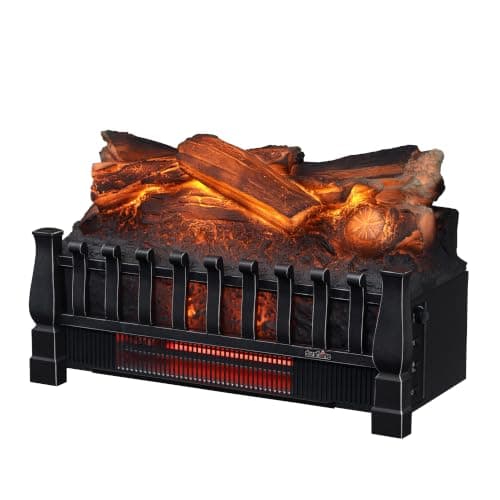
Duraflame DFI030ARU 20" Infrared Electric Fireplace Log Set
If you are unsure whether you want one at all, a log set is the least expensive way to find out, and it lifts straight back out.
The strongest argument for starting here is reversibility. A log set drops into the firebox, plugs in, and comes out again in thirty seconds if you decide the whole idea was not for you.
Infrared quartz heat, rated by Duraflame for supplemental heating up to 1,000 square feet, with independent flame and heat controls so you can run the look on its own for under two cents an hour.
Nothing about it is permanent, which is exactly the right property for a purchase you are still arguing yourself into.
What it does not do: The 1,000 sq ft figure is the manufacturer's supplemental-heat rating, not a claim that it will hold temperature in a 1,000 sq ft room. See our BTU page for what the wattage actually buys.
Published specs
- Heater:
- Infrared quartz, rated by the manufacturer for up to 1,000 sq ft
- Width:
- 20 in
- Form:
- Drop-in log set for an existing firebox
- Flame:
- LED with resin cast logs and glowing embers
- Control:
- Remote with adjustable thermostat
What it costs to run
- 27.5¢/hr on full heat
- $99.04 across a 90-day winter at 4 hrs a night
- 5,118 BTU/hr · 12.5 A on a 120 V circuit
Computed at 18.34¢/kWh (EIA, June 2026). Your rate will differ — work out your own.
#ad We earn a commission on this link at no cost to you. How this is funded. Price as of October 17, 2026.
Specs from: Duraflame DFI030ARU listing — infrared, 1,000 sq ft rating; Bed Bath & Beyond product page — 20 in infrared log set.
#2 · Committing properly
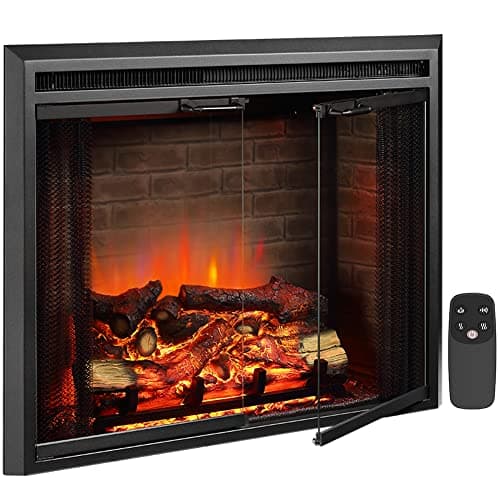
PuraFlame Klaus 33" Electric Fireplace Insert
If the answer turned out to be yes, this is the version with its own glass, screen and brick-look interior — a fireplace rather than a heater in a hole.
The difference between a log set and a full insert is whether the result looks like a fireplace or like a fireplace with something in it. The Klaus brings a glass door, a mesh screen and a three-sided brick interior, so the finished object is coherent.
750 W and 1,500 W settings, 33 1/16 inches wide, 25 9/16 high. In a masonry opening, fit it with a trim kit and check the rear width first.
This is the purchase for someone who has already decided the room needs a working focal point, rather than someone testing whether it does.
What it does not do: No trim kit in the base version — an existing masonry opening wider than 33 in leaves a visible gap unless you buy the trim separately.
Published specs
- Heater:
- 750 W / 1,500 W, two settings
- Width:
- 33 1/16 in
- Height:
- 25 9/16 in
- Flame:
- LED, three intensity settings, runs with heat off
- Front:
- Glass door, mesh screen, three-sided brick interior
- Log:
- Resin cast log, 11 13/16 in high, on a grate over the ember bed
What it costs to run
- 27.5¢/hr on full heat
- $99.04 across a 90-day winter at 4 hrs a night
- 5,118 BTU/hr · 12.5 A on a 120 V circuit
Computed at 18.34¢/kWh (EIA, June 2026). Your rate will differ — work out your own.
#ad We earn a commission on this link at no cost to you. How this is funded. Price as of October 17, 2026.
Specs from: PuraFlame Klaus insert listing (specifications and dimensions); Walmart product listing — 750/1500 W rating confirmed.
When to say no
- You need to heat more than about 256 square feet. No plug-in electric unit does this. Look at a heat pump or a proper heating solution instead.
- The room is bright and open-plan. The flame will read as a lit panel for most of the day, and you will stop switching it on.
- You want the smell and sound of a real fire. It has neither. A crackle speaker is not the same thing and everyone knows it.
- You are counting on it to cut a heating bill without changing anything else. It will add to the bill, not subtract from it.
- Your opening has no power within reach and you are not willing to add a receptacle. A cord across the hearth ruins the effect you are paying for.
Questions people actually ask
Do electric fireplaces save money on heating?
Only if you turn the central thermostat down and heat one occupied room instead of the whole house. On its own, added to existing heating, an electric fireplace increases your bill by about 27.5 cents for every hour it runs on full heat. Whether zone heating saves you anything depends on what your house is heated with.
How long do electric fireplace inserts last?
The LED flame assemblies are rated for tens of thousands of hours and are usually not the failure point. The parts that fail are moving ones — the flame motor on reflector-style units, and the fan on fan-forced heaters. Both are commonly replaceable, and warranty terms vary widely by brand, which is one of the few genuine differentiators at the premium end.
Are electric fireplaces cheaper to run than gas?
Usually not, per unit of heat, in most US markets — natural gas is generally cheaper per BTU than electricity. The electric case is about install cost, venting and maintenance rather than fuel cost. Full comparison on electric vs gas.
Is an electric fireplace insert better than a space heater?
For heat, they are the same appliance — both cap at 1,500 W and about 5,118 BTU per hour. The fireplace costs more and gives you a flame effect, and it can run that flame with the heater off for under two cents an hour, which a space heater cannot do at all. If the flame does not matter to you, a space heater does the identical job for less money. Full comparison on electric fireplace vs space heater.
Sources
Every figure on this page is either taken from one of these documents or computed from a formula shown on the page. Nothing here is recalled from memory.
- EIA Electric Power Monthly, Table 5.3 — US residential average, June 2026
- Duraflame DFI030ARU — infrared quartz log set, 1,000 sq ft rating
- PuraFlame Klaus 33 in insert — 750/1500 W, dimensions
- This Old House — best electric fireplaces (the ~18 cents per hour figure we are correcting)
- EcoCostSavings — measured wattage and BTU across 117 electric fireplace models
Read next
- What an electric fireplace costs to run
27.5 cents an hour on heat, under two cents on flame alone — computed at the real 2026 rate, with the source.
- What installing an electric fireplace insert really costs
Trim kits, receptacles, framing and electrical work — the costs that arrive after the unit does.
- Electric vs gas fireplace
Install cost, running cost, heat, realism and venting — with an honest account of where gas wins.
- The best electric fireplace inserts
Six inserts ranked by opening fit, flame mechanism and computed running cost — plus the one we would not buy.
- Cheap electric fireplaces worth buying
Budget units produce the same 5,118 BTU as the flagships. Five worth buying, plus a clear list of what the extra money genuinely buys elsewhere.