Comparison · the honest one about wood
Electric fireplace vs wood-burning fireplace
Wood wins the argument about fire and loses the argument about heat, which is the opposite of how this comparison usually gets written. Here is the arithmetic, with your own cord price plugged in.
By Scooter M.Published October 10, 2026Last reviewed October 10, 2026
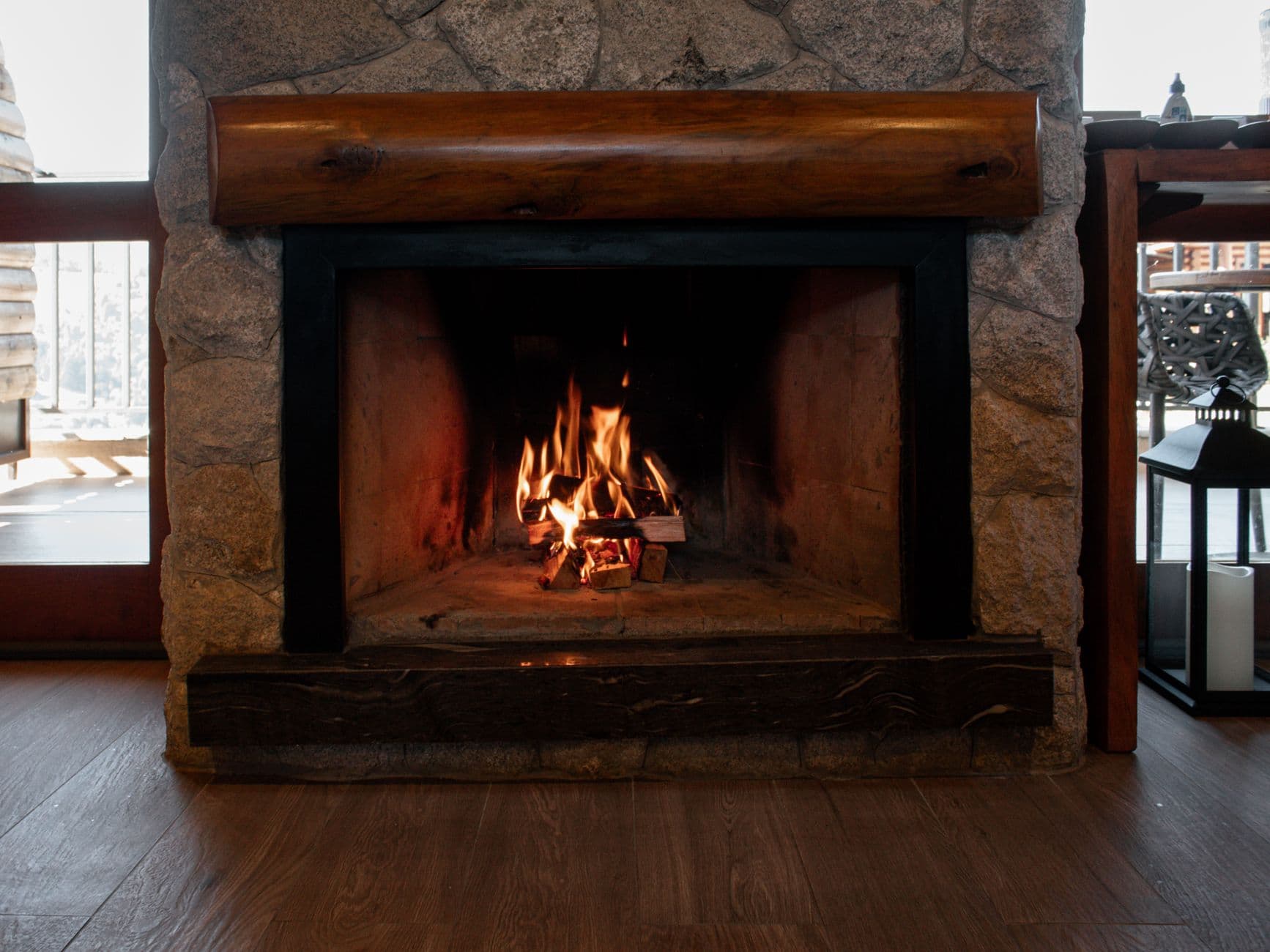
Disclosure: the buy links below are affiliate links. We earn a commission on Amazon purchases at no extra cost to you. It has never changed a ranking on this site, and every roundup here names a unit we think you should skip. How this site is funded.
The answer first
An open wood fire is not a heating appliance. Penn State Extension puts a fireplace at 10-20% efficient at creating heat, and GreenBuildingAdvisor states flatly that open fireplaces produce a net loss of heat, not a gain. An electric fireplace converts essentially 100% of what it draws into heat in the room, but it is capped at 1,500 W and about 5,118 BTU per hour. So wood wins the argument about fire and loses the argument about heat. And if heat is actually what you want out of that masonry opening, the answer is neither of them — it is an EPA-certified wood insert.
That is close to the reverse of how this comparison usually gets written, which tends to treat wood as the serious heating choice and electric as the decorative one. On delivered heat per unit of fuel burned, an open fire is the least serious appliance in this entire category.
Why "wood is free heat" is usually wrong
A fire in an open masonry fireplace has to pull air from somewhere to burn, and the somewhere is the room. That air has already been heated by whatever actually heats your house, and it goes up the flue. As GBA's editor Martin Holladay puts it: *a fireplace is designed to heat people standing (or sitting) directly in front of it. A fireplace is not designed to heat a house. The faster the fire burns, the more cold outdoor air is introduced into the house.*
That is why the efficiency figure is a band rather than a number, and why the bottom of the band is so low. Penn State Extension's introduction to heating with wood also notes that a fireplace can have a negative heating impact when the flue is left open with no fire burning — an open damper is a hole in your building envelope, and it does not care whether there is a fire under it.
The arithmetic, with your own cord price
Here is the part that makes this decidable instead of arguable. A cord of air-dried wood carries a known amount of energy, an open fireplace delivers a known fraction of it, and electricity delivers all of what it draws. So we can price the heat a cord of wood *actually puts in your room* against the electricity that would do the same job.
| Wood, air-dried | Gross per cord | Delivered at 10% | Delivered at 20% | Delivered at 80% |
|---|---|---|---|---|
| White oak | 25.7 MMBTU | 2.57 MMBTU | 5.14 MMBTU | 20.56 MMBTU |
| Northern red oak | 24.0 MMBTU | 2.40 MMBTU | 4.80 MMBTU | 19.20 MMBTU |
| Hickory | 28.0 MMBTU | 2.80 MMBTU | 5.60 MMBTU | 22.40 MMBTU |
| Osage orange | 30.7 MMBTU | 3.07 MMBTU | 6.14 MMBTU | 24.56 MMBTU |
Electricity, at the EIA US residential average of 18.34 cents per kWh, delivers heat at about $53.75 per million BTU, and because it is essentially 100% efficient at the point of use that figure is both the gross and the delivered cost. Run the two together and a cord of white oak burned in an open fireplace puts somewhere between 2.57 and 5.14 million BTU into the room — which is the same heat you would get from roughly 500 to 1,000 hours of an electric fireplace on full heat, or about $138 to $276 of electricity.
What goes in the opening if you stop burning wood
Ranked. The running cost column is computed from each unit's rated wattage, not quoted from a manufacturer. Tap a row for the full write-up.
| # | Product | Best for | Cost per hour | Price |
|---|---|---|---|---|
| 1 | 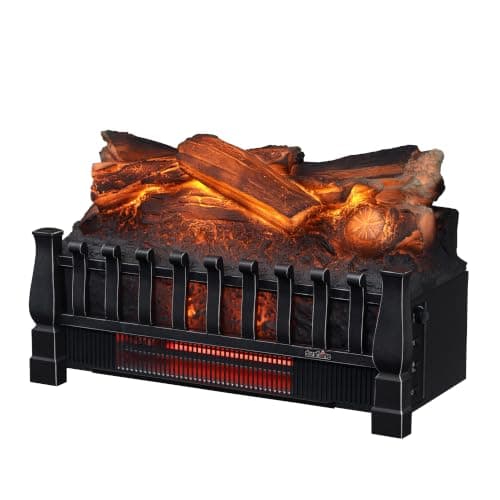 Duraflame DFI030ARU 20" Infrared Electric Fireplace Log SetA 20-inch drop-in log set at the bottom of the market. The cheapest honest way to put light back in a dead firebox. | Stopping the hole being a hole | 27.5¢1,500 W · 5,118 BTU | |
| 2 | 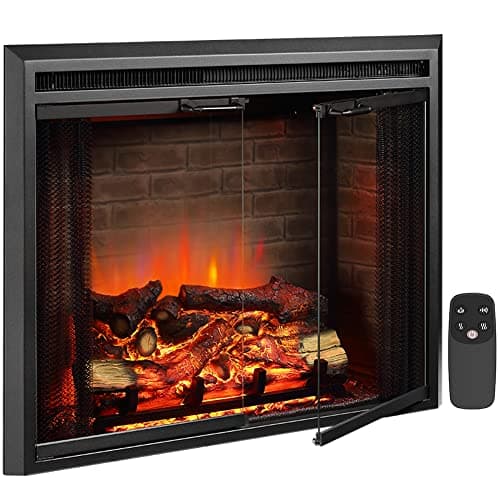 PuraFlame Klaus 33" Electric Fireplace InsertA 33-inch insert with a glass door, a mesh screen and a three-sided brick interior. It reads as a firebox rather than as a screen in a hole. | The mainstream masonry conversion | 27.5¢1,500 W · 5,118 BTU | |
| 3 | 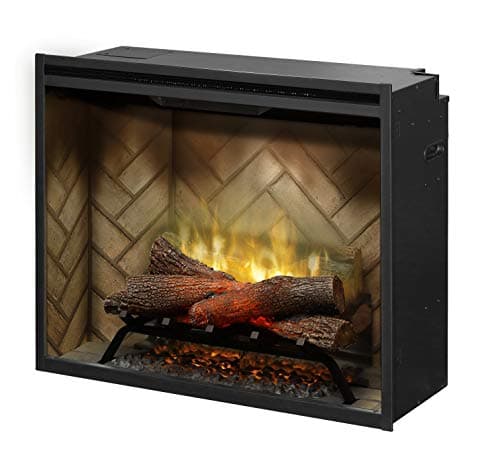 Dimplex Revillusion RBF30 30" Built-In FireboxThe one unit here whose depth is an advantage rather than a problem. A real firebox is deep, and this is a firebox rather than a panel. | When it still has to read as a real fire | 27.5¢1,500 W · 5,118 BTU | |
| — | 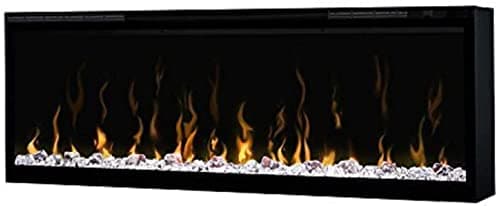 Dimplex IgniteXL 50" Linear Fireplace (XLF50)An excellent linear fireplace built to sit flush in 2x6 framing. A masonry firebox is not framing, and this is the wrong shape for the hole you have.Skip this one | Nothing, for this particular job | 27.5¢1,500 W · 5,118 BTU |
#ad Buy links are affiliate links — we earn a commission on Amazon purchases at no extra cost to you, and it never changes the ranking. How this site is funded. Running cost is computed at 18.34¢/kWh; see what these actually cost to run.
Side by side
| Wood-burning (open) | Electric | |
|---|---|---|
| Efficiency at creating heat | 10-20%, and negative with the flue open and no fire | Essentially 100% at the point of use |
| Peak output | High, but mostly up the flue | 1,500 W, about 5,118 BTU/hr, all of it in the room |
| Running cost | Cord price, divided by what little it delivers | About 27.5¢/hr on full heat |
| Flame | Real fire. Nothing matches it | An effect, and it knows it |
| Flue | Required | None |
| Annual maintenance | Professional inspection and cleaning each year, per EPA and fire officials | Wipe the glass |
| Fuel handling | Buy, stack, season, carry, light, remove ash | Switch on |
| Indoor air | Fine particles (PM2.5) are the main health threat from smoke | No combustion, so none |
| Flame without heat | Not a thing | Yes — under 2¢/hr |
| Works in a power cut | Yes | No |
| Needs an existing chimney | Yes | No. It goes anywhere |
What wood genuinely wins
- It is actually fire. No LED, no water vapor and no mirror trick is going to match combustion, and anyone telling you otherwise is selling something. If the fire itself is the point, wood wins and the rest of this page is secondary.
- Radiant heat on your skin. The 10-20% that does reach the room arrives largely as radiation, which is why a fire feels warm from the armchair even while the house gets colder. That sensation is real and an electric fireplace gives you only a fraction of it.
- It works when the power is out. The one night a year that matters, this is the whole argument, and it is not a small one.
- It can be close to free if you cut your own. Our arithmetic above prices a purchased cord. If you have woodland, a saw and the time, the fuel side of the comparison changes completely — though the annual inspection does not.
What electric genuinely wins
- Every unit of energy stays in the room. No flue means nothing to lose up it, which is the entire efficiency gap. It is also why the comparison is not close on delivered heat per dollar once a cord costs real money.
- No chimney, no sweep, no fuel, no ash. EPA and fire officials recommend having a wood appliance, chimney and vents professionally inspected and cleaned every year. That is a recurring cost and a recurring errand, and converting to electric deletes both.
- No combustion in your living room. The EPA is unambiguous that the biggest health threat from wood smoke is fine particles, PM2.5, which can worsen asthma, trigger attacks, and contribute to heart attacks, stroke, irregular heart rhythms and heart failure in at-risk groups. An electric fireplace burns nothing, so it emits nothing.
- The flame runs without the heat. For most of the year the thing you want from a fireplace is the look, not the warmth, and only one of these two can give you that for under two cents an hour. A wood fire has exactly one setting.
- It goes where there is no flue. An apartment, a bedroom, a basement, a wall that never had a chimney. The comparison only exists at all if you already own a masonry opening.
The emissions gap, if you are staying with wood
If the fire is the point and you are keeping it, the appliance you keep it in matters more than almost anything else on this page. The EPA's figures are stark: older uncertified stoves release 15 to 30 grams of smoke per hour, against no more than 4.5 grams for a new EPA-certified stove, and the Step 2 standard in force since May 2020 is 2.0 grams per hour. The agency's own summary of the mechanism is that the more efficiently you burn wood, the less smoke is created — efficiency and air quality are the same lever, not competing ones.
If you want heat from that opening, buy neither
This is the recommendation we would make to most people who arrive at this comparison wanting the fireplace to warm the room. The EPA describes a fireplace insert as *a wood stove designed to fit inside an existing fireplace*, and Penn State Extension puts a modern wood stove at 80% or more efficient against the fireplace's 10-20%. That is not a marginal improvement — on the table above it is the difference between 2.57 and 20.56 million BTU delivered from the same cord of white oak.
So the honest three-way verdict is this. Want heat from the masonry opening: an EPA-certified wood insert, and no electric unit on this site competes. Want the opening to stop being a cold hole, with no fuel, no ash, no flue and no annual sweep: electric, and the picks above are what goes in. Want to keep a real fire because it is a real fire: keep burning wood, get it inspected every year, and do not tell yourself it is heating the house. And if the appeal was thermostatic, hands-off heat rather than the fire itself, the comparison you actually want is electric vs a pellet stove.
What an electric conversion costs to run
| Usage | Hours | Heat on (1,500 W) | Flame only (~100 W) |
|---|---|---|---|
| One evening | 4 | $1.10 | $0.07 |
| A week of evenings | 28 | $7.70 | $0.51 |
| A month, 4 hrs a night | 120 | $33.01 | $2.20 |
| A 90-day winter, 4 hrs a night | 360 | $99.04 | $6.60 |
| Per hour | 1 | 27.5¢ | 1.8¢ |
About 27.5 cents an hour on full heat, and roughly $99 across a 90-day winter at four hours a night. The flame-only row is the one with no equivalent on the wood side of this page at all: an evening of lit logs with the heater off costs a couple of cents, which is the mode most converted fireboxes end up living in.
The measurement that decides which unit fits
A masonry firebox is deep, and that changes which electric unit looks right in it. Most of this category is engineered to be thin so it can disappear into a stud wall; set a four-inch panel into the front of a twenty-inch cavity and it reads as a screen covering a hole rather than as a fire in a hearth. This is the one context where a deep unit is the better buy, and it is why the Revillusion is on this page. Measure the opening at the back as well as the front before you choose — the back is usually narrower, and it is what actually limits you. The full measuring sequence is on electric fireplace inserts for an existing fireplace, and the install itself on how to install an electric fireplace insert.
What converting does not solve
The chimney does not disappear when the fire does. You still own a flue, and an open damper above an electric insert is still a hole in the building envelope doing exactly what it did before — so capping or sealing it is part of the job rather than an optional extra, and it is where a lot of the comfort improvement actually comes from. The masonry also still needs to be sound enough to hold the unit and whatever surround you put around it, and the opening still needs power brought to it, which is the step people leave until last and should not. Those are all covered on inserts for an existing fireplace.
#1 · Stopping the hole being a hole
Duraflame DFI030ARU 20" Infrared Electric Fireplace Log Set
A 20-inch drop-in log set at the bottom of the market. The cheapest honest way to put light back in a dead firebox.
If the fire stopped years ago and the problem is that the room now has a cold black cavity in the middle of it, this is the proportionate answer. It sits on the floor of the existing firebox, plugs in, and gives you lit logs and an ember bed where there used to be ash.
Published as a 20-inch drop-in log set for an existing firebox, infrared quartz heat rated by the manufacturer for up to 1,000 square feet, LED flame with resin cast logs and glowing embers, and a remote with an adjustable thermostat.
Two cons, and the first is the honest one about the rating. The 1,000 square foot figure is a supplemental-heat rating, not a claim it will hold temperature in a room that size — the 1,500 W ceiling is the number to plan from. And a 20-inch log set in a wide masonry opening leaves the brick visible around it, which some people want and others read as unfinished; if you want the opening filled, the next pick does that instead.
What it does not do: The 1,000 sq ft figure is the manufacturer's supplemental-heat rating, not a claim that it will hold temperature in a 1,000 sq ft room. See our BTU page for what the wattage actually buys.
Published specs
- Heater:
- Infrared quartz, rated by the manufacturer for up to 1,000 sq ft
- Width:
- 20 in
- Form:
- Drop-in log set for an existing firebox
- Flame:
- LED with resin cast logs and glowing embers
- Control:
- Remote with adjustable thermostat
What it costs to run
- 27.5¢/hr on full heat
- $99.04 across a 90-day winter at 4 hrs a night
- 5,118 BTU/hr · 12.5 A on a 120 V circuit
Computed at 18.34¢/kWh (EIA, June 2026). Your rate will differ — work out your own.
#ad We earn a commission on this link at no cost to you. How this is funded. Price as of October 17, 2026.
Specs from: Duraflame DFI030ARU listing — infrared, 1,000 sq ft rating; Bed Bath & Beyond product page — 20 in infrared log set.
#2 · The mainstream masonry conversion
PuraFlame Klaus 33" Electric Fireplace Insert
A 33-inch insert with a glass door, a mesh screen and a three-sided brick interior. It reads as a firebox rather than as a screen in a hole.
This is the usual right answer for a masonry opening, because it is built to look like the thing it is replacing. The glass door and mesh screen in front of a three-sided brick interior give the eye the layers it expects from a real firebox, which is most of why a converted fireplace either convinces or does not.
Published as 33 1/16 inches wide and 25 9/16 inches high, with 750 W and 1,500 W heat settings, an LED flame across three intensity settings that runs with the heat off, and a resin cast log 11 13/16 inches high sitting on a grate over the ember bed.
The con is dimensional and it is the one that catches people out. There is no trim kit in the base version, so a masonry opening wider than 33 inches leaves a visible gap unless you buy the trim separately — measure the opening before the unit, not after. Masonry openings are rarely the tidy rectangle the catalog assumes.
What it does not do: No trim kit in the base version — an existing masonry opening wider than 33 in leaves a visible gap unless you buy the trim separately.
Published specs
- Heater:
- 750 W / 1,500 W, two settings
- Width:
- 33 1/16 in
- Height:
- 25 9/16 in
- Flame:
- LED, three intensity settings, runs with heat off
- Front:
- Glass door, mesh screen, three-sided brick interior
- Log:
- Resin cast log, 11 13/16 in high, on a grate over the ember bed
What it costs to run
- 27.5¢/hr on full heat
- $99.04 across a 90-day winter at 4 hrs a night
- 5,118 BTU/hr · 12.5 A on a 120 V circuit
Computed at 18.34¢/kWh (EIA, June 2026). Your rate will differ — work out your own.
#ad We earn a commission on this link at no cost to you. How this is funded. Price as of October 17, 2026.
Specs from: PuraFlame Klaus insert listing (specifications and dimensions); Walmart product listing — 750/1500 W rating confirmed.
#3 · When it still has to read as a real fire
Dimplex Revillusion RBF30 30" Built-In Firebox
The one unit here whose depth is an advantage rather than a problem. A real firebox is deep, and this is a firebox rather than a panel.
Every other electric fireplace on this site fights to be shallow, because it is trying to fit a stud wall. In a masonry conversion that logic inverts: you have a genuinely deep cavity, and a thin unit set into the front of it looks like a screen taped over an opening. At 12 1/8 inches deep this one occupies the firebox the way a fire did.
Published as 31 1/8 inches wide by 26 5/8 inches high by 12 1/8 inches deep, 50 pounds, a built-in firebox framed into a wall or a surround, with the Revillusion mirror-free viewing area over a herringbone brick interior, a fan-forced heater, and up to 8,794 BTU per hour on the higher-voltage configuration. Our longer assessment of the mechanism is on the Revillusion RBF30 review.
Three cons. It is a firebox, not a plug-in wall unit, so it needs a purpose-built enclosure or a real masonry opening — it will not go into a 2x4 or even a 2x6 wall. The higher BTU figures need a higher-voltage hardwired supply and a licensed electrician; on an ordinary outlet it delivers the same ceiling as everything else. And it costs several times what the first two picks cost, which is only worth it if realism is genuinely the thing you are buying.
What it does not do: This is a firebox, not a plug-in wall unit. At 12 1/8 in deep it will not go into a 2x4 or even a 2x6 wall — it needs a purpose-built enclosure. The higher BTU figures require a higher-voltage hardwired supply and a licensed electrician.
Published specs
- Dimensions:
- 31 1/8 in W x 26 5/8 in H x 12 1/8 in D
- Weight:
- 50 lb
- Form:
- Built-in firebox — framed into a wall or a surround, not a stud bay
- Heat output:
- Up to 8,794 BTU/hr on the higher-voltage configuration
- Flame:
- Revillusion mirror-free viewing area with herringbone brick interior
- Heater:
- Fan-forced
What it costs to run
- 27.5¢/hr on full heat
- $99.04 across a 90-day winter at 4 hrs a night
- 5,118 BTU/hr · 12.5 A on a 120 V circuit
Computed at 18.34¢/kWh (EIA, June 2026). Your rate will differ — work out your own.
#ad We earn a commission on this link at no cost to you. How this is funded. Price as of October 17, 2026.
Specs from: Dimplex Revillusion RBF30 owner's manual; Retailer listing — RBF30 dimensions and weight.
Skip this one
Dimplex IgniteXL 50" Linear Fireplace (XLF50)
An excellent linear fireplace built to sit flush in 2x6 framing. A masonry firebox is not framing, and this is the wrong shape for the hole you have.
There is nothing wrong with the IgniteXL 50 and we recommend it elsewhere. Published as 51 1/2 inches wide by 16 1/2 inches high by 5 7/8 inches deep, 73.96 pounds, built to fit flush into 2x6 framing, with a Comfort$aver ceramic heater that modulates fan speed and wattage, a five-year parts and in-home-service warranty, and sizes running 50, 60, 74 and 100 inches.
It is the skip here on shape before anything else. This is a long, shallow architectural slot designed to be built into a wall you are constructing. An existing masonry fireplace is a deep rectangular cavity, usually shorter and taller than this unit, and dropping a 51-inch linear panel into it means building a false wall across the front of your own chimney breast — at which point you have done carpentry comparable to a real conversion and covered the feature you were trying to restore.
The second reason is the arithmetic above. It is the one unit in our catalog that can exceed the class ceiling — 2,500 W and 8,530 BTU per hour — but only on a 240 V hardwired supply, which means an electrician, a dedicated circuit and usually a permit. If you are willing to commission that work to get more heat out of a masonry opening, an EPA-certified wood insert at 80% efficiency will deliver several times as much, and that is the honest recommendation rather than this one.
What it does not do: The 8,530 BTU figure needs a 240 V hardwired supply — an electrician, a dedicated circuit and usually a permit. On an ordinary 120 V outlet it delivers the same 5,118 BTU as everything else. At 5 7/8 in it also will not fit a 2x4 wall.
Published specs
- Dimensions:
- 51 1/2 in W x 16 1/2 in H x 5 7/8 in D
- Weight:
- 73.96 lb
- Electrical:
- 120 V or 240 V — 1,500 W or 2,500 W
- Heat output:
- 5,118 BTU/hr at 120 V; 8,530 BTU/hr at 240 V
- Coverage:
- Rated by the manufacturer for up to 1,000 sq ft
- Framing:
- Built to fit flush into 2x6 framing
- Heater:
- Comfort$aver ceramic, modulating fan speed and wattage
- Warranty:
- 5 years, parts and in-home service
- Sizes in the line:
- 50, 60, 74 and 100 in
What it costs to run
- 27.5¢/hr on full heat
- $99.04 across a 90-day winter at 4 hrs a night
- 5,118 BTU/hr · 12.5 A on a 120 V circuit
Computed at 18.34¢/kWh (EIA, June 2026). Your rate will differ — work out your own.
#ad We earn a commission on this link at no cost to you. How this is funded. Price as of October 17, 2026.
Specs from: Dimplex IgniteXL XLF50 product page — full published specification; Dimplex — five-year IgniteXL warranty covering parts and in-home service.
Questions people actually ask
Is an electric fireplace more efficient than a wood-burning fireplace?
Yes, by a wide margin, and it is not close. Penn State Extension puts an open fireplace at 10-20% efficient at creating heat, and GreenBuildingAdvisor describes open fireplaces as producing a net loss of heat rather than a gain, because the fire draws already-heated room air up the flue. An electric fireplace converts essentially all of the electricity it draws into heat in the room, because there is no flue to lose anything up.
Is it cheaper to run a wood fireplace or an electric fireplace?
It depends entirely on what a cord costs you, and the comparison has to be made on delivered heat rather than gross. A cord of air-dried white oak carries about 25.7 million BTU, of which an open fireplace delivers roughly 2.57 to 5.14 million. Electricity delivers heat at about $53.75 per million BTU at the EIA US average of 18.34 cents per kWh, so that cord is worth about $138 to $276 of electricity. Below that, wood is cheaper per unit of heat; above it, electric is.
Can an electric fireplace replace a wood-burning fireplace?
As a feature in the room, yes — an insert or log set drops into the existing firebox, needs no flue and no fuel, and runs its flame with the heat off. As a heat source it replaces very little, because it is capped at 1,500 W and about 5,118 BTU per hour. If you want the opening to actually heat the room, an EPA-certified wood insert at 80% or more efficiency is the appliance for that, not an electric unit.
Do I still need to sweep the chimney after converting to electric?
The annual sweep goes away with the fire, since nothing is burning and no creosote is forming. The chimney itself does not go away, though. An open damper above an electric insert is still an opening in your building envelope, so capping or sealing the flue should be part of the conversion rather than an afterthought.
Which electric fireplace is best for an existing masonry fireplace?
The one that fits the depth you actually have. Masonry fireboxes are deep, so a thin wall-mount panel set into the front of one looks like a screen over a hole; a deep built-in firebox occupies the cavity the way a fire did. Measure the opening at the back as well as the front, because the back is usually narrower and is what limits you.
Is wood smoke from a fireplace actually bad for you?
The EPA is direct about it: the biggest health threat from smoke is fine particles, PM2.5, which can worsen asthma, trigger asthma attacks, and contribute to heart attacks, stroke, irregular heart rhythms and heart failure in vulnerable people. Burning dry, seasoned wood in a certified appliance produces far less of it than an open fire — the agency's framing is that the more efficiently you burn, the less smoke is created.
Sources
Every figure on this page is either taken from one of these documents or computed from a formula shown on the page. Nothing here is recalled from memory.
- Penn State Extension, "Heating with Wood: An Introduction" — "A fireplace is only 10-20% efficient at creating heat" while "modern wood stoves are 80% or more efficient"; a fireplace can have a negative heating impact when the flue is left open with no fire burning; air-dried heat content per cord runs from 24 MMBTU (northern red oak) to 25.7 (white oak), 28.0 (hickory) and 30.7 (Osage orange), and a cord of seasoned northern red oak carries about the same heat as 159 gallons of fuel oil
- Penn State Extension, "Wood Heat for Your Home: Does It Pay Off?" — appliance efficiencies used in its cost model: wood stove 60%, pellet stove 80%, gas furnace 80%, oil boiler 80%
- GreenBuildingAdvisor, "Does a fireplace belong in a green home?" — "Open fireplaces produce a net loss of heat, not a gain"; editor Martin Holladay: "A fireplace is designed to heat people standing (or sitting) directly in front of it. A fireplace is not designed to heat a house. The faster the fire burns, the more cold outdoor air is introduced into the house"
- EPA Burn Wise, frequent questions about wood-burning appliances — "A fireplace insert is a wood stove designed to fit inside an existing fireplace"; "Generally, fireplaces are not an efficient means of burning wood. They do not burn as cleanly as an EPA-certified wood stove"; EPA and fire officials recommend professional inspection and cleaning of stove, chimney and vents each year
- EPA Burn Wise, choosing the right wood-burning stove — older uncertified stoves release 15 to 30 grams of smoke per hour against no more than 4.5 for new EPA-certified stoves; the Step 2 standard in force since 15 May 2020 is 2.0 g/h (2.5 g/h by the cord wood test method)
- EPA Burn Wise, wood smoke and your health — "The biggest health threat from smoke is from fine particles" (PM2.5), which can worsen asthma, trigger attacks and contribute to heart attacks, stroke, irregular heart rhythms and heart failure in at-risk groups; "The more efficiently you burn wood ... the less smoke is created"
- EIA Electric Power Monthly, Table 5.3 — US residential average, June 2026
- EcoCostSavings — measured wattage and BTU across 117 electric fireplace models
- Wikipedia — Electric fireplace (mechanism and history)
Read next
- Electric fireplace inserts for an existing fireplace
What fits a real masonry firebox, why the rear width is the constraint, and the three units that suit brick.
- Electric vs gas fireplace
Install cost, running cost, heat, realism and venting — with an honest account of where gas wins.
- What an electric fireplace costs to run
27.5 cents an hour on heat, under two cents on flame alone — computed at the real 2026 rate, with the source.
- Electric fireplace vs baseboard heater
Same cost per BTU, because both are resistance heat. Baseboard can be built past 1,500 W; a plug-in fireplace cannot. Which one that favors depends on the room.
- How to install an electric fireplace insert
Eight steps for fitting an insert into an existing firebox, and the point at which you stop and call an electrician.