Comparison · the first fork inside a firebox
Electric log sets vs fireplace inserts
Both go in the fireplace you already have. One leaves the old firebox visible and one covers it up, and that single difference decides which you should buy.
By Scooter M.Published September 6, 2026Last reviewed September 6, 2026
Disclosure: the buy links below are affiliate links. We earn a commission on Amazon purchases at no extra cost to you. It has never changed a ranking on this site, and every roundup here names a unit we think you should skip. How this site is funded.
The decision in one sentence
If the firebox is attractive, buy a log set. If it is not, buy a full insert. A log set leaves the original masonry visible and frames the fire with it; an insert brings its own housing and covers the opening up. Everything else — depth, price, install effort — follows from that one choice.
This is a genuinely easy decision that gets made badly because the two products are sold side by side under the same search terms. People buy a log set for an ugly firebox and are disappointed that it is still ugly, or buy a full insert for a beautiful one and cover up the thing they liked.
Side by side
| Log set | Full insert | |
|---|---|---|
| What you see afterward | Your original firebox, with a fire in it | The insert. The old opening disappears |
| Enclosure | None — a bare tray of logs | Its own housing, glass and usually a screen |
| Sizing | Nothing to size. It just sits in the opening | Must clear the opening at the BACK as well as the front |
| Trim kit | Not needed | Usually needed, usually sold separately |
| Depth needed | A few inches for entry units; 13 in for the Revillusion | Typically 8 in or more |
| Install | Minutes. Place and plug in | An afternoon, plus trim |
| Reversible | Lift it straight out | Lift it out, but you may have fitted trim |
| Output | 1,500 W, ~5,118 BTU/hr | 1,500 W, ~5,118 BTU/hr |
| Running cost | ~27.5¢/hr | ~27.5¢/hr |
Quick picks: log sets and inserts
Ranked. The running cost column is computed from each unit's rated wattage, not quoted from a manufacturer. Tap a row for the full write-up.
| # | Product | Best for | Cost per hour | Price |
|---|---|---|---|---|
| 1 | 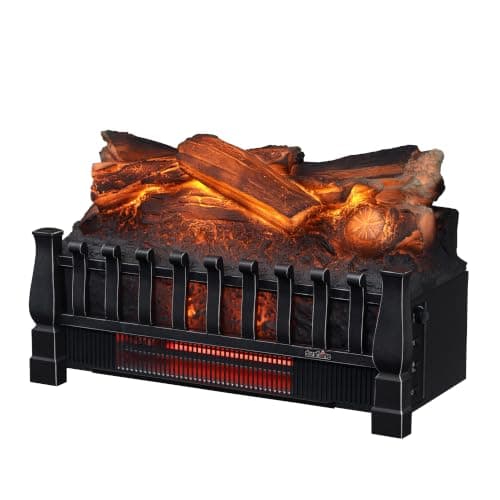 Duraflame DFI030ARU 20" Infrared Electric Fireplace Log SetThe cheapest honest way to put fire back in attractive masonry. Nothing to size, nothing to trim. | A firebox worth looking at | 27.5¢1,500 W · 5,118 BTU | |
| 2 | 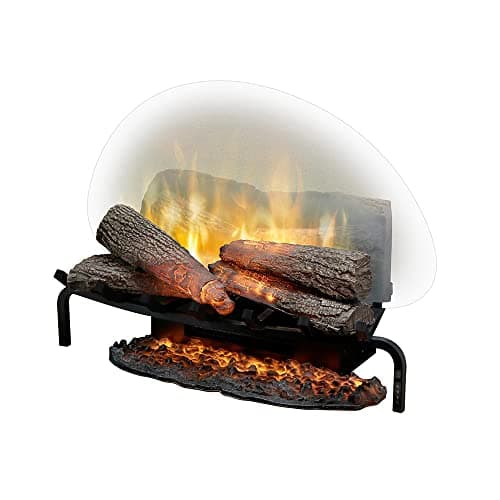 Dimplex Revillusion RLG25 25" Plug-In Log SetThe premium log set, with a glowing ash mat under the logs. Also 13 inches deep, which rules out a lot of fireboxes. | A deep firebox and a bigger budget | 27.5¢1,500 W · 5,118 BTU | |
| 3 | 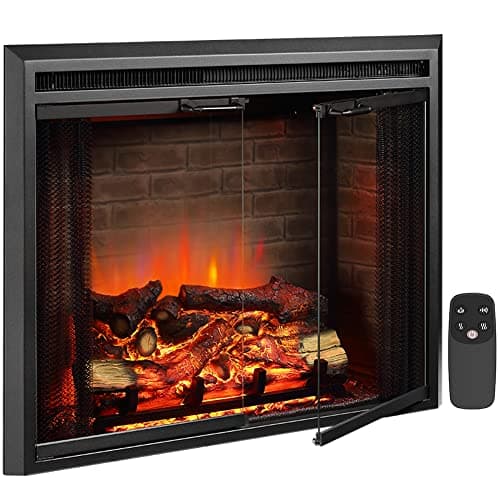 PuraFlame Klaus 33" Electric Fireplace InsertA full insert with its own glass door, mesh screen and brick-look interior. It replaces the view instead of sitting inside it. | A firebox you would rather not see | 27.5¢1,500 W · 5,118 BTU | |
| 4 | 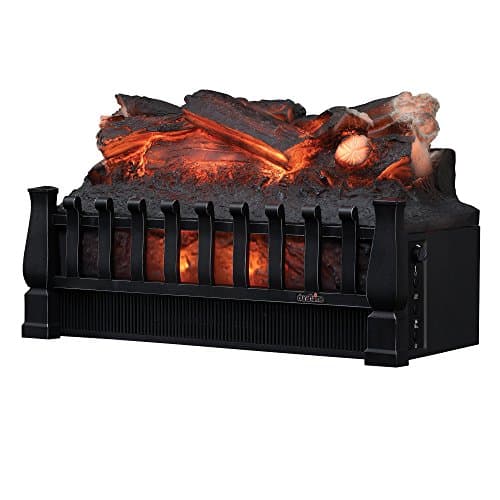 Duraflame DFI021ARU 20" Electric Fireplace Log SetThe entry point of the entire category. It will not impress anyone up close, and it is not trying to. | A small opening on the smallest budget | 27.5¢1,500 W · 5,118 BTU | |
| — | 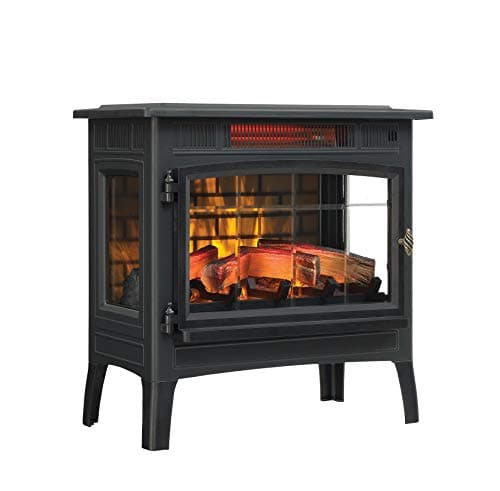 Duraflame DFI-5010-01 3D Infrared Fireplace StoveA freestanding stove. It is not a log set and not an insert, and it will not go in your firebox.Skip this one | Neither side of this comparison | 27.5¢1,500 W · 5,118 BTU |
#ad Buy links are affiliate links — we earn a commission on Amazon purchases at no extra cost to you, and it never changes the ranking. How this site is funded. Running cost is computed at 18.34¢/kWh; see what these actually cost to run.
The depth trap
Log sets are usually described as the shallow option, and at the entry tier that is true. It stops being true as you move up the range. The Dimplex Revillusion RLG25 is 13 inches deep — deeper than plenty of full inserts, and deeper than a lot of shallow prefabricated fireboxes will take.
So do not use form factor as a proxy for depth. Measure your opening front to back, then check the published depth of the specific unit. A shallow firebox can take an entry log set and refuse the premium one, which is exactly backwards from what most buyers expect. Once you know your numbers, our log set picks work through the width of each set against three example firebox widths.
What neither one changes
| Usage | Hours | Heat on (1,500 W) | Flame only (~100 W) |
|---|---|---|---|
| One evening | 4 | $1.10 | $0.07 |
| A week of evenings | 28 | $7.70 | $0.51 |
| A month, 4 hrs a night | 120 | $33.01 | $2.20 |
| A 90-day winter, 4 hrs a night | 360 | $99.04 | $6.60 |
| Per hour | 1 | 27.5¢ | 1.8¢ |
About 27.5 cents an hour on full heat at the June 2026 US average, or roughly $99 across a 90-day winter at four hours a night. The form factor has no effect on this whatsoever, because the constraint is a 120 V circuit rather than the shape of the box.
The flame-only column is where both products get interesting. Every unit here separates flame from heater, and running the flame alone costs about seven cents for an evening. If what you wanted was for the fireplace to stop looking dead, that is the number that describes how you will actually use it — and it is the same for a $150 log set and a $600 insert.
#1 · A firebox worth looking at
Duraflame DFI030ARU 20" Infrared Electric Fireplace Log Set
The cheapest honest way to put fire back in attractive masonry. Nothing to size, nothing to trim.
A log set is a tray of resin logs with a heater behind it. You put it in the opening, plug it in, and the brick you already have frames it exactly as it framed the fire that used to be there. There is no trim kit to buy and no gap to close, because you are not covering anything.
Duraflame rates this one for supplemental heating up to 1,000 square feet using an infrared quartz element rather than a fan blowing across a coil. Infrared matters more in a masonry recess than anywhere else on this site: convection has to escape the opening before it reaches anyone, and a deep brick firebox is very good at absorbing it on the way out.
The trade is obvious and worth stating plainly: everything you already dislike about the firebox is still there. Stained brick, a ragged opening, a cracked back panel — a log set puts a good-looking fire inside all of it.
What it does not do: The 1,000 sq ft figure is the manufacturer's supplemental-heat rating, not a claim that it will hold temperature in a 1,000 sq ft room. See our BTU page for what the wattage actually buys.
Published specs
- Heater:
- Infrared quartz, rated by the manufacturer for up to 1,000 sq ft
- Width:
- 20 in
- Form:
- Drop-in log set for an existing firebox
- Flame:
- LED with resin cast logs and glowing embers
- Control:
- Remote with adjustable thermostat
What it costs to run
- 27.5¢/hr on full heat
- $99.04 across a 90-day winter at 4 hrs a night
- 5,118 BTU/hr · 12.5 A on a 120 V circuit
Computed at 18.34¢/kWh (EIA, June 2026). Your rate will differ — work out your own.
#ad We earn a commission on this link at no cost to you. How this is funded. Price as of October 22, 2026.
Specs from: Duraflame DFI030ARU listing — infrared, 1,000 sq ft rating; Bed Bath & Beyond product page — 20 in infrared log set.
#2 · A deep firebox and a bigger budget
Dimplex Revillusion RLG25 25" Plug-In Log Set
The premium log set, with a glowing ash mat under the logs. Also 13 inches deep, which rules out a lot of fireboxes.
Dimplex publishes 25.625 by 19 by 13 inches, 25 pounds, 1,500 W at 120 V and 12.5 A, 5,118 BTU per hour and a 400 square foot rating. The flame is Revillusion LED with a glowing ash mat beneath the logs, which is the detail that separates it from the entry tier — light coming from under the fuel is what real fires do, and almost nothing at the cheap end reproduces it.
The 13-inch depth is the thing to check before anything else. Entry log sets are shallow enough to sit in almost any opening; this one needs a genuinely deep firebox. Measure front to back wall before you order, not after.
It is also the more expensive way to solve a problem the cheaper log set solves adequately. If your fireplace is in a room you sit in every evening and look at closely, the ash mat earns its money. In a guest bedroom it does not.
What it does not do: At 13 in deep it needs a genuinely deep firebox — considerably more than the shallow log sets it competes with. No enclosure or trim; the existing masonry stays visible around it.
Published specs
- Dimensions:
- 25.625 in W x 19 in H x 13 in D
- Weight:
- 25 lb
- Electrical:
- 120 V, 12.5 A, 1,500 W
- Heat output:
- 5,118 BTU/hr
- Heater:
- Fan-forced ceramic
- Coverage:
- Rated by the manufacturer for up to 400 sq ft
- Wiring:
- Plug-in
- Flame:
- LED, with a glowing ash mat under the logs
What it costs to run
- 27.5¢/hr on full heat
- $99.04 across a 90-day winter at 4 hrs a night
- 5,118 BTU/hr · 12.5 A on a 120 V circuit
Computed at 18.34¢/kWh (EIA, June 2026). Your rate will differ — work out your own.
#ad We earn a commission on this link at no cost to you. How this is funded. Price as of October 22, 2026.
Specs from: Dimplex Revillusion RLG25 product page — dimensions, 1,500 W, 5,118 BTU, 400 sq ft; Dimplex RLG25 owner's manual.
#3 · A firebox you would rather not see
PuraFlame Klaus 33" Electric Fireplace Insert
A full insert with its own glass door, mesh screen and brick-look interior. It replaces the view instead of sitting inside it.
This is the other half of the fork. A full insert brings its own housing, so what you look at afterward is the insert rather than the hole it went into. Published dimensions are 33 1/16 inches wide by 25 9/16 high, with 750 W and 1,500 W settings and a three-sided brick-effect lining.
The log sits on a grate above the ember bed rather than flat on the floor of the box, which is the same trick the Revillusion ash mat plays — get light underneath the fuel and the flame reads as three-dimensional.
Two honest cons. Masonry openings taper toward the back, so measure the REAR width as well as the front; an insert that clears the front lip and fouls the back does not go in, and this is the most common return in the category. And the trim kit that closes the gap around it is usually a separate purchase even when the product photography shows one fitted.
What it does not do: No trim kit in the base version — an existing masonry opening wider than 33 in leaves a visible gap unless you buy the trim separately.
Published specs
- Heater:
- 750 W / 1,500 W, two settings
- Width:
- 33 1/16 in
- Height:
- 25 9/16 in
- Flame:
- LED, three intensity settings, runs with heat off
- Front:
- Glass door, mesh screen, three-sided brick interior
- Log:
- Resin cast log, 11 13/16 in high, on a grate over the ember bed
What it costs to run
- 27.5¢/hr on full heat
- $99.04 across a 90-day winter at 4 hrs a night
- 5,118 BTU/hr · 12.5 A on a 120 V circuit
Computed at 18.34¢/kWh (EIA, June 2026). Your rate will differ — work out your own.
#ad We earn a commission on this link at no cost to you. How this is funded. Price as of October 22, 2026.
Specs from: PuraFlame Klaus insert listing (specifications and dimensions); Walmart product listing — 750/1500 W rating confirmed.
#4 · A small opening on the smallest budget
Duraflame DFI021ARU 20" Electric Fireplace Log Set
The entry point of the entire category. It will not impress anyone up close, and it is not trying to.
Twenty inches wide, a 400 square foot supplemental rating, an LED flame with resin logs and a glowing ember bed, and a remote that separates flame from heat so you can run the look without the warmth.
Small period fireplaces — bedroom grates, cottage openings, anything under about 26 inches — rule out most full inserts entirely. This fits where nothing else will, which is the whole argument for it.
The con is that it is plainly a lit tray of plastic in daylight. In a dim room at night it does its job; anywhere brighter it does not, and no amount of goodwill changes that.
What it does not do: No enclosure, no glass, no trim. It sits inside the masonry opening you already have, so the old firebox is still visible around it.
Published specs
- Heater:
- Rated by the manufacturer for spaces up to 400 sq ft
- Width:
- 20 in
- Form:
- Drop-in log set — sits inside an existing firebox, no framing
- Flame:
- LED with resin cast logs and a glowing ember bed
- Control:
- Remote with independent flame and heat settings
What it costs to run
- 27.5¢/hr on full heat
- $99.04 across a 90-day winter at 4 hrs a night
- 5,118 BTU/hr · 12.5 A on a 120 V circuit
Computed at 18.34¢/kWh (EIA, June 2026). Your rate will differ — work out your own.
#ad We earn a commission on this link at no cost to you. How this is funded. Price as of October 22, 2026.
Specs from: Duraflame DFI021ARU listing — 400 sq ft rating; Mantels Direct product page — 20 in log set.
Skip this one
Duraflame DFI-5010-01 3D Infrared Fireplace Stove
A freestanding stove. It is not a log set and not an insert, and it will not go in your firebox.
It is a well-specified product — 5,200 BTU per hour, 120 V at 12.5 A per the manual, 24 by 23.4 by 13.1 inches, a layered 3D flame across five brightness settings, an adjustable thermostat and an overheat shutoff. As a stove it is a reasonable buy.
It is a skip here because it answers a different question. It has feet, it stands on the floor, and it needs clearance in front of its glass door. Put it inside a masonry opening and you have a stove sitting in a fireplace, which is a look but not the one this page is about.
If you have no usable opening at all, a stove is genuinely the right answer and we say so on best electric fireplaces for heat. If you have a firebox to fill, everything above it here is a better fit.
What it does not do: It is a freestanding stove, not an insert. It will not fill a masonry opening and it needs floor space plus clearance in front of the glass door.
Published specs
- Heat output:
- 5,200 BTU/hr
- Electrical:
- 120 V, 12.5 A
- Dimensions:
- 24 in W x 23.4 in H x 13.1 in D
- Weight:
- 28.6 lb
- Flame:
- Layered 3D flame effect, five brightness settings
- Safety:
- Overheat shutoff, adjustable digital thermostat
What it costs to run
- 27.5¢/hr on full heat
- $99.04 across a 90-day winter at 4 hrs a night
- 5,118 BTU/hr · 12.5 A on a 120 V circuit
Computed at 18.34¢/kWh (EIA, June 2026). Your rate will differ — work out your own.
#ad We earn a commission on this link at no cost to you. How this is funded. Price as of October 22, 2026.
Specs from: Duraflame DFI-5010-02-3A user manual — 120 V, 12.5 A; Walmart product page — 5,200 BTU, dimensions, weight.
The cases that are not obvious
- You want the chimney back one day. Both lift out, but a log set leaves absolutely nothing behind. If reversibility matters, that is the safer choice.
- Your firebox is shallow. Check the depth figure per unit rather than assuming log sets are shallow. Several are not.
- You have no receptacle in the fireplace. This is the real blocker for both, and it is the same job either way — see installation cost.
- Your opening is enormous. A 20-inch log set floating in a 48-inch opening looks lost. A large opening usually wants a full insert plus trim, or a proper surround built around it.
- The firebox is genuinely handsome brick. Buy the log set and stop reading. Covering it up would be the mistake.
Questions people actually ask
Is a log set the same as an electric fireplace insert?
No. A log set is a bare tray of resin logs with a heater behind it and no enclosure, so the original firebox stays visible around it. A full insert brings its own housing, glass and screen, and fills the opening so you see the insert rather than the masonry. The full comparison, including the depth trap that catches people out, is on log sets vs inserts.
Which one gives off more heat?
Neither. Both are capped at 1,500 W and about 5,118 BTU per hour by a standard 120 V household circuit. Heat is not a reason to choose between them.
Are log sets easier to install?
Usually yes — you place it in the opening and plug it in, with no sizing and no trim kit. The exception is depth: premium log sets such as the Dimplex Revillusion RLG25 are 13 inches deep and need more firebox than some shallow openings have.
Do I need a trim kit?
For a log set, no. For a full insert, almost certainly — if the unit is narrower than your opening you will see a gap, and trim kits are usually a separate purchase even when the marketing photography shows one fitted.
Can I fit either one into a prefabricated metal firebox?
Often, but check the manufacturer's guidance for your specific firebox and the specific unit. Prefabricated boxes are frequently shallower than masonry ones, which rules out the deeper products. Where the answer depends on the firebox's own listing, that is a question for its manufacturer rather than for us.
Sources
Every figure on this page is either taken from one of these documents or computed from a formula shown on the page. Nothing here is recalled from memory.
- EIA Electric Power Monthly, Table 5.3 — US residential average, June 2026
- Duraflame DFI030ARU — infrared quartz log set, 1,000 sq ft rating
- Dimplex Revillusion RLG25 log set — 25.625 x 19 x 13 in, 1,500 W, 120 V, 12.5 A, 5,118 BTU
- PuraFlame Klaus 33 in insert — 750/1500 W, dimensions
- Duraflame DFI-5010 user manual — 120 V, 12.5 A
- EcoCostSavings — measured wattage and BTU across 117 electric fireplace models
Read next
- Electric fireplace inserts for an existing fireplace
What fits a real masonry firebox, why the rear width is the constraint, and the three units that suit brick.
- The best electric fireplace inserts
Six inserts ranked by opening fit, flame mechanism and computed running cost — plus the one we would not buy.
- Logs vs crystals vs glass
Logs, crystals or glass — what each one does to the flame, and why whether the bed is lit matters more than what it is made of.
- What installing an electric fireplace insert really costs
Trim kits, receptacles, framing and electrical work — the costs that arrive after the unit does.
- 30-inch electric fireplace inserts
Why a 30-inch insert needs more than a 30-inch opening, and the four units worth considering in the 24 to 33-inch range.
- Freestanding electric fireplace stoves
No opening, no framing, no electrician. Four stoves compared on heater type, flame depth and the floor space they genuinely need.
- The best electric fireplace logs
Four log sets for an existing firebox, picked on width, depth and heater type — plus the chimney above it that quietly costs more than the fire.
- Electric fireplace trim kits
What a trim kit actually covers, the gap arithmetic that decides whether one will work, and the inserts that ship with a surround included.