Guide · start here
The electric fireplace buying guide
Five decisions, in order. Get them in this order and the shortlist writes itself; get them out of order and you will compare specifications that do not differ.
By Scooter M.Published September 2, 2026Last reviewed September 2, 2026

Disclosure: the buy links below are affiliate links. We earn a commission on Amazon purchases at no extra cost to you. It has never changed a ranking on this site, and every roundup here names a unit we think you should skip. How this site is funded.
The five decisions, in order
1. Form factor — decided by what you already have. 2. Size — decided by the opening or the wall. 3. Flame technology — decided by your room's light. 4. Heater type — infrared or fan-forced. 5. Budget. Notice what is not on the list: heat output, which is identical across the entire category.
Decision 1: form factor
| What you have | What to buy | Where to read |
|---|---|---|
| A masonry firebox | An insert or a log set | Inserts |
| A flat wall | A linear wall unit, hung or recessed | Wall-mount |
| A television and no fireplace | A console | Mantels & TV stands |
| A corner or a very small room | A freestanding stove | Best for heat |
| A traditional room and no opening | A mantel package | Mantel packages |
Decision 2: size
- Insert into masonry: measure front width, rear width, height and depth. The rear is the constraint and it is the one people skip.
- Recessed wall unit: the unit must be thinner than your cavity — about 3.5 inches in a standard 2x4 wall.
- Console: about two-thirds the width of the wall, and always wider than the television.
- Everything: nominal width is not a standard measurement. Find the manufacturer's overall width and rough-opening figures, which frequently differ.
Decision 3: flame technology
Decided by your room's light rather than your budget. A dim evening room is forgiving and layered LED is genuinely convincing in it. A bright open-plan room defeats every LED unit at every price, and only water vapor holds up. Full taxonomy on flame technology explained.
Decision 4: heater type
Infrared for a masonry recess, a large room, or a dry house. Fan-forced to warm a cold room faster. Identical output either way — 1,500 W and about 5,118 BTU/hr. See infrared vs fan-forced.
Decision 5: budget, and what it buys
| Tier | What you get | What you do not |
|---|---|---|
| Entry | Reflector or basic layered LED, full 1,500 W heat, a remote | Depth, adjustment range, good housing |
| Mid | Layered LED, lit ember bed, adjustable brightness and speed, real glass | Frameless fronts, screen or mist flame |
| Upper-mid | Frameless glass, three-sided options, better housing and warranty | Water vapor |
| Premium | LCD screen or ultrasonic mist flame | More heat — nobody has more heat |
Quick picks
Ranked. The running cost column is computed from each unit's rated wattage, not quoted from a manufacturer. Tap a row for the full write-up.
| # | Product | Best for | Cost per hour | Price |
|---|---|---|---|---|
| 1 | 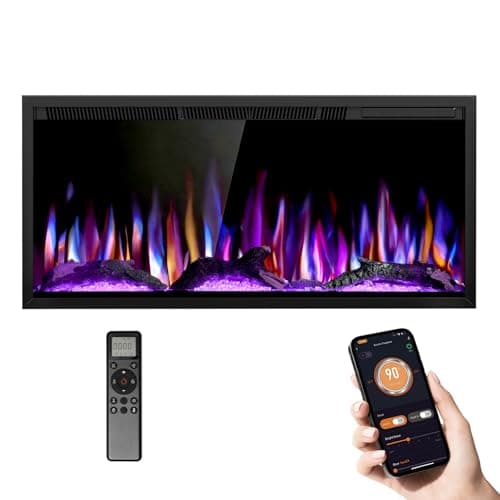 R.W.FLAME 36" Ultra-Thin Recessed & Wall-Mount FireplaceThin enough to recess, published specs throughout, two heat stages, and enough flame adjustment to fix the settings that matter. | The all-round sensible answer | 27.5¢1,500 W · 5,118 BTU | |
| 2 | 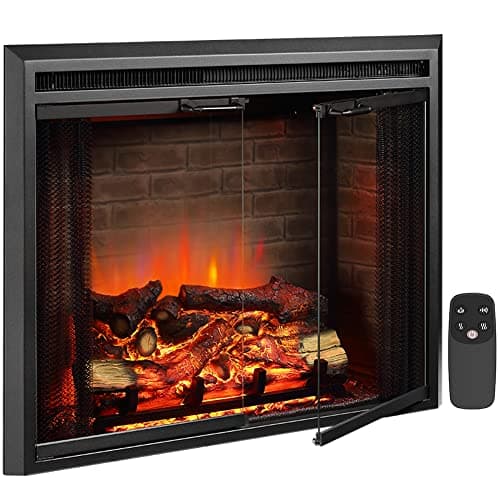 PuraFlame Klaus 33" Electric Fireplace InsertThe traditional answer. Glass, mesh, brick interior and a raised log — the cues that matter in a masonry opening. | If you have a firebox | 27.5¢1,500 W · 5,118 BTU | |
| 3 | Walker Edison Simple 70" 2-Door TV Stand with Fireplace70 inches, a 75-inch TV, storage. When the fireplace is furniture, buy the furniture and treat the fire as a feature. | If the television is the point | 27.5¢1,500 W · 5,118 BTU |
#ad Buy links are affiliate links — we earn a commission on Amazon purchases at no extra cost to you, and it never changes the ranking. How this site is funded. Running cost is computed at 18.34¢/kWh; see what these actually cost to run.
The four specifications that do not matter
- Heat output. Every plug-in unit is 1,500 W and about 5,118 BTU/hr. It is the circuit, not the product.
- Advertised coverage in square feet. A supplemental-heat rating, not an output figure. Read the wattage instead.
- Flame color count. Twelve colors means you will use one. Blue fire is a two-week novelty.
- A crackling speaker. Almost universally switched off within a fortnight. It is a short loop and it does not sound like fire.
What it will cost you to run
| Usage | Hours | Heat on (1,500 W) | Flame only (~100 W) |
|---|---|---|---|
| One evening | 4 | $1.10 | $0.07 |
| A week of evenings | 28 | $7.70 | $0.51 |
| A month, 4 hrs a night | 120 | $33.01 | $2.20 |
| A 90-day winter, 4 hrs a night | 360 | $99.04 | $6.60 |
| Per hour | 1 | 27.5¢ | 1.8¢ |
Work out your own running cost
Four numbers, no email address. The rate defaults to the US residential average; the number that matters is the one on your own bill.
1,500 W is the 120 V ceiling.
US average: 18.34¢.
- Per hour
- 27.5¢
- A month at this usage
- $33.01
- The whole season
- $99.04
At 1,500 W this unit produces about 5,118 BTU/hr and draws 12.5 A on a 120 V circuit. The formula is (watts ÷ 1000) × rate, applied for the hours you entered — the same function that renders every cost figure elsewhere on this site. Default rate from EIA Electric Power Monthly, Table 5.3 (June 2026).
#1 · The all-round sensible answer
R.W.FLAME 36" Ultra-Thin Recessed & Wall-Mount Fireplace
Thin enough to recess, published specs throughout, two heat stages, and enough flame adjustment to fix the settings that matter.
If you asked us to pick one unit for someone who has not decided anything yet, it would be this — mostly because it keeps options open. At 3.86 inches it hangs today and recesses later on the same unit.
750 W low and 1,500 W high at 120 V, a published 5,100 BTU/hr and 400 square feet supplemental, with five brightness levels and five flame speeds.
Available from 30 to 68 inches on identical specification, so the wall decides the size rather than the product line.
What it does not do: No mantel, no surround and no trim for a masonry opening. Recessing it means cutting drywall and, in most homes, running a receptacle inside the cavity.
Published specs
- Heater:
- 750 W low / 1,500 W high
- Electrical:
- 120 V
- Heat output:
- 5,100 BTU/hr (manufacturer figure)
- Depth:
- 3.86 in — thin enough for a 2x4 stud bay
- Coverage:
- Rated by the manufacturer for up to 400 sq ft
- Flame:
- 12 flame colors, 12 ember-bed colors, 5 brightness levels, 5 speeds
- Sizes in the line:
- 30, 36, 42, 50, 60 and 68 in
What it costs to run
- 27.5¢/hr on full heat
- $99.04 across a 90-day winter at 4 hrs a night
- 5,118 BTU/hr · 12.5 A on a 120 V circuit
Computed at 18.34¢/kWh (EIA, June 2026). Your rate will differ — work out your own.
#ad We earn a commission on this link at no cost to you. How this is funded. Price as of October 17, 2026.
Specs from: R.W.FLAME recessed/wall-mount product page — full specifications.
#2 · If you have a firebox
PuraFlame Klaus 33" Electric Fireplace Insert
The traditional answer. Glass, mesh, brick interior and a raised log — the cues that matter in a masonry opening.
A masonry opening changes the whole decision, because the expensive part of a fireplace is the opening and you already have one.
33 1/16 by 25 9/16 inches, 750/1500 W, with its own housing so an unattractive firebox stops being visible.
Measure the rear width of the opening before ordering. That measurement decides more returns than any other in this category.
What it does not do: No trim kit in the base version — an existing masonry opening wider than 33 in leaves a visible gap unless you buy the trim separately.
Published specs
- Heater:
- 750 W / 1,500 W, two settings
- Width:
- 33 1/16 in
- Height:
- 25 9/16 in
- Flame:
- LED, three intensity settings, runs with heat off
- Front:
- Glass door, mesh screen, three-sided brick interior
- Log:
- Resin cast log, 11 13/16 in high, on a grate over the ember bed
What it costs to run
- 27.5¢/hr on full heat
- $99.04 across a 90-day winter at 4 hrs a night
- 5,118 BTU/hr · 12.5 A on a 120 V circuit
Computed at 18.34¢/kWh (EIA, June 2026). Your rate will differ — work out your own.
#ad We earn a commission on this link at no cost to you. How this is funded. Price as of October 17, 2026.
Specs from: PuraFlame Klaus insert listing (specifications and dimensions); Walmart product listing — 750/1500 W rating confirmed.
#3 · If the television is the point
Walker Edison Simple 70" 2-Door TV Stand with Fireplace
70 inches, a 75-inch TV, storage. When the fireplace is furniture, buy the furniture and treat the fire as a feature.
A large share of people shopping for an electric fireplace are actually shopping for a television stand. If that is you, buy the console on its furniture merits.
Home Depot lists this at 70 inches with a maximum television of 75 inches, with two doors and open center shelving.
Accept that the heat sits at ankle height and is a bonus rather than a plan. See do TV stands give off heat.
What it does not do: Same caveat as the Reema: no published wattage on the retailer page. Assume the usual 1,500 W ceiling for cost planning, and verify on the box.
Published specs
- Width:
- 70 in
- Max TV:
- Up to 75 in
- Storage:
- Two doors plus open center shelving
- Model:
- HD70FPSCDW (Dark Walnut)
What it costs to run
- 27.5¢/hr on full heat
- $99.04 across a 90-day winter at 4 hrs a night
- 5,118 BTU/hr · 12.5 A on a 120 V circuit
Computed at 18.34¢/kWh (EIA, June 2026). Your rate will differ — work out your own.
#ad We earn a commission on this link at no cost to you. How this is funded. Price as of October 17, 2026.
Specs from: Home Depot product page — Walker Edison Simple 70, max TV 75 in.
Questions people actually ask
What should I look for in an electric fireplace?
In order: the form factor your room dictates, the size your opening or wall allows, a flame technology suited to your room's light, and a heater type suited to where it will sit. Heat output is not on the list because it is identical across the category.
How much should I spend on an electric fireplace?
Enough to get layered LED with a lit ember bed and adjustable brightness, which is available at the entry-to-mid tier. Beyond that you are buying frameless glass, housing and warranty — real things, but not warmth, which does not vary at all.
What size electric fireplace do I need?
For an insert, whatever fits your opening measured at the back as well as the front. For a wall unit, thinner than your cavity if recessing. For a console, about two-thirds the wall width and always wider than the television. Size has no effect on heat.
Do I need infrared or is fan-forced fine?
Fan-forced is fine for most wall-mounted and console installs. Choose infrared if you are heating out of a masonry recess, if the room is large or drafty, or if you find fan-forced heat drying.
Sources
Every figure on this page is either taken from one of these documents or computed from a formula shown on the page. Nothing here is recalled from memory.
- EIA Electric Power Monthly, Table 5.3 — US residential average, June 2026
- R.W.FLAME recessed / wall-mount range — 3.86 in depth, 750/1500 W, 5,100 BTU
- PuraFlame Klaus 33 in insert — 750/1500 W, dimensions
- Home Depot — Walker Edison Simple 70, max TV size 75 in
- EcoCostSavings — measured wattage and BTU across 117 electric fireplace models
- Wikipedia — Electric fireplace (mechanism and history)
Read next
- Best electric fireplaces under $1,000
The $500 to $1,000 band buys width, format and a published rough opening — never heat. Five picks by job, one to avoid, and the measurements to take first.
- Which brand of electric fireplace is best?
What each brand actually specializes in, what they publish, and which purchase each one suits.
- Flame technology explained
The four flame mechanisms, how each physically works, and the exact conditions where each one gives itself away.
- What an electric fireplace costs to run
27.5 cents an hour on heat, under two cents on flame alone — computed at the real 2026 rate, with the source.
- Are electric fireplaces safe?
No combustion, no carbon monoxide, no flue. The four electrical considerations that do matter.
- Cheap electric fireplaces worth buying
Budget units produce the same 5,118 BTU as the flagships. Five worth buying, plus a clear list of what the extra money genuinely buys elsewhere.
- Smart and WiFi electric fireplaces
The units with real WiFi and voice control, what smart features are genuinely worth having, and the 2.4 GHz band issue that breaks setup on dual-band routers.