Single-product review · updated for the 2026 heating season
Touchstone Sideline 50: a specification review
The default recommendation in this category, and the only mainstream unit whose maker publishes a clearance to a television. It is also a lesson in reading the manual rather than the product page.
By Scooter M.Published October 23, 2026Last reviewed October 23, 2026
Disclosure: the buy links below are affiliate links. We earn a commission on Amazon purchases at no extra cost to you. It has never changed a ranking on this site, and every roundup here names a unit we think you should skip. How this site is funded.
Buy it if you want the best-documented wall-mount fireplace in the category and you can live with a one-year warranty. The Touchstone Sideline 50 is a 50 3/8-inch, 1,500-watt linear unit with a front heating vent, a documented 750-watt low stage, CSA testing and — uniquely among mainstream units — a published clearance to a television of 8 inches. It produces the same 5,118 BTU per hour as every other 120-volt fireplace on this site, so you are not buying heat; you are buying a manual that answers the questions a built-in install actually raises. Do not buy it if you need more than supplemental heat, or if warranty length is your deciding factor, in which case Dimplex's IgniteXL range gives five years against this unit's one.
What you are actually buying
The Sideline 50 is the default answer when somebody asks which 50-inch electric fireplace to buy, and it is worth being precise about why, because it is not performance. Every plug-in electric fireplace in the United States is capped at 1,500 watts by a 120-volt, 15-amp branch circuit. That is about 5,118 BTU per hour. A $110 insert and a $2,800 Dimplex both hit the same ceiling, and so does this.
What differs is the paperwork, and on an appliance you are cutting a hole in a wall for, paperwork is the specification that matters. Touchstone ships a 36-page manual covering nine Sideline widths with a clearance table, a per-model specification table, a documented two-stage heater, a CSA statement and an explicit circuit requirement. Over four rounds of researching this category we have not found another mainstream brand that publishes a distance from the top of its unit to a television. Touchstone does, in two separate documents.
The specification, as published
| Published figure | Source | |
|---|---|---|
| Overall size (W x H x D) | 50 3/8 x 21 1/2 x 5 1/2 in | Product page and manual agree |
| Firebox | 46 7/8 x 20 1/4 x 5 1/4 in | Product page |
| Rough opening | 47 1/8 x 20 1/2 x 5 3/4 in | Product page |
| Fire size | 45 in wide x 12 in tall | Product page |
| Voltage / watts / amps | 120 V AC, max 1500 W, 12 AMP | Manual specification table |
| Heat stages | Low 750 W, high 1500 W | Manual operation section |
| BTU | 5,000 (Touchstone) - 5,118 computed from 1,500 W | Product page; our arithmetic |
| Room rating | 400 sq ft "under ideal conditions" | Product page |
| Heater type | Coil wire heater with blower (fan-forced, not infrared) | Product page |
| Vent direction | Front - "so that the unit can be flush mounted into wall" | Product page |
| Flame | 3 colors, 5 variable speeds; 10-color pulsating ember bed, independent | Product page |
| Timer | 0.5 to 8 hours in one-hour steps | Manual (the product page disagrees - see below) |
| Thermostat | Range not published; heater will not start if the room is above the setting | Manual |
| Certification | Tested to CSA standards for fixed and location-dedicated electric room appliances | Manual (absent from the product page) |
| Warranty | 1 year; paid 1- and 2-year extensions offered | Manual and product page |
Where Touchstone contradicts itself
Three times, and one of them is in the buyer's favor. We are listing them because a specification review that reports only the tidy figures is not a review.
- The timer, twice on one page. The product page's feature list says the unit will "shut off in 30 minutes to 7.5 hours". The FAQ further down the same page says "built-in timer (1-8 hrs.)". The manual says settings range "from 0.5 hours to 8 hours" in one-hour steps (30, 1H through 8H). The manual is consistent with the control description and is the figure we use.
- The weight, by 13 pounds. The product page gives 59 pounds for the fireplace and 62 for shipping. The manual's specification table gives 46 pounds and 56 pounds for the same model 80004. That is not a rounding difference, and it matters if you are choosing a wall fixing.
- The low heat stage, omitted entirely. The product page lists 1,500 watts with no low setting mentioned. The manual documents the heater twice as running "Low heat (750w)" and "High heat(1500w)", with settings H0 (off) to H2 (high). This one is in your favor: the unit is more capable than its own sales page claims, and the 750-watt stage halves the running cost.
- And one omission rather than a contradiction. The product page publishes no safety certification at all, while the manual states the fireplace "has been tested in accordance with the CSA Standards for fixed and location-dedicated electric room appliances in the United States and Canada". On a 12-amp appliance that is the single most important line in either document, and it is on the one most buyers never open.
The heater, honestly
It is a coil wire element with a blower — fan-forced, not infrared — and Touchstone says so on the product page rather than leaving you to guess, which is worth something. The practical consequences are a modest fan noise whenever the heater runs, warm air that moves rather than radiating, and the 10-second cool-air purge the manual documents before the element comes on and after it goes off.
That purge is a real design feature and the reason not to kill power to this unit at a wall switch or a smart plug mid-cycle. It is also why putting a fireplace on a scheduled smart plug is a worse idea than using the unit's own timer, which is covered in more detail on can you leave an electric fireplace on all night?
The front vent is the specification with the widest consequences. Because the warm air leaves the front face rather than the top edge, the unit can be flush-mounted and can sit under a television with only the published 8 inches above it. Touchstone's own guidance generalizes the point: "An electric fireplace with front or bottom heat vents offers a safer alternative when mounted below the TV." Can you put a TV above an electric fireplace? goes through what that permission does and does not cover.
| Usage | Hours | Heat on (1,500 W) | Flame only (~100 W) |
|---|---|---|---|
| One evening | 4 | $1.10 | $0.07 |
| A week of evenings | 28 | $7.70 | $0.51 |
| A month, 4 hrs a night | 120 | $33.01 | $2.20 |
| A 90-day winter, 4 hrs a night | 360 | $99.04 | $6.60 |
| Per hour | 1 | 27.5¢ | 1.8¢ |
| Usage | Hours | Heat on (750 W) | Flame only (~100 W) |
|---|---|---|---|
| One evening | 4 | $0.55 | $0.07 |
| A week of evenings | 28 | $3.85 | $0.51 |
| A month, 4 hrs a night | 120 | $16.51 | $2.20 |
| A 90-day winter, 4 hrs a night | 360 | $49.52 | $6.60 |
| Per hour | 1 | 13.8¢ | 1.8¢ |
The low stage is the figure most reviews of this unit miss, and over a winter it is the difference between $99.04 and $49.52 on four-hour evenings. The running cost calculator will price it against your own tariff.
The install
This is where the manual earns its keep. The clearance table is unusually complete for this category, and all of it is measured from the front of the glass panel rather than from the case.
| Clearance | Minimum |
|---|---|
| Bottom of fireplace to floor | 6 in |
| Sides of fireplace | 0 in |
| Back of fireplace | 0 in |
| Top of fireplace to a mantel | 8 in |
| Top of fireplace to a TV | 8 in |
| Top of fireplace to the ceiling | 8 in |
| Front of glass to furniture, bedding, curtains, papers | 36 in |
Three further install facts from the manual worth having before you start. The four rubber feet on the underside are removable with a Philips screwdriver for a recessed install. The unit can be either plugged into a grounded three-prong outlet or hard wired, so a concealed-cord install does not require an adapter — see plug-in vs hardwired. And the circuit requirement is stated outright: "Only use this fireplace on a 120V AC, 15-Amp grounded circuit", with "Avoid plugging other appliances into the same circuit as this fireplace."
The 5 3/4-inch rough opening depth is the number that decides whether your wall will take it. A standard interior stud wall gives about 3 1/2 inches, so a flush install usually means furring the wall out or choosing the stud bay carefully. Depth and clearance covers the arithmetic, and how to mount or recess an electric fireplace covers the work.
The Sideline 50 and what to weigh it against
Ranked. The running cost column is computed from each unit's rated wattage, not quoted from a manufacturer. Tap a row for the full write-up.
| # | Product | Best for | Cost per hour | Price |
|---|---|---|---|---|
| 1 | 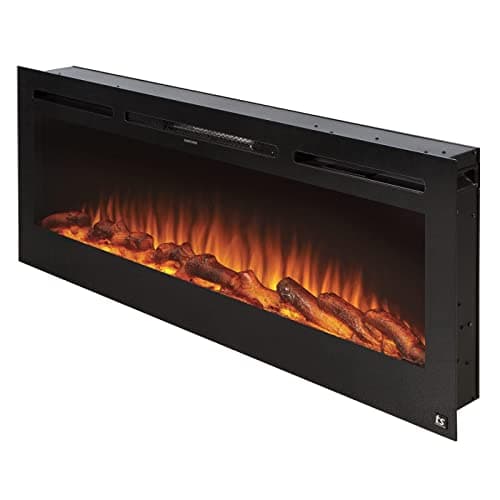 Touchstone The Sideline 50Front-venting, CSA-tested, with a published 8-inch clearance to a television and a 750-watt low stage. The reason to buy it is that Touchstone writes things down. | The default 50-inch wall-mount, bought on documentation | 27.5¢1,500 W · 5,118 BTU | |
| 2 | 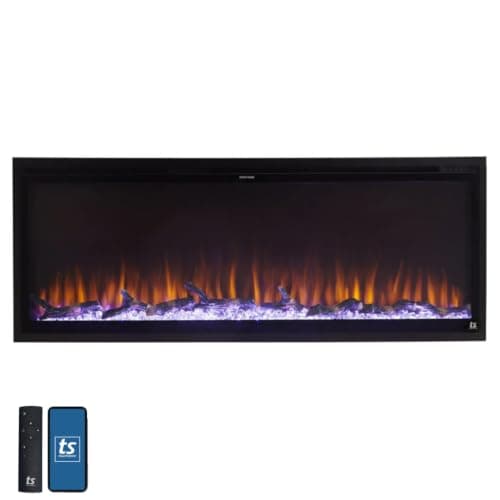 Touchstone Sideline Elite 50The Elite range removes the visible black frame around the glass for roughly double the money. Same 1,500-watt ceiling, same heat, different face. | The same install with a frameless front | 27.5¢1,500 W · 5,118 BTU | |
| 3 | 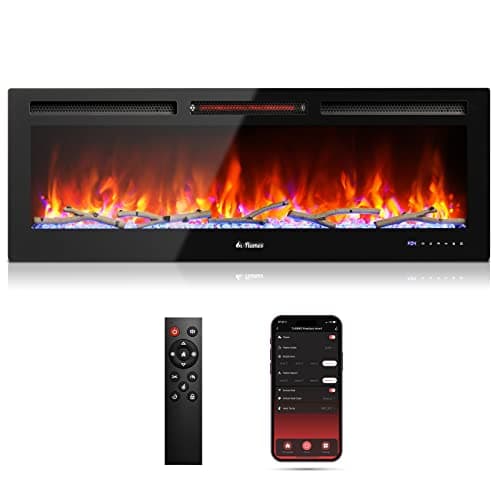 TURBRO In-Flame INF50W-3D 50" Smart WiFi Infrared FireplaceFifty inches, 1,500 watts infrared, WiFi and a crackling sound effect, at around a fifth of the Sideline's price. Thinner documentation and an optimistic room rating. | The same width for a fifth of the money | 27.5¢1,500 W · 5,118 BTU | |
| 4 | 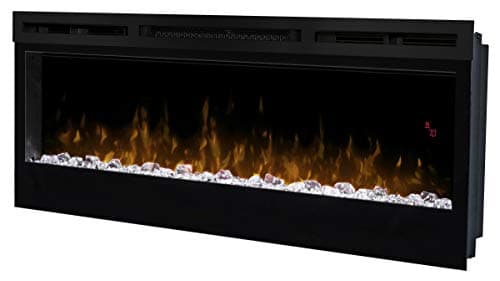 Dimplex Prism 50" Linear Fireplace (BLF5051)Dimplex's 50-inch built-in at 1,230 watts — genuinely less heat than the Sideline, a two-year warranty, and a flame most people prefer. | A better-looking fire that produces less heat | 22.6¢1,230 W · 4,197 BTU |
#ad Buy links are affiliate links — we earn a commission on Amazon purchases at no extra cost to you, and it never changes the ranking. How this site is funded. Running cost is computed at 18.34¢/kWh; see what these actually cost to run.
The four, side by side
| Unit | Size (W x H x D) | Watts | BTU | Warranty |
|---|---|---|---|---|
| Touchstone Sideline 50 | 50 3/8 x 21 1/2 x 5 1/2 in | 750 / 1,500 | 5,000 published | 1 year |
| Touchstone Sideline Elite 50 | Frameless front; range rated at 750/1500 W | 750 / 1,500 | 5,118 (Elite range) | 1 year |
| TURBRO INF50W-3D | 50 x 16 x 4.6 in, 47.6 lb | 1,500 infrared | Not published; 5,118 computed | Not published |
| Dimplex Prism 50 | 50 x 19 1/2 x 7 in, 75 lb | 1,230 | 4,197 published | 2 years |
The full write-ups
#1 · The default 50-inch wall-mount, bought on documentation
Touchstone The Sideline 50
Front-venting, CSA-tested, with a published 8-inch clearance to a television and a 750-watt low stage. The reason to buy it is that Touchstone writes things down.
The case for this unit is not that it does anything a $260 competitor does not. On a 120-volt circuit it produces the same 5,118 BTU per hour as everything else, because 1,500 watts is 1,500 watts. The case is that Touchstone publishes a 36-page owner's manual with a clearance table, a specification table across nine widths, a documented two-stage heater, a CSA listing and a stated circuit requirement — and almost nobody else in this category does.
The specifics: 50 3/8 by 21 1/2 by 5 1/2 inches with a 47 1/8 by 20 1/2 by 5 3/4-inch rough opening, a 45 by 12-inch fire, a coil wire heater with a blower venting from the front, three flame colors across five variable speeds, and a pulsating ten-color ember bed that runs independently of the flame. The manual records 120 V AC, max 1500 W and 12 AMP.
Two published numbers make it genuinely more useful than its competitors rather than just better papered. The first is the clearance table: 6 inches from the floor, 0 inches at the sides and back, and 8 inches from the top to a mantel, a TV or the ceiling — the only mainstream unit in this category that commits to a distance from a television in writing. The second is the heater's low stage at 750 watts, which halves the running cost on a mild evening.
The honest costs, and there are real ones. The warranty is one year, against Napoleon's two and Dimplex's five on IgniteXL. No thermostat temperature range is published anywhere — only the behavior that the heater will not start in an already-warm room. And Touchstone's own documents disagree with each other on the timer and the weight, which the section below sets out in full.
What it does not do: At 5 1/2 in deep it does not sit flush in a standard 2x4 stud bay. Recessing needs a framed cavity; surface-mounting it works but leaves the unit standing proud of the wall, which reads very differently in a small room.
Published specs
- Dimensions:
- 50 3/8 in W x 21 1/2 in H x 5 1/2 in D
- Weight:
- 59 lb
- Heater:
- Coil wire heater with blower, 1,500 W — about 5,000 BTU/hr
- Electrical:
- 120 V — plug in or hardwire
- Form:
- Recessed or wall-mounted linear unit
- Line:
- The volume seller of the Sideline range (model 80004)
What it costs to run
- 27.5¢/hr on full heat
- $99.04 across a 90-day winter at 4 hrs a night
- 5,118 BTU/hr · 12.5 A on a 120 V circuit
Computed at 18.34¢/kWh (EIA, June 2026). Your rate will differ — work out your own.
#ad We earn a commission on this link at no cost to you. How this is funded. Price as of October 23, 2026.
Specs from: Touchstone Sideline 50 (80004) product page — 50 3/8 x 21 1/2 x 5 1/2 in, 59 lb, coil wire heater with blower.
#2 · The same install with a frameless front
Touchstone Sideline Elite 50
The Elite range removes the visible black frame around the glass for roughly double the money. Same 1,500-watt ceiling, same heat, different face.
If the Sideline's look is the only thing giving you pause, this is the fix and it is the honest upgrade path. The Elite range is the frameless version: the glass runs to the edge instead of sitting inside a bezel, which reads as a slot in the wall rather than an appliance on it. Touchstone publishes 750/1500 W and 5,118 BTU for the Elite range, so the heat is identical.
That identity is the point worth internalizing before you spend the difference. The BTU figure, the circuit, the 12-amp draw and the supplemental-heat reality are all the same as the standard Sideline. What changes is the front of the unit and the precision of the hole you cut for it, because a frameless face has no bezel to hide an imperfect opening behind.
Touchstone's TV guidance applies the same 8-inch clearance to Sideline, Sideline Elite and Forte alike, so choosing the Elite does not change the install geometry above the unit either.
The honest cost is the price, which is roughly double for a cosmetic difference and a harder install. We have written the full head-to-head on Sideline vs Sideline Elite, and the short version is that the frameless front is worth it when the unit is going into finished joinery and is not worth it when it is going onto a plasterboard wall at chest height. Note also that Touchstone's Elite 50 figures are published per-model and we have verified the range's 750/1500 W rating from the Elite 60 page rather than a 50-specific document.
What it does not do: The heater is the same 1,500 W ceiling as the cheaper Sideline 50. The extra money buys the glass front and the flame presentation, not warmth.
Published specs
- Width:
- 50 in
- Form:
- Recessed, frameless glass front
- Position in line:
- Above The Sideline 50, below the Elite Pro
What it costs to run
- 27.5¢/hr on full heat
- $99.04 across a 90-day winter at 4 hrs a night
- 5,118 BTU/hr · 12.5 A on a 120 V circuit
Computed at 18.34¢/kWh (EIA, June 2026). Your rate will differ — work out your own.
#ad We earn a commission on this link at no cost to you. How this is funded. Price as of October 23, 2026.
Specs from: Touchstone electric fireplaces collection — Sideline Elite 50.
#3 · The same width for a fifth of the money
TURBRO In-Flame INF50W-3D 50" Smart WiFi Infrared Fireplace
Fifty inches, 1,500 watts infrared, WiFi and a crackling sound effect, at around a fifth of the Sideline's price. Thinner documentation and an optimistic room rating.
This is the unit that makes the Sideline's price an actual question rather than a given, and it deserves to be named honestly. TURBRO publishes 50 by 16 by 4.6 inches at 47.6 pounds, 1,500 watts of infrared quartz heat, app and voice control, a crackling sound effect and 42 dB of fan noise. At 4.6 inches deep it is shallower than the Sideline, which makes it easier to recess.
The heat is the same 1,500 watts, delivered differently. An infrared quartz element warms objects in its line of sight rather than heating the air, which feels faster and more directional; infrared vs fan-forced sets out what that genuinely changes and what it does not. Neither approach produces more energy than the other.
The WiFi is a real feature rather than a bullet point if you want the fire on before you get home, and it is something the standard Sideline does not offer at any price — Touchstone reserves app control for its Elite Pro and Outdoor Elite models.
The honest costs are documentation and the room claim. TURBRO's own listing quotes "400-1,000 sq ft", and the upper end of that range is not supportable: 1,500 watts is about 5,118 BTU per hour, which at the widely used 20 BTU per square foot rule of thumb is roughly 256 square feet of supplemental heat. We have found no published clearance table, no stated vent direction and no TV clearance for it, and no warranty term we could verify — which is precisely the gap the Sideline's manual fills.
What it does not do: TURBRO does not publish a BTU figure for this model, so we do not quote one — the 1,500 W rating is the number to plan from. At 4.6 in deep it will not sit flush in a standard 2x4 stud bay, and the app needs a 2.4 GHz network, which catches people out on modern dual-band routers.
Published specs
- Heater:
- 1,500 W infrared quartz
- Coverage:
- Rated by the manufacturer for 400-1,000 sq ft
- Dimensions:
- 50 in L x 16 in H x 4.6 in D
- Weight:
- 47.6 lb
- Noise:
- 42 dB or lower (manufacturer figure)
- Thermostat:
- Adjustable, 60-99 °F
- Timer:
- 30 minutes to 12 hours
- Media bed:
- Five birch logs and crystals
- Mounting:
- Recessed or wall-mounted
- Smart control:
- App, Alexa and Google Assistant over 2.4 GHz WiFi
What it costs to run
- 27.5¢/hr on full heat
- $99.04 across a 90-day winter at 4 hrs a night
- 5,118 BTU/hr · 12.5 A on a 120 V circuit
Computed at 18.34¢/kWh (EIA, June 2026). Your rate will differ — work out your own.
#ad We earn a commission on this link at no cost to you. How this is funded. Price as of October 23, 2026.
Specs from: Home Depot — TURBRO INF50W-3D, 50 in, 1,500 W infrared quartz, WiFi and voice control; TURBRO In-Flames INF50W-3D product page — 50 x 16 x 4.6 in, 47.6 lb, 400-1,000 sq ft, 42 dB, 60-99 °F.
#4 · A better-looking fire that produces less heat
Dimplex Prism 50" Linear Fireplace (BLF5051)
Dimplex's 50-inch built-in at 1,230 watts — genuinely less heat than the Sideline, a two-year warranty, and a flame most people prefer.
The Prism is the premium alternative at this width and it illustrates something counter-intuitive about the category. Dimplex's own sell sheet publishes 120 V, 1,230 watts, 4,197 BTU and 10.5 amps. That is less heat than the Sideline, not more, despite costing roughly twice as much — the money buys the flame and the finish, not warmth.
What it does buy is a fire that reads better in a dark room, which on this site is the thing most people are actually shopping for. Dimplex is the brand in this category whose ranges genuinely differ in how the flame is made rather than in body style, and the Prism sits above the mainstream wall-mounts on that axis. Retailer figures give it as 50 by 19 1/2 by 7 inches at 75 pounds, rated for 400 square feet, with a two-year warranty.
The two years matters more than it sounds. It is double Touchstone's term on a unit far more likely to be built into finished carpentry, and extraction is most of the cost of a failure in a built-in — the reasoning we set out on how long do electric fireplaces last?
The honest costs. Seven inches deep rules out a standard stud wall without furring the wall out, which is a bigger job than the Sideline's 5 3/4-inch opening. The 4,197 BTU is a real reduction in output and the 400-square-foot retailer rating does not follow from it — at 20 BTU per square foot, 4,197 BTU is closer to 210 square feet. And at 10.5 amps it is still most of a 15-amp circuit, so none of the circuit arithmetic gets easier.
What it does not do: 1,230 W and 4,197 BTU/hr put it roughly 18% below the 1,500 W class ceiling — genuinely less heat than most units at this width. At 7 in deep it is also the thickest linear unit in our catalog, and it is the older Prism series rather than the current IgniteXL.
Published specs
- Dimensions:
- 50 in W x 19 1/2 in H x 7 in D
- Weight:
- 75 lb
- Electrical:
- 120 V, 1,230 W, 10.5 A
- Heat output:
- 4,197 BTU/hr
- Coverage:
- Rated by the manufacturer for up to 400 sq ft
- Fuel bed:
- Acrylic ice embers
- Mounting:
- Fully recessed, partially recessed or surface mount
- Warranty:
- 2 years
What it costs to run
- 22.6¢/hr on full heat
- $81.21 across a 90-day winter at 4 hrs a night
- 4,197 BTU/hr · 10.3 A on a 120 V circuit
Computed at 18.34¢/kWh (EIA, June 2026). Your rate will differ — work out your own.
#ad We earn a commission on this link at no cost to you. How this is funded. Price as of October 23, 2026.
Specs from: Dimplex Prism series (BLF5051) sell sheet; Retailer listing — dimensions, weight, 120 V / 1,230 W / 4,197 BTU, 2-year warranty.
Who should buy it
- Anyone putting a fireplace under a wall-mounted television who wants a clearance figure from the manufacturer rather than from a blog.
- Anyone recessing into a wall, because the 0-inch side and back clearances and the published rough opening make the job plannable before you cut.
- Anyone who wants a real low-heat stage. 750 watts is the setting most evenings actually want, and it halves the running cost.
- Anyone who values a named safety certification. CSA testing is stated in the manual, which is more than several competitors at this width manage anywhere.
- Anyone buying one of the other eight Sideline widths, from 28 to 100 inches - the manual, the clearances and the two-stage heater are common across the series.
Who should not
- Anyone who needs real heat. 5,118 BTU per hour is supplemental warmth for one room and no 120-volt unit does better; do electric fireplaces actually heat a room? is blunt about it.
- Anyone for whom warranty length decides it. One year is the shortest term of the four units here, and Dimplex's IgniteXL range gives five with in-home service.
- Anyone shopping primarily on flame quality. The Prism above and the Dimplex Revillusion range both read better in a dark room; the most realistic electric fireplaces ranks on that axis instead.
- Anyone on a tight budget who does not need the documentation. The TURBRO above is the same width and the same wattage for roughly a fifth of the money.
- Anyone who wants app control. The standard Sideline has none; Touchstone puts WiFi on its Elite Pro and Outdoor Elite models instead.
Questions people actually ask
Does the Touchstone Sideline 50 have a low heat setting?
Yes, 750 watts, and this is the most useful thing the manual tells you that the product page does not. The operation section documents the heater as running "Low heat (750w)" and "High heat(1500w)", with panel settings H0 through H2. The product page lists only 1,500 watts, so the unit is more capable than its own sales listing claims.
How much heat does the Sideline 50 actually produce?
Touchstone publishes 5,000 BTU and rates it for 400 square feet "under ideal conditions". The arithmetic from 1,500 watts gives 5,118 BTU per hour, and at the widely used 20 BTU per square foot rule of thumb that is nearer 256 square feet of supplemental heat. Treat 400 square feet as the manufacturer's figure rather than ours.
Can I put a TV above a Touchstone Sideline 50?
Yes, and Touchstone is one of the very few manufacturers that publishes the number: 8 inches from the top of the fireplace to the TV, measured from the front of the glass panel. It appears both in the owner's manual clearance table and in Touchstone's own guidance article. The unit vents from the front, which is why the gap can be that small.
What size opening does the Sideline 50 need?
Touchstone publishes a rough opening of 47 1/8 by 20 1/2 by 5 3/4 inches. The depth is the figure that decides most installs: a standard interior stud wall gives about 3 1/2 inches, so a flush fit usually means furring the wall out. Side and back clearances are both 0 inches, which is what makes a flush install possible at all.
Is the Sideline 50 certified safe?
The owner's manual states it "has been tested in accordance with the CSA Standards for fixed and location-dedicated electric room appliances in the United States and Canada". Note that the product page publishes no certification at all, which is why we go to the manual. The manual also requires wiring to NFPA 70 in the US or CSA C22.1 in Canada.
How long is the Touchstone Sideline 50 warranty?
One year from date of purchase, with replacement parts free in that year. After that, parts carry 90 days or the remainder of the original year, whichever is greater - so a part fitted late in year one does not restart the clock. Touchstone offers paid one- and two-year extensions. Fitting third-party parts voids the warranty, and so does outdoor use.
Is the Sideline 50 worth it against a cheaper 50-inch unit?
Not on heat, because every 120-volt unit at this width produces the same 1,500 watts. It is worth it on documentation: a published clearance table, a stated vent direction, a CSA listing, a documented low stage and a rough opening you can plan a wall around. The TURBRO INF50W-3D is the same width and wattage for roughly a fifth of the price, with none of those published.
Sources
Every figure on this page is either taken from one of these documents or computed from a formula shown on the page. Nothing here is recalled from memory.
- Touchstone Sideline 50 (80004) product page — 50 3/8 x 21 1/2 x 5 1/2 in, firebox 46 7/8 x 20 1/4 x 5 1/4 in, rough opening 47 1/8 x 20 1/2 x 5 3/4 in, fire 45 in wide x 12 in tall, 59 lb (62 lb shipping), 120 V, 1,500 W, 5,000 BTU, 400 sq ft "under ideal conditions", coil wire heater with blower, "Designed with front heating vent so that the unit can be flush mounted into wall", 3 flame colors with 5 levels of variable flame speed, pulsating 10-color ember bed, recommended placement 8 in below the ceiling or mounted flat screen TV and at least 6 in from the floor, 1-year warranty with 1- and 2-year extensions offered
- Touchstone Sideline Series owner's manual (rev. 251114), Operation and Specifications — all Sideline models 120 V AC, max 1500 W, 12 AMP; the heater runs in two stages, "Low heat (750w)" and "High heat(1500w)", and "the heater blows cool air for 10 seconds before the heater turns on, and after it turns off"; timer settings range from 0.5 hours to 8 hours (30, 1H-8H); "If the room temperature is ABOVE the temperature listed on the display, the heater will not turn ON"; tested to CSA standards for fixed and location-dedicated electric room appliances; one-year warranty with replacement parts free of charge in the first year, replacement parts then covered 90 days or the remainder of the original year, whichever is greater; "This fireplace is not intended for outdoor use. Use of this fireplace outdoors voids this warranty"
- Touchstone Sideline Series owner's manual (rev. 251114), Choosing Installation Location — minimum clearances measured from the front of the glass panel: bottom of fireplace to floor 6 in, sides 0 in, back 0 in, top of fireplace 8 in to mantel, 8 in to TV and 8 in to ceiling; combustible materials such as furniture, pillows, bedding, papers, clothes and curtains at least 36 in from the front; "Ensure clearances to combustibles are maintained when building a mantel or shelves above the fireplace. Elevated temperatures on the wall or in the air above the fireplace can cause melting, discoloration or damage to decorations, television or other electronic components"
- Touchstone Sideline Series owner's manual (rev. 251114), Safety Information and 3-prong Outlet Installation — "Always plug this fireplace into a wall outlet or receptacle. Never plug this fireplace into a surge protector, extension cord, or relocatable power tap"; "Only use this fireplace on a 120V AC, 15-Amp grounded circuit. Never overload the circuit"; "Avoid plugging other appliances into the same circuit as this fireplace"; "To prevent a possible fire, do not block the air intakes or exhaust in any manner. Do not use on soft surfaces, like a carpet, where openings may be blocked"; "Do not place the cord under carpeting. Do not cover cord with throw rugs, runners, or the like"
- Touchstone Sideline Series owner's manual — covers 80004/80011/80014/80015/80025, max 1,500 W at 12 A, heater fan runs 8-10 s before and after the element
- Touchstone Home Products, "Safely Mount a TV Above an Electric Fireplace" — "we advise 8 inches from the top of the fireplace to the mantel, TV or ceiling" (8 in for Sideline, Sideline Elite and Forte; 6 in for Chesmont); the Sideline Outdoor needs no space above it because it has no built-in heater; "The intense heat from a wood or gas burning fireplace can potentially damage a television"; "An electric fireplace with front or bottom heat vents offers a safer alternative when mounted below the TV"
- Touchstone Sideline Elite 60 (80037) product page — 59.75 x 19.25 x 5.5 in, 5,118 BTU, 750/1500 W
- Home Depot — TURBRO INF50W-3D, 50 in, 1,500 W infrared quartz, 50 x 16 x 4.6 in, 47.6 lb, 400-1,000 sq ft, 42 dB
- Dimplex Prism 50 (BLF5051) retailer listing — 50 x 19 1/2 x 7 in, 75 lb, 400 sq ft, 2-year warranty
- Dimplex Prism series (BLF5051) sell sheet — 120 V, 1,230 W, 4,197 BTU, 10.5 A
- Dimplex — five-year IgniteXL warranty, covering parts and in-home service
- NFPA — National Electrical Code (NFPA 70), the standard behind US branch-circuit limits
- EIA Electric Power Monthly, Table 5.3 — US residential average, June 2026
Read next
- The best wall-mount electric fireplaces
Linear wall units ranked on recess depth, real wattage and running cost — including the one that is 100 W short.
- Touchstone Sideline vs Sideline Elite
Identical heaters, roughly double the price. The real differences are the frameless glass, the viewing area and a two-inch height change that affects your framing.
- Depth and clearance
3.5 inches of cavity in a standard wall, and what fits it. Plus the clearances that actually matter.
- Can you put a TV above an electric fireplace?
Yes — and Touchstone publishes the number: 8 inches from the top of the fireplace to the TV. The condition is vent direction: front or bottom is safe under a screen, top is not.
- How long do electric fireplaces last?
No maker publishes a service life, so buy on the only number they do publish: the warranty. Dimplex gives five years on IgniteXL, Napoleon two, Touchstone one.
- Touchstone electric fireplaces: which one to buy
Eight Touchstone families explained by what actually differs — width, depth and the front of the unit — because the heater is the same in all of them.