Roundup · updated for the 2026 heating season
The best electric fireplaces for a sunroom
The room you want to use in October and April, not January. Buy for that and this works beautifully; buy expecting a heated glass box in deep winter and no unit in this category can deliver it.
By Scooter M.Published October 23, 2026Last reviewed October 23, 2026
Disclosure: the buy links below are affiliate links. We earn a commission on Amazon purchases at no extra cost to you. It has never changed a ranking on this site, and every roundup here names a unit we think you should skip. How this site is funded.
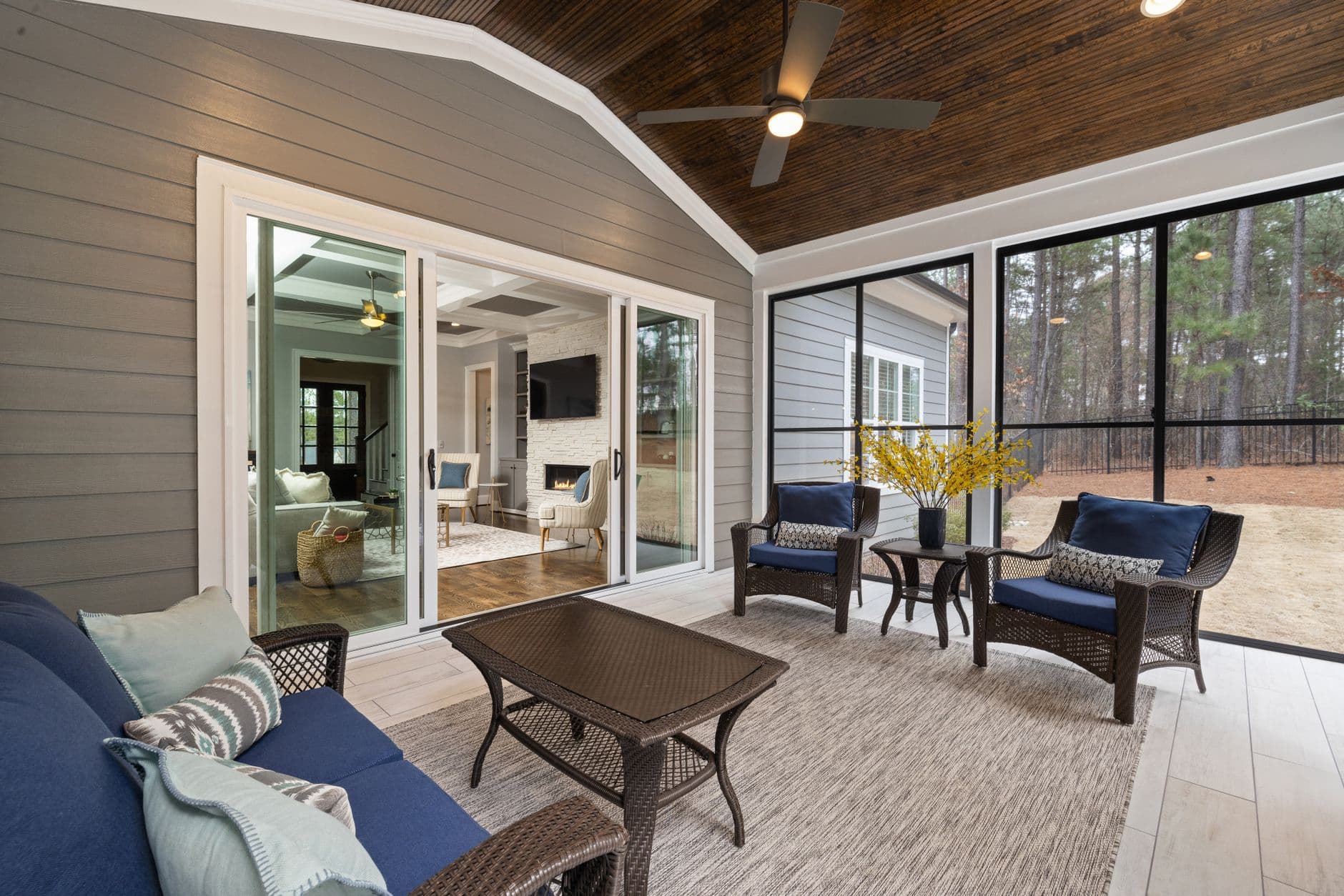
Buy a portable infrared stove, and buy it to extend your shoulder seasons rather than to win January. Our pick is the Duraflame DFI-5010, a freestanding infrared stove you can wheel out to the sunroom in October and back indoors in December. The reason no unit on this page will heat a glass room in deep winter is arithmetic, not product quality: the US Department of Energy puts windows at "only 10% of the surface area of a typical home" but "30-40% of the heat loss in winter", and a sunroom is almost entirely window. Every 120-volt electric fireplace is capped at 1,500 watts, or about 5,118 BTU per hour. If your sunroom is really a screened porch open to the air, the only honest answer is a weather-rated unit with no heater at all.
Why a glass room is the hardest case
Every other room-specific page on this site is about matching a 1,500-watt ceiling to a room's volume. A sunroom is different in kind, because the problem is not how much air there is to warm — it is how fast the heat leaves.
The Department of Energy's Building Technologies Office puts the scale of it plainly for an ordinary house: although windows "constitute only 10% of the surface area of a typical home", they "can account for 30-40% of the heat loss in winter". Now invert the geometry. A sunroom is not 10% glass, it is most of the way to 100% glass, frequently single-glazed, usually with an uninsulated roof and often a slab floor with no insulation under it.
So the honest framing is not "which fireplace heats a sunroom" but "how many weeks of the year does this room become usable". On a mild October evening at 50 °F outside, a 1,500-watt radiant unit pointed at two chairs makes that room genuinely pleasant. At 20 °F in January, with 30-40% heat-loss physics working against 5,118 BTU, it does not — and nothing in this category will.
Sunroom or screened porch? This decides what you can buy
People use the words interchangeably and the manufacturers do not. Getting this wrong voids warranties, so it is worth settling first.
| Sealed sunroom | Screened or open porch | |
|---|---|---|
| Glazed and weathertight? | Yes - glass, closing doors, no water ingress | No - screens or open sides, rain reaches the walls |
| Can you use an indoor-rated unit? | Yes | No. Touchstone: outdoor use "voids this warranty" |
| What to buy | Any unit here - stove, wall-mount or recessed | A weather-rated unit, which in this category means no heater |
| Realistic heat expectation | Comfortable in the shoulder seasons; not January | None. These units are fire effects, not heaters |
| Our pick | Duraflame DFI-5010 (portable) or TURBRO INF50W-3D (fixed) | Touchstone Sideline Outdoor 50 |
Why infrared, specifically, in this room
This site is generally skeptical of infrared marketing, because an infrared unit and a fan-forced unit drawing the same 1,500 watts put exactly the same energy into the room. In a sunroom that skepticism needs one genuine exception, and it is about where the energy goes rather than how much of it there is.
A fan-forced heater warms air. In a room losing air heat through glazing at the rate the DOE figures describe, warmed air is a leaky container — you are heating a volume that is continuously exchanging its warmth with the outdoors. An infrared element warms surfaces in its line of sight: the chair, the table, the person. That heat does not have to survive in the air to reach you, which is why an infrared unit feels effective in a cold glass room where a fan heater feels like it is losing.
It is still the same 5,118 BTU per hour and it still will not heat the room in January. What it does is put a larger share of that fixed energy budget onto the two people sitting in front of it, which in this specific room is the right allocation. Infrared vs fan-forced is the fuller treatment, including where the claims go too far.
How we judged
- Radiant rather than air-warming heat delivery, because a glass room cannot hold warm air.
- Portability, or a shallow enough body to recess into a sunroom wall - which is often shallower than an interior wall.
- An honest published room rating. Where a maker claims 1,000 square feet from 1,500 watts we say so rather than repeating it.
- A weather rating where the room is genuinely open to the air, and no indoor unit recommended for one.
- A live, buyable listing with a real photograph. Nothing featured here was out of stock when we checked.
Quick picks: fireplaces for a glass room
Ranked. The running cost column is computed from each unit's rated wattage, not quoted from a manufacturer. Tap a row for the full write-up.
| # | Product | Best for | Cost per hour | Price |
|---|---|---|---|---|
| 1 | 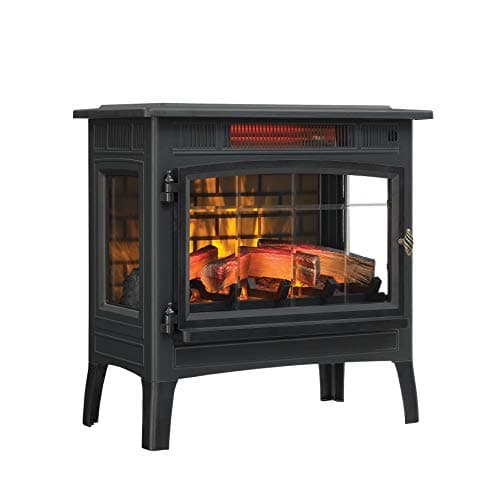 Duraflame DFI-5010-01 3D Infrared Fireplace StoveThe one unit here that moves with the season. Infrared heat you feel immediately, on castors, so the same appliance serves the sunroom in spring and the den in January. | A three-season room you want back in October and April | 27.5¢1,500 W · 5,118 BTU | |
| 2 | 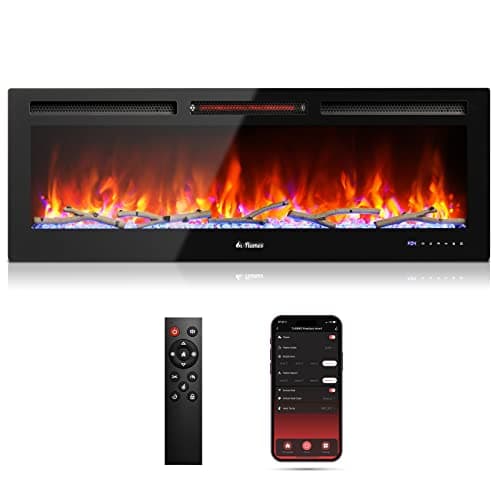 TURBRO In-Flame INF50W-3D 50" Smart WiFi Infrared FireplaceFifty inches of wall-mounted infrared at 4.6 inches deep, with app control so the room is warm before you walk into it. Its own room rating is not supportable. | A finished, insulated sunroom you treat as a real room | 27.5¢1,500 W · 5,118 BTU | |
| 3 | 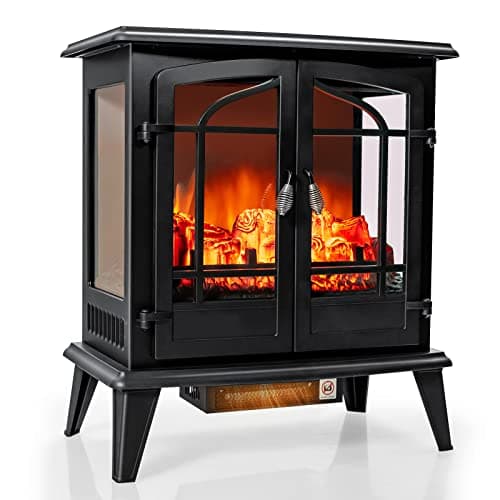 Tangkula 25" Freestanding Electric Fireplace StoveA 25-inch stove at 1,400 watts with a thermostat running to 95 °F. Less heat than the others by a measurable margin, and the right size for a small glazed porch. | The smallest three-season nook, cheaply | 25.7¢1,400 W · 4,777 BTU | |
| 4 | 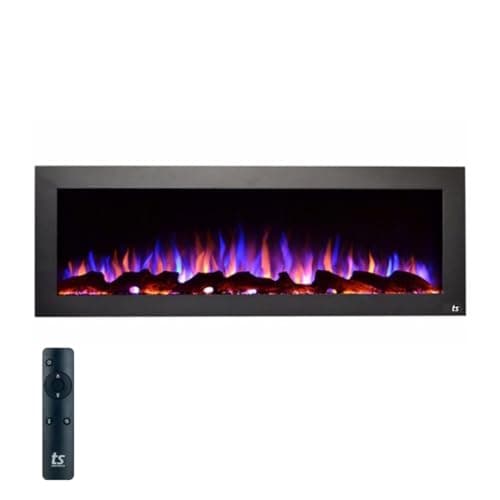 Touchstone Sideline Outdoor/Indoor 50 (80017)The only unit here rated for a space open to the weather - and it has no heater at all, which is exactly why. Buy it for the fire, never for the warmth. | A screened porch that is not actually sealed | No heaterflame effect only | |
| — | 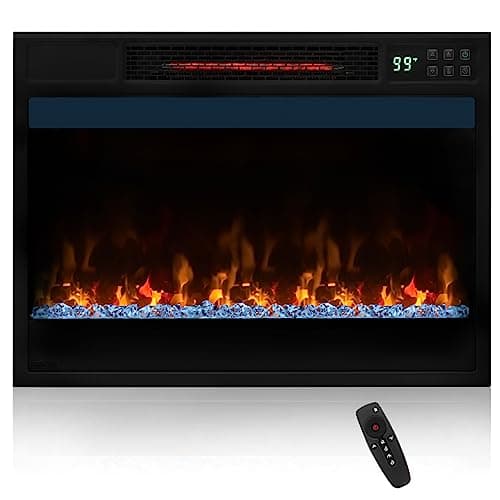 Tangkula 23" Infrared Quartz Recessed InsertA competent insert carrying a 1,000 sq ft manufacturer rating. In a glass room that figure is further from the truth than anywhere else in the house.Skip this one | Nothing you are buying on its square-foot claim | 27.5¢1,500 W · 5,118 BTU |
#ad Buy links are affiliate links — we earn a commission on Amazon purchases at no extra cost to you, and it never changes the ranking. How this site is funded. Running cost is computed at 18.34¢/kWh; see what these actually cost to run.
The four, side by side
| Unit | Format | Watts | BTU | Published room rating |
|---|---|---|---|---|
| Duraflame DFI-5010 | Freestanding infrared stove | 1,500 | 5,118 computed | Not published for this model |
| TURBRO INF50W-3D | Wall-mount infrared, 4.6 in deep | 1,500 | 5,118 computed | 400-1,000 sq ft (maker's; not supportable) |
| Tangkula 25 in stove | Freestanding stove, 35.5 lb | 1,400 | 4,777 published | Not published |
| Touchstone Sideline Outdoor 50 | Weatherproof wall-mount | 50 W total - no heater | None | n/a |
| Tangkula 23 in infrared - our skip | Recessed insert | 1,500 | 5,120 published | 1,000 sq ft (maker's; not supportable) |
The full write-ups
#1 · A three-season room you want back in October and April
Duraflame DFI-5010-01 3D Infrared Fireplace Stove
The one unit here that moves with the season. Infrared heat you feel immediately, on castors, so the same appliance serves the sunroom in spring and the den in January.
This is the pick because of portability as much as heat, and in a sunroom portability is a feature rather than a compromise. A three-season room is by definition a room you use for part of the year, and a freestanding stove can be wheeled out to it in October, used through the shoulder season, and brought back into the house when the glass stops being winnable in January. A unit recessed into a sunroom wall cannot do that, and spends four months of the year heating a room nobody is sitting in.
The heat is infrared quartz, and that distinction matters more in a glass room than anywhere else on this site. An infrared element warms objects in its line of sight rather than warming air, and in a room losing air heat through acres of glazing, heating the person rather than the volume is simply the better strategy. You feel it in seconds in the chair opposite rather than in twenty minutes everywhere. Infrared vs fan-forced sets out what that genuinely changes.
Duraflame publishes 120 volts and 12.5 amps for the DFI-5010, and the price is the other half of the argument: this is among the cheapest units on this page by a wide margin, which is the right way to buy heat for a room you occupy seasonally.
The honest costs. It stands on the floor, which means it needs a hard, level surface — a problem in a sunroom with indoor-outdoor carpet, and the reason we skip it on can you put an electric fireplace on carpet?. It is still capped at 1,500 watts, so it will not beat January. And a stove is tall and narrow, which in a room full of glass and wicker is the shape most likely to get knocked over.
What it does not do: It is a freestanding stove, not an insert. It will not fill a masonry opening and it needs floor space plus clearance in front of the glass door.
Published specs
- Heat output:
- 5,200 BTU/hr
- Electrical:
- 120 V, 12.5 A
- Dimensions:
- 24 in W x 23.4 in H x 13.1 in D
- Weight:
- 28.6 lb
- Flame:
- Layered 3D flame effect, five brightness settings
- Safety:
- Overheat shutoff, adjustable digital thermostat
What it costs to run
- 27.5¢/hr on full heat
- $99.04 across a 90-day winter at 4 hrs a night
- 5,118 BTU/hr · 12.5 A on a 120 V circuit
Computed at 18.34¢/kWh (EIA, June 2026). Your rate will differ — work out your own.
#ad We earn a commission on this link at no cost to you. How this is funded. Price as of October 23, 2026.
Specs from: Duraflame DFI-5010-02-3A user manual — 120 V, 12.5 A; Walmart product page — 5,200 BTU, dimensions, weight.
#2 · A finished, insulated sunroom you treat as a real room
TURBRO In-Flame INF50W-3D 50" Smart WiFi Infrared Fireplace
Fifty inches of wall-mounted infrared at 4.6 inches deep, with app control so the room is warm before you walk into it. Its own room rating is not supportable.
If your sunroom is properly built — insulated roof, double glazing, a real floor — then it is a room rather than a porch, and a permanent wall-mounted unit makes sense. TURBRO publishes 50 by 16 by 4.6 inches at 47.6 pounds, 1,500 watts of infrared quartz, app and voice control, a crackling sound effect and 42 dB of fan noise.
The 4.6-inch depth is the useful number. Sunroom walls are frequently shallower than interior walls — often a stud wall with glazing above a low dwarf wall — and 4.6 inches is among the shallowest in this category, which makes a recessed install possible where a 5 3/4-inch unit would not fit.
App control earns its place in this specific room more than in any other. A sunroom is cold when you are not in it by design, so being able to switch the fire on from indoors twenty minutes before you go out there is the difference between using the room and intending to.
The honest costs, and the first is a claim we will not repeat. TURBRO's own listing quotes "400-1,000 sq ft". At 1,500 watts the unit produces about 5,118 BTU per hour, which at the widely used 20 BTU per square foot rule of thumb is roughly 256 square feet of supplemental heat in an insulated room — and a sunroom is the least insulated room in the house, so the real figure is lower still, not higher. Treat the 1,000 as marketing. TURBRO also publishes no clearance table, no vent direction and no warranty term we could verify.
What it does not do: TURBRO does not publish a BTU figure for this model, so we do not quote one — the 1,500 W rating is the number to plan from. At 4.6 in deep it will not sit flush in a standard 2x4 stud bay, and the app needs a 2.4 GHz network, which catches people out on modern dual-band routers.
Published specs
- Heater:
- 1,500 W infrared quartz
- Coverage:
- Rated by the manufacturer for 400-1,000 sq ft
- Dimensions:
- 50 in L x 16 in H x 4.6 in D
- Weight:
- 47.6 lb
- Noise:
- 42 dB or lower (manufacturer figure)
- Thermostat:
- Adjustable, 60-99 °F
- Timer:
- 30 minutes to 12 hours
- Media bed:
- Five birch logs and crystals
- Mounting:
- Recessed or wall-mounted
- Smart control:
- App, Alexa and Google Assistant over 2.4 GHz WiFi
What it costs to run
- 27.5¢/hr on full heat
- $99.04 across a 90-day winter at 4 hrs a night
- 5,118 BTU/hr · 12.5 A on a 120 V circuit
Computed at 18.34¢/kWh (EIA, June 2026). Your rate will differ — work out your own.
#ad We earn a commission on this link at no cost to you. How this is funded. Price as of October 23, 2026.
Specs from: Home Depot — TURBRO INF50W-3D, 50 in, 1,500 W infrared quartz, WiFi and voice control; TURBRO In-Flames INF50W-3D product page — 50 x 16 x 4.6 in, 47.6 lb, 400-1,000 sq ft, 42 dB, 60-99 °F.
#3 · The smallest three-season nook, cheaply
Tangkula 25" Freestanding Electric Fireplace Stove
A 25-inch stove at 1,400 watts with a thermostat running to 95 °F. Less heat than the others by a measurable margin, and the right size for a small glazed porch.
Not every sunroom is a room. A great many are a glazed porch with two chairs in it, and for that the smallest, cheapest competent stove is the correct purchase rather than a compromise. Tangkula publishes 25 by 15 by 28.5 inches at 35.5 pounds, 1,400 watts and 4,777 BTU, with a thermostat spanning 68 to 95 °F.
The thermostat range is worth noting because its top end is unusually high for this category — 95 °F against the 82 °F ceiling on most inserts. In a room that loses heat as fast as a glass porch does, a thermostat that will keep calling for heat at a high setpoint behaves more usefully than one that thinks the job is done at 82.
At 35.5 pounds it is genuinely liftable by one person, which matters for the same seasonal-migration reason the Duraflame does: this is a unit you carry out in March and back in December.
The honest costs. 1,400 watts is a real reduction, not a rounding — 4,777 BTU against the 5,118 a 1,500-watt unit produces. Tangkula does not publish a low-heat stage for this model, so it is full power or off. And Tangkula's documentation across its range has been inconsistent in our experience: on its 28.5-inch insert the brand contradicts its own wattage twice on one page, which is context worth having about the publisher even when this particular specification looks clean.
What it does not do: At 1,400 W it sits below the 1,500 W class ceiling — roughly 340 BTU/hr less than most units here. That is a real difference, not a rounding one. Freestanding, so it needs floor space rather than an opening.
Published specs
- Heater:
- 1,400 W
- Heat output:
- 4,777 BTU/hr
- Dimensions:
- 25 in L x 15 in W x 28.5 in H
- Weight:
- 35.5 lb
- Electrical:
- 120 V, 60 Hz
- Thermostat:
- Adjustable, 68-95 °F
- Viewing:
- Three-sided panoramic flame effect
- Safety:
- Automatic shutoff if internal temperature runs high
- Cord:
- 67.5 in
What it costs to run
- 25.7¢/hr on full heat
- $92.43 across a 90-day winter at 4 hrs a night
- 4,777 BTU/hr · 11.7 A on a 120 V circuit
Computed at 18.34¢/kWh (EIA, June 2026). Your rate will differ — work out your own.
#ad We earn a commission on this link at no cost to you. How this is funded. Price as of October 23, 2026.
Specs from: Tangkula product page — 25 x 15 x 28.5 in, 1,400 W, 4,777 BTU, 35.5 lb, 68-95 °F; Amazon listing — Tangkula 25 in electric fireplace stove, 1,400 W.
#4 · A screened porch that is not actually sealed
Touchstone Sideline Outdoor/Indoor 50 (80017)
The only unit here rated for a space open to the weather - and it has no heater at all, which is exactly why. Buy it for the fire, never for the warmth.
There is a real distinction between a sunroom and a screened porch, and it decides which half of this page applies to you. A sunroom is glazed and sealed. A screened porch is open to the air, gets rained into at an angle, and swings to outdoor temperature. No indoor-rated electric fireplace belongs in the second one, and Touchstone's own warranty says so of its indoor models: "This fireplace is not intended for outdoor use. Use of this fireplace outdoors voids this warranty."
This is the model built for it. Touchstone publishes a weatherproof case, 50 by 17 1/2 by 5 3/4 inches, a GFI plug, three flame colors across five settings — and 50 watts total for the whole appliance, because there is no heater in it. The manual documents a 70 °C ambient limit and warns against covering it in direct sunlight.
The absence of a heater is a design consequence rather than a cost saving, and Touchstone is straightforward about it: a sealed weatherproof enclosure and a 1,500-watt fan heater are not compatible. The upside is a running cost of about seven cents for an eight-hour evening and no clearance requirement above the unit, which also makes it the easiest thing to put under a television — see can you put a TV above an electric fireplace?
The honest cost is total: zero heat, ever, at a higher price than the heated Sideline 50. If you are reading a page about heating a sunroom, this is almost certainly not what you came for — but if your "sunroom" is really a screened porch, it is the only honest answer on the page, and the alternative is voiding a warranty. Outdoor electric fireplaces covers the format properly.
What it does not do: It produces no heat at all — that is the design, not a fault. Touchstone also warns that direct sunlight can push the temperature behind the glass past the 70 °C limit and damage the unit, so it should be kept covered when not in use in hot weather or full sun. Stock has been showing as low-quantity on Amazon.
Published specs
- Dimensions:
- 50 in W x 17 1/2 in H x 5 3/4 in D
- Heat:
- None — this is a decorative flame effect only
- Electrical:
- 120 V AC, 50 W total draw; GFI plug for outdoor use, hardwire compatible
- Flame:
- 3 flame colors (blue, orange, combined) across 5 settings — 15 combinations
- Media bed:
- Logs and crystals included
- Mounting:
- Recessed or wall-mounted; designed for hanging on brick, stone or siding
- Temperature limit:
- Rated for use in ambient temperatures up to 70 °C (158 °F)
What it costs to run
No heater. The flame effect alone draws far less than a heating unit — see what these cost to run.
Computed at 18.34¢/kWh (EIA, June 2026). Your rate will differ — work out your own.
#ad We earn a commission on this link at no cost to you. How this is funded. Price as of October 23, 2026.
Specs from: Touchstone 80017 Sideline Outdoor/Indoor 50 in — 50 x 17 1/2 x 5 3/4 in, 120 V, 50 W, no heat, GFI plug, 3 flame colors across 5 settings; Touchstone 80017 owner's manual — outdoor installation, temperature limit and covering guidance.
Skip this one
Tangkula 23" Infrared Quartz Recessed Insert
A competent insert carrying a 1,000 sq ft manufacturer rating. In a glass room that figure is further from the truth than anywhere else in the house.
We recommend this insert elsewhere and we are skipping it here for one reason: the number that sells it is the number that will mislead you most in this particular room. Tangkula publishes 1,500 watts, 12.5 amps, 5,120 BTU and a rating of "up to 1,000 square feet". The BTU figure is right and the square-foot figure cannot be, because 5,120 BTU per hour is 5,120 BTU per hour wherever you put it.
At the widely used 20 BTU per square foot rule of thumb, 5,120 BTU is about 256 square feet of supplemental heat in a reasonably insulated room. A sunroom is the opposite of a reasonably insulated room. Buying on a 1,000-square-foot claim and installing into a glass box is the single most predictable disappointment in this category.
The unit itself is fine and we have said so: a 60 to 99 °F thermostat, an eight-hour timer, a child lock, a six-foot cord, a CSA listing and a five-inch depth at 19 pounds. On replacement inserts it is the pick for getting the most heat through a console cutout, and that is a job it does well.
One further honesty note about the product itself rather than the claim: Tangkula describes the heater as an infrared quartz tube combined with a resistor wire, which makes it a hybrid rather than the pure radiant element the title implies. Nothing wrong with that — but in a sunroom the pure-radiant behavior is the part you actually wanted.
What it does not do: It is sold as a 23-inch unit but the body measures 25 in across, so size the opening to 25 in and not to the name. Tangkula also describes the heater as an infrared quartz tube combined with a resistor wire, which means it is a hybrid rather than the pure radiant element the listing title implies.
Published specs
- Heater:
- Infrared quartz tube combined with a heating resistor wire
- Heat output:
- 5,120 BTU/hr (manufacturer figure)
- Coverage:
- Rated by the manufacturer for up to 1,000 sq ft
- Electrical:
- 120 V, 60 Hz, 1,500 W, 12.5 A
- Dimensions:
- 25 in L x 18 in H x 5 in D
- Weight:
- 19 lb
- Thermostat:
- Adjustable, 60-99 °F
- Flame:
- 6 flame settings and 5 brightness levels
- Safety:
- Overheat protection, child lock, CSA certified
- Timer:
- 8 hours
- Cord:
- 6 ft
What it costs to run
- 27.5¢/hr on full heat
- $99.04 across a 90-day winter at 4 hrs a night
- 5,118 BTU/hr · 12.5 A on a 120 V circuit
Computed at 18.34¢/kWh (EIA, June 2026). Your rate will differ — work out your own.
#ad We earn a commission on this link at no cost to you. How this is funded. Price as of October 23, 2026.
Specs from: Tangkula product page — 1,500 W, 5,120 BTU, 1,000 sq ft, 60-99 °F thermostat, 8 h timer; Amazon listing — Tangkula 23 in infrared quartz recessed insert, 1,500 W.
What it costs to run out there
A sunroom is the one room where you may genuinely want the heater on every minute you are in it, rather than for twenty minutes to take the edge off. That changes the running cost from trivial to noticeable, so it is worth seeing before you buy.
| Usage | Hours | Heat on (1,500 W) | Flame only (~100 W) |
|---|---|---|---|
| One evening | 4 | $1.10 | $0.07 |
| A week of evenings | 28 | $7.70 | $0.51 |
| A month, 4 hrs a night | 120 | $33.01 | $2.20 |
| A 90-day winter, 4 hrs a night | 360 | $99.04 | $6.60 |
| Per hour | 1 | 27.5¢ | 1.8¢ |
| Usage | Hours | Heat on (1,400 W) | Flame only (~100 W) |
|---|---|---|---|
| One evening | 4 | $1.03 | $0.07 |
| A week of evenings | 28 | $7.19 | $0.51 |
| A month, 4 hrs a night | 120 | $30.81 | $2.20 |
| A 90-day winter, 4 hrs a night | 360 | $92.43 | $6.60 |
| Per hour | 1 | 25.7¢ | 1.8¢ |
And the heaterless outdoor unit for contrast: at 50 watts, an eight-hour evening is about seven cents, and a 90-night season is around $6.60. That gap — roughly thirty to one — is the clearest argument on this page for being honest with yourself about whether you want warmth or firelight. The running cost calculator will price any of these against your own tariff and hours.
Four things that help more than the fireplace does
On a page about buying an appliance, this is the uncomfortable part: in a glass room the envelope matters more than the heater, and a fraction of the fireplace budget spent here buys more comfort than a bigger unit would.
- Insulated blinds or cellular shades on the glass, closed after dark. The glazing is where the DOE's 30-40% goes, and at night you are not using the view.
- Sealing the door to the house and the gaps around the glazing. A sunroom frequently leaks air as well as conducting heat, and drafts defeat radiant heat specifically because they move air across you.
- A rug over a slab floor. An uninsulated slab is a large cold surface radiating against everything in the room, including the people.
- Pointing the unit at the seating rather than at the room. With a radiant heater this is not a detail, it is most of the effect. Aim it where people sit and nowhere else.
None of that is a product we can sell you, which is exactly why it is worth saying. Do electric fireplaces actually heat a room? and BTU and room size go through the arithmetic in full.
Before you buy for a sunroom
- Settle whether the room is sealed or open to the air. If it is open, only a weather-rated unit is honest, and in this category that means no heater.
- Decide whether you want a unit that migrates with the season. In a room you use for part of the year, a stove you can move is worth more than a built-in.
- Prefer infrared, and aim it at the chairs rather than at the room.
- Ignore square-foot claims above about 250 sq ft from a 1,500-watt unit, and ignore them entirely for a glass room.
- Check the circuit. 1,500 watts is 12.5 amps, and sunroom circuits are frequently an afterthought shared with outdoor sockets - see watts, amps and your circuit.
Questions people actually ask
Can an electric fireplace heat a sunroom?
In the shoulder seasons, yes, for the people sitting in front of it. In deep winter, no. Every 120-volt unit is capped at 1,500 watts, about 5,118 BTU per hour, and the Department of Energy puts winter heat loss through windows at 30-40% in a house that is only 10% glass. A sunroom is mostly glass, so the loss side of that equation is far larger and the supply side cannot grow.
What size electric fireplace do I need for a sunroom?
Width is a styling decision here, not a heat one — a 25-inch stove and a 50-inch wall-mount both top out at the same 1,500 watts. What to size instead is your expectation: at 20 BTU per square foot, 5,118 BTU is about 256 square feet of supplemental heat in an insulated room, and less in a glazed one. If the room is larger than that, the fireplace heats the seating area rather than the room.
Is infrared better than fan-forced for a sunroom?
In this room, yes — and it is one of the few places on this site where we say that. Both put the same energy in, but a fan-forced unit warms air that a glass room keeps losing, while an infrared element warms the chair and the person directly. The heat does not have to survive in the air to reach you. It does not produce more heat; it allocates the same heat better.
Can I put an electric fireplace in a screened porch?
Not an indoor-rated one. Touchstone's warranty states "This fireplace is not intended for outdoor use. Use of this fireplace outdoors voids this warranty," and that is typical. A screened porch needs a weather-rated unit, and in this category weather-rated means heaterless — Touchstone's Sideline Outdoor draws 50 watts and produces no heat, because a sealed weatherproof case and a fan heater are not compatible designs.
Should I recess a fireplace into my sunroom wall or buy a freestanding one?
Freestanding, in most cases, and the reason is seasonal rather than technical. A three-season room is unoccupied for months, and a recessed unit spends that time as a fixture in a room nobody is in. A stove on castors serves the sunroom in October and the living room in January. Recess one only if the sunroom is fully insulated and you treat it as a year-round room.
Why do the listings claim 1,000 square feet?
Because square-foot ratings in this category are marketing rather than measurement, and nobody audits them. The arithmetic is fixed: 1,500 watts is about 5,118 BTU per hour, and at the common 20 BTU per square foot rule of thumb that is roughly 256 square feet of supplemental heat. Where a manufacturer claims 1,000 square feet we report the claim as theirs and the computed figure as ours.
Sources
Every figure on this page is either taken from one of these documents or computed from a formula shown on the page. Nothing here is recalled from memory.
- US Department of Energy, Building Technologies Office (23 June 2022) — of windows in a typical home: "Although they constitute only 10% of the surface area of a typical home" they "can account for 30-40% of the heat loss in winter"
- Duraflame DFI-5010 user manual — 120 V, 12.5 A
- Home Depot — TURBRO INF50W-3D, 50 in, 1,500 W infrared quartz, 50 x 16 x 4.6 in, 47.6 lb, 400-1,000 sq ft, 42 dB
- Tangkula 25 in electric fireplace stove — 25 x 15 x 28.5 in, 1,400 W, 4,777 BTU, 35.5 lb, 68-95 °F
- Tangkula 23 in infrared quartz recessed insert — 1,500 W, 12.5 A, 5,120 BTU, 1,000 sq ft, 60-99 °F thermostat, 8 h timer, quartz tube plus resistor wire
- Touchstone 80017 Sideline Outdoor/Indoor 50 in — 50 x 17 1/2 x 5 3/4 in, 120 V, 50 W total, no heat, GFI plug, 3 flame colors across 5 settings
- Touchstone 80017 owner's manual — outdoor installation, 70 °C ambient limit, and the direct-sunlight covering warning
- Touchstone Sideline Series owner's manual (rev. 251114), Operation and Specifications — all Sideline models 120 V AC, max 1500 W, 12 AMP; the heater runs in two stages, "Low heat (750w)" and "High heat(1500w)", and "the heater blows cool air for 10 seconds before the heater turns on, and after it turns off"; timer settings range from 0.5 hours to 8 hours (30, 1H-8H); "If the room temperature is ABOVE the temperature listed on the display, the heater will not turn ON"; tested to CSA standards for fixed and location-dedicated electric room appliances; one-year warranty with replacement parts free of charge in the first year, replacement parts then covered 90 days or the remainder of the original year, whichever is greater; "This fireplace is not intended for outdoor use. Use of this fireplace outdoors voids this warranty"
- Amazon listing — Tangkula 28.5 in recessed electric fireplace insert (model EF-30D, part FP10388US), title states 700W/1500W while the feature text states 750 W low and 1500 W high
- NFPA — National Electrical Code (NFPA 70), the standard behind US branch-circuit limits
- EIA Electric Power Monthly, Table 5.3 — US residential average, June 2026
Read next
- Outdoor electric fireplaces
Outdoor-rated units are decorative by design — 36 to 50 W, no heater. Why the weatherproof case rules one out, and the three worth considering.
- Freestanding electric fireplace stoves
No opening, no framing, no electrician. Four stoves compared on heater type, flame depth and the floor space they genuinely need.
- Infrared vs fan-forced
Identical output, different delivery. Which one suits a recess, a big room, or a dry house.
- BTU and room size
BTU-to-square-feet, banded — with a calculator that reports the shortfall as honestly as the fit.
- Do electric fireplaces actually heat a room?
Yes, up to about 256 square feet. Above that it is supplemental heat, and no plug-in unit does better.
- Can you put an electric fireplace on carpet?
Touchstone: "Do not use on soft surfaces, like a carpet, where openings may be blocked." Buy a wall-mount or a console instead - both keep the vents clear of the floor.