Guide · joinery, not drywall
Electric fireplaces in a cabinet or media wall
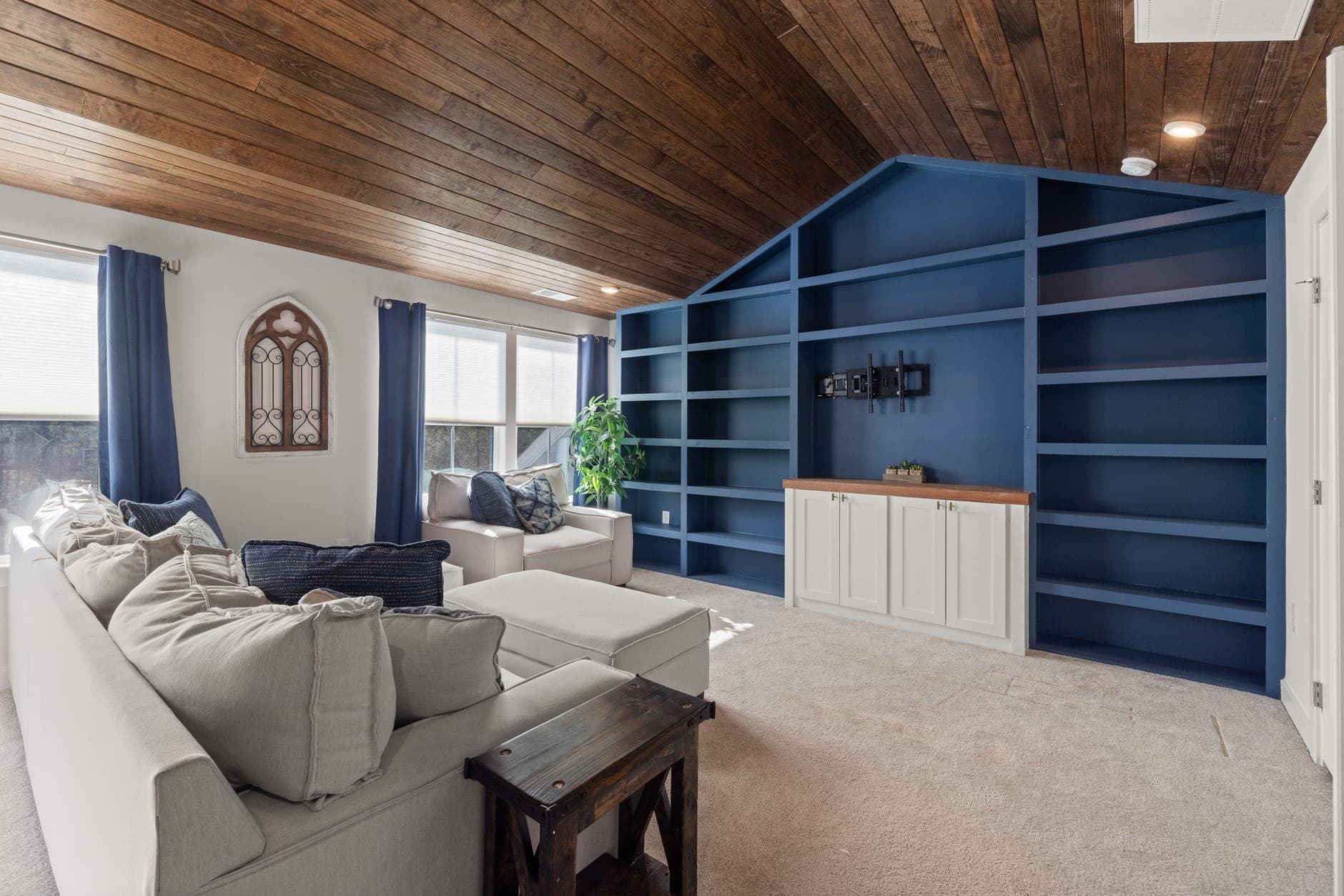
A media wall is millwork, not a stud bay, and the unit that is fine on a wall may not be fine inside a box. Two manufacturers publish exactly what they will allow. Almost nobody reads it before the carpenter starts.
By Scooter M.Published October 23, 2026Last reviewed October 23, 2026
Disclosure: the buy links below are affiliate links. We earn a commission on Amazon purchases at no extra cost to you. It has never changed a ranking on this site, and every roundup here names a unit we think you should skip. How this site is funded.
Yes, but it is a different job from hanging one on a wall, and the rules come from the manual rather than from the internet. Two things decide it. First, the manufacturer has to publish a rough opening — the framed hole, not the product dimension — and a surprising number of expensive brands do not. Second, you have to honor the clearance above: Touchstone requires 8 inches from the top of the fireplace to a mantel, a television or a ceiling, which is exactly where a media wall wants to put a shelf. Nothing may block the air intakes or exhaust, and nothing may cover the front.
Two different jobs that look like one
"Can I build it in?" is really two questions, and they have different answers. Recessing a slim wall panel into a stud bay is the job covered on how to mount or recess an electric fireplace: a hole in drywall, a framed opening, a finished face. Building a fireplace into cabinetry — a media wall, a run of joinery, a built-in bookcase — is carpentry around a box, and the box has rules about what may touch it and what may sit above it.
The products split the same way. A wall panel is designed to be seen on a wall and tolerates being recessed. A built-in firebox is designed to disappear into something you build. They are not interchangeable, they are not the same depth, and the one most people buy for a media wall is the first kind.
What the manufacturers actually say
Most of this category publishes nothing useful about enclosed installs. Two brands publish a great deal, and because they publish different things, the contrast is the most useful thing on this page.
| Dimplex Revillusion (built-in firebox) | Touchstone Sideline (wall panel) | |
|---|---|---|
| Intended destination | "a cabinet or media center of your own" | A wall — recessed or surface-mounted |
| Rough opening published | Yes — a full rough-in framing table | Yes — per model, width x height x depth |
| Opening tolerance | Surround cut to the framing dimensions; the 1/4 in flange is cosmetic only | "no more than 1/4" larger than metal firebox portion" |
| Venting | "does not require any special venting" | Front heating vent on the Sideline 50, so it can be flush mounted |
| Clearance above | Zero clearance, except 2 in at the top from insulation or vapor barrier | 8 in to a mantel, a TV or the ceiling |
| Contact with insulation | Must NOT be in direct contact with vapor barrier or insulation | Enclosure walls should be finished in sheetrock; avoid loose insulation |
| Structural | Framed opening, firebox fixed through four mounting flanges | Non-load-bearing walls ONLY |
| Absolute rule | "Do not partially or fully cover or obstruct the front of the firebox" | "do not block the air intakes or exhaust in any manner" |
The rough opening is the number the project runs on
A product dimension tells you how big the fireplace is. A rough opening tells you how big to cut the hole, and the gap between the two is what the trim flange hides. Build to the product dimension and the unit does not fit; build too generously and the flange does not cover the gap. Touchstone's instruction is to create an opening "no more than 1/4" larger than metal firebox portion of fireplace" — a quarter of an inch is the whole tolerance.
This is where the category sorts itself out, and not by price. Touchstone publishes a rough opening on a $549 unit. Modern Flames and Amantii, at three and four times that, publish none for the models we list. We found the same inversion when we costed the top of the market on high-end electric fireplaces: the more you spend, the less the manufacturer tends to tell you. For a wall-hung unit that is annoying. For millwork it decides whether the project can start.
What a cabinet does that a wall does not
A stud bay is open at the back into an insulated cavity and open at the top into the rest of the wall. A cabinet is a closed box with a back, a top and two sides, usually made of plywood or MDF, with a shelf immediately above. That changes two things.
The first is heat. These units put out about 5,118 BTU per hour at 1,500 watts, all of it into the room through a vent — and if the vent faces upward into the underside of a shelf, the shelf is the thing being heated. Touchstone's own warning is explicit that "elevated temperatures on the wall or in the air above the fireplace can cause melting, discoloration or damage to decorations, television or other electronic components". Find out which way your unit vents before the joinery is drawn, not after.
The second is access. A fireplace inside a built-in still has a plug, a control panel and, eventually, a fan that fails. Touchstone requires the unit to go straight into a wall outlet — "Never plug this fireplace into a surge protector, extension cord, or relocatable power tap" — so there has to be a receptacle inside the cavity, and someone has to be able to reach it. Joinery that traps the unit permanently is a joinery mistake, not a fireplace one.
The checks to make before anyone cuts
- Get the rough opening in writing from the manufacturer. Not the product dimension, not the carton. If the brand will not supply one, that is an answer about the brand.
- Find out which way it vents. Front-venting units can be enclosed and flush-finished. An upward vent under a fixed shelf is the single most common built-in mistake.
- Leave the published clearance above, and treat it as a hard line. Touchstone's is 8 inches to a mantel, a TV or a ceiling. Design the shelf height from that number rather than fitting the number to the shelf.
- Put a receptacle inside the cavity and keep it reachable. Direct to a wall outlet, on its own 120 V 15-amp circuit — watts, amps and your circuit covers what else can share it.
- Finish the inside of the enclosure. Touchstone asks for sheetrock, as you would finish any other outside wall, so clearance to combustibles holds inside the cavity. Bare framing and loose insulation against the unit is what the manuals forbid.
- Check the wall is not load-bearing before it becomes a hole. Touchstone's instruction is non-load-bearing walls only, in capitals. A media wall built against a structural wall is a question for a builder.
Quick picks: units you can actually build joinery around
Ranked. The running cost column is computed from each unit's rated wattage, not quoted from a manufacturer. Tap a row for the full write-up.
| # | Product | Best for | Cost per hour | Price |
|---|---|---|---|---|
| 1 | 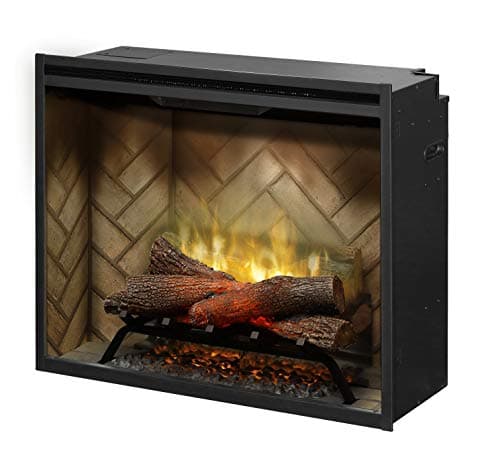 Dimplex Revillusion RBF30 30" Built-In FireboxThe only unit here whose own manual names a cabinet as the intended destination, and publishes a rough-in framing table to build it from. | The one the manufacturer built for this | 27.5¢1,500 W · 5,118 BTU | |
| 2 | 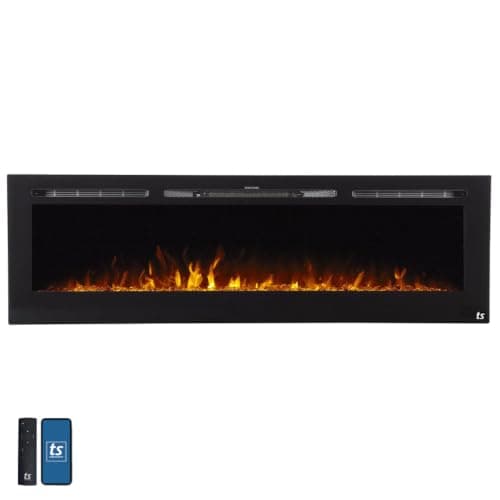 Touchstone The Sideline 72 (80015)Six feet of fire with a published rough opening and a published clearance table — the panel route, properly documented. | A documented panel, at full media-wall width | 27.5¢1,500 W · 5,118 BTU | |
| 3 | 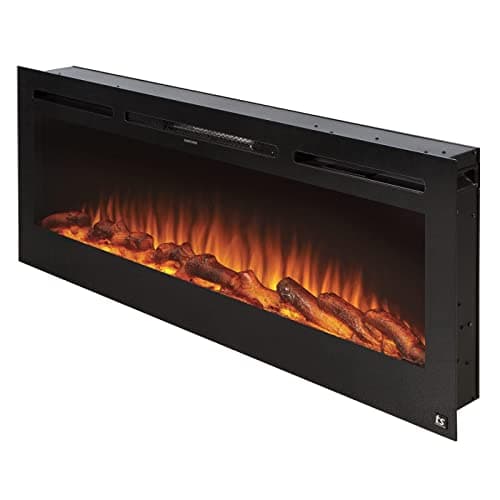 Touchstone The Sideline 50The volume seller, with a published rough opening and a front heating vent — the detail that makes a flush, enclosed install possible at all. | The same documentation, at a third of the money | 27.5¢1,500 W · 5,118 BTU | |
| — | 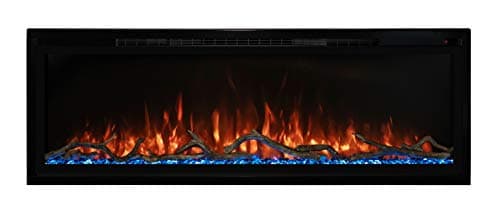 Modern Flames Spectrum Slimline 60 (SPS-60B)The shallowest unit Modern Flames makes, at a serious price, with no published rough opening — the one specification a joinery project cannot proceed without.Skip this one | Nothing you are going to build cabinetry around | 27.5¢1,500 W · 5,118 BTU |
#ad Buy links are affiliate links — we earn a commission on Amazon purchases at no extra cost to you, and it never changes the ranking. How this site is funded. Running cost is computed at 18.34¢/kWh; see what these actually cost to run.
The question to ask before you draw the joinery
Not "which fireplace looks best in the render", but "which fireplace has a published rough opening, a published clearance above, and a vent that points away from the shelf". That question eliminates most of the category in about ten minutes, and what survives it is a much shorter list than the one you started with.
If the answer is that nothing you like survives, the honest fallback is to surface-mount rather than build in. A unit hung on the face of a media wall, with the cabinetry running around it rather than over it, breaks none of these rules and can be changed in an afternoon. Depth and clearance has the numbers for both routes.
#1 · The one the manufacturer built for this
Dimplex Revillusion RBF30 30" Built-In Firebox
The only unit here whose own manual names a cabinet as the intended destination, and publishes a rough-in framing table to build it from.
Most of this category tolerates being built in. This one is designed for it, and Dimplex says so in the opening line of its own specification page: the Revillusion built-in firebox "can give your existing fireplace new life or transform a cabinet or media center of your own into a stunning focal point". That is the manufacturer describing this page's project, which is not something any other unit we have documented does.
What makes it buildable is that the manual publishes a rough-in framing table rather than just a product dimension. For the RBF30 the framed opening is 30 5/8 inches wide by 26 3/16 high, at a framing depth of 12 1/2 inches, and the manual is explicit that the finished surround has to be cut to those width and height dimensions because the quarter-inch self-trimming flange "is only to create a finished appearance". A carpenter can work from that. There is no equivalent number on most of this category's product pages.
Two more rules make the joinery straightforward. Dimplex states the firebox "does not require any special venting", which removes the question people most often get wrong about an enclosed install. And it is described as "a zero clearance design, with the exception of the top of the unit, where any insulation and vapor barrier should be placed a minimum of 2" (5.1 cm) from the firebox" — one standoff to honor, at one surface.
The costs are real and they are the reason this is not the automatic answer. At roughly 12 inches deep it will not go into a 2x4 or even a 2x6 wall, so it needs purpose-built joinery or a chase — this is a cabinetmaker's project, not a weekend one. It is a firebox rather than a plug-in panel, and the higher output ratings need a hardwired higher-voltage supply and a licensed electrician. It is also by some distance the most expensive unit on this page. The full review is on the Revillusion RBF30.
What it does not do: This is a firebox, not a plug-in wall unit. At 12 1/8 in deep it will not go into a 2x4 or even a 2x6 wall — it needs a purpose-built enclosure. The higher BTU figures require a higher-voltage hardwired supply and a licensed electrician.
Published specs
- Dimensions:
- 31 1/8 in W x 26 5/8 in H x 12 1/8 in D
- Weight:
- 50 lb
- Form:
- Built-in firebox — framed into a wall or a surround, not a stud bay
- Heat output:
- Up to 8,794 BTU/hr on the higher-voltage configuration
- Flame:
- Revillusion mirror-free viewing area with herringbone brick interior
- Heater:
- Fan-forced
What it costs to run
- 27.5¢/hr on full heat
- $99.04 across a 90-day winter at 4 hrs a night
- 5,118 BTU/hr · 12.5 A on a 120 V circuit
Computed at 18.34¢/kWh (EIA, June 2026). Your rate will differ — work out your own.
#ad We earn a commission on this link at no cost to you. How this is funded. Price as of October 23, 2026.
Specs from: Dimplex Revillusion RBF30 owner's manual; Retailer listing — RBF30 dimensions and weight.
#2 · A documented panel, at full media-wall width
Touchstone The Sideline 72 (80015)
Six feet of fire with a published rough opening and a published clearance table — the panel route, properly documented.
If the design is a long horizontal band of fire inside a run of cabinetry rather than a deep firebox, this is the one to build around, and the reason is paperwork rather than flame. Touchstone publishes a rough opening of 68 3/4 inches wide by 20 1/2 high by 5 3/4 deep for this model, which is the dimension a joiner actually needs and which most of this category does not print anywhere.
It also publishes the clearance table the rest of the page is built on. Measured from the front of the glass: 6 inches from the bottom of the fireplace to the floor, 0 inches at the sides, 0 inches at the back, and 8 inches from the top of the fireplace to a mantel, to a television or to the ceiling. In a media wall the 8-inch figure is the one that bites, because a shelf is exactly the thing people want to run straight above the opening.
The install instructions are unusually specific for joinery work too. The opening should be "no more than 1/4" larger than metal firebox portion of fireplace", the enclosure walls should be finished in sheetrock as you would finish any other outside wall so that clearance to combustibles is maintained inside the cavity, and the fireplace goes into non-load-bearing walls only.
The honest costs: at 5 1/2 inches deep it still will not sit flush in a 2x4 bay, so the cabinet back has to be built out. At 95.3 pounds it is a genuine two-person lift into a framed opening. Three flame colors is fewer than the Elite range offers. And Touchstone's own manual tells you to consult a local builder before recessing it, which on a bespoke media wall is advice worth taking rather than a disclaimer to skim.
What it does not do: At 5 1/2 in deep it does not sit flush in a standard 2x4 stud bay — you need 2x6 framing or a built-out chase. It is also the widest unit in the standard Sideline range and the heaviest at 95.3 lb, which makes hanging it a two-person job. Three flame colors is fewer than the Elite's six.
Published specs
- Dimensions:
- 72 in W x 21 1/2 in H x 5 1/2 in D
- Rough opening:
- 68 3/4 in W x 20 1/2 in H x 5 3/4 in D
- Weight:
- 95.3 lb
- Heater:
- Coil wire heater with blower, 1,500 W
- Heat output:
- 5,000 BTU/hr (manufacturer figure)
- Coverage:
- Rated by the manufacturer for up to 400 sq ft
- Electrical:
- 120 V, 11 A and up — plug in or hardwire
- Flame:
- 3 flame colors (orange, blue, combination), 5 variable speeds
- Timer:
- 30 minutes to 7.5 hours
- Warranty:
- 1 year standard, extensions available
What it costs to run
- 27.5¢/hr on full heat
- $99.04 across a 90-day winter at 4 hrs a night
- 5,118 BTU/hr · 12.5 A on a 120 V circuit
Computed at 18.34¢/kWh (EIA, June 2026). Your rate will differ — work out your own.
#ad We earn a commission on this link at no cost to you. How this is funded. Price as of October 23, 2026.
#3 · The same documentation, at a third of the money
Touchstone The Sideline 50
The volume seller, with a published rough opening and a front heating vent — the detail that makes a flush, enclosed install possible at all.
Most media walls do not need six feet of fire, and this is the one we would build into a standard run of cabinetry. Touchstone publishes a rough opening of 47 1/8 inches by 20 1/2 by 5 3/4, a firebox of 46 7/8 by 20 1/4 by 5 1/4, and a 59-pound weight — the same class of documentation as the 72 at roughly a third of the price.
The detail that matters most for joinery is easy to miss on the product page: Touchstone describes the unit as "designed with front heating vent so that the unit can be flush mounted into wall". Where the hot air leaves the unit is the whole question in an enclosed install. A front-venting unit exhausts into the room; a unit that vents upward into the underside of a shelf you have just built does not.
Everything else that applies to the 72 applies here, from the same manual: the same 8-inch clearance above to a mantel, a television or a ceiling, the same quarter-inch maximum oversize on the opening, the same non-load-bearing requirement, and the same instruction to finish the inside of the enclosure in drywall.
The costs are the 72's, scaled down. It is 5 1/2 inches deep, so a 2x4 back still will not take it. The flame is Touchstone's layered LED rather than a concealed-source firebox, which at eye level in a built-in is a visible step below the Revillusion. And it is worth knowing that Touchstone's own documents disagree with each other on this model's timer and weight — we go through that on the Sideline 50 review.
What it does not do: At 5 1/2 in deep it does not sit flush in a standard 2x4 stud bay. Recessing needs a framed cavity; surface-mounting it works but leaves the unit standing proud of the wall, which reads very differently in a small room.
Published specs
- Dimensions:
- 50 3/8 in W x 21 1/2 in H x 5 1/2 in D
- Weight:
- 59 lb
- Heater:
- Coil wire heater with blower, 1,500 W — about 5,000 BTU/hr
- Electrical:
- 120 V — plug in or hardwire
- Form:
- Recessed or wall-mounted linear unit
- Line:
- The volume seller of the Sideline range (model 80004)
What it costs to run
- 27.5¢/hr on full heat
- $99.04 across a 90-day winter at 4 hrs a night
- 5,118 BTU/hr · 12.5 A on a 120 V circuit
Computed at 18.34¢/kWh (EIA, June 2026). Your rate will differ — work out your own.
#ad We earn a commission on this link at no cost to you. How this is funded. Price as of October 23, 2026.
Specs from: Touchstone Sideline 50 (80004) product page — 50 3/8 x 21 1/2 x 5 1/2 in, 59 lb, coil wire heater with blower.
Skip this one
Modern Flames Spectrum Slimline 60 (SPS-60B)
The shallowest unit Modern Flames makes, at a serious price, with no published rough opening — the one specification a joinery project cannot proceed without.
This is a genuinely good fireplace and the site recommends the brand elsewhere. It is skipped here for one reason that is specific to this page: Modern Flames publishes no rough opening for it, and no wattage, no amperage and no coverage figure either.
On a wall-hung install that is an irritation. On a built-in it is a blocker. A cabinetmaker cutting a hole in a finished carcass needs a number from the manufacturer, not a measurement taken off the unit in the box, because the tolerance between the firebox and the trim flange is what decides whether the finished face looks deliberate or approximate. Touchstone prints that number at a third of the price.
The frustrating part is that this unit is otherwise the obvious choice for exactly this job. At 3.875 inches it is the only Modern Flames that clears a 2x4 stud bay, which is precisely the constraint a media wall imposes, and the Hybrid-FX flame is better than anything else on this page bar the Revillusion.
If the brand is the reason you are here, ask Modern Flames for the rough opening in writing before anyone cuts anything, and do not let a carpenter work from the carton dimensions. Stock has also been intermittent on this model. The range is decoded on Modern Flames electric fireplaces.
What it does not do: At 3.875 in this is the shallowest unit Modern Flames makes and the only one in the range that will clear a 2x4 stud bay, which is the practical reason to choose it over a Landscape Pro — but the brand publishes no rough opening, no wattage, no amperage and no coverage figure for it. It is also the entry price into the brand, which means the Hybrid-FX flame without the Landscape Pro's driftwood log set. Stock has been intermittent.
Published specs
- Dimensions:
- 59.75 in W x 17 in H x 3.875 in D
- Weight:
- 95 lb
- Heat output:
- 5,000 BTU/hr
- Heater:
- Integrated, and Modern Flames states heat and flame operate independently of each other
- Flame:
- Hybrid-FX with high-intensity LED lighting and an active ember bed
- Installation:
- Wall mount or built-in, minimal trim for maximum viewing area
What it costs to run
- 27.5¢/hr on full heat
- $99.04 across a 90-day winter at 4 hrs a night
- 5,118 BTU/hr · 12.5 A on a 120 V circuit
Computed at 18.34¢/kWh (EIA, June 2026). Your rate will differ — work out your own.
#ad We earn a commission on this link at no cost to you. How this is funded. Price as of October 23, 2026.
Questions people actually ask
Can you build an electric fireplace into a cabinet or media wall?
Yes, and some are designed for exactly that — Dimplex describes its Revillusion built-in firebox as a way to "transform a cabinet or media center of your own into a stunning focal point". The conditions are that the manufacturer publishes a rough opening to frame to, that the clearance above is respected, and that nothing covers the front or blocks the air intakes and exhaust. A unit with no published rough opening is not one to build millwork around.
How much space do you need above an electric fireplace in a media wall?
Follow the manufacturer, not a rule of thumb. Touchstone's Sideline manual requires 8 inches from the top of the fireplace to a mantel, to a television or to the ceiling, measured from the front of the glass panel. Dimplex's Revillusion firebox is a zero-clearance design except at the top, where insulation and vapor barrier must sit at least 2 inches away. Those are different numbers for different products, which is exactly why the manual is the source.
Does an electric fireplace need venting in a cabinet?
Not a flue — there is no combustion, so there is nothing to vent outside. But the unit's own air intake and heat outlet have to stay clear. Dimplex states the Revillusion "does not require any special venting"; Touchstone's rule is that you must not block the air intakes or exhaust in any manner. The practical question is which way your unit exhausts: a front heating vent can be enclosed and flush-finished, an upward vent under a fixed shelf cannot.
What is a rough opening and why does it matter more than the dimensions?
The rough opening is the framed hole, slightly larger than the firebox, that the trim flange covers. The product dimension is the size of the fireplace itself. Build to the second and the unit will not go in; build too large and the flange will not hide the gap. Touchstone's tolerance is an opening "no more than 1/4" larger than metal firebox portion of fireplace", which is why the number has to come from the manufacturer.
Can I put a TV above an electric fireplace in a built-in?
Within the published clearance, yes. Touchstone is the only mainstream brand we have found that states a clearance to a television specifically, and it is 8 inches from the top of the fireplace, with a warning that elevated temperatures above the unit can damage electronics. We work through heat, sightlines and mounting in full on putting a TV above an electric fireplace.
Sources
Every figure on this page is either taken from one of these documents or computed from a formula shown on the page. Nothing here is recalled from memory.
- Dimplex Revillusion built-in electric firebox owner's manual, Specifications / Framing / Placement — the firebox "can give your existing fireplace new life or transform a cabinet or media center of your own into a stunning focal point"; "The Revillusion Built-in Electric Firebox does not require any special venting"; RBF30 rough-in framing 30 5/8 in wide x 26 3/16 in high at a framing depth of 12 1/2 in, and the finished surround must be cut to those dimensions because the 1/4 in self-trimming flange "is only to create a finished appearance"; "This firebox is a zero clearance design, with the exception of the top of the unit, where any insulation and vapor barrier should be placed a minimum of 2" (5.1 cm) from the firebox"; "The built-in electric firebox must NOT be in direct contact with any building vapor barrier or insulation"; "DANGER!: High temperatures may be generated under certain abnormal conditions. Do not partially or fully cover or obstruct the front of the firebox"
- Dimplex Revillusion RBF30 owner's manual — built-in firebox installation and ratings
- Touchstone Sideline Series owner's manual (rev. 251114), Choosing Installation Location — minimum clearances measured from the front of the glass panel: bottom of fireplace to floor 6 in, sides 0 in, back 0 in, top of fireplace 8 in to mantel, 8 in to TV and 8 in to ceiling; combustible materials such as furniture, pillows, bedding, papers, clothes and curtains at least 36 in from the front; "Ensure clearances to combustibles are maintained when building a mantel or shelves above the fireplace. Elevated temperatures on the wall or in the air above the fireplace can cause melting, discoloration or damage to decorations, television or other electronic components"
- Touchstone Sideline Series owner's manual (rev. 251114), Recessed Installation — "Create opening in the wall that is no more than 1/4" larger than metal firebox portion of fireplace"; "To avoid the possibility of exposed insulation or vapor barrier coming in contact with the fireplace, it is recommended that the walls of the fireplace enclosure be 'finished' (i.e. Sheetrock, drywall, etc.) as you would finish any other outside wall of your home. This will ensure that clearance to combustibles is maintained within the wall cavity"; "Never install fireplace into load-bearing walls. When recessing fireplace in a wall, recess into non-load bearing walls ONLY!"; "Due to many different finish materials used on walls, it is highly recommended that you consult your local builder before you install this fireplace in the wall"
- Touchstone Sideline 50 (80004) product page — 50 3/8 x 21 1/2 x 5 1/2 in, firebox 46 7/8 x 20 1/4 x 5 1/4 in, rough opening 47 1/8 x 20 1/2 x 5 3/4 in, fire 45 in wide x 12 in tall, 59 lb (62 lb shipping), 120 V, 1,500 W, 5,000 BTU, 400 sq ft "under ideal conditions", coil wire heater with blower, "Designed with front heating vent so that the unit can be flush mounted into wall", 3 flame colors with 5 levels of variable flame speed, pulsating 10-color ember bed, recommended placement 8 in below the ceiling or mounted flat screen TV and at least 6 in from the floor, 1-year warranty with 1- and 2-year extensions offered
- Touchstone Sideline Series owner's manual (rev. 251114), Safety Information and 3-prong Outlet Installation — "Always plug this fireplace into a wall outlet or receptacle. Never plug this fireplace into a surge protector, extension cord, or relocatable power tap"; "Only use this fireplace on a 120V AC, 15-Amp grounded circuit. Never overload the circuit"; "Avoid plugging other appliances into the same circuit as this fireplace"; "To prevent a possible fire, do not block the air intakes or exhaust in any manner. Do not use on soft surfaces, like a carpet, where openings may be blocked"; "Do not place the cord under carpeting. Do not cover cord with throw rugs, runners, or the like"
Read next
- How to mount or recess an electric fireplace
Hanging one takes an afternoon. Recessing takes a weekend and an electrician. Both procedures, step by step.
- Depth and clearance
3.5 inches of cavity in a standard wall, and what fits it. Plus the clearances that actually matter.
- The best recessed electric fireplaces
Ranked by published depth against a real 3.5-inch cavity, with the built-in fireboxes that need a purpose-built enclosure instead.
- Can you put a TV above an electric fireplace?
Yes — and Touchstone publishes the number: 8 inches from the top of the fireplace to the TV. The condition is vent direction: front or bottom is safe under a screen, top is not.
- Dimplex Revillusion RBF30: a specification review
The best flame in its class, a 12-inch depth that rules out stud walls, and a headline BTU figure that needs a higher-voltage supply.